


For many non‑American travelers, a classic Caribbean plan once looked simple: a week in Havana and Viñales, followed by shopping in Miami or a New York city break on the way home. Since January 12, 2021, that kind of Cuba plus United States itinerary has become legally complicated. A change in United States policy means most travelers who visit Cuba on or after that date are no longer eligible to use ESTA under the Visa Waiver Program, even if they hold a British, Italian, Spanish or other participating passport.
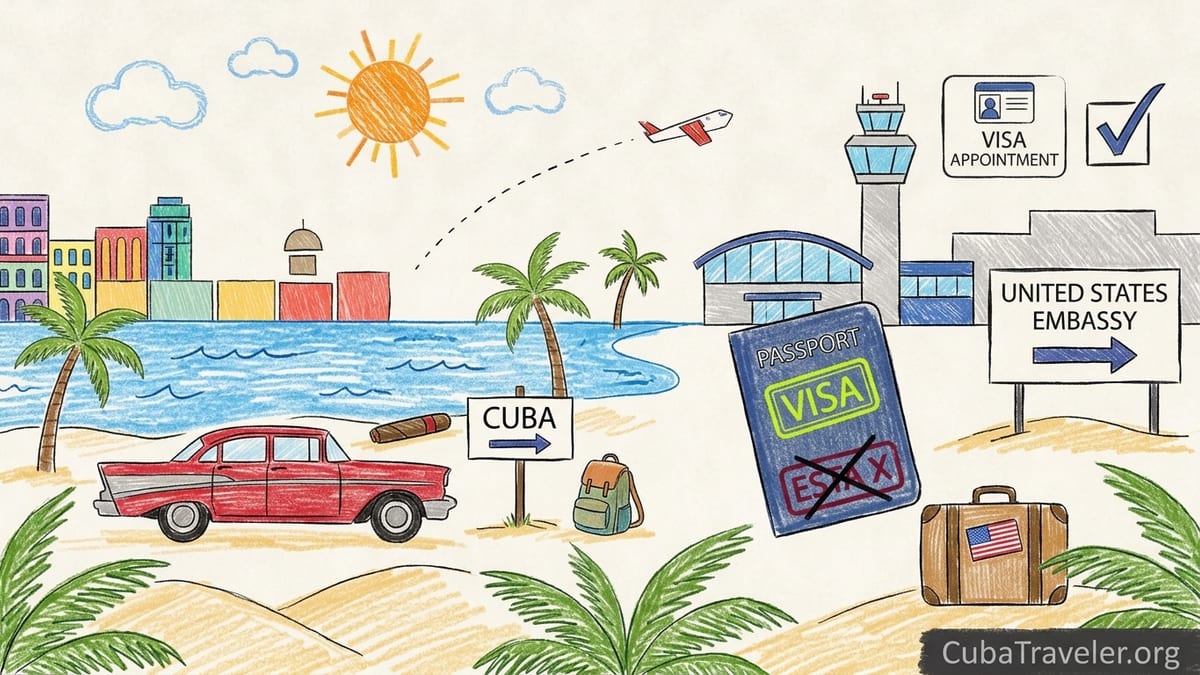
Why January 12, 2021 Is So Important For Cuba and ESTA
On January 12, 2021, the United States redesignated Cuba as a “state sponsor of terrorism.” In the months that followed, United States authorities, including Customs and Border Protection and the Department of Homeland Security, clarified that this change affects eligibility for the Visa Waiver Program and ESTA. The crucial practical outcome for travelers is that most people who have been in Cuba on or after January 12, 2021 are considered ineligible to use ESTA to enter or transit the United States.
This rule does not mean that visiting Cuba makes you automatically banned from entering the United States. Instead, it changes the process you must follow. If you are affected, you usually have to apply for a regular visitor visa or other appropriate visa at a United States embassy or consulate, attend an interview, pay a visa fee and wait for processing. For many travelers, this replaces a quick online ESTA authorization that previously cost a modest fee and was often approved in minutes.
It is essential to understand that the key factor is the date of your presence in Cuba, not when you apply for ESTA. For example, a French tourist who traveled to Havana in March 2019 and never returned to Cuba is treated differently from a German business traveler who attended a conference in Havana in November 2022. The former usually remains eligible to apply for ESTA, while the latter is generally not, regardless of when they submit the ESTA application.
Travelers should also know that this Cuba rule sits alongside existing restrictions for anyone who has been present in countries such as Iran, Iraq, North Korea, Sudan, Syria, Libya, Somalia and Yemen in certain periods. For many Europeans, however, Cuba is the first time they encounter this type of destination-based ESTA ineligibility in a popular holiday location, which is why it is catching some travelers by surprise.
Who Is Affected: Understanding ESTA Ineligibility Versus A United States Ban
The language around these rules can sound alarming, but it is important to differentiate between ESTA ineligibility and being barred from entering the United States. If you have visited Cuba on or after January 12, 2021, you are generally ineligible to use ESTA or the Visa Waiver Program. That means you cannot board a flight to the United States using only ESTA approval and your passport, whether you intend to holiday, attend meetings or simply transit through an airport.
However, ESTA ineligibility does not automatically mean that you are refused entry to the United States under all circumstances. Instead, it means that you must follow the regular visa process applicable to your purpose of travel. For short tourism or business visits, most affected travelers will need to apply for a B1/B2 visitor visa at a United States embassy or consulate. If you plan to study, work or join family, you may need a different visa category, such as F for students or various work-related visas.
In everyday terms, imagine a British couple who spent a week in Havana in 2022 and now want to attend a friend’s wedding in Chicago. Before 2021, they would likely have completed an ESTA form online, paid the ESTA fee and flown to the United States visa-free. Today, because of their Cuba visit on or after January 12, 2021, they will usually need to secure B1/B2 visas in advance, which involves filling out a DS-160 form, paying a non-refundable application fee and attending an in-person interview at the United States Embassy in London or the consulate in Belfast.
The distinction matters practically and emotionally. Many travelers fear that a post-2021 trip to Cuba will “blacklist” them permanently. In most cases, that is not accurate. You may face more paperwork, higher costs and longer lead times, but many travelers who have been to Cuba after January 12, 2021 are still approved for United States visas once they complete the proper process and satisfy a consular officer that they meet the usual requirements.
Tourism, Business Trips and Airport Transit: How The Rule Plays Out
The Cuba and ESTA rule touches almost every type of casual United States visit. For tourism, the impact is obvious. A Spanish traveler who has enjoyed several road trips across Florida, relying on ESTA each time, may suddenly discover that a single beach holiday in Varadero in 2023 means the ESTA route is closed for future Orlando or New York vacations. Similarly, an Italian family planning a cruise that starts in Miami may not be able to rely on last-minute ESTA approval if one of the parents popped over to Havana for a long weekend after January 12, 2021.
Business travel is also affected. A German sales manager who attended an industry expo in Havana in 2022, for instance, would typically become ineligible for ESTA afterward. If their company expects them to visit a trade show in Las Vegas or meet clients in Houston, the traveler will need to secure an appropriate United States visa ahead of time. Firms that frequently send staff to both Cuba and the United States are increasingly revising their travel policies to reflect this reality, sometimes asking employees to avoid Cuba trips if rapid, short-notice United States travel is important to their role.
One of the most easily overlooked areas is airport transit. Under the Visa Waiver Program, many travelers used ESTA simply to change planes at large United States hubs, such as Miami, New York JFK, Dallas Fort Worth or Atlanta, en route between Latin America and Europe or between the Caribbean and Asia. The post-2021 rules mean that if you have been in Cuba on or after January 12, 2021, you generally cannot use ESTA even for this kind of airside transit. A Dutch traveler flying from Havana to Amsterdam via New York, for example, would not be able to complete the journey on ESTA once the Cuba visit has taken place and would instead need a visa or a route that bypasses the United States.
Even travelers who never intended to leave the airport and see the United States beyond the transit lounge are caught by the same rule. United States airport transit is legally treated as an entry for most immigration purposes, so the Cuba-related ESTA ineligibility applies whether you plan a two-week road trip or a two-hour layover between flights.
What If You Already Have ESTA Approval And Then Visit Cuba
Some travelers face an awkward timing question. Perhaps you applied for and received ESTA approval in early 2024, used it to visit New York in the spring, and are now considering a New Year’s trip to Havana. Official guidance from United States authorities makes it clear that ESTA status can be revoked if it later emerges that you have an ineligible travel history, including presence in Cuba on or after January 12, 2021.
In practice, this means that an approved ESTA is not a guarantee of future boarding or admission if your circumstances change. For example, consider a Swedish traveler whose ESTA is valid until late 2025. If they fly to Cuba for a holiday in March 2025 and then try to use the same ESTA to transit via Miami on the way home from a later trip to Costa Rica, airline staff or United States officials can cancel or refuse the ESTA at check-in or on arrival once the Cuba trip is known.
United States authorities typically cross-check passenger records, including airline passenger name records, previous entry stamps and sometimes even accommodation or cruise manifests. The rule concerns whether you were actually in Cuba, not whether a border official stamped your passport. A previously issued ESTA can be pulled back when these checks reveal a post-2021 Cuba visit, which can result in denied boarding at your departure airport.
From a practical standpoint, if you know you plan to visit Cuba and also hope to use ESTA in the future, it is usually safer to assume that the Cuba trip will close the ESTA option going forward. If you are a frequent United States visitor, some travelers choose to apply for a B1/B2 visa pre-emptively before their Cuba holiday, so they have a reliable route for future United States trips without worrying about last-minute ESTA issues.
Decision Guide: Your Cuba Travel History And ESTA Options
The following decision-style overview can help clarify the main categories of traveler, although every case depends on individual circumstances and official assessments:
First, if you visited Cuba only before January 12, 2021 and have not returned since, you are generally still eligible to apply for ESTA, assuming you meet all other Visa Waiver Program conditions. For instance, an Irish backpacker who explored Cuba in 2018 and now wants to visit Boston for a conference in 2027 will usually be able to complete a fresh ESTA application in the normal way.
Second, if you visited Cuba on or after January 12, 2021, you are generally ineligible for ESTA from that point onward. A Canadian who spent a week in Havana in February 2022, or a Japanese tourist who visited Trinidad and Cienfuegos in 2023, should work on the basis that any future entry or transit through the United States will require a visa, rather than relying on ESTA. The same is true even if the Cuba trip was brief, such as a one-day stop on a cruise.
Third, if you intend to visit Cuba soon and have not yet gone, your future ESTA options depend largely on your priorities. A New Zealander who regularly flies to Los Angeles for work and loves spontaneous city breaks may decide that keeping ESTA eligibility is more important than a short break in Havana and postpone Cuba until their need for rapid United States travel declines. Another traveler, perhaps a retiree from Portugal whose main interest is exploring Cuba and the rest of the Caribbean, might accept that losing ESTA access is an acceptable trade-off and plan to secure a United States visa only if needed later.
Fourth, if you already hold a valid United States visa, such as a B1/B2 visitor visa or an F student visa, the Cuba rule does not cancel that visa automatically. You should still be able to travel under that visa as long as it remains valid and you continue to meet its terms. For example, an Australian postgraduate student with an F visa at a college in California could potentially visit family in Havana during a semester break and then re-enter the United States using the same student visa, subject to the usual admission checks. Finally, certain dual Cuban nationals are ineligible for ESTA even if they have never lived in Cuba. If, for example, you hold both Spanish and Cuban nationality, ESTA may not be available to you regardless of your recent travel history, and you would need to use a visa route instead.
Why Avoiding A Cuba Passport Stamp Does Not Solve The Problem
Some travelers hope to get around the rule by arranging for Cuban immigration to avoid stamping their passport on arrival or departure. While passport stamping practices can vary in different destinations and periods, relying on this approach misunderstands how United States authorities assess travel history. The United States government has stated that it considers actual presence in Cuba, not just visible passport evidence, when applying the rule.
In real terms, airlines and border agencies share substantial passenger and flight data. If you buy a return ticket from Madrid to Havana with a major carrier, the route, dates and passenger name record can often be accessed by security agencies. Cruise passenger lists and overland entry records can also be available. Even if your passport looks “clean,” a post-2021 Cuba trip can still be detected when you next apply for ESTA or arrive in the United States.
Consider a hypothetical Italian traveler who flies Milan to Havana via Paris, asks Cuban officials not to stamp their passport and pays in cash for local services. If that traveler later applies for ESTA and answers the security questions inaccurately, they risk a finding of misrepresentation if the Cuba visit is uncovered through travel records. That can create significantly more serious immigration problems than the original ESTA ineligibility, including potential long-term difficulties obtaining any United States visa.
The safer approach is to treat the rule as unavoidable and plan your travel accordingly. If you choose to visit Cuba on or after January 12, 2021, you should assume your future United States trips will involve the regular visa process and adjust your timelines and budgets to reflect that reality.
Real-World Scenarios: British, Italian And Spanish Travelers
To illustrate the practical impact, consider three different European travelers. First, a British marketing manager based in Manchester enjoyed a week in Havana and Viñales in late 2023, flying via Madrid. In 2026 she receives an invitation to a technology conference in San Francisco. Before 2021, she would have applied for ESTA online and probably received an approval within minutes. With the post-2021 Cuba rule, she is now generally ineligible for ESTA. She completes the DS-160 visa application form, pays the visitor visa application fee and books an interview at the United States Embassy in London. Available slots might be several weeks or even a few months ahead, depending on demand, so she has to plan the conference trip around the visa timeline.
Second, an Italian couple from Florence are planning their honeymoon. They dream of combining a vintage car tour in Havana with shopping in New York. If they visit Cuba first in 2025, then wish to continue to the United States, they will normally need to secure B1/B2 visas before flying onward. In some travel agency discussions, they discover that waiting times for United States visa appointments in Italy can stretch into months in busy years. They might therefore choose to reverse the order, visiting the United States first under ESTA, then heading to Cuba, understanding that any future United States trips will likely require visas.
Third, a Spanish digital nomad based in Barcelona frequently spends winters in Latin America. She holds a Spanish passport and has flown via Miami several times on ESTA to reach Mexico and Colombia. In 2024 she spends two months in Cuba, staying in Havana and Santiago de Cuba. The following year she wants to transit through Miami again on her way to Costa Rica. Because of her 2024 presence in Cuba, her previous pattern of ESTA-based travel will no longer be available. She will need to plan ahead, secure a United States visa at the consulate in Madrid and build visa fees and travel to the consulate into her budget.
These scenarios highlight that the rule is not theoretical. It influences honeymoon planning, business obligations and long-term digital nomad itineraries. Understanding the consequences before booking flights and accommodation can prevent expensive last-minute changes and disappointment at the airport.
Planning A Cuba Plus United States Trip: Timelines, Fees And Practical Tips
If you hope to combine Cuba and the United States in a single trip, careful sequencing and timing are now essential. One widely used strategy is to schedule the United States portion of the journey first, while ESTA eligibility still exists, and then travel to Cuba afterward. For example, a traveler from Denmark might spend five days in New York, then fly onward to Havana and finally return home to Copenhagen via Mexico City, deliberately avoiding United States transit on the way back.
Another approach, especially for those who travel to the United States frequently, is to secure a United States visa well before any planned Cuba visit. Visitor visa application fees are set in United States dollars and can change periodically, so travelers should check the current amount quoted by the embassy or consulate handling their case. On top of the fee, there are indirect costs to consider, such as travel to the embassy city, time off work for the interview and potential accommodation if an early morning appointment is required.
Visa interview wait times vary widely by location and season. In some European capitals, appointment waits might be measured in weeks, while in others they can stretch into several months during busy periods or after disruptions. For example, a traveler in Rome or Madrid might find that the earliest available date is several weeks away, while someone in a smaller country may face different backlogs. Because processing after the interview can also take additional time, many seasoned travelers now allow several months between starting a visa application and their planned departure date.
For multi-country holidays, an itinerary might look like this in practice. A Dutch traveler wants to spend two weeks in Florida and one week in Cuba during a single long vacation. She decides to apply for a B1/B2 visa almost a year ahead, knowing she might also use it for later trips. After securing the visa, she books Amsterdam to Miami flights, then Miami to Havana, and finally Havana back to Europe through a non-United States hub such as Madrid or Paris. She pays the visa fee, airline tickets and Cuban accommodation knowing that, although the costs are higher than a pure ESTA-based trip, her route is legally sound under current rules.
Communicating your plans clearly to airlines and consular staff, keeping copies of booking confirmations and monitoring official embassy announcements can all help navigate this more complex environment. The key is to avoid assuming that pre-2021 habits still apply and to verify visa and ESTA requirements well before you finalize nonrefundable reservations.
The Takeaway: Cuba Entry, ESTA Eligibility And United States Visa Rules
The post-2021 rules governing Cuba and the United States Visa Waiver Program can feel confusing, but the core points are relatively simple once you separate them from each other. Visiting Cuba on or after January 12, 2021 generally makes you ineligible to use ESTA for future entry or transit through the United States. This ineligibility applies regardless of whether your passport was stamped and can result in previously approved ESTAs being revoked if a later Cuba visit comes to light.
At the same time, ESTA ineligibility is not the same as being banned from the United States. Many travelers who have visited Cuba after January 12, 2021 are still able to obtain appropriate United States visas, such as B1/B2 visitor visas, once they complete the required application steps, pay the relevant fee and satisfy a consular officer of their intentions and ties to their home country. Some travelers with existing visas, including students and longer-term visitors, can continue to rely on those visas even after a Cuba trip, subject to individual review at the border.
It is also vital to distinguish among three separate concepts. First, Cuba entry permission is determined by Cuban authorities and, for most non-American travelers, remains straightforward when arriving with a tourist card or visa as required. Second, ESTA eligibility relates only to the United States Visa Waiver Program and can be lost due to Cuba travel after January 12, 2021 or due to factors such as dual Cuban nationality. Third, United States visa requirements operate independently of ESTA. Even if you cannot use ESTA, you may be able to travel with the right visa, though it usually involves more time, cost and documentation.
For non-American travelers who can legally visit Cuba, the decision now carries an extra layer of consequence. If future spontaneous United States trips, short-notice business travel or easy transits through United States hubs are important to you, consider the timing of any Cuba visit, or plan ahead to secure a visa so your broader travel ambitions remain open.
FAQ
Q1. Will visiting Cuba after January 12, 2021 automatically cancel my ESTA?
Visiting Cuba on or after January 12, 2021 generally makes you ineligible to use ESTA in the future, and United States authorities state that an existing ESTA can be revoked if a later Cuba trip is identified through travel records.
Q2. If I went to Cuba before January 12, 2021, can I still apply for ESTA?
If your only Cuba visits were before January 12, 2021 and you meet all other Visa Waiver Program requirements, you are usually still eligible to apply for ESTA like any other traveler.
Q3. Does this rule mean I am banned from entering the United States forever?
No, ESTA ineligibility is not a permanent ban. It simply means you must apply for an appropriate United States visa, such as a B1/B2 visitor visa, and be approved before traveling.
Q4. I only transited through Havana airport for a few hours. Does that count?
Yes, even short transit stays count as presence in Cuba. If that transit occurred on or after January 12, 2021, it can make you ineligible for ESTA going forward.
Q5. Can I avoid problems by asking Cuba not to stamp my passport?
No, avoiding a passport stamp does not change the rule. United States authorities can use airline and other travel records to see if you have been in Cuba after January 12, 2021.
Q6. I already have a valid United States visa. Will a future trip to Cuba cancel it?
Visiting Cuba does not automatically cancel a valid United States visa. However, your overall eligibility is always assessed at each entry, so you should carry documents that explain your travel plans and ties to your home country.
Q7. I am a dual Cuban and European national who has never lived in Cuba. Can I use ESTA?
Certain dual Cuban nationals are independently ineligible for ESTA, regardless of whether they have recently been in Cuba, and generally need to apply for a visa instead.
Q8. What if I visit the United States first on ESTA, then fly to Cuba on the same trip?
You may be admitted to the United States on ESTA for that initial leg, but once you have been in Cuba on or after January 12, 2021, you should assume you cannot rely on ESTA for any future United States entry or transit.
Q9. How long does it take to get a United States visitor visa after visiting Cuba?
Processing times vary by embassy and season, but travelers often face interview wait times of several weeks or months, plus additional time for visa printing, so applying well in advance is wise.
Q10. I only plan to transit through a United States airport after visiting Cuba. Do I still need a visa?
Yes, if you have been in Cuba on or after January 12, 2021, you generally cannot use ESTA even for airport transit and instead need an appropriate United States visa or a flight route that avoids United States territory.