


Cuba in 2026 is opening up economically while still keeping a tight grip on what crosses its borders. For visitors, that means more flexibility on everyday items like medicines and basic supplies, but strict oversight of drones, professional equipment, high‑value electronics and cash. This guide walks you through what tourists can bring into Cuba and take home again, with a focus on the latest non‑commercial import rules and the new Resolution 340/2026 that reshapes how customs treats personal baggage.
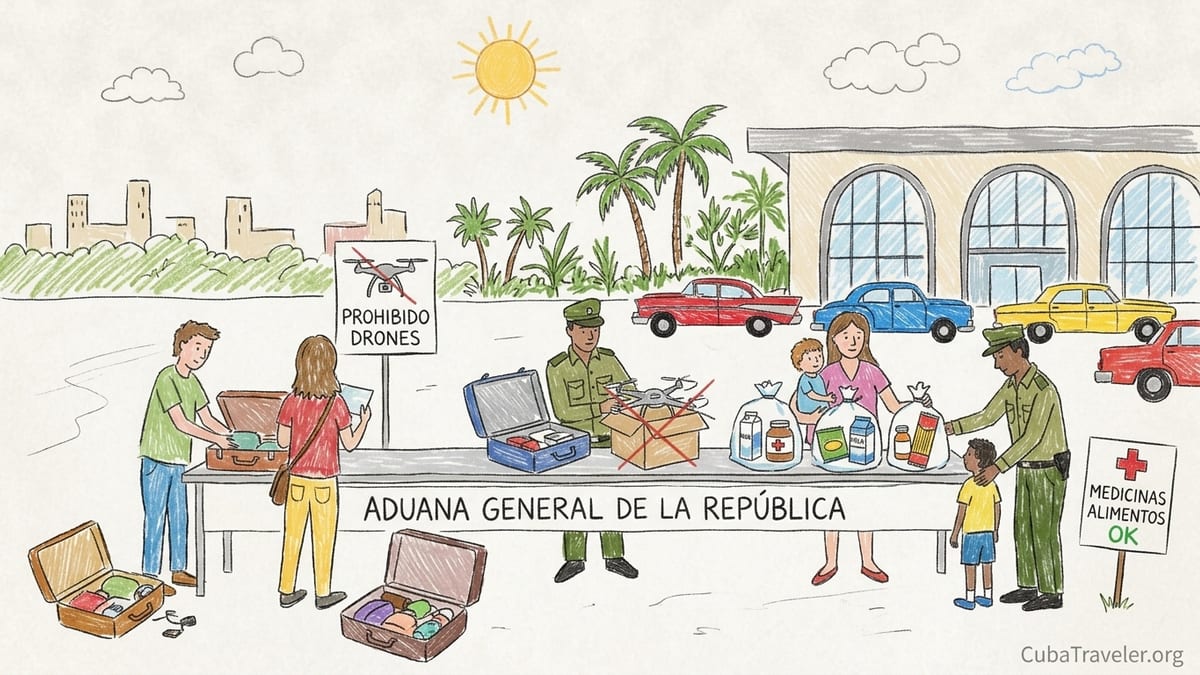
How Cuban customs works for tourists in 2026
Every traveler arriving in Cuba in 2026 passes under the authority of the Aduana General de la República, Cuba’s national customs service. At Havana’s José Martí International Airport and other gateways like Varadero, Holguín or Santiago, your luggage is screened and your customs declaration is checked against what you are actually carrying. Cuba participates in international agreements on customs facilities for tourism, so ordinary personal baggage is treated relatively generously, but anything that looks commercial or sensitive is scrutinized closely.
The legal framework changed again in early and mid‑2026. Resolution 340/2026 updated the rules for non‑commercial imports by individuals, refining how customs decides whether what you bring is for personal use or for resale. At the same time, separate 2026 measures extended earlier relief that allows food, toiletries, medicines and medical supplies to enter duty‑free when they are clearly non‑commercial. Travelers arriving with suitcases full of rice, powdered milk and over‑the‑counter painkillers for relatives, for example, now encounter a clearer process at inspection, although officers still have the final word.
For many tourists, the most visible change is a more formal distinction between “miscellaneous” personal effects like clothing and toiletries, and higher‑risk categories such as unmanned aircraft, satellite gear, heavy electronics and professional filming or communications equipment. Those latter items may require prior authorization or are simply not admitted for visitors. The safest approach in 2026 is to assume that if an item can record, transmit or fly, you need to verify whether it is allowed before you pack it.
Customs procedures remain relatively simple on the surface. You complete your D’Viajeros online declaration shortly before travel, choosing whether you have anything to declare beyond personal belongings and non‑commercial goods up to the stated value limits. At the airport, green and red channels separate travelers with nothing to declare from those carrying dutiable or controlled goods. Random inspections are common, and officers may open bags, photograph items and issue a custody receipt if something must be held until departure.
Personal baggage vs non‑commercial imports
Cuban rules in 2026 distinguish between three broad categories of items brought by travelers. First is personal baggage: the clothes, toiletries, an ordinary smartphone, a small point‑and‑shoot camera, a laptop, a pair of headphones, a used tablet for reading, a travel hairdryer or electric shaver. These items are presumed to be for your own use during the trip and, when carried in reasonable quantities, do not attract duties or special paperwork.
The second category is non‑commercial imports, known locally as importaciones sin carácter comercial. Under Resolution 340/2026, this covers items that are clearly intended as gifts or support for family but are not part of a business. Examples include an extra pair of new sneakers for a cousin, a boxed budget laptop for a niece, a small tool kit for repairs, or a suitcase containing food staples and toiletries. Customs uses reference values and quantity thresholds to decide when something crosses the line into commercial territory, such as ten identical smartphones or dozens of brand‑new routers still in retail packaging.
Resolution 340/2026 incorporates the updated reference values and clarifies that non‑commercial imports can still be subject to customs duties once you exceed duty‑free allowances, even when they are clearly not for resale. This matters for visitors who arrive with large loads of goods purchased abroad to help relatives or private businesses. For example, a traveler landing in Havana with several mid‑range power tools, boxed LED lighting, routers and cordless drills risks having part of the shipment treated as commercial, with higher tariffs or even refusal of entry for the excess.
The third category is commercial imports, which 2026 reforms now allow individuals to formalize in certain circumstances by paying tariffs in hard currency. This is primarily aimed at Cuban private businesses, not tourists. As a visitor on a short stay, you should assume that customs expects what you bring to fall under personal baggage or non‑commercial imports. If the volume or repetition of items suggests a resale operation, customs can reclassify your goods, apply steep duties and, in some cases, seize part of the shipment.
Drones, unmanned aircraft and specialist equipment
Drones are one of the most sensitive items at Cuban borders in 2026. Recreational travelers cannot simply pack a DJI Mini, Anafi or similar quadcopter in their carry‑on and expect to use it on the Malecón or over resort beaches. Under Cuba’s current aviation and customs rules, including the framework reflected in Resolution 340/2026, unmanned aircraft systems and their associated parts are admitted only with prior authorization from the competent aviation authority, the Instituto de Aeronáutica Civil de Cuba (IACC), often with coordination by telecommunications authorities.
In practice this means that a tourist arriving at Havana with a foldable drone in its branded case but without an official Cuban permit is almost certain to have the aircraft withheld at customs. Travelers report that drones discovered at screening are taken to a separate inspection table, logged, and either immediately confiscated or stored under customs custody without a reliable mechanism for short‑term visitors to retrieve them on departure. Even micro‑drones under 250 grams and toy‑grade quadcopters are treated as unmanned aircraft, especially if they carry a camera or can transmit a signal.
Resolution 340/2026 slots drones and their components into the category of items that either require explicit prior authorization or are simply prohibited from non‑commercial import by passengers. That includes spare propellers, flight controllers, gimbals, radio controllers and FPV goggles that clearly belong to an unmanned aircraft system. For visiting filmmakers or surveyors who do have formal contracts in Cuba, drone operations must be arranged well in advance with the IACC and, usually, with a Cuban state partner. Tourists planning a beach holiday or a classic‑car photo tour should leave drones at home and rely on handheld cameras instead.
Other specialist gear sits in a similar grey zone. High‑gain satellite communications terminals, portable VSAT dishes, encrypted radios, aviation scanners or maritime AIS transponders can trigger security concerns and may be held or refused entry. So can advanced GPS mapping rigs designed for land surveying, particularly if carried with tripods, base stations and multiple antennas. If your work involves such equipment, coordinate with your Cuban counterpart long before travel, and carry original authorization letters in Spanish. For regular tourists, anything beyond a consumer‑grade smartphone, GPS hiking watch or basic handheld GPS receiver is unnecessary risk at the customs line.
Electronics, phones, cameras and communications gear
Cuban customs deliberately distinguishes ordinary consumer electronics from professional filming, broadcasting or communications equipment. A visitor entering with one personal smartphone, one laptop, a compact mirrorless camera body with a lens, a Kindle‑type e‑reader and a pair of Bluetooth earbuds is unlikely to face more than cursory questions. These are classic examples of personal baggage, particularly if the items are clearly used and not duplicated in quantity.
Issues arise when travelers carry multiple new devices in sealed boxes or gear that appears configured for professional production. For example, arriving with three new iPhones, two GoPro action cameras, several high‑capacity solid‑state drives and a cinema‑grade camera body with cinema lenses can prompt customs to treat part of the load as a non‑commercial import subject to duties. Add a professional gimbal, shotgun microphones, LED light panels and wireless audio transmitters, and officers may suspect commercial filming activity, which in Cuba often requires separate permits beyond customs clearance.
Communications and GPS‑related equipment needs particular caution. Standalone satellite phones, Starlink‑style user terminals, Iridium or Inmarsat portable modems and high‑power VHF or HF radios are each likely to be refused entry or stored by customs pending authorization that most tourists will not have. Even small ham‑radio transceivers can be sensitive. By contrast, an ordinary Android or iOS smartphone with offline maps, a consumer GPS hiking unit for tracking trails in Viñales, or a standard car GPS borrowed from home are normally tolerated when part of normal travel gear.
Power banks, camera batteries and laptop chargers are accepted as long as they comply with airline safety rules, which usually cap lithium‑ion batteries at around 100 Wh in carry‑on. Customs is less concerned with a single 20,000 mAh power bank than with boxes of new batteries obviously intended for resale. If you enter with a stack of identical phone batteries, twenty loose 18650 cells and several boxed inverters, expect detailed questioning and the possibility of reclassification as commercial import. As of 2026, travelers should also be prepared for closer screening of vaping devices and e‑liquid, which some carriers servicing Cuba now highlight as restricted or banned on local legal grounds.
Medicines, medical supplies and Cuba’s 2026 relief measures
Against the backdrop of a severe medicine shortage, Cuba has kept in place and refined generous customs relief for medicines and related supplies. A 2026 health and finance package extended non‑commercial, duty‑free import of medicines, medical supplies, basic food items and toiletries for arriving passengers. Under the current rules, medicines and medical inputs brought as accompanied baggage by travelers for personal or family use can enter without value or weight limits and without customs duties, as long as they are clearly non‑commercial and properly documented.
For practical purposes, this means a tourist flying from Madrid or Toronto can dedicate an entire suitcase to over‑the‑counter painkillers, antihistamines, blood‑pressure pills prescribed for a relative, bandages, syringes, glucometer strips and similar items destined for Cuban family or humanitarian donation. Customs officers at Havana airport are used to seeing transparent plastic bins full of blister‑packed tablets and sealed bottles. When the medicines are organized, labeled and separated from other goods like clothing or electronics, they are usually processed quickly through the green channel after a brief inspection.
Documentation remains very important in 2026. Prescription medications, particularly controlled substances such as strong opioids, benzodiazepines or ADHD medications, should be carried in original pharmacy packaging with your name, the prescribing doctor and dosage clearly visible. Travelers should also bring a printed prescription or doctor’s letter, ideally translated into Spanish, explaining the medical need. Cuban customs can deny entry or restrict quantities of narcotic and psychotropic drugs, even for legitimate patients, especially if the amount carried looks excessive for the length of stay.
Medical devices such as glucometers, blood‑pressure monitors, CPAP machines, insulin pens or nebulizers are generally admitted when intended for personal use or donation. A Canadian traveler bringing a portable CPAP machine for a weeklong stay in Varadero should pack it in hand luggage with a note from a sleep specialist. Someone transporting several new CPAP units and ten spare masks for donation to a Havana clinic can usually still benefit from the 2026 customs relief, but should be prepared for extra paperwork and questions to confirm the non‑commercial, humanitarian nature of the shipment.
Food, plant products and other restricted goods
Cuba’s food import rules balance the urgent need for supplies with agricultural and health controls. As of 2026, non‑commercial imports of many shelf‑stable foods are allowed and often benefit from the same duty‑free treatment as medicines when brought as accompanied baggage: items like powdered milk, pasta, rice, canned tuna, cooking oil, flour, sugar and individually packaged snacks. Travelers arriving from Miami often dedicate checked luggage to multipacks of canned beans, breakfast cereals and packets of instant soup for relatives coping with shortages.
At the same time, restrictions apply to fresh meat, dairy, produce and plant material. Unprocessed meat products, fresh sausages, raw poultry and unpackaged cheeses may be refused entry due to veterinary and sanitary rules. Sealed, commercially labeled cans of meat or UHT boxed milk with printed expiry dates have a better chance of acceptance. Fresh fruits and vegetables, soil, seeds and live plants are subject to plant health regulations intended to prevent pests and diseases. A tourist who tries to bring a bag of backyard mangoes from Mexico or tomato seedlings from Canada for a friend’s garden in Trinidad risks having them confiscated at inspection.
Processed snacks and sweets are generally tolerated in personal quantities, but bulky quantities of identical branded goods can trigger a non‑commercial import assessment. A suitcase with several large bags of rice, a carton of instant coffee sachets, and a few boxes of cereal for family breakfast is consistent with personal support. Five identical cases of an energy drink or twenty restaurant‑size tins of tomato paste look like supplies for a private café and can be treated as commercial, with corresponding tariffs and potential refusal of part of the load.
Other prohibited or tightly restricted goods include firearms, ammunition, explosives and certain knives. Sporting firearms for hunting tourism require advance permits coordinated through authorized Cuban entities and are not handled under the standard tourist regime. Narcotics and illegal drugs, pornographic material, and propaganda deemed hostile to Cuba can all provoke seizure and legal consequences. Travelers should also remember that high‑powered fireworks, pepper spray and some self‑defense equipment common in other countries may fall on the prohibited side of Cuban law.
Currency rules and cash declarations in 2026
Cuba’s currency rules are particularly relevant in 2026, when electronic payments using foreign cards remain unreliable and many visitors rely on cash. On entry, any traveler who brings more than the equivalent of 5,000 US dollars in foreign currency must make a customs declaration. This threshold applies to the combined value of all freely convertible currencies you carry, whether in US dollars, euros, Canadian dollars or other major currencies. If you arrive in Havana with 3,000 euros and 3,000 US dollars in cash, you cross the declaration threshold and must declare the total.
On exit, separate rules govern foreign currency and local Cuban pesos (CUP). A traveler can usually take out up to the equivalent of 5,000 US dollars in foreign currency without special authorization, provided that any larger amount was either declared on entry or authorized by the Cuban Central Bank. By contrast, the limit for carrying Cuban pesos when leaving the country is much lower. Current guidance indicates that individuals may not take more than 5,000 CUP out of Cuba, a figure that corresponds to a modest sum given the peso’s depreciated value in recent years.
Customs officers at Havana and Varadero airports enforce these limits through random checks and by cross‑referencing your departure declaration with the D’Viajeros data submitted on arrival. Travelers who changed large sums into CUP during their stay are advised to spend or reconvert most of that currency before reaching airport security. Holding thick bundles of CUP banknotes in your carry‑on may raise questions at screening, and any excess over the limit can be confiscated. The safest practice is to enter with a realistic amount of foreign cash, declare any sum above 5,000 US dollars equivalent, and avoid leaving with significant quantities of CUP.
It is also important to recognize that Cuba’s customs rules on currency interact uneasily with sanctions and banking restrictions affecting some foreign cards, especially those issued in the United States. American visitors often cannot rely on ATMs or card payments and instead travel with physically carried cash. In 2026, that reality makes the 5,000 US dollar declaration threshold a practical planning tool: consider whether you can safely manage your trip with slightly under that amount, or, if you must carry more, prepare to declare it and keep a record of your entry declaration in case questions arise at departure.
Taking things home: exports of cigars, rum, art and more
Leaving Cuba with souvenirs and gifts involves a second customs encounter at departure. Cuban law controls exports of cultural heritage, wildlife products, and certain strategic goods, and customs also applies quantity limits to popular exports like cigars and rum. While some of the strictest cigar export caps aimed at foreign sanctions rather than Cuban rules have eased in recent years, travelers should still be prepared for inspection of tobacco purchases and for differing import limits back home in the United States, Canada or Europe.
For cigars and rum, Cuban customs focuses mainly on authenticity and tax compliance. Purchasing boxes of Habanos from official Casa del Habano shops or hotel boutiques, complete with government seals and receipts, greatly reduces the risk of trouble at the airport. Buying unbranded or counterfeit cigars from street vendors in Old Havana may lead to confiscation, especially if you try to leave with several bundles that look commercial. Travelers should also keep in mind that their own country’s import rules may be stricter. A European tourist may be allowed to import several hundred cigars duty‑free at home, while a US traveler’s entitlement can differ depending on current sanctions and personal exemption limits.
Artworks, antiques and cultural objects fall under Cuba’s heritage protection regime. Original paintings bought from recognized galleries or artists in Havana or Trinidad usually require an export authorization stamp from the National Registry of Cultural Goods or a related authority. Many reputable galleries arrange this stamp on the back of the canvas or issue a certificate. Without it, customs may seize the piece on departure to verify that it is not an unauthorized export of national patrimony. The same caution applies to old books, colonial‑era furniture, religious icons and items that look like archaeological finds. When in doubt, ask the seller to secure the necessary export certificate before you leave.
Wildlife products are another sensitive area. Coral, certain seashells, stuffed animals, feathers and reptile skins can be restricted or outright banned from export under Cuban law and international conservation agreements. A diver tempted to take a piece of coral from a reef near Jardines de la Reina risks both local penalties and confiscation on arrival back home, where many countries enforce strict bans on coral imports. Even seemingly innocuous items, such as polished shells sold on beaches, may fall foul of environmental rules if collected from protected areas.
Practical examples, scenarios and customs documentation
To make these rules concrete, consider a few real‑world travel scenarios in 2026. In the first, a French couple flies to Varadero for a week at an all‑inclusive resort. They pack clothes, sunscreen, a DSLR camera, two smartphones, a tablet, a compact Bluetooth speaker and a few packets of specialty coffee as gifts. They carry 3,000 euros in cash between them and no medicines beyond a personal asthma inhaler and ibuprofen. They stay well under the 5,000 US dollar cash declaration threshold and fall squarely within the definition of personal baggage. At Havana airport on departure, they check their suitcase of souvenirs, including two bottles of aged Cuban rum and a small box of cigars bought at the hotel shop, and clear customs without incident.
In the second scenario, a Cuban‑American family travels from Miami to Havana to support relatives. Each adult checks one large suitcase filled entirely with powdered milk, pasta, canned tuna, over‑the‑counter medicines, bandages and toiletries. They also bring several blood‑pressure monitors and glucometers as gifts. Under 2026 relief measures, these non‑commercial imports of food, medicines and medical supplies can enter duty‑free as accompanied baggage, although customs officers may open the suitcases, confirm the contents and ensure there are no restricted controlled substances. The family keeps their food, medicines and toiletries separated in distinct bags, which speeds inspection.
A third scenario illustrates risks. A European content creator heads to Havana with a drone, a professional mirrorless camera, two large cinema lenses, a gimbal, wireless microphones, six boxed SSDs and a satellite hotspot device. They also pack 7,000 euros in cash to cover several weeks of travel across Cuba. On arrival, x‑ray screening detects the drone and satellite terminal. Without prior authorization from the IACC or telecommunications authorities, customs withholds both devices. The traveler must complete a custody form acknowledging that the items will remain in customs storage and are unlikely to be released during a tourist stay. Because their cash exceeds the equivalent of 5,000 US dollars, they are also required to file a currency declaration. On departure, the traveler cannot recover the drone and hotspot and may face additional questions if customs believes their video gear was used for unauthorized commercial filming.
When customs withholds goods temporarily, it issues documentation that is important to keep. At Cuban airports, this typically takes the form of a multi‑copy receipt listing your name, passport number, flight details, the description and serial number of the held item, and the reason for retention. One copy remains with customs and another is handed to you. In theory, long‑term residents with standing authorizations can use this document to retrieve items later once paperwork is complete. Short‑term tourists, however, should treat the receipt primarily as proof that customs, not another party, has taken possession of the item, which can be useful for travel insurance claims back home.
Packing checklist for Cuba in 2026
The cumulative effect of Resolution 340/2026 and the ongoing relief measures for basic supplies is that some older advice about Cuban customs is now inaccurate or incomplete. In particular, pre‑2026 guidance that implied travelers could slip small recreational drones into their luggage if they were discreet, or that limited medicines and food to narrow weight caps, no longer reflects the reality at Cuban airports. A 2026‑specific packing strategy should respect current prohibitions while taking full advantage of expanded room for humanitarian items.
For electronics, plan on one smartphone per traveler, one laptop per adult if needed, and a single consumer camera setup. Leave drones, satellite phones, satellite internet terminals and high‑powered radios at home unless you have written Cuban authorization in hand. Limit boxed duplicate devices: for instance, a single spare phone for emergencies is usually reasonable, but a stack of five new mid‑range phones can attract customs attention. Store all chargers and power banks in your carry‑on within airline safety limits and keep packaging to a minimum to emphasize personal rather than commercial use.
For medicines and medical supplies, lean into the 2026 relief. Pack personal prescriptions in original labeled bottles, plus paper copies of prescriptions for any controlled substances. If you are bringing supplies for relatives or donation, use clear containers and group items by type: one suitcase for medicines, another for hygiene products, a third for foodstuffs like pasta and rice. Avoid mixing these with electronics or clothing, which can lengthen inspections. Keep an inventory list in Spanish if possible, noting quantities of key items such as antihypertensive tablets, metformin, wound dressings or glucometer strips.
For food, prioritize durable, commercially packaged items with intact labels and expiry dates. Skip fresh meats, unpasteurized cheeses and home‑canned products that could raise sanitary concerns. Do not bring seeds, live plants or garden cuttings. On the money side, decide whether you can travel with less than the equivalent of 5,000 US dollars in cash; if not, be ready to declare. Finally, give thought to the souvenirs you will take home. Buy cigars and rum from official outlets with receipts, ask galleries to secure export stamps on artworks, and avoid removing coral or other natural materials from beaches or reefs, no matter how tempting the memento.
FAQ
Q1. Can I bring a recreational drone to Cuba in 2026 if I promise not to fly it near airports?
Recreational tourists cannot reliably bring drones into Cuba in 2026. Unmanned aircraft and their parts fall under strict aviation and customs controls, and Resolution 340/2026 treats them as items requiring prior authorization from the Cuban aviation authority. In practice, drones found in luggage are usually withheld by customs on arrival, with little prospect of temporary tourist recovery. The safest course is not to travel to Cuba with any drone at all.
Q2. Are normal smartphones, tablets and cameras a problem at Cuban customs?
Ordinary consumer devices like one personal smartphone per traveler, a laptop, a tablet and a compact camera are generally treated as personal baggage and allowed without difficulty. Issues begin when you carry multiple new devices in sealed boxes or obvious professional filming or broadcasting equipment such as cinema cameras, large gimbals and wireless audio kits. Those can be reclassified as non‑commercial imports subject to duties or as specialized gear requiring additional permits.
Q3. How much foreign cash can I bring into Cuba without declaring it?
You may bring in up to the equivalent of 5,000 US dollars in foreign currency without a declaration. If your combined cash in euros, US dollars and other convertible currencies exceeds that threshold, you must declare it to customs on entry. Keeping copies or photos of your declaration can help if questions arise when you leave with a similar amount of foreign currency.
Q4. Can I still bring suitcases of medicines and food for relatives duty‑free?
Yes, 2026 customs relief measures continue to allow non‑commercial imports of medicines, medical supplies, basic foodstuffs and toiletries as accompanied baggage without value or weight limits and without customs duties, provided they are clearly for personal or family use and not for resale. You should pack these items in original packaging where possible, separate them from other goods and be prepared for inspection. Large volumes of identical high‑value products may still trigger questions.
Q5. Do I need special paperwork for my prescription medicines?
For most routine prescriptions, carrying medicines in their original pharmacy containers with your name and dosage is sufficient. For controlled substances such as strong painkillers, sedatives or certain stimulants, you should bring a printed prescription or doctor’s letter, ideally in Spanish or with a translation. Customs can restrict or question large quantities of controlled drugs, especially if they exceed what a typical traveler would use during the planned stay.
Q6. What happens if Cuban customs holds one of my items when I arrive?
If customs decides to withhold an item such as a drone, satellite phone or other restricted equipment, they will usually issue a written receipt or custody form describing the item, serial number, your passport details and the reason for retention. One copy stays with customs and another is given to you. For short‑term tourists, retrieval during the same trip is unlikely, so you should keep the document mainly as proof for your records or for any insurance claim you may need to file later.
Q7. Are there limits on cigars and rum I can take home from Cuba?
Cuban customs focuses on ensuring cigars and rum are authentic and properly taxed, while export quantities must also comply with the import rules of your home country. Buying from official shops and keeping receipts reduces the risk of confiscation. While Cuba itself may allow you to leave with several regular‑size boxes of cigars and multiple bottles of rum, your own country may impose tighter limits or additional duties on arrival, so you should check those rules before you travel.
Q8. Can I export Cuban art or antiques that I buy on my trip?
You can take contemporary art and certain antiques out of Cuba, but many pieces require an export authorization stamp or certificate from Cuban cultural authorities. Reputable galleries and state‑run shops typically arrange this paperwork. If you buy an old painting, religious sculpture or antique object without documentation, customs may hold it at departure to check whether it is protected cultural heritage. Always ask the seller to secure the necessary export permit and keep all receipts with the item.
Q9. Is it allowed to bring seeds, plants or fresh produce into Cuba?
Seeds, live plants, cuttings, soil and most fresh fruits and vegetables are restricted because of plant health and biosecurity rules. Tourists should not bring garden seeds, potted plants or fresh produce from home. Shelf‑stable, commercially packaged foods like pasta, rice or canned vegetables are a better choice and easier to clear through customs. Any prohibited agricultural items discovered at inspection are likely to be confiscated.
Q10. How can I avoid problems with Cuban customs when packing in 2026?
Pack as if you expect your bags to be x‑rayed and opened. Limit yourself to one set of ordinary personal electronics per traveler, leave drones and satellite devices at home, and keep medicines in original packaging with prescriptions. Separate humanitarian items such as food, toiletries and medical supplies into dedicated bags, and avoid large quantities of identical high‑value goods that look commercial. Carry less than the equivalent of 5,000 US dollars in cash if possible, or be prepared to declare more. Buy cigars, rum and artwork from reputable outlets that provide proper documentation, and steer clear of coral, shells and other wildlife products.