


In late May 2026, planning a reporting trip to Havana, I did what every seasoned Cuba writer is supposed to do: I cross-checked embassy advisories, tourism-board FAQs and the usual chorus of travel blogs. They all repeated a reassuring mantra. U.S. cards were complicated, they said, but European and Canadian Visa and Mastercard would still work in big hotels, some restaurants and ATMs, as long as you stayed within the official system. Then, on June 3, Reuters quietly reported that Cuba’s central bank would suspend all Visa and Mastercard transactions starting June 6 after losing its foreign processor. Overnight, the country that had been difficult for card payments became, in practical terms, a cash-only destination for visitors.
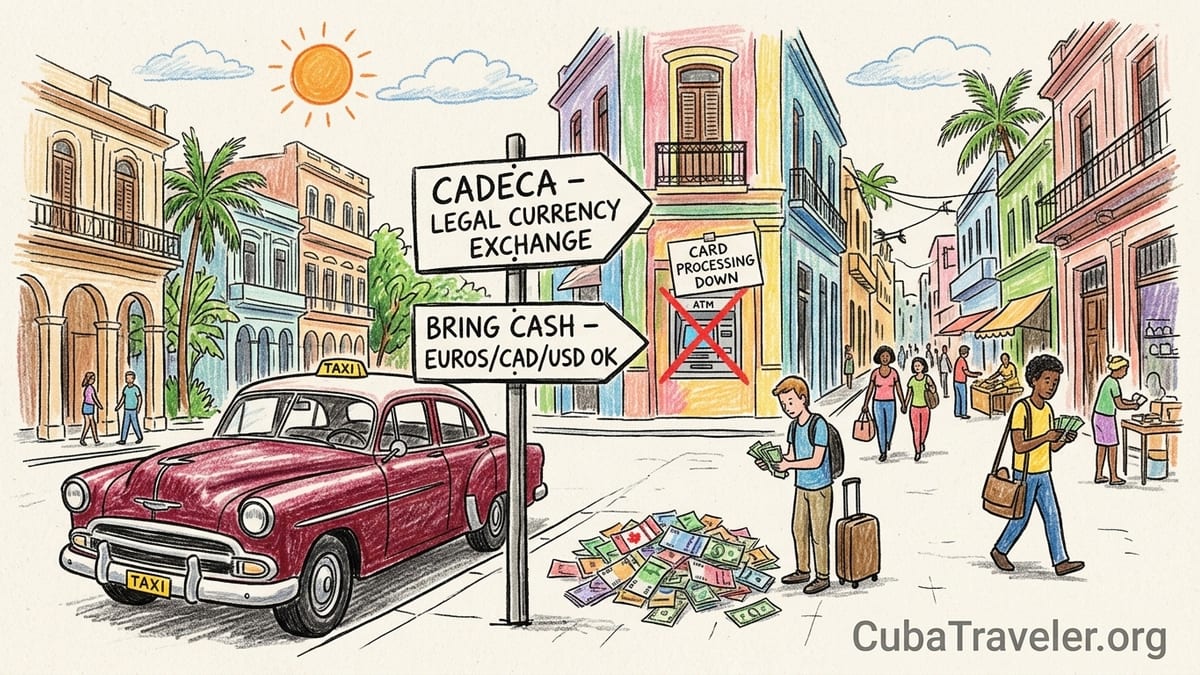
How June 6, 2026 Really Changed Paying for Anything in Cuba
I postponed my own flight and spent June and July immersed in reports instead: dispatches from Reuters, embassy warnings, statements from the Cuban central bank, and frantic posts from travelers who landed in Havana with “backup” European cards that suddenly did nothing. What emerged was stark. From June 6, 2026, international Visa and Mastercard transactions stopped working in Cuba after the foreign company that processed them pulled out under tightened U.S. sanctions. The Cuban authorities themselves acknowledged that they were “unable to receive income from the sale of goods and services” through these cards, which in practice meant that foreign-issued plastic no longer cleared inside the country.
Before that date, the picture had already been patchy. Many U.S. cards never worked at all, but Canadian and European travelers could often pay at hotels run by brands like Meliá or Iberostar, settle tabs in some state restaurants, and occasionally draw cash from ATMs in Havana and Varadero. Older guidebooks leaned heavily on this partial functionality. They advised bringing some cash “just in case,” but reassured readers that modern resorts and government-run tourism services were integrated into the international payments network. The June 6 cutoff shattered that assumption in one morning.
This matters because those outdated assurances still echo around the internet. A 2025 PDF from a major tour operator, for example, calmly states that Visa and Mastercard are accepted in Cuban hotels provided they are not issued by U.S. banks. That was already fragile advice by early 2026, and it became actively misleading from June 6 onward. Travelers who rely on those claims arrive in a country where the card terminals at hotel reception beep but never approve, where ATMs swallow cards and return only error messages, and where even tour companies quietly admit that “cash is strongly recommended.”
Several embassies updated their advisories in early June to say almost exactly what the Japanese embassy in Havana told its citizens: from June 6, Visa and Mastercard would no longer function and travelers should bring adequate cash for their entire stay. Reading those warnings side by side with still-optimistic travel blogs reveals the gap between the official reality and what most English-language guides are prepared to admit. Cuba has not become slightly more cash-oriented. For practical, on-the-ground travel, it has become a destination where you must behave as if there are no reliable card payments at all.
Why “European and Canadian Cards Still Work” Is Now Dangerous Advice
To understand why older advice about European and Canadian cards is now unreliable, you have to separate two things that used to be conflated. One is whether Cuban businesses technically accept the Visa or Mastercard brands. The other is whether there is an active foreign processing partner that actually routes those transactions to overseas banks. Until June 2026, many hotels and state agencies did accept those brands, but only because a specific intermediary handled the back-end. When that company pulled its services in response to wider sanctions, the terminals did not vanish, but the international pipe behind them did.
This is why a traveler can still walk into a modern lobby in Vedado, see the familiar blue and red logos on the reception desk, and yet be told that “the system is down” when they try to pay. The problem is not your German or Canadian bank. It is that Cuba has no active route to get the transaction out of the country, so the attempt simply times out. Staff sometimes explain this honestly. More often they blame temporary connectivity problems, in the hope that things will change. Four months after the cutoff, there is still no credible sign that a replacement processor has stepped in.
The same logic applies to ATMs. Machines operated under Cuban banks still exist, and some can technically accept foreign cards. But without a working connection to an international network, they are useless for visitors. A few scattered traveler reports describe being able to withdraw small amounts with non-U.S. cards at specific ATMs in the weeks after June 6, but these are anomalies rather than a system. When even travel forums dedicated to Cuba now tell guests to assume that “there are no dependable ATMs anymore,” it is time to retire the myth that European plastic will save you.
That also means that general “card friendliness” rankings for hotels are now suspect. A Varadero resort that boasted in 2024 that it accepted international cards for extras such as spa treatments or à la carte restaurants may still display those promises in brochures printed before the cutoff. In reality, guests arriving in mid-2026 find handwritten notices at reception requesting cash for everything from minibar restocking to airport shuttles, precisely because the hotel cannot clear the card payments it used to rely on.
Rebuilding a Trip from the Ground Up: How You Actually Pay Now
Once you accept that functional card payments have effectively disappeared for foreign visitors, you have to rebuild your entire trip around cash and a limited set of Cuban prepaid options. Start with accommodation. In Havana, a realistic range for a good casa particular in 2026 runs roughly from 36 to 110 dollars per night in Old Havana, a bit more in Vedado for a modern apartment or 1950s house, and from the mid 20s for simpler rooms in Centro Habana. In Varadero, family-run rooms near the beach hover around 30 to 60 dollars per night, while full houses with more space and sometimes a pool can run from the mid 60s to well into three figures per night, especially in peak season.
Most online booking platforms and specialist agencies now encourage visitors to prepay as much of their accommodation as possible in hard currency through foreign-based systems, precisely because local settlement has become so awkward. If you reserve a Havana apartment through a European agency and pay in advance, the host receives their funds through channels outside Cuba and you arrive with nothing due on arrival beyond extras such as breakfast or laundry. That does not solve the cash problem for everything else, but it removes one large category of uncertain, in-country payments.
Where travelers still run into trouble is with balances due locally. Many casas particulares that accept direct reservations quote prices in dollars or pesos but still expect cash on arrival. A host might tell you by email that you can “pay by card at the bank” when you get there. After June 6, that is usually wishful thinking. In places like Trinidad or Viñales, owners who once walked guests to a nearby bank branch to process foreign-card payments now shrug and ask you to find dollars or euros instead. If you arrive with neither, the awkward conversation very quickly becomes a question of whether you can even stay the night.
Food, transport and everyday living follow the same logic. Evening meals cooked at a casa run approximately 8 to 15 dollars per person in many parts of the island. Restaurant dinners in Havana’s more tourist-focused paladares can easily land in the 12 to 25 dollar range excluding drinks, and even modest lunches now absorb the equivalent of several dollars per person at official exchange rates. Private taxi transfers quoted in hard currency have climbed in line with fuel shortages and sanctions; a non-luxury car from Havana to Viñales can cost the equivalent of 80 to 120 dollars one way, with Havana to Varadero often a little less but still well above pre-pandemic prices. Every one of those transactions now wants cash in your hand, counted onto the table or into the driver’s palm.
Currencies, CUP and CLASICA Cards: What You Can Really Use
Traveling in today’s Cuba is less about one currency than about a hierarchy of what locals trust. The official unit is the Cuban peso, or CUP, and CADECA, the state currency-exchange agency, lists exchange rates against major currencies including euros, Canadian dollars, British pounds, Swiss francs, Japanese yen and Mexican pesos. In late 2026, the posted rate for U.S. dollars hovers at roughly 120 CUP to one U.S. dollar at official outlets, though that figure is constantly tweaked. That rate is what you should expect to receive if you change cash at a CADECA counter in an airport or city office, or at an authorized bank branch or hotel front desk that offers the same service.
The complication is that the U.S. dollar carries both political and practical baggage. For several years, Cuba heavily restricted banking operations in U.S. dollars, which meant visitors were sometimes told they could not exchange physical U.S. cash at CADECA at all, even as they were quietly encouraged to pay with it directly for high-value goods and services. Those rules have softened and hardened in cycles, and in 2026 some CADECA offices advertise that they once again buy and sell dollars at published rates. Even so, euros and Canadian dollars remain the least controversial currencies to bring: they are fully listed in CADECA tables, do not suffer from sanctions-related stigma, and are widely recognized by hotels and tour agencies.
Alongside physical cash, Cuba has experimented with prepaid cards aimed at foreigners. The “Clasica” card allows visitors to deposit hard currency such as euros or dollars in exchange for a card denominated in a convertible internal unit which can be used to pay for goods and services in many state-run establishments. Official tourism FAQs describe these prepaid cards as available at CADECA offices, airports, hotels and ports in set denominations, usually from 50 to 1000 units. The sales pitch is simple: instead of walking around with a wad of banknotes, you park funds on a Cuban-issued card and tap or insert that card at participating merchants.
In reality, “participating” is the key word. Cuban sources broadly claim that Clasica and similar products work in most tourist-focused businesses, but traveler reports paint a patchier picture. Visitors who obtained cards at Havana airport or at hotel desks in places like the Hotel Nacional describe being able to pay in some chain supermarkets, fuel stations and government-run restaurants, but not in many private paladares, independent tour operators or smaller casas. Some report being turned away at pharmacies that simply do not have working terminals, or being told that “the system is out” at the very moment they attempted a large payment.
This uncertainty means that prepaid cards are best understood as a secondary tool, not a replacement for cash. If you can buy one at a CADECA counter on arrival, it can reduce how much paper money you carry for predictable state transactions such as fuel, intercity bus tickets or entrance fees to major museums. It will not, however, pay your private driver in Trinidad, your seafood dinner in Viñales, or the doctor you hope you never need to see in Cienfuegos. Anyone who tells you that a Clasica or similar card is “universally accepted” in Cuba in 2026 is overstating the case.
Legal Exchange Only: Why CADECA Matters More Than Ever
Because Cuba went through years when the official exchange rate was wildly out of line with street rates, many seasoned travelers shrug at the mention of CADECA and immediately look for informal alternatives. That reflex is now out of date in an important way. In late 2025 and early 2026, the government moved to bring official rates far closer to the real market and to normalize the buying and selling of foreign currency at CADECA outlets. News segments and on-the-ground reports describe a situation where airport CADECA offices offer a slightly worse rate, but city branches provide something broadly in line with what private exchangers would give, without the risk of scams or counterfeit notes.
From a legal and practical standpoint, this matters. Official tourism communications explicitly instruct visitors to exchange money only at CADECA, banks, or authorized hotels. They caution against informal street exchange, not only because it is illegal for locals to buy and sell foreign currency outside the system, but because travelers have repeatedly reported being shortchanged or given obsolete notes. As Cuba’s economy has lurched from one currency regime to another, there are now multiple generations of pesos and bonds in circulation, some of which hold no value at all. A traveler trying to shave a few percentage points off their exchange by dealing with an unlicensed exchanger outside a hotel risks ending up with bundles of paper they cannot spend.
On my own postponed trip planning, I built itineraries assuming all exchanges would be through CADECA or hotel front desks. At Havana airport, that means you stand in the same line as returning Cubans and convert a starting sum of euros or Canadian dollars into CUP before leaving the terminal. In the city, it could mean taking a taxi to a known CADECA branch in Vedado or Old Havana at the start of the day, changing another tranche of currency, and then walking out with an envelope of pesos for the next several days. It is slower and less flexible than haggling with a private exchanger in a café, but in the current environment it is vastly safer.
This legal-exchange-only approach is even more important now that there is no card backstop. In a world where ATMs work and international cards are accepted somewhere, you can recover from a bad exchange decision by going back to the machine. In present-day Cuba, if you lose confidence in the notes in your pocket or find that half your cash is in an unusable form, there is no easy reset button. For mainstream travelers who do not speak Spanish or know how to vet local currency, staying inside the official system is less about obeying rules and more about avoiding ruinous mistakes.
What a Realistic 7-Day and 14-Day Cash Budget Looks Like
So how much cash does a traveler actually need to carry into Cuba in this new environment. The answer will vary by style, but building realistic budgets using current price ranges is sobering. Start with a relatively modest one-week trip for two people focused on Havana and Viñales, staying in mid-range casas but not scrimping on food. If you prepay your accommodation through an overseas agency, your in-country cash needs revolve around meals, local transport, incidentals and activities.
For food, assume breakfast is included at the casa in Havana and Viñales, but you eat most lunches and dinners out. If you budget the equivalent of 20 to 30 dollars per person per day for meals and occasional drinks, you are looking at 40 to 60 dollars per day for two people. Over seven days, that is roughly 280 to 420 dollars. Add local taxis within Havana at perhaps 5 to 10 dollars per ride for several days, short inter-neighborhood hops in classic cars or modern taxis, and you can easily spend another 80 to 120 dollars over the week.
Transport between cities is a bigger line item. A private car between Havana and Viñales currently quotes in the 80 to 120 dollar range one way, depending on vehicle and negotiation. Even if you find a slightly cheaper shared option at 25 to 40 dollars per person each way, a couple is still spending 100 to 160 dollars on this leg alone. Add airport transfers at the start and end at roughly 20 to 30 dollars per ride, and you are approaching another 80 to 100 dollars. Entrance fees to museums and sites, occasional paid internet access, tips and small purchases can easily absorb an additional 100 to 150 dollars. Put those pieces together and a cautious traveler might want at least 650 to 950 dollars in cash for a seven-day trip for two, even with accommodation prepaid.
For a two-week trip that adds destinations like Trinidad and Cienfuegos and mixes in a couple of nights at a Varadero resort, the numbers scale up quickly. Even if you prepay the resort stay abroad, additional private transfers between cities can easily add 200 to 300 dollars per leg for two passengers once routes lengthen. Food and local transport double to 560 to 840 dollars over 14 days. Activities such as guided walking tours, horse-riding excursions around Viñales, or classic-car cruises on the Malecón might add another 200 to 300 dollars across the trip. A conservative total cash requirement for two people on a 14-day mid-range itinerary, with as much accommodation prepaid as possible, sits comfortably in the 1,500 to 2,000 dollar range, before any shopping or emergencies.
These figures are not luxury budgets. They assume you are staying in decent casas rather than five-star hotels, eating at a mix of local paladares and simpler spots, and using a combination of private taxis and occasional shared options. If you lean toward top-end restaurants, prefer door-to-door private transfers in air-conditioned late-model cars, or want to spend freely on cocktails in Havana’s more international bars, your realistic cash needs climb higher still. It is entirely plausible for a cost-conscious but not bare-bones couple to feel most comfortable landing with 2,000 to 2,500 dollars equivalent for a two-week stay, even when several nights of accommodation have been paid in advance.
The Heavy Wallet Problem: Risk, Declarations and Disputes
Carrying that much cash into any country concentrates risk in ways most modern travelers have almost forgotten. In Cuba, where there are no dependable ATMs or card processors to turn to if money goes missing, the stakes are even higher. On a practical level, visitors need to think about redundancy. That means dividing cash between partners, using money belts or hidden pouches for a portion of it, and leaving some locked in a secure place at the accommodation. Many casas and hotels provide safes, but not all. Those that do sometimes have units that are too small for large envelopes of banknotes, or that are locked and unlocked only by staff.
Damaged banknotes are another underreported issue. Cuban banks and CADECA offices can be surprisingly strict about the condition of foreign currency. Notes with tears, heavy creases, writing or tape may be rejected outright, especially U.S. dollars. That creates an incentive to carry newer, pristine bills, ideally in smaller denominations that are easier to use and less catastrophic to lose. It also means that stuffing a large roll of twenties into a sweaty pocket or an overstuffed wallet is a bad idea. Every mark increases the risk that an official counter will refuse your money when you most need to convert it.
There is also the legal requirement to declare large sums at the border. Cuban customs rules have shifted over the years, but travelers bringing in the equivalent of more than 5,000 U.S. dollars in cash are generally expected to declare it on arrival. For the average couple, the budgets described above fall below that line, but high-end travelers or extended stays can push them close. Failing to declare large sums can cause headaches if you are questioned on departure, especially if you are also carrying Cuban pesos or receipts that suggest significant in-country spending. For most visitors, the more immediate concern is theft or loss. Havana and other Cuban cities are not uniquely dangerous, but petty crime exists, and a stolen day bag containing a week’s worth of cash is not something you can recover from by walking to the nearest bank.
Disputes over payment become more stressful in a cash-only context. Imagine arriving at a casa in Trinidad that quoted you 35 dollars per night by email, only to be told the price is now 45 dollars due to “inflation” and that the owner will not release the room unless you agree. If you have prepaid through a reputable agency, you can point to your voucher. If you owe cash, you are bargaining with finite physical notes with no way to top up. The same tension arises with taxi drivers who attempt to revise previously agreed fares once luggage is loaded, or restaurants that casually add unrequested items to the bill. In a country where you cannot retreat to the safety of a credit-card chargeback once home, it is far better to prevent such disputes than to hope you can fix them later.
Health, Emergencies and the Illusion of a Safety Net
Medical care in Cuba has long been promoted as high quality for visitors, and many tour operators still reassure guests that tourist clinics accept card payments or that insurance policies bought abroad will “take care of everything” in an emergency. After June 6, 2026, these assurances are only partially true. While it is vital to travel with comprehensive medical insurance that explicitly covers Cuba, the immediate reality of a medical emergency is that you may be asked to pay upfront in cash at a clinic or hospital, especially for outpatient services, tests and medications.
There are state-run international clinics in Havana, Varadero and other key destinations that are better equipped to handle foreign patients and insurance paperwork. Even so, traveler accounts describe being asked to pay for X-rays, blood tests or specialist consultations on the spot, with the expectation that you will reclaim the cost from your insurer later. Pharmacies that stock imported medications often operate partly in hard currency or its electronic equivalents, and may not have working card terminals. In a world where foreign Visa and Mastercard no longer clear, that “just use your card” fallback vanishes at the worst possible moment.
For trip planning, that means ring-fencing a portion of your cash budget as an emergency medical reserve. A relatively routine clinic visit with tests can easily run to the equivalent of 100 to 200 dollars. More serious interventions, overnight observation or complex diagnostic work can cost several times that, whether billed in CUP at official rates or in de facto hard-currency equivalents. For a two-week trip, arriving with an extra 300 to 500 dollars set aside exclusively for potential healthcare and kept separate from daily spending money is a prudent, if uncomfortable, measure.
The psychological contradiction is sharp. Cuba markets itself as a safe, friendly destination where the biggest danger is a mojito hangover, but the payment reality now insists that you carry the kind of emergency fund most travelers associate with far riskier regions. The more honest view is that you are not just guarding against crime or personal negligence. You are hedging against a fragile infrastructure that can strand you without recourse if an accident, illness or bureaucratic snag collides with your dwindling pile of banknotes.
The Big Drawbacks of Traveling to a Nearly Cash-Only Cuba
When you pull back and look at the system as a whole, at least five major drawbacks emerge for anyone considering Cuba after June 2026. The first is the absence of dependable ATMs. Machines exist, but there is no guarantee your foreign card will work in any of them, and plenty of evidence that many do not process international withdrawals at all. The second is the unreliability of international cards more broadly. Even where terminals remain installed, the underlying processing partnership that used to handle Visa and Mastercard has collapsed, leaving devices that flash familiar logos but cannot finalize a sale.
The third drawback is the uncertainty surrounding prepaid cards such as the Clasica. Official sources highlight them as a solution, but on-the-ground use shows they are not universally accepted and are vulnerable to the same power cuts, network drops and administrative glitches that plague the rest of the system. You may be able to buy one at a CADECA in Havana and spend it at a supermarket and a government-run restaurant, only to find it refused at a provincial fuel station or a pharmacy that insists on cash.
The fourth and perhaps most tangible problem is the sheer volume of cash you now need to carry. Even a moderate two-week itinerary for two people can justify bringing 1,500 to 2,000 dollars equivalent in pristine banknotes, more if you have not prepaid accommodation. That leads directly to the fifth, which is budgeting difficulty in a volatile, multi-currency environment with dual price expectations for locals and foreigners. You are constantly juggling CUP and hard currency, trying to anticipate transport and food costs that can shift quickly as inflation and supply disruptions bite, knowing that there is no way to plug gaps if you miscalculate.
Layered on top of all this are electronic outages and unexpected transport costs. Power cuts and network failures are a fact of life in Cuba and hit payment terminals hardest. Even where a Clasica card should work in theory, it may fail in practice because the local system is down. Transport prices spike without warning when fuel deliveries are disrupted or when a taxi cooperative decides it must raise fares to cope with costs. Guides that blithely suggest you “just use the ATM if you run short” or treat prepaid cards as a universal fix are not simply out of date. In the wake of the June 6 shutdown, they have become actively misleading.
The Takeaway
Cuba remains a fascinating, culturally rich destination, but the 2026 payment-system shock has altered the basic mechanics of travel in ways that most mainstream guides still underplay. The end of international Visa and Mastercard processing on June 6 was not a minor inconvenience. It was the moment when Cuba stopped being awkward but manageable for card users and tipped into a regime where any visitor must behave as if the country is cash-only. That shift touches every aspect of a trip, from how you book your room to how you pay a doctor.
As a traveler, you now have to reverse decades of habits. You prepay as much as possible through foreign systems before you fly. You bring more physical cash than you feel comfortable carrying, in the best condition notes you can obtain. You exchange that cash only through legal, official channels like CADECA and banks, even if someone whispers about better rates elsewhere. You treat Cuban prepaid cards as helpful but nonessential, and you budget extra for emergencies, including healthcare and surprise transport costs.
Perhaps the most important mental adjustment is accepting that there is no electronic safety net. In most destinations, a lost wallet or underestimated budget can be patched over with an ATM withdrawal, a quick call to your bank, or a temporary card loaded into a smartphone wallet. In Cuba after June 6, 2026, those options either do not exist or cannot be relied on when it matters. Enjoying the island’s music, history and warmth is still very possible, but doing so responsibly now requires a degree of financial self-sufficiency that few other destinations demand.
Before you click “book,” examine whether you are willing to travel under those conditions. If the idea of carrying and managing that much cash, navigating official currency exchanges, and living without card backups for one or two weeks seems intolerable, it may be better to wait and watch for changes. If you do decide to go, go with clear eyes, realistic budgets, and a plan that does not depend on a payment system that, for now, effectively no longer exists.
FAQ
Q1. Do any foreign Visa or Mastercard cards still work in Cuba after June 6, 2026.
In practice you should plan as if none do. Official statements and multiple embassy advisories indicate that international Visa and Mastercard transactions were suspended from June 6, 2026 after the loss of a foreign processing partner. Some isolated traveler reports mention occasional successes, but there is no reliable pattern, and you should not base your trip on the hope that a particular card will work.
Q2. Is it safe to rely on ATMs for cash withdrawals in Cuba now.
No. While ATMs still exist, there is no dependable access to cash for foreign cardholders after the June 2026 cutoff. Machines may accept your card but then fail to process a withdrawal, or simply display error messages. Plan your trip on the assumption that you will not be able to obtain local currency from ATMs and must bring the cash you need from abroad.
Q3. Which foreign currencies are best to bring to Cuba.
Euros and Canadian dollars are generally the most straightforward options. They are fully listed in official CADECA exchange-rate tables and do not carry the sanctions baggage that complicates U.S. dollars. Some CADECA offices now buy and sell U.S. dollars again, but rules have shifted in recent years, so it is safer to arrive with a mix that includes euros or Canadian dollars if you can obtain them easily.
Q4. Where can I legally exchange money in Cuba.
You can legally exchange foreign currency at CADECA offices, banks and some authorized hotels and airports. These outlets use official exchange rates published by Cuban authorities. You should avoid exchanging money on the street or through unlicensed individuals, both because it is illegal and because there is a real risk of receiving counterfeit or obsolete notes, or simply being shortchanged without effective recourse.
Q5. Are Cuban prepaid cards like the Clasica a reliable substitute for cash.
They are a useful supplement but not a full substitute. Clasica and similar cards can usually be purchased at CADECA offices, airports and some hotels, and are accepted in many state-run establishments such as certain shops, fuel stations and restaurants. However, acceptance is not universal, technical outages are common, and many private businesses and medical providers still expect cash. You should not rely on a prepaid card as your only means of payment.
Q6. How much cash should I bring for a one-week trip for two people.
If you prepay accommodation abroad and travel in a mid-range style, a realistic one-week cash budget for two people might run from around 650 to 950 U.S. dollars or equivalent. That covers meals, local transport, intercity transfers between two destinations, modest activities and incidental expenses, but not major emergencies or luxury spending. More comfort, additional destinations or higher restaurant standards will push that figure upward.
Q7. How does the 5,000 dollar declaration rule affect ordinary travelers.
Travelers bringing more than the equivalent of 5,000 U.S. dollars in cash are generally expected to declare it at Cuban customs on arrival. Most mid-range tourists will need less than that for typical trips, especially if they prepay accommodation, so the rule mainly affects long stays and high-end travelers. Even if you stay below the threshold, keep a clear record of what you bring in and how you spend it, in case questions arise on departure.
Q8. What are the main risks of carrying all my travel money in cash.
The main risks are theft, loss, damage to banknotes and the lack of any backup if things go wrong. A stolen bag, a forgotten envelope in a taxi or a stack of notes rendered unacceptable by damage can derail your trip because you cannot simply replace the funds at an ATM. Mitigate these risks by splitting money between people and locations, using secure storage, keeping notes in good condition and holding a separate emergency reserve you do not touch for daily spending.
Q9. How should I prepare for medical or other emergencies under these payment restrictions.
Buy comprehensive travel insurance that explicitly covers Cuba, then plan to pay smaller medical expenses in cash and reclaim them from your insurer later. Set aside an emergency cash fund, separate from daily spending money, large enough to cover at least a few hundred dollars in clinic visits, tests and medications. Carry key policy details and contact information in print, and ask your accommodation which nearby clinics are best equipped for foreign visitors.
Q10. What exactly should I confirm before booking a trip to Cuba now.
Before committing, confirm that your accommodation is either fully prepaid through an overseas system or crystal clear about how you will pay on arrival. Check current embassy travel advisories about payment methods, especially any updates on card acceptance and cash recommendations. Verify where you can find CADECA offices or banks near your planned destinations, and ask your tour operator or host whether they have recent, concrete experience with prepaid cards if you plan to use one. Above all, make sure you are personally comfortable traveling with and managing the amount of cash your budget will require.