


I was not supposed to be writing an investigative piece about Cuba travel rules. I was supposed to be leading 18 graduate students from a U.S. university into Havana in mid-October 2026 under a carefully planned educational program, followed by a regional public-health conference at a hotel in Vedado. Flights were ticketed, deposits paid, syllabi printed. Our legal basis, like that of countless other academic and nonprofit travelers, rested on long-familiar general licenses for educational activities and professional meetings under the Cuban Assets Control Regulations. Then, on September 29, 2026, OFAC quietly released an amendment that took effect the very next day. Overnight, what had been a routine, fully vetted itinerary became a compliance minefield.
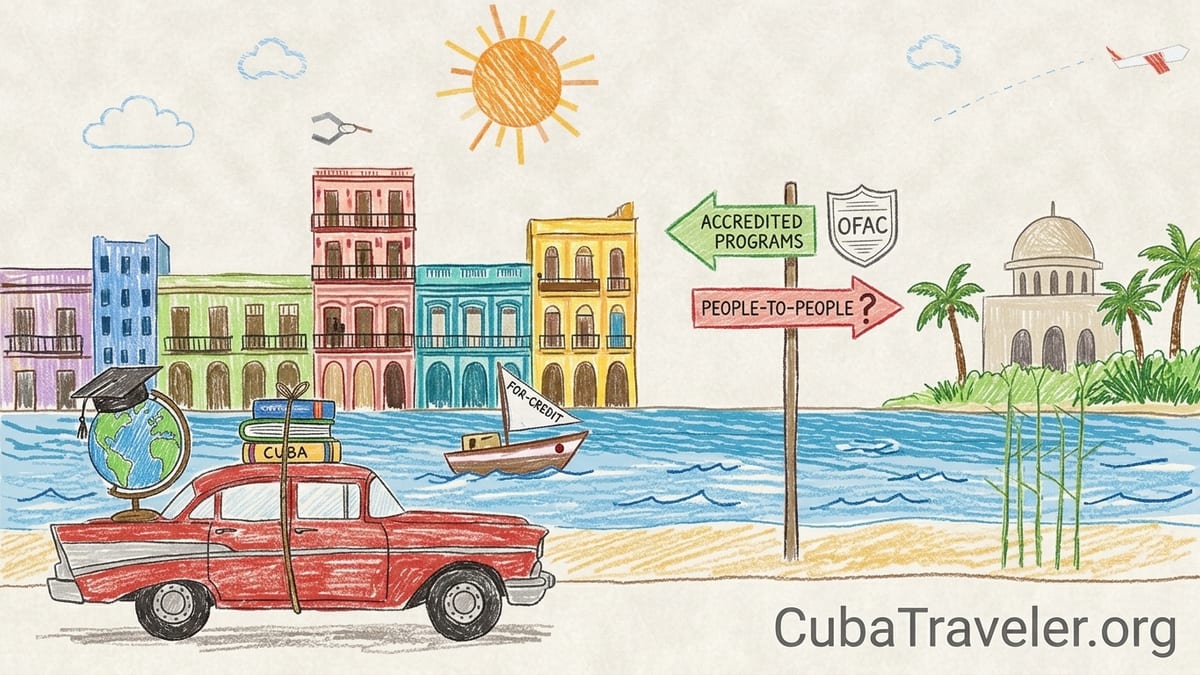
How a Legitimate Educational Trip Suddenly Became Legally Fragile
Our program had been built cautiously. The university’s general counsel and export controls office had cleared the travel months earlier under the educational activities provisions in 31 CFR 515.565, combined with the separate authorization related to professional meetings in 31 CFR 515.564. Flights on American and Delta were booked in late July for travel in mid-October. Students paid a program fee that covered a licensed U.S. tour operator’s ground package, including casa particular stays vetted against the State Department’s Cuba Restricted List and local academic partners. At every step we documented our good-faith reliance on then-current OFAC guidance.
Legally, our intent was solid. The academic portion rested on the still-permitted accredited-educational travel category for for-credit coursework, with a full-time itinerary of lectures at the University of Havana, site visits to public-health clinics, and joint seminars with Cuban researchers. The conference portion was authorized under the long-standing general license for professional meetings or conferences in Cuba. As recently as late summer 2026, OFAC’s own consolidated FAQs described both educational activities and professional meetings as permissible categories, subject to conditions such as full-time schedules and avoidance of restricted entities.
We booked in reliance on that language. By early September, every traveler had at least one completed travel-related transaction, from nonrefundable airfare to partial payment on accommodations. For faculty, this was standard Cuba compliance practice. For students who had never heard of OFAC, it was simply a set of extra forms on top of their course registration. No one expected that within weeks, the ground rules would reset around a narrow “grandfather” rule that would validate some of those bookings but leave others exposed.
The first sign of trouble came not from an official alert, but from a terse advisory email from our U.S. tour partner on September 29. They flagged a new OFAC rule filing and warned that group people-to-people educational travel and conference authorizations were being curtailed effective September 30, 2026, with a limited grandfathering of trips tied to pre-September-30 transactions. By the time I pulled up the Federal Register notice and the updated OFAC FAQs that evening, our October program was no longer plainly covered by the general licenses we thought we had.
What Actually Changed on September 30: People-to-People and Grandfathering
To understand the shock, you have to distinguish between the types of educational travel that OFAC regulates. Individual people-to-people travel, where a lone traveler self-certifies a full-time schedule of educational exchanges, had already fallen out of favor years ago and was not generally authorized by 2026. Those solo educational trips were already gone. What many universities, museums, and nonprofit providers still relied on, however, was group people-to-people travel, where an organization subject to U.S. jurisdiction curated and supervised the program.
The September 29, 2026 amendment, effective September 30, eliminated the general authorization for that group people-to-people category. In the Federal Register and new OFAC FAQ 704, Treasury clarified that persons subject to U.S. jurisdiction could no longer rely on the group people-to-people general license for trips after the effective date, subject only to a grandfathering clause. The rule also narrowed broader educational authorizations in section 515.565 and tied them explicitly to accredited academic programs and organizational sponsorship.
The new heart of the matter appears in the grandfather provisions referenced in OFAC FAQ 1274 and the amended text of 31 CFR 515.565. Educational travel and group people-to-people programs that would otherwise have been cut off may still proceed if, and only if, the traveler completed at least one travel-related transaction for that specific trip before September 30, 2026. OFAC gives examples such as purchasing a flight or reserving accommodation. This is not a blanket validation of everything conceived or marketed before that date. It hinges on the timing and specificity of each traveler’s transaction.
In practice, that nuance created immediate winners and losers among people who considered themselves part of the same “Fall 2026 Cuba program.” A student who had paid a program deposit on September 25 and whose airfare was ticketed on September 28 might fit squarely within the grandfather text. Another who had only filled out an interest form and been invoiced, but had not actually paid or ticketed before September 30, would not be clearly covered under the same provision. The same itinerary, same professor, same learning objectives, but divided by the happenstance of when a credit card was charged.
Educational Categories After the Rule: What Still Works and What Broke
Once the dust settled, it became clear that not all educational travel had been shut off. The amendment narrowed and reorganized the authorizations so that some accredited programs stayed viable, while loosely structured non-credit experiences became much riskier. OFAC’s updated guidance on September 29 emphasized that persons subject to U.S. jurisdiction may still travel for certain accredited educational activities, especially for-credit coursework as part of a degree program or official academic exchange, but with tighter guardrails and a heavier role for U.S.-based institutions.
For example, a semester-abroad program run by a U.S. university where students remain enrolled for credit, pay tuition to their home institution, and follow a curriculum that the university controls can still fit within 515.565(a)(1). Those programs must be sponsored by the accredited institution itself, and faculty or staff typically accompany the group as official representatives. Similarly, certain short-term courses, such as a three-week architecture studio studying Havana’s historic urban fabric, may remain covered if they are credit-bearing, institutionally sponsored, and meet the full-time educational standard.
By contrast, nonprofit-led educational tours and gap-year style programs that used to rely on group people-to-people authorizations are now forced back into the narrow grandfather window or into more complex categories like support for the Cuban people. A U.S. nonprofit that marketed a winter-break cultural immersion focused on independent artists in Trinidad and Viñales, for instance, might previously have used the group people-to-people license, with a U.S. representative accompanying the group. Post-September 30, 2026, new bookings for such programs can no longer rely on that category, and many do not cleanly fit into the remaining educational or humanitarian authorizations.
University research travel sits in the middle. OFAC preserved a general license for professional research, but it now excludes direct and, as of September 30, 2026, indirect financial transactions with entities on the Cuba Restricted List. In addition, the grandfather rule does not automatically bless any research trip that happens to have some payments before the cut-off. A principal investigator planning new fieldwork in Cuba for late 2026 or early 2027 may need to restructure the work under a different general license, seek a specific license, or postpone altogether, particularly if the project involves conferences or collaborative events that resemble the now-unauthorized professional meetings category.
Professional Conferences: From General License to Wind-Down Only
The most brutal surprise for many travelers was the change to professional meetings and conferences. Effective September 30, 2026, OFAC amended section 515.564 to remove the general license that had long allowed attendance at, or organization of, professional meetings or conferences in Cuba. Updated FAQs, including FAQ 701 and 1275, spelled out that the previous authorization to travel for conferences no longer exists as a general category. The rule adds that specific licenses may still be issued on a case-by-case basis for certain meetings tied to otherwise authorized activities, but that is a higher, individualized bar, not a simple box to tick when you book flights.
For our public-health conference, this shift was devastating. Organizers based in the United States had planned a regional event at a Havana conference venue, expecting U.S. participants to rely on the professional meetings general license just as attendees at prior editions had done. By the time OFAC published the changes, registration had been open for months, panel slots filled, abstracts accepted, and hotel blocks confirmed. Now we were reduced to parsing wind-down language: OFAC indicated that travelers already in Cuba under the prior authorization could complete their activities and depart by a date certain, which in similar rulemakings has often been set roughly a month after the effective date.
For U.S.-based attendees who had not yet traveled by September 30, the outlook was poor. Some might arguably fit under other categories, such as professional research if their conference activities could be reframed as research with a full-time schedule, or educational activities if tied to an accredited program. But most were simply business and academic professionals going to present papers and network at a conference. That activity is no longer generally authorized. Without a specific license, these travelers faced a binary choice: cancel, or risk violating U.S. sanctions.
The wind-down provisions did little to rescue future events. Conference organizers could allow currently-in-country U.S. attendees to finish their sessions and return home, and they could process cancellations and refunds for those now unable to attend. What they could not realistically do was conjure a new legal basis for hundreds of U.S. professionals to convene in Havana weeks or months later. Sponsors who had advertised their events as fully compliant under the old rules suddenly had to scramble to explain to registrants that the legal landscape had shifted in ways beyond the organizer’s control.
Commercial Tour Marketing vs. OFAC Language: A Tense Gap
The travel industry’s response has been mixed. In the first two weeks after the rule, I reviewed marketing materials from several prominent Cuba-focused tour operators, both nonprofit and for-profit, aimed at U.S. travelers. Some updated their websites almost immediately to reflect that group people-to-people travel was no longer available for new bookings after September 30, 2026. They pivoted their copy towards still-legal categories like support for the Cuban people, religious activities, or accredited educational partnerships, and removed references to conference tie-ins.
Others left pre-September language in place, at least temporarily. Brochures printed months before the rule change still described “people-to-people educational exchange programs authorized by OFAC,” sometimes with sample itineraries built around meetings with independent entrepreneurs, artists, and community leaders. Online booking pages for early 2027 departures remained live under the same banner. To be fair, many of these companies also issued direct emails to existing clients explaining the rules had changed and that some departures were under legal review or subject to cancellation, even if their general marketing copy lagged behind.
Legally, it is important not to jump straight from outdated marketing to accusations of unlawful sales. OFAC’s own regulations contemplate that organizations may need a period to update materials and to unwind trips that can no longer proceed. The key compliance question is not whether an operator’s brochure still uses the phrase “people-to-people,” but whether they are accepting new bookings from U.S. persons for Cuba travel that no longer fits any general or specific license. A responsible operator will freeze or reclassify such departures, communicate clearly with passengers, and, where necessary, cancel with refunds rather than encourage travelers to proceed under invalid assumptions.
As a traveler or group leader, however, you should not assume that a polished website equals current legal accuracy. Before paying a deposit for a 2027 “educational” Cuba tour, ask the company to identify the exact OFAC category they think applies, how the September 30, 2026 rule affects that category, and whether your booking is protected by the grandfather provisions. If their answer relies solely on the fact that their organization has “been doing this for years,” without referencing the new text of 515.564 and 515.565 or the updated FAQs, treat that as a warning sign and consider seeking counsel or alternative plans.
Refunds, Deposits, and Nonrefundable Payments: Who Bears the Loss?
The human side of a sanctions rule change is financial. In our case, the average graduate student had paid roughly a few thousand dollars between airfare and program fees by late September. Airline tickets to Havana commonly range from about 300 to 800 dollars from U.S. gateways depending on season and advance purchase. Many economy fares, especially on legacy carriers, are nonrefundable beyond limited credits or change vouchers. Our ground operator had required a 30 to 40 percent deposit on land services, with a contract that made that deposit partially or fully nonrefundable if cancellation occurred within 30 to 60 days of departure.
When the OFAC amendment hit, we confronted a blunt question: if a trip can no longer proceed lawfully under the general license that both parties relied upon, who eats the sunk costs? Airlines are not obligated under sanctions law to offer refunds beyond the fare rules, though in some past Cuba rule shifts, U.S. carriers have offered waivers as a goodwill measure. Some fall 2026 travelers reported that customer service agents were willing to convert Havana tickets into credits for other Caribbean destinations without change fees, while others faced standard penalty structures even though the legal basis for the trip had evaporated.
Tour operators and conference organizers faced similar dilemmas. Many contracts treat sanctions or regulatory changes as force majeure events, which can allow the operator to cancel without full refunds, or to refund only after retaining certain unrecoverable costs from Cuban providers. Yet U.S. consumer expectations, shaped by pandemic-era refund practices, now favor more generous treatment when a trip is legally frustrated. In conversations with colleagues and students, I saw deep frustration at paying the price for a political decision in Washington that they neither caused nor anticipated.
There is no one-size-fits-all legal rule for these refund disputes. Travelers should review their booking confirmations, terms and conditions, and travel insurance policies. Some “cancel for any reason” policies purchased through independent insurers may reimburse a portion of nonrefundable costs even when the trigger is a sanctions change. Others exclude government actions. From a compliance perspective, however, one point is simple: the fact that airfare or hotel deposits are nonrefundable does not magically render an otherwise unauthorized post-September-30 trip lawful. You cannot cure a sanctions violation by pointing to your cancellation penalties after the fact.
Five Common Planning Failures Exposed by the September 2026 Changes
Looking across our own experience and those of other groups caught out by the rule, several recurring planning failures stand out. None of these travelers saw themselves as risk-takers. They were academics, students, nonprofit professionals, and conference organizers acting in good faith. Yet their strategies were built on assumptions that the September 30 amendment shattered.
The first failure was outdated marketing and overreliance on historical practice. Many educational and conference programs continued to promote Cuba travel as if the regulatory environment were frozen in time. They reused boilerplate language about people-to-people exchanges and professional meetings without a system to monitor OFAC updates closely. When the 2026 amendment landed, travelers discovered that the “assurance” in a brochure meant very little if it did not match the current text of 31 CFR part 515.
The second was misunderstanding of deadlines, particularly the difference between trip start dates and transaction dates. Some travelers assumed that any trip scheduled before an informal grace period, or before an organizer’s advertised cut-off, would qualify for grandfathering. In reality, OFAC’s own wording focuses on when a traveler completed at least one travel-related transaction prior to September 30, 2026. A November 2026 departure might be grandfathered if tickets were bought in August, while an October 2026 departure might not be if the traveler waited until October 1 to pay.
The third failure involved blanket grandfather assumptions. Organizations sometimes told entire groups that they were “grandfathered” based on the date the program contract was signed, or the date the operator reserved hotel space on a group basis, even though not every individual traveler had made a qualifying transaction. OFAC’s examples point to traveler-specific actions, like purchasing a flight or reserving accommodation. Assuming that an un-ticketed, unpaid participant automatically inherits the group’s grandfather status risks leaving that person personally out of compliance.
The fourth problem was underestimating the impact of conference restrictions. Professional associations built Havana meetings into multi-year rotation cycles based on the old general license. When that license was removed, they scrambled to argue that attendance could fit under research, educational, or support-for-the-Cuban-people categories, even when the substance of the event remained a typical conference. That kind of creative relabeling may not withstand scrutiny if the underlying activities do not change to meet the stricter criteria.
Finally, nonrefundable payments created a perverse incentive to push ahead with questionable trips. Students and faculty who had paid deposits felt intense pressure to “make it work” rather than cancel and absorb losses. In some cases, they looked for looser interpretations of the rules or assumed that enforcement risk was low. That mindset confuses financial regret with legal analysis. Planning a Cuba trip under U.S. jurisdiction now demands building in refundable options or at least clear contingencies for sanctions-driven cancellation, instead of hoping the rules will remain stable.
A Practical Compliance Framework for Travelers and Organizers
Given the new landscape, how should travelers, educators, nonprofits, and conference planners approach any Cuba trip touching dates after September 30, 2026? From my own scramble to salvage an educational program and protect students, I arrived at a simple but rigorous framework. It will not answer every question, but it can keep you from walking blindly into a violation.
Start with the category. Identify the exact OFAC general license or specific license under which you think the travel fits: educational activities, professional research, support for the Cuban people, religious activities, or another. Do not rely on vague labels like “people-to-people” that no longer exist as general authorizations for new group travel. Then consult the latest OFAC FAQs and the regulatory text in 31 CFR 515.564 and 515.565 to confirm whether that category survived the September 30 amendment and under what conditions.
Next, map your transactions against the grandfather rule. For any trip that would have relied on group people-to-people or the broader pre-amendment educational authorizations, create a record of each traveler’s first qualifying transaction date. That means the date a flight to or from Cuba was ticketed, a specific Cuban accommodation was reserved, or a program fee directly tied to the Cuba itinerary was paid. If that date falls before September 30, 2026, you may have a colorable argument that the traveler is covered by the grandfather provision for that specific trip. If it falls after, you should not assume coverage.
Third, evaluate whether your itinerary still matches the substantive requirements of the claimed category. For accredited educational travel, that means a full-time schedule of coursework or academic activities, control by an accredited U.S. institution, and, in most cases, a faculty or staff representative accompanying the group. For professional research, it means a documented research plan, full-time activities, and careful screening to avoid dealings with entities on the Cuba Restricted List. Simply “being in Cuba” while holding a conference badge is not the same as engaging in professional research authorized by OFAC.
Fourth, build refund and modification contingencies into contracts. Push airlines, tour operators, and conference venues for terms that allow cancellation or re-routing if U.S. sanctions change materially between booking and travel. Ask explicitly how they handled past Cuba rule shifts, and whether they will indemnify or support travelers forced to cancel for legal reasons. Even when you cannot secure full refunds, clear language will reduce disputes and make it easier to justify early cancellation rather than waiting until nonrefundable windows close.
Finally, when in doubt, consider postponement or alternative destinations rather than forcing a marginal case. OFAC does offer the possibility of specific licenses in some scenarios, including certain educational activities and professional meetings tied to other authorized programs, but those applications take time and are not guaranteed. For university-sponsored travel, export controls or general counsel offices should be looped in early and empowered to halt or redirect programs when rules tighten, rather than being asked to bless decisions post hoc.
FAQ
Q1. Is any people-to-people travel to Cuba still legal for U.S. travelers after September 30, 2026?
Individual people-to-people travel was already not generally authorized, and the September 30 rule removed the general authorization for new group people-to-people educational travel, except for certain trips protected by the grandfather provision tied to pre-September-30 transactions.
Q2. How do I know if my previously booked educational trip is grandfathered?
You need to confirm that you personally completed at least one qualifying travel-related transaction for that specific trip, such as buying a flight or reserving accommodation, before September 30, 2026, and that the trip otherwise met the former educational authorization criteria.
Q3. Does a deposit paid to a U.S. tour operator count as a qualifying transaction for grandfathering?
OFAC’s examples focus on travel-related transactions like flights and accommodations, but many compliance professionals interpret a clearly documented, trip-specific program payment as potentially qualifying. You should seek legal advice based on your exact payment documentation.
Q4. Can I still attend a professional conference in Cuba under a general license?
No. The general license for attending or organizing professional meetings and conferences in Cuba was removed effective September 30, 2026. Only limited wind-down for those already in Cuba and possible case-by-case specific licenses remain.
Q5. Are accredited university semester-abroad programs in Cuba still possible?
Yes, within limits. Certain for-credit programs controlled by U.S. accredited institutions can still be authorized under the revised educational activities provisions, provided they meet requirements such as a full-time academic schedule and institutional sponsorship.
Q6. What happens if my trip is no longer authorized but I go anyway?
Persons subject to U.S. jurisdiction who travel to Cuba without a valid general or specific license risk civil or, in serious cases, criminal penalties. They may also face issues in future background checks, especially for sensitive federal employment or contracting.
Q7. Can my organization reclassify a canceled people-to-people tour as “support for the Cuban people” and proceed?
Only if the itinerary is genuinely redesigned to meet the strict support-for-the-Cuban-people criteria, including a full-time schedule of activities that strengthen Cuban civil society and avoidance of restricted entities. Cosmetic relabeling without substantive changes is risky.
Q8. Will airlines and tour operators automatically refund trips canceled due to the new OFAC rules?
Not automatically. Refunds depend on each carrier’s and operator’s contract terms, as well as any discretionary waivers they offer. Travelers should review fare rules, tour contracts, and travel insurance to understand their options.
Q9. Do I need a specific license from OFAC for all Cuba travel now?
No. Several general license categories remain, including family visits, certain educational activities, professional research, religious activities, support for the Cuban people, and others. But activities like group people-to-people travel and professional conferences now generally require either grandfathering or a specific license.
Q10. What is the safest first step if I am unsure whether my planned Cuba trip is compliant?
Gather your contracts and payment records, identify the claimed OFAC category, check the latest OFAC FAQs and regulations for September 30, 2026 changes, and consult your institution’s compliance office or a sanctions attorney before making further payments or traveling.