


My search for a perfectly legal long weekend in Havana went off the rails the moment I clicked “Book now.” I had my flights picked, an itinerary built around a lawful Support for the Cuban People trip, and a short list of classic hotels along the Malecón. Yet every time I thought I had found “the one,” a deep dive into U.S. rules turned that bookable room into a legal tripwire. The gulf between what the internet invites Americans to reserve in Cuba and what U.S. sanctions law actually lets us pay for has rarely been wider than it is after September 30, 2026.
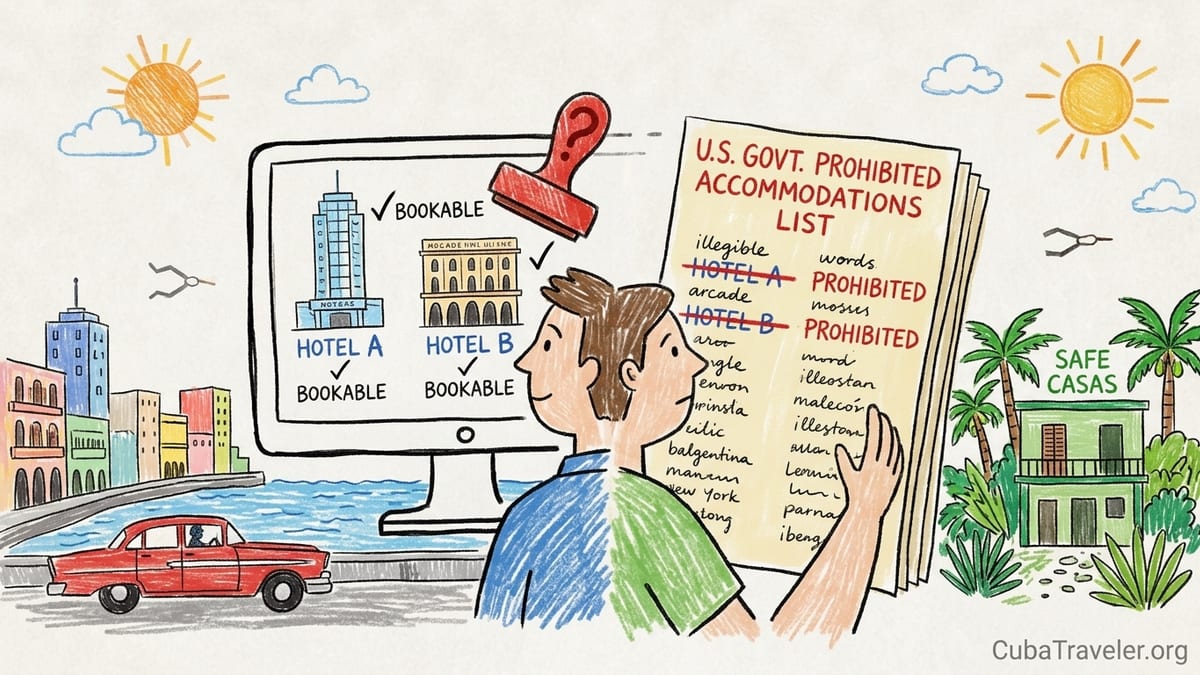
Starting With A Simple Havana Hotel Search
I began the way most travelers do: I opened a major U.S. booking platform, plugged in Havana, picked three nights in February 2027, and set the filter to midrange and upscale hotels. The first results looked dreamy. A seafront tower on the Malecón with 1950s lines and a modern Iberostar logo. A gleaming luxury property in restored pre-revolutionary arcades. A storied hotel facing Parque Central with rooftop views of El Capitolio. Prices hovered around 220 to 280 U.S. dollars per night, with free cancellation and “pay at property” options that made it feel almost casual.
On-screen, nothing hinted at risk. There were no pop-up warnings about U.S. sanctions, no notes about restricted entities, no suggestion that completing the booking could violate U.S. law. In terms of user experience, reserving a room in Havana felt exactly like reserving one in Cancún or San Juan.
But I was planning to travel under a legitimate general license category from the Office of Foreign Assets Control, the U.S. agency that administers the Cuba embargo. That meant my trip plan and every payment had to line up with the Cuban Assets Control Regulations. Before I clicked “confirm,” I cross-checked the shiny hotels on my screen against the dry but decisive government lists that actually determine where a traveler under U.S. jurisdiction can legally sleep.
Within minutes, the gap became obvious. Several of the most prominent, easy-to-book Havana hotels in my search were on one or both U.S. sanctions lists. The booking engine saw available rooms and valid credit cards. OFAC saw prohibited financial transactions.
The Two Lists That Quietly Control Where You Can Sleep
For Cuba, the U.S. government uses two separate but overlapping tools that matter deeply for hotel bookings. The first is the State Department’s Cuba Restricted List, an inventory of Cuban entities and sub-entities tied to the Cuban military, intelligence, or security services. Section 515.209 of the Cuban Assets Control Regulations bars people subject to U.S. jurisdiction from engaging in certain financial transactions with anything on this restricted list. As of a rule that took effect September 30, 2026, that prohibition now explicitly covers both direct and indirect financial transactions.
The second tool is the Cuba Prohibited Accommodations List, also maintained by the State Department and implemented through OFAC regulations. That list names specific hotels, resorts, marinas, and similar properties in Cuba where U.S.-jurisdiction travelers are generally prohibited from lodging, paying for lodging, or making reservations for themselves or others. It is tied to section 515.210 of the regulations and sits on top of the broader embargo framework.
These two lists often overlap but are not interchangeable. A hotel can be on the Prohibited Accommodations List without its parent conglomerate appearing separately on the Cuba Restricted List. Conversely, an entity that owns a portfolio of resorts could be on the Restricted List, which then taints any financial transaction that benefits it, even if a specific property’s name appears nowhere on the Prohibited Accommodations List. Both lists are updated periodically in the Federal Register and on State Department and Treasury resources, and both have changed significantly since they were first published.
For a traveler, this distinction is not academic. The Prohibited Accommodations List controls where you may stay. The Cuba Restricted List, when combined with the September 30, 2026 expansion to indirect transactions, can reach behind glossy brand names to capture who ultimately receives or controls your payment. Relying on an old blog post that copied an out-of-date set of names is not enough. You must look at the current official lists before you pull out a card.
Finding Real Hotels That Are Bookable But Off Limits
To test the system, I picked several well-known Havana properties that still show up on major booking platforms and then checked them against the latest official U.S. lists. One example is the Gran Hotel Manzana Kempinski La Habana, the luxury hotel that occupies the historic Manzana de Gómez block in Old Havana. In the July 14, 2025 update to the Cuba Prohibited Accommodations List, this property appears by its Spanish name and address in central Havana. As of fall 2026, that listing remains in force. Yet on commercial travel sites, rooms at the Manzana were easily available for dates in early 2027 at nightly rates around the mid-200 dollar range, with no hint that a person under U.S. jurisdiction is barred from lodging there.
A second example is Habana Riviera by Iberostar, the mid-century tower on the Malecón in Vedado. The State Department’s 2025 notice updating the Prohibited Accommodations List includes Habana Riviera By Iberostar with its Paseo y Malecón address. Despite managerial shifts reported in European media during 2026, the U.S. listing has not been removed. On my search, the property still appeared with Iberostar branding and standard booking options on non-U.S. platforms that U.S. users can access, again without sanctions warnings.
A third example is Hotel Saratoga, the boutique-style landmark on Paseo del Prado just off Parque de la Fraternidad, whose partial collapse in 2022 made global headlines. The same 2025 Federal Register update names Hotel Saratoga, with its Havana Vieja address, as a prohibited accommodation. Recent booking searches, however, show it reappearing in some inventories for 2027 dates, with promotional language and refundable rates that ignore its status under U.S. rules.
All three of these properties are still widely recognized, marketed in multiple languages and currencies, and present on international booking engines. From the traveler’s point of view, they look like any other Caribbean luxury hotel: real-time availability, free cancellation, well-known brands. Under U.S. sanctions law, though, paying to stay there remains prohibited for persons under U.S. jurisdiction, regardless of how simple it is to click “reserve.”
Why September 30, 2026 Made Indirect Bookings Riskier
Before September 30, 2026, most U.S.-based Cuba specialists already understood that they could not pay a Havana hotel that appeared on the Cuba Prohibited Accommodations List or that belonged to a listed military conglomerate. Some travelers tried to sidestep this by using third-country cards, foreign friends, or overseas travel agencies to handle hotel payments. They reasoned that if no money moved directly from a U.S. bank or U.S. traveler to a listed entity, they might avoid triggering U.S. sanctions.
The amendment to the Cuban Assets Control Regulations that took effect on September 30, 2026 explicitly undercuts that line of thinking. The revised text of section 515.209 now bars persons subject to U.S. jurisdiction not only from direct financial transactions with any entity or sub-entity on the Cuba Restricted List, but also from indirect financial transactions in which such an entity is the originator or the ultimate beneficiary. OFAC’s new and amended FAQs clarify that this indirect prohibition applies across the general licenses that authorize most travel, unless a specific exception is clearly stated.
In practice, this means that paying a third-country travel agency, which then settles invoices with a listed Cuban hotel operator, can still be a prohibited indirect transaction if you are a U.S. person or otherwise subject to U.S. jurisdiction. Even participating in a group trip where a non-U.S. tour organizer has pre-paid a block of rooms at a prohibited hotel can create problems, because your share of the package contributes to a chain of payments that benefits a listed entity.
OFAC preserved limited grandfather relief for certain transactions completed before the September 30, 2026 effective date. For example, the agency described a wind-down period through October 30, 2026 for some travelers who were already in Cuba under older authorizations when the rule changed, and it allows previously completed travel-related payments under a valid general license to stand. But those carve-outs are narrow. They do not bless new bookings at prohibited hotels made through foreign middlemen after the rule’s effective date.
What You See Online Versus Who Really Gets Paid
Part of the confusion comes from how hotels in Cuba present themselves online. Booking engines show brand names, star ratings, room types, and cancellation policies. The Gran Hotel Manzana emphasizes its affiliation with Kempinski. The Habana Riviera highlights Iberostar. Other properties lean on labels like “Selection,” “Grand,” “Parque Central,” or “Royalton.” None of these words tell you who actually owns the bricks, who signs the staff paychecks, or which corporate entity ultimately receives your nightly rate once card processors, travel agencies, and management companies take their cut.
U.S. sanctions, by contrast, care intensely about those unseen layers. The Cuba Restricted List identifies corporate groups linked to the Cuban military and security apparatus, such as the conglomerates that hold stakes in numerous hotels through joint ventures and subsidiaries. When a U.S.-jurisdiction traveler pays 240 U.S. dollars per night for a stay at a restricted hotel in Havana, even through a global booking platform, some portion of that payment flows up to a listed entity.
The way property names are written can make cross-checking even harder. The Prohibited Accommodations List tends to use Spanish names and original spellings, complete with accents, abbreviations like “Habana,” and local address conventions that differ from what English-language travel sites show. A booking engine might list “Kempinski Manzana Havana” while the Federal Register entry reads “Gran Hotel Manzana Kempinski, San Rafael entre Monserrate y Agramonte, Habana.” Travelers who search only for the English phrase could miss the match entirely.
Management churn in 2026 layered on more complexity. As U.S. sanctions pressure increased, European chains like Iberostar and Meliá publicly announced that they were exiting management of dozens of Cuban properties while continuing to operate others. Media in Spain and Latin America reported lists of hotels where branding would change or contracts would end, but those changes did not instantly rewrite U.S. sanctions lists. A hotel that quietly swaps one foreign flag for another can remain off limits if the underlying Cuban owner or operator is still a listed entity that benefits from your payment.
Independent Casas Versus Conventional Hotels
One of the most practical responses to the sanctioned-hotel maze has been the rise of independent private accommodation known as casas particulares. These are licensed private homes and small guesthouses that Cuban individuals operate on their own, often with two or three rooms and family-run service. From both an ethical and regulatory standpoint, they tend to align more closely with U.S. policy objectives around supporting the Cuban people than large state-linked hotels do.
From a legal perspective, OFAC’s Cuba-related FAQs recognize categories that allow certain transactions with bona fide private sector entrepreneurs in Cuba. In many cases, paying a genuinely independent casa owner directly in cash on the island, or through a payment channel that does not involve a restricted conglomerate, poses fewer sanctions issues than paying for a room in a big beachfront resort complex. Many Cuba travel specialists now design Support for the Cuban People itineraries around stays in casas combined with meals at small private restaurants and activities with independent guides.
However, it is dangerous to treat “private accommodation” as an automatic safe harbor. Some properties advertised as “casa particular” or “apartment” online are effectively units inside hotel complexes controlled by listed entities. Others are managed through state-run or military-linked intermediaries that handle foreign bookings and payments. A stay in what looks like a small guesthouse can still route your money into a prohibited chain if, for example, you reserve it through a Cuban state tourism agency or a foreign consolidator that has contracted with a restricted hotel group.
During my own planning, I compared a simple two-room casa in Centro Habana, where the host communicated directly, accepted payment in cash on arrival, and provided a copy of her Cuban self-employment license, with a slick “loft” in Vedado promoted on a global platform. The latter turned out, after some digging, to be part of a condo-hotel complex whose operations tied back to one of the big tourism conglomerates. The first option aligned much better with the spirit and letter of OFAC’s current rules, even though both appeared at similar nightly prices.
Grandfathering, Cancellations, and Moving Targets
Another wrinkle concerns timing. What if you legally booked a hotel that was not yet on the Prohibited Accommodations List, only to see it added later? OFAC’s regulations and FAQs recognize that rules change, sometimes with little advance public notice. The September 30, 2026 amendment, for example, includes language and subsequent guidance that allow certain previously completed transactions to stand, especially when travelers had already made nonrefundable payments or were physically in Cuba at the time of the change.
If you reserved and paid for a hotel stay before it appeared on the Prohibited Accommodations List, and your overall travel fits within an applicable general license, U.S. regulators have historically treated that prior transaction differently from a new booking made after the listing. There is, in effect, a limited grandfathering concept: rules usually do not retroactively criminalize conduct that was authorized at the time it occurred. However, OFAC’s wind-down periods are finite, and they often require that you complete travel or cancel by specified dates.
From a practical standpoint, this creates genuine cancellation risk. You may think your legal homework is done when you reserve a hotel six months before departure. If the State Department updates the Cuba Prohibited Accommodations List or the Cuba Restricted List in the interim and your property appears on it, you may have to scramble to change accommodations, negotiate refunds, or seek specific legal advice. The online booking site will almost never notify you that your perfectly valid reservation has become a sanctions problem.
It is also critical to keep Cuba’s banking and card-processing crisis separate from U.S. sanctions law. Payment problems on the island have accelerated in recent years because of shortages of foreign currency, local financial controls, and operational issues with Cuban and foreign banks. A U.S. traveler might find that a foreign card simply does not work at Cuban point-of-sale terminals. That is a real constraint, but it is different from the legal question of whether paying for a particular hotel is prohibited in the first place. Sanctions compliance must be solved on top of, not instead of, the practical challenge of moving money.
Six Practical Problems Every U.S. Traveler Faces
By the time I finished mapping my Havana hotel options against current U.S. rules, six recurring problems stood out. First, ownership structures are opaque. Hotels in Cuba often involve joint ventures between Cuban state entities and foreign chains, with multiple layers of subsidiaries. A traveler sees “Brand X Havana,” not the specific Cuban corporation that receives the proceeds.
Second, the official lists themselves can feel stale by the time they reach casual readers. The State Department publishes updates in the Federal Register and on agency websites, but travel blogs, message boards, and even some legal summaries may quote versions that are a year or more out of date. Whenever a high-profile management change hits the news, such as European chains exiting some properties while keeping others, armchair analysts tend to over- or under-assume which hotels remain restricted.
Third, third-party booking platforms obscure sanctions issues. Large global sites often have limited or no Cuba-specific compliance messaging for individual consumers. They may be relying on back-end filters for users in the United States or on representations from suppliers, but none of that substitutes for a traveler’s own duty to obey U.S. law. If the booking engine offers a room, it does not automatically mean OFAC has blessed the transaction.
Fourth, the September 30, 2026 expansion of indirect transaction prohibitions means that even creative payment routes can be problematic. Paying in euros through a non-U.S. website that settles with a listed Cuban hotel operator still involves an indirect financial transaction if you are a U.S. person, and that can be off limits unless a narrow exception applies.
Fifth, cancellation and refund risks are amplified by the moving target nature of the lists. A property can shift from legally bookable to prohibited with a single Federal Register notice. If your reservation terms are nonrefundable or only partly refundable, you could be left absorbing costs to stay within the law.
Sixth, there is the persistent illusion that online availability equals legal permissibility. In reality, the OFAC rules operate on a different plane than consumer websites. A room calendar may be wide open, rates attractive, and payment screens working perfectly, yet the simple act of pressing “confirm” can create a sanctions issue. That disconnect is at the heart of the problem for ordinary travelers who are trying in good faith to comply.
The Takeaway
My Havana hotel search started as a routine bit of trip planning and turned into an uncomfortable education in how far apart consumer travel technology and U.S. sanctions law have drifted. On one screen, Cuba looks like any other sun-and-history destination, with big-brand hotels, instant confirmations, and fine print that focuses on weather, bed types, and breakfast. On another, far less visible screen, OFAC and State Department lists quietly label some of those exact hotels as off limits, and as of September 30, 2026, extend the reach of that prohibition to indirect payment routes as well.
The core lesson is not that Americans must avoid Cuba entirely. U.S. regulations still contain lawful pathways under various general license categories, and many independent businesses on the island stand to benefit from careful, compliant travel. The real lesson is that you cannot outsource sanctions compliance to a booking platform, a foreign tour operator, or a friend with a non-U.S. card. You must independently verify whether the places you plan to pay are entangled with restricted entities or appear on the Prohibited Accommodations List.
If you want your next Cuba trip to be both enriching and legally sound, treat hotel research as a two-track exercise. One track looks at charm, price, and location. The other looks at ownership, sanctions status, and payment flows. Only when both tracks align should you consider clicking “confirm.”
Below is a step-by-step process I now use, and recommend, before making any Cuba accommodation payment and again right before departure.
FAQ
Q1. How do I check if a Cuba hotel is on the Cuba Prohibited Accommodations List?
The U.S. State Department publishes the Cuba Prohibited Accommodations List in the Federal Register and maintains an updated version on its official sanctions-related pages. Before booking, locate the current list by its most recent publication date, then search carefully for your hotel using all likely name variants, including Spanish spelling and accents, as well as its street address and municipality.
Q2. What is the difference between the Cuba Restricted List and the Cuba Prohibited Accommodations List?
The Cuba Restricted List identifies Cuban entities and sub-entities tied to the military and security services where certain financial transactions are broadly prohibited. The Cuba Prohibited Accommodations List names specific lodging properties where persons under U.S. jurisdiction may not stay or pay for lodging. Some hotels appear on both, but they are separate tools that are updated on their own schedules and must be checked independently.
Q3. Did the September 30, 2026 rule change mean I can no longer use foreign friends or agencies to pay for restricted hotels?
The rule that took effect on September 30, 2026 expanded the ban to cover many indirect financial transactions with entities on the Cuba Restricted List. If a foreign friend, agency, or platform ultimately forwards your funds to a listed hotel operator, that can still be a prohibited indirect transaction for you as a U.S.-jurisdiction traveler, even if you never pay the hotel directly.
Q4. Are all big hotels in Havana and Varadero automatically off limits to Americans?
No. Some large hotels are on the Prohibited Accommodations List or are tied to entities on the Cuba Restricted List, but others are not. Because ownership and management arrangements change, you must check individual properties against the latest official lists rather than assuming that size or star level alone determines their status.
Q5. Are small casas particulares always safe under U.S. law?
Not always. Many independent casas particulares are run by genuine private entrepreneurs who fall within policy goals to support the Cuban people, but some small accommodations are booked or managed through state or military-linked intermediaries. You should look for direct relationships with the host, avoid state tour agencies for bookings, and, when possible, confirm that your payments do not pass through listed entities.
Q6. If I booked a hotel before it was added to a sanctions list, can I still stay there?
It depends on timing and the specific authorization that applied when you booked. OFAC sometimes allows limited wind-down or grandfathering for completed transactions made before a rule or list change, especially if travelers are already in Cuba. However, new stays after the effective date can be problematic even if the reservation was made earlier. In borderline cases, consider seeking legal advice or switching to a clearly permissible accommodation.
Q7. How does the card-processing crisis in Cuba interact with U.S. sanctions rules?
Cuba’s card-processing problems relate to the island’s financial system and foreign banking relationships, and they can make it difficult or impossible to use some cards on the ground. U.S. sanctions rules are a separate overlay that govern whether you are legally allowed to make a given payment in the first place. A payment can be both technically impossible at a terminal and still prohibited in principle under U.S. law.
Q8. Does using a non-U.S. booking website keep me safe from OFAC enforcement?
No. OFAC’s regulations apply to persons under U.S. jurisdiction regardless of what website they use. Reserving a prohibited hotel through a non-U.S. platform, paying in a foreign currency, or routing a transaction through a non-U.S. bank does not automatically remove sanctions risk if a listed entity ultimately benefits from your payment.
Q9. What concrete steps should I take before paying for accommodation in Cuba?
First, confirm that your overall trip fits within one of OFAC’s general license categories. Second, pull the current Cuba Prohibited Accommodations List and Cuba Restricted List from official U.S. government sources. Third, search for your intended hotel by all known names and addresses on both lists. Fourth, consider how your payment will flow and avoid arrangements where funds reach a listed entity, directly or indirectly. Finally, repeat this check shortly before departure in case the lists have changed.
Q10. Where can I get reliable updates on future changes to Cuba sanctions that affect travel?
The most reliable sources are official communications from the U.S. Treasury’s Office of Foreign Assets Control and the U.S. State Department, including Federal Register notices, updates to OFAC’s Cuba-related FAQs, and State Department announcements about changes to the Cuba Restricted List or Prohibited Accommodations List. Professional Cuba-focused legal and compliance resources that cite those primary documents can also help interpret what new rules mean for travelers.