


In October 2026 I flew from Miami to Havana with my eight‑year‑old son for a family visit. I am a U.S. citizen, he is a U.S. citizen, and his other parent stayed home in Florida. Planning any Cuba trip takes work, but traveling with a minor added a second, more delicate layer: passports, consent letters, medical preparations, and understanding how Cuba treats children with Cuban roots differently from foreign‑born kids. What follows is a straightforward account of what I actually had to check and prepare, and what I learned along the way.
Our Family Setup and Why My Child Needed His Own Documents
To make this guide concrete, here is our exact situation. I am a U.S. citizen by birth with no Cuban nationality. My son was born in Florida, has only U.S. nationality, and holds his own U.S. passport. His father, also a U.S. citizen with no Cuban citizenship, did not travel with us. We departed from Miami International Airport (MIA) and flew directly to Havana. We traveled on a U.S. “Support for the Cuban People” category flight, which is still one of the common legal categories for U.S. travelers heading to Cuba in 2026.
One of the first things I confirmed, both through official guidance and with our airline, was that my son could not “share” my passport or visa. Cuba expects every traveler, including infants, to arrive with their own valid passport and their own entry authorization. U.S. agencies and airlines say the same thing: each child, no matter how young, needs an individual passport and, if required by the destination, an individual visa or e‑visa. That meant I had to renew his passport months before our trip when I saw it would drop under the six‑month validity window many countries expect.
For Cuba, short‑stay leisure and family visitors typically need what used to be a paper tourist card and is now being replaced for many nationalities by an online e‑visa system. In our case, our Miami–Havana airline sold a separate Cuba tourist card for each passenger. The child price was the same as the adult price. In October 2026, carriers out of the United States were generally charging in the region of 75 to 100 U.S. dollars per card, per person, including children, payable during online check‑in or at the departure gate. The exact fee changed by airline and route, so I checked carefully in advance.
Once I understood that my son would be treated as a separate traveler on paper, everything about our preparations became easier to organize. Instead of thinking in terms of “my ticket and plus‑one,” I worked with two parallel files: one for my documents and one for his. That mindset also helped when it came time to complete Cuba’s D’Viajeros form and carry backup paperwork such as his birth certificate and the consent letter from his father.
Passports, D’Viajeros and How Family Groups Really Work
Cuba’s digital arrival form, known as D’Viajeros, is the document that confused me most in the early stages. Friends had told me they did “one form per family,” which sounds reassuring but is not actually how the current system works. By mid‑2026, official guidance and traveler reports were clear that each traveler, including babies and elderly grandparents, must have their own individual D’Viajeros declaration and unique QR code. The platform lets one adult fill out several forms in a row, but the result is still one code per person, not a single family QR.
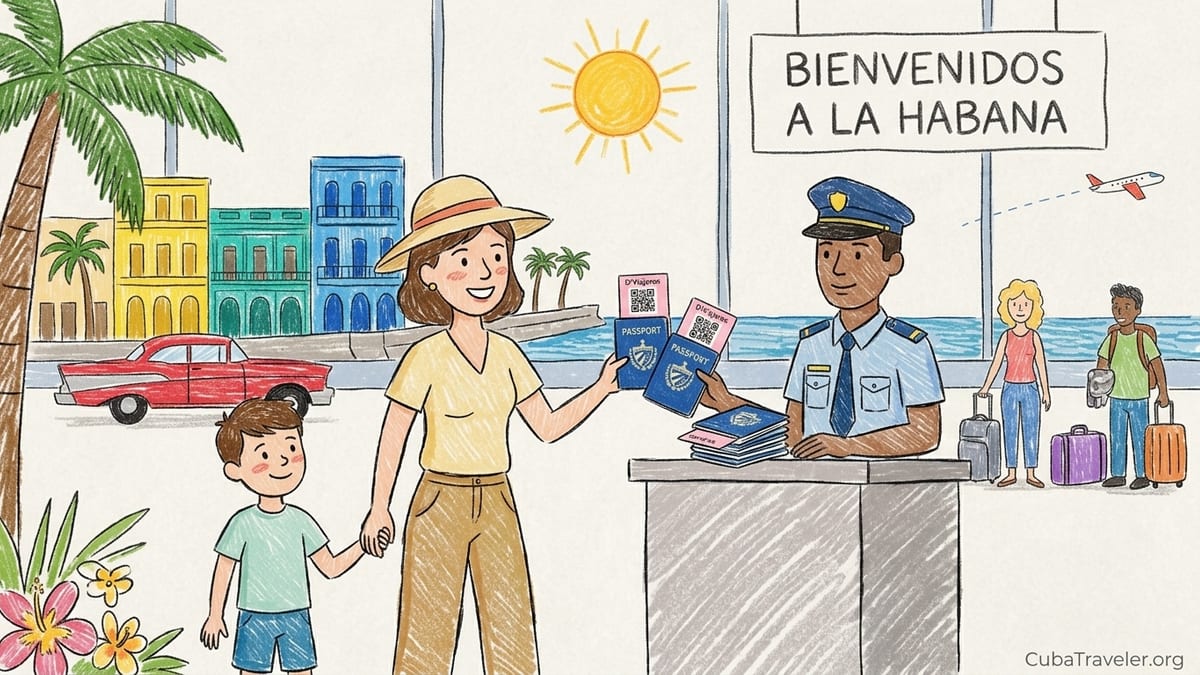
Practically this meant I sat down at my laptop one evening, opened the D’Viajeros portal, and first filled out my own form. Immediately afterward, I created a second form for my son, using his passport details and indicating that he was a minor traveling with me as his parent. At the end, the system issued two separate QR codes in PDF format. I printed both and also saved them in a travel folder on my phone. At Miami check‑in, airline staff scanned both QR codes before issuing our boarding passes.
On arrival in Havana, the family dynamic mattered more in how the officers directed us through the lines than in how the paperwork was structured. We approached passport control together. I handed over both passports and both printed QR pages. The officer checked each QR code against each passport, then waved us through as a single family unit. At no point did they ask to see my son’s paper tourist card separately from mine, but each card number had been linked individually in the airline’s system. The point for parents is that you prepare separate documents for each child, but you use them at the border as a group.
If you are traveling with several children or extended family, it helps to create a simple system before you arrive. On our flight, I watched another parent traveling with three kids fumble with a mix of phones and crumpled papers. What worked for us was a small, zippered pouch with passports in order of age, folded D’Viajeros QR printouts tucked inside each passport, and the tourist cards sandwiched between the pages. When the officer called us forward, I could hand over the whole stack as a single, neat bundle.
When Your Child Is Cuban or a Dual National
Our preparations were more complicated because of extended family. My cousin in New Jersey is a Cuban‑born U.S. citizen and was considering joining us with her teenage daughter, who was also born in Cuba but now lives in the United States with a U.S. passport. Planning with them forced me to understand how differently Cuba treats people it considers Cuban citizens, even if they hold another passport.
Current U.S. and Cuban information align on the core point: if someone was born in Cuba or otherwise holds Cuban nationality, Cuban authorities usually expect that person to enter and leave Cuba using a Cuban passport, not a foreign one. The United States, on the other hand, requires U.S. citizens, including dual nationals, to use a U.S. passport to enter and leave the United States. In practice, that means a Cuban‑American adult or teenager may need to travel with both passports, presenting the U.S. passport in Miami and the Cuban passport in Havana.
For children born in Cuba, or children born abroad who have been registered as Cuban citizens through a Cuban consulate, the same logic generally applies. Once Cuba considers a person to be a Cuban citizen, they are treated as Cuban only while on Cuban territory. A girl born in Havana, who later obtained Spanish or U.S. citizenship, might need to renew her Cuban passport and pay Cuban consular fees before she can visit family back on the island. In recent years those fees have run to several hundred dollars for issuance and renewals, not including travel to the consulate, which can come as a shock to families who assumed their new nationality would simplify life.
This is very different from the situation of my U.S.‑born son, who has no Cuban nationality at all. Cuba treated him like any other foreign minor visitor. He needed a valid foreign passport, an entry visa or tourist card, D’Viajeros, proof of health insurance, and evidence of an onward or return ticket. He did not need a Cuban passport, and there was no question of consular fees or Cuban nationality rules. If you have one child who is Cuban‑born and another who is foreign‑born, you may find yourself managing two very different sets of requirements in one family trip.
Traveling With One Parent: Consent Letters, Custody Papers and Surnames
Because my son’s father stayed in Florida, one‑parent travel was not just an abstract scenario for us. I paid a lot of attention to what both the United States and Canada say about children traveling without both guardians. U.S. government guidance explains that some countries require a consent letter if a child is traveling with only one parent, and Canadian guidance goes even further by providing a model letter and strongly recommending one for any child traveling without all legal guardians present.
Officially, Cuba’s entry rules for foreign visitors do not list a notarized consent letter as a mandatory item. In October 2026, I was not able to find a Cuban government document that required such a letter for foreign minor visitors at the border in the way that some Schengen countries do. However, airlines and departure‑country exit controls can, and sometimes do, ask for proof that the non‑traveling parent consents to the trip. The fact that a destination does not demand a consent letter does not always mean your airline or home country will be equally relaxed.
For peace of mind, I brought a consent letter signed by my son’s father and notarized in Florida. It stated his full name, my full name, our child’s full name and date of birth, the dates of our trip, our flight numbers, and that he granted permission for me to take our son to Cuba and back. We had it prepared in English, which was sufficient for U.S. authorities and airline staff. I carried a photocopy of his passport’s data page paper‑clipped to the letter. We were never asked to show it at Miami or Havana, but having it in my document pouch meant I was not worrying at every checkpoint.
If your family situation involves sole custody, separation, or different surnames, it is worth going a step further. Travelers with sole custody are often advised to carry a court order or guardianship papers. Parents with different surnames from their children often carry a long‑form birth certificate that clearly lists both parents’ names. In some countries those documents need to be translated into Spanish or English by a sworn translator, but for Cuba in 2026 I could not find evidence of a firm translation rule for foreign visitors. I personally brought my son’s U.S. birth certificate in English without translation, reasoning that it would at least show a consistent family story to any officer who asked.
Children Traveling With Grandparents or Other Guardians
On our Havana flight there were at least two children traveling with grandparents but without parents. Watching those families go through check‑in reminded me how much more paperwork is involved when the adult who loves the child is not the same adult who has legal responsibility on paper. Different countries handle this differently, but the general pattern I saw while researching was clear: the further a traveling adult is from legal guardian status, the more documentation is expected.
If we had decided to send our son with his grandmother instead of me, I would have prepared a more detailed consent package. That would have included a notarized consent letter signed by both parents, naming the grandmother, listing her passport details, giving permission for her to make medical decisions in an emergency, and authorizing her to accompany our child in and out of Cuba for specific dates. We would also have given her a copy of our son’s birth certificate and copies of both parents’ passports. In some countries, especially in Europe, border officers explicitly look for such consent letters when minors travel with grandparents or family friends.
Names and family links also matter in less obvious ways. One boy on our flight had a different surname from his grandmother. At Miami check‑in, the airline agent very politely asked a few extra questions and took a moment longer to examine their documents. From what I could see, the grandmother presented a letter from the boy’s parents and a birth certificate that showed the mother’s surname matching her own. The process still moved smoothly, but there were clearly more steps than for a nuclear family with matching surnames.
The practical lesson for guardians is to over‑prepare. In 2026, flights to Havana were often running full, and delays could stack up quickly for any passenger whose documents required extra checking. A detailed letter, a clear birth certificate, and, where relevant, translations into Spanish can save a child a stressful questioning at the gate. Even if no one asks, having that folder in your bag is reassuring when you are the person temporarily responsible for someone else’s child.
Health, Medication and Cuba’s 2026 Shortages
Cuba’s healthcare system has a strong reputation for training medical staff, but by late 2026 the country continued to experience serious shortages of medications, basic supplies, and even some types of food. News reports and traveler accounts over the past two years repeatedly mentioned empty pharmacy shelves, difficulty finding common painkillers, and very limited availability of specific pediatric formulations. For families, this environment changes how you pack.
Before our trip I spoke with our pediatrician about our son’s usual medications and possible issues in Cuba. He does not have a chronic condition, so our needs were straightforward: children’s acetaminophen, ibuprofen, oral rehydration salts, allergy syrup, and his regular multivitamins. Our pediatrician confirmed what many travelers had already observed anecdotally. We should not rely on Cuban pharmacies to stock even basic branded medicines in 2026, let alone children’s versions. She wrote a short note on her letterhead listing the medications we were bringing and their dosages.
At U.S. departure and Cuban arrival, no one inspected our small medical kit, but I was careful to follow common‑sense rules that line up with many countries’ laws on importing medicine. I packed all medications in their original packaging, with the pharmacy label intact where there was one. I kept the doctor’s note and our health insurance cards in the same pouch. For over‑the‑counter painkillers and allergy medicine, quantities appropriate for a several‑week stay were not a problem.
Controlled substances are another story. Parents whose children take medication for attention‑deficit disorders, epilepsy, or other conditions that involve controlled drugs should speak with their pediatrician and check both U.S. and Cuban rules months ahead. In general, travelers are safer carrying only the amount needed for the stay, keeping medicines in their original, clearly labeled containers, and bringing a doctor’s letter and, if possible, a copy of the prescription. At some borders, inspectors may ask questions about any medication that looks like a narcotic or stimulant, even if it is perfectly legal with a prescription.
Insurance, Accommodation Proof, Tickets and What It All Cost Us
Cuba requires foreign visitors to have health insurance that covers medical care in Cuba. Airlines flying from the United States often bundle a basic Cuban‑approved health policy into the ticket price, which was our experience in October 2026. Our Miami–Havana tickets were in the mid‑hundreds of dollars per person, and the fine print stated that they included Cuban medical insurance valid for the duration of the stay. At Havana airport an officer briefly asked whether we had insurance; when I showed the itinerary with the note about included coverage, that was enough.
For accommodation, we booked a licensed private guesthouse in Havana. The host sent a simple confirmation in Spanish with our names, dates, and address. I printed it and saved a screenshot on my phone. At the Cuban border no one asked to see it, but on departure from Miami the airline agent checked that we had at least a first‑night address. In a family context, having that confirmation printed is useful for emergencies too. If your child needs medical care or you get separated at some point, a piece of paper with a local address and phone number can be more helpful than a hotel name buried inside an email account.
Return tickets are another key piece of documentation. Cuba expects visitors to arrive with evidence of onward travel. For us, this was a straightforward round‑trip booking on the same airline, with the return date clearly printed on our confirmations. The airline checked this at check‑in in Miami, and the Cuban officer in Havana glanced at our return flight number as part of the arrival interview. For children, especially those traveling with one parent or guardians, a clear return plan tends to reassure officials that the trip is a normal family visit, not an attempt at irregular migration.
In terms of direct child‑specific costs, our budget for official paperwork per child looked roughly like this in 2026: one passport (or passport renewal) fee paid months earlier to the U.S. government; one Cuba tourist card or e‑visa charged by the airline at about the same price as adults; possible notarization fees for consent letters, which in Florida ran around 10 to 25 dollars per signature depending on where we went; and a modest extra insurance buffer in case the airline policy did not satisfy Cuban rules. All told, I set aside around 150 to 200 dollars in document‑related costs for my son, separate from his airfare and daily expenses.
Managing Documents, Baggage and Delays With Kids in Tow
Once I understood how many individual documents my son needed, I spent time on the unglamorous parts of family travel: document organization and contingency planning for delays. In 2026, commercial aviation struggled with staffing issues, and flights to and from Cuba were no exception. Delays and last‑minute schedule changes were common, and I did not want an overtired eight‑year‑old to be waiting in line while I searched my bag in a panic.
My solution was to use two slim, brightly colored document wallets. One held my passport, tourist card, D’Viajeros QR printout, ticket printout, travel insurance confirmation, and copies of my credit cards. The other held the same set for my son plus his birth certificate and the notarized consent letter from his father. I used binder clips inside each wallet to keep originals, copies, and “just in case” papers separate. When an airline agent or border officer asked for documents, I always pulled from the relevant wallet rather than from a loose pile.
On the baggage side, we chose one checked suitcase shared between us and two carry‑ons. This mattered more than I expected. On our return flight from Havana, check‑in was slowed by a system outage. Families with multiple checked bags were juggling suitcases while managing small children at the counter. Because we had minimized baggage, I could keep one hand free for my son and one for documents. For families with babies or toddlers, that advantage may be even more pronounced.
For contingencies, I assumed that any leg of the trip could be delayed by several hours. I packed extra snacks that my son actually eats, a full change of clothes for both of us in the carry‑on, and a small bag of age‑appropriate activities. Given Cuba’s food supply issues, I did not count on buying child‑friendly snacks easily in Havana Airport for the return flight. Instead, I reserved a sealed stash from the United States for the journey home, within the usual customs allowances for personal food items.
The Takeaway
Traveling to Cuba with my child in October 2026 was entirely manageable, but it demanded more advance work than a typical beach holiday. The key realization was that my son was not “on my passport” or “under my visa.” He was, on paper, a separate traveler who happened to be eight years old and related to me. Once I treated him that way in our planning, every task became more straightforward. He needed his own passport, his own Cuba tourist card or e‑visa, his own D’Viajeros form and QR code, and his own health and travel insurance coverage.
The second major lesson was that family status matters deeply in Cuba’s legal landscape. Foreign‑born children like my son, with no Cuban nationality, follow one path of requirements. Children who are Cuban citizens, whether by birth in Cuba or by registration through Cuban parents abroad, follow a more complicated path that usually involves Cuban passports, consular processes, and Cuban‑specific migration rules. Mixing those two situations in one family can be confusing, so clarifying each child’s status early is essential.
Finally, traveling as the only accompanying parent sharpened my awareness that airlines and departure countries often apply their own standards about consent letters and custody. Even when a destination does not list such documents as obligatory, having a well drafted, notarized letter and clear birth and custody paperwork is an inexpensive form of insurance against awkward questions at a check‑in counter. Combined with realistic packing for Cuba’s ongoing shortages of medicines and supplies, those steps turned our trip into what it should be: time for my son to meet relatives, see Havana’s streets for himself, and come home with memories instead of administrative headaches.
FAQ
Q1. Does my child need their own passport to travel to Cuba, or can they be added to mine?
Children, including infants, need their own passport to travel internationally to Cuba. Airlines and border authorities will not accept a child added to a parent’s passport, and each child must also have their own entry visa or tourist card where required.
Q2. How does the D’Viajeros form work for families with children?
D’Viajeros requires one form per traveler. For a family of four you complete four separate declarations and receive four QR codes, even for babies. One adult can fill in all the forms, but you will still show an individual QR code for each family member at check‑in and on arrival.
Q3. What extra rules apply if my child is Cuban‑born or has Cuban citizenship?
Cuba generally treats anyone it considers a Cuban citizen, including many Cuban‑born dual nationals, as Cuban only while in Cuba. That often means they must enter and leave using a Cuban passport, even if they also hold U.S., Canadian, or European citizenship. This is separate from the rules that apply to foreign‑born children with no Cuban nationality.
Q4. Is a notarized consent letter really necessary if only one parent is traveling?
In practice, a notarized consent letter is strongly recommended anytime a minor travels with only one parent, even if Cuba’s own entry rules do not list it explicitly. Airlines and departure‑country officers may ask for evidence that the non‑traveling parent agrees to the trip, and a short notarized letter is usually the easiest way to provide that proof.
Q5. What documents should grandparents or non‑parent guardians carry when taking a child to Cuba?
Grandparents and guardians should carry a detailed consent letter signed by all legal parents or guardians, copies of the child’s birth certificate, copies of parents’ passport data pages, and any relevant custody or guardianship orders. Having translations into Spanish can help if questions arise in Cuba.
Q6. Are there special health or medication issues for children in Cuba in 2026?
Yes. Cuba has experienced significant shortages of medicines and basic supplies, including some pediatric items. Families should bring necessary medications for the entire stay, in original packaging, with a doctor’s note and copies of prescriptions, especially for controlled drugs such as some seizure or attention‑deficit medications.
Q7. How much does the Cuba visa or tourist card cost for a child?
In 2026, airlines flying from the United States to Cuba have generally charged children the same tourist card or e‑visa fee as adults, often in the range of about 75 to 100 U.S. dollars per person. Exact amounts vary by carrier and route, so parents should confirm prices with their airline before traveling.
Q8. What proof of insurance, accommodation and return travel should I carry for my child?
Each child should be covered by health insurance accepted in Cuba, either bundled with the airline ticket or purchased separately. It is prudent to carry printed confirmation of your accommodation booking and a copy of the return or onward ticket that includes the child’s name, as officials may ask to see proof that the stay is temporary and properly arranged.
Q9. How should I organize our documents so border checks with kids go smoothly?
Many parents find it easiest to create a dedicated document pouch for each traveler. For a child this might include their passport, tourist card or e‑visa confirmation, D’Viajeros QR printout, birth certificate, consent letter, insurance proof, and flight confirmation, all clipped together so it can be handed over as a neat bundle.
Q10. What are the main differences between traveling with a Cuban dual‑national child and a foreign‑born child?
A foreign‑born child with no Cuban nationality usually needs only a valid foreign passport, visa or tourist card, D’Viajeros, insurance and return tickets. A Cuban dual‑national child may also need a valid Cuban passport, possibly renewed through a Cuban consulate, and must follow Cuban citizenship and migration rules while in Cuba. Parents should clarify each child’s nationality status well before booking flights.