


I am a United States citizen who traveled to Havana from Miami in early October 2026, and I decided to handle Cuba’s new eVisa and the D’Viajeros digital form entirely on my own instead of paying an agency. What follows is a factual, step by step account of what I actually did online, what it cost me in dollars, how long it took in my specific case, and how those digital documents were checked by the airline and Cuban authorities when I arrived.
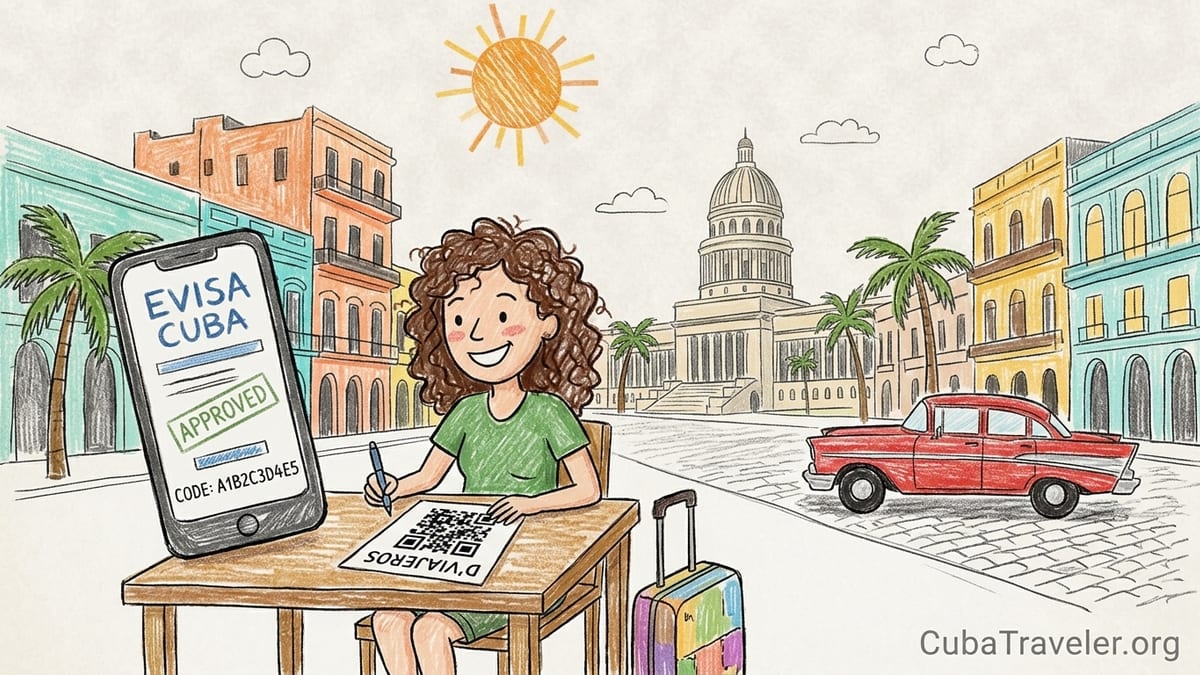
Why I Chose the DIY Route for Cuba’s New eVisa
My trip to Havana was booked for October 5 to October 12, 2026, with a morning flight from Miami International Airport to José Martí International Airport. Once my flights were confirmed, the next question was how to handle the paperwork. For years, information about Cuba had revolved around buying a colored paper tourist card, often pink for flights from the United States, at the airport or through a tour operator. When I started researching in September 2026, I kept seeing references to Cuba’s new eVisa portal instead of those physical cards.
I saw plenty of agencies offering to “handle everything” for 90 to 150 US dollars, promising express approvals and email delivery. At the same time, official information from Cuba’s tourism portal indicated there was now an electronic tourist visa that travelers could obtain directly through evisacuba, as long as they applied through the consulate responsible for their place of residence. The idea of skipping the middleman and dealing directly with the Cuban system appealed to me, especially if it meant having control over the timing and details.
Another factor was that I live in the United States, where travel to Cuba still involves choosing an authorized travel category. Agencies often bundle that step together with visa services, but I already understood my category and had my flights in hand. What I needed was clear, current information about the eVisa process and the D’Viajeros arrival form, plus reassurance that I would not find myself stuck at the departure gate because my paperwork was incomplete.
Ultimately, I decided to apply independently through evisacuba, pay with my own card, and complete D’Viajeros myself. I went into the process aware that my experience would be shaped by my specific dates, airline and nationality, and that nothing online could genuinely guarantee a universal processing time or outcome.
First Contact With eVisacuba: Account, Consulate and Passport Details
I started my eVisa application about three weeks before departure. The evisacuba portal first required me to register with an email address and password, then confirm my email by clicking a one time code. Once inside, the system prompted me to choose my country of nationality and the Cuban consulate that had jurisdiction over my place of residence in the United States. This consular selection step is built directly into the platform and determines where your application is processed and how much you will pay.
After selecting the appropriate consulate, the site moved to the visa application form itself. The layout followed a predictable pattern: personal information, passport details, travel dates and contact information. It asked for my full name as shown on my passport, date and place of birth, gender and current residential address. The passport section required the passport number, issuing country, issue date and expiry date. The system clearly enforced the rule that the passport must be valid for at least six months beyond the planned date of entry to Cuba.
Next came the travel details. I had to input my intended arrival date in Cuba and my planned length of stay. In my case, I entered October 5, 2026, as the entry date and indicated one week for the stay. The form did not ask for the exact flight number at this stage, but it did require me to specify Havana as the port of entry. For contact information, I provided my mobile number and the same email address I used for registration, acknowledging that this would be the channel through which the visa code would be delivered.
There was also a field where I had to upload a digital image of my passport’s biographical page. I used a clear smartphone photo taken in good light, ensuring that all text and the machine readable zone were fully visible. The portal allowed common file formats and gave an immediate on screen confirmation once the file had been successfully attached. Up to that point, the process felt straightforward and comparable to other consular eVisa sites I have used for different countries.
Fees, Payment Method and Receiving the Ten Character Visa Code
Only after completing the personal and passport sections did evisacuba display the applicable fee for my application. Because the cost can vary by consulate and service provider, I will not claim that what I paid is universal, but for my specific consulate in the United States in September 2026, the portal showed a visa fee around the equivalent of 55 to 60 US dollars, expressed in the consulate’s chosen currency. The site also noted an additional service or processing charge. Together, the amounts came to a total that was noticeably lower than the 90 to 150 dollars that third party intermediaries were advertising to US travelers.
The payment page presented several options depending on region, but for me the practical choice was to use a standard international credit card. The portal redirected me to a secure payment gateway with a basic checkout screen: total amount, card number, expiry date, security code and cardholder name. I completed that form using a Visa credit card issued in the United States. The transaction processed without an error message, and within a few seconds the browser window returned me to evisacuba with a confirmation screen showing that my application had been successfully submitted.
Crucially, evisacuba did not instantly generate an approved visa or make any promise that all applications would be turned around in a fixed number of hours. Instead, the portal explained that my request would be processed by the selected consulate and that I would receive an email once a decision was made. In my case, that email arrived the next business day, less than 24 hours after payment, but I consider that my individual outcome rather than a guaranteed standard. The message contained a PDF attachment with my electronic tourist visa and, in the body of the email, a ten character alphanumeric visa code that serves as the reference number.
The PDF showed my name, passport number, nationality, validity dates, and the same ten character code. It explicitly labeled the document as an eVisa for tourism, replacing the familiar colored paper tourist card. From that point on, the visa code became a key piece of information, particularly for the D’Viajeros form, where it is one of the required fields for foreign visitors entering Cuba with an eVisa.
Navigating Conflicting Advice on When to Complete D’Viajeros
Once the eVisa was in hand, I turned to the D’Viajeros form, Cuba’s digital arrival declaration. Researching this turned out to be more confusing than applying for the visa. Official and semi official sources did not agree on how far in advance travelers should submit the form. The United Kingdom’s foreign travel advice for Cuba, updated in 2024, stated that travelers must complete the D’Viajeros online arrival form within 72 hours before entering the country, and that airlines check for completion at check in. German foreign ministry guidance, written in German, instructed travelers to fill out the form within 48 hours before check in for the flight to Cuba, emphasizing that the QR code would be required by the airline representative.
Meanwhile, U.S. focused guidance produced by operators and advisory documents I saw framed D’Viajeros as something that could be done up to seven days before departure. Some American tour providers described completing the form a full week out so that the QR code could be printed at leisure. I also read first hand accounts from recent travelers who had submitted the form three days, two days or even 24 hours before their flights, all apparently without problems. The discrepancy between 48 hours, 72 hours and seven days created understandable anxiety, because the airline’s interpretation on the day of travel is what ultimately matters for boarding.
Faced with competing instructions, I chose a cautious middle ground. My flight from Miami to Havana was scheduled for the morning of October 5, 2026. I decided to complete D’Viajeros two days before, in the early evening of October 3. At that moment, when I logged into the official D’Viajeros portal, the system allowed me to begin and submit a new form without any warning that I was too early. There were no pop up messages or date restrictions blocking travelers who were more than 48 hours from check in or more than 72 hours from arrival.
That practical behavior of the live portal is important. Regardless of what individual foreign ministries recommend in their travel advice, on October 3 the Cuban system itself accepted my information slightly more than 36 hours before my scheduled departure from Miami and roughly 42 hours before my expected arrival in Havana. Within seconds of submitting, I received an email confirmation and a downloadable PDF containing my personalized QR code, which is the proof that the D’Viajeros declaration has been completed.
Step by Step: Filling Out D’Viajeros for Arrival in Havana
The D’Viajeros form is divided into several logical sections, each focused on a different aspect of the traveler’s details. The first section covers personal and passport information. I entered my full name, date and country of birth, nationality and passport number, as well as the passport issue and expiry dates. The form explicitly required me to select United States as my country of nationality and to confirm that the document I was using to travel was a passport, not a national ID card.
The second section related to the trip itself. I provided my arrival date in Cuba, airline, flight number and airport of arrival, selecting Havana’s José Martí International Airport from a drop down menu. The form asked me to specify whether my travel was for tourism, business or another purpose. For travelers from the United States, the D’Viajeros form does not replace the need to comply with U.S. legal categories, but it does require a basic statement of travel purpose for Cuban authorities.
The third section dealt with accommodation information. Because I had booked a private rental in central Havana, I entered the full street address and neighborhood as stated in my reservation. The form allowed me to select the type of accommodation, and I chose private house rather than hotel. There was also a field for a contact phone number in Cuba, which I populated with the host’s number provided in my booking confirmation. This information is used both for immigration and for any necessary health or emergency follow up.
The final parts of D’Viajeros combined customs and health questions. I had to declare whether I was carrying more than a specified amount of cash, commercial goods or restricted items, and whether I was bringing in electronics or other goods that might be subject to customs duties. On the health side, the form asked whether I had any symptoms such as fever or respiratory issues, and whether I had recently been in contact with someone with a serious infectious disease. For each question, I selected yes or no as appropriate. At the end, the system presented a summary screen, including my name, passport number, flight details, accommodation and declarations. After confirming that everything was accurate, I submitted the form and immediately saw a confirmation page with my QR code.
Digital Versus Printed Documents at Miami Check In and Boarding
With both the eVisa and the D’Viajeros QR code in my email inbox, I prepared two sets of documents before leaving for Miami. First, I saved digital copies to my phone: the eVisa PDF and the D’Viajeros PDF, each tagged with an obvious file name. Second, I printed paper copies of both documents, in part because multiple government advisories explicitly recommend having a printed D’Viajeros form in case airport internet access is unreliable. This turned out to be a sensible decision.
At Miami International Airport on October 5, I checked in at the regular counter for my airline rather than using a kiosk. The agent first examined my U.S. passport and asked under which category I was traveling to Cuba, as required by U.S. regulations. After that, she requested proof of my Cuban visa. When I showed her the printed eVisa sheet with my ten character code, she looked at it briefly, verified my name and passport number, and made a notation in the reservation system. There was no requirement to show a colored paper tourist card, and the agent did not mention the older practice of selling pink tourist cards at the gate.
Only after confirming the visa did the agent ask about the D’Viajeros form. She specifically requested to see the QR code and said that it could be presented either on my phone or on paper. To avoid any risk of a slow connection or a dead battery, I handed over the printed D’Viajeros page. She scanned the QR code using a handheld device, watched the screen for a second, then handed the paper back with my boarding pass. There were no follow up questions about my customs or health answers at that point.
At the boarding gate, airline staff conducted a second, quicker document check before allowing passengers to walk down the jet bridge. In my case, they only looked again at my passport and boarding pass and did not ask to rescan the D’Viajeros QR code, suggesting that the initial check at the check in desk was sufficient for them. However, another passenger near me was asked to show his QR code on his phone, which the gate agent glanced at visually rather than scanning. Based on that experience, I would strongly recommend having both digital and printed copies of the QR code ready, because different staff members may have slightly different habits when enforcing the same underlying requirement.
Arrival in Havana: Immigration, Health and Customs
Upon arrival at José Martí International Airport, the plane parked at a jet bridge and we entered the terminal into a relatively quiet immigration hall. The process at Havana was clearly divided into immigration first, followed by baggage claim, then health and customs. At the entrance to the immigration area, a member of the airport staff directed foreign passengers into one queue and Cuban nationals into another. There were no paper arrival cards to fill out; everything depended on the passport, eVisa and D’Viajeros data already submitted.
When it was my turn at the immigration booth, I presented my U.S. passport and the printed eVisa sheet. The officer scanned my passport, looked at his screen and then at the eVisa page, focusing on the ten character visa code and its validity dates. He did not ask to see the D’Viajeros QR code at this stage, and there were no detailed questions about my itinerary or purpose of visit beyond a brief confirmation that I was in Cuba for tourism. After a silent pause while he typed, he stamped my passport with the entry stamp and returned the documents without comment.
From immigration, I walked to the baggage carousel and collected my checked luggage. Before exiting into the public arrivals area, all passengers were funneled toward a set of health and customs checkpoints. Here, the D’Viajeros QR code finally came into use on the Cuban side. A staff member stationed before the customs x ray machines asked each traveler to show the code either on a phone or on paper. I again chose to show the printed copy, which she scanned quickly with a handheld device.
After the QR code was scanned, I was directed toward the customs x ray belts. My bags were placed on the belt, and a customs officer observed them on the screen. Because I had nothing to declare beyond personal belongings and a modest amount of cash, I was waved through without any questions or manual search. No one asked for a paper customs form; the declarations I had made in D’Viajeros served that function. Within minutes, I exited into the arrivals hall. There were no additional interviews, medical checks or forms requested beyond what I have described.
Timeline, Total Cost and Real Troubleshooting
Looking back at the process from a practical perspective, my digital paperwork timeline for this October 2026 trip to Havana looked like this. Approximately three weeks before departure, I registered on evisacuba and completed my eVisa application, including the passport photo upload and payment. Within one business day, I received the approval email with the attached eVisa PDF and the ten character visa code. Two days before my flight, I logged into the D’Viajeros portal, filled in the personal, flight, accommodation, customs and health sections, and submitted the form. The system accepted it at that time and immediately sent me the QR code as a PDF, which I printed that same evening.
In terms of cost, the eVisa fee as charged through my designated consulate was equivalent to roughly the mid double digits in US dollars, plus a small processing charge from the payment gateway. The D’Viajeros form itself was free of charge. Compared with the combined agency packages I had considered at the beginning, which quoted prices close to or above one hundred dollars for handling both the visa and D’Viajeros on my behalf, my do it yourself approach saved a noticeable amount of money while still keeping everything within official channels.
The main troubleshooting issues I encountered were relatively minor but worth noting. First, the evisacuba site occasionally loaded slowly when I tried to access it in the evening from the United States. Refreshing the page or waiting a minute usually resolved it. Second, my initial attempt to upload the passport photo failed because the image file size was larger than the site allowed. I solved that by re taking the photo at a slightly lower resolution and trying again. Third, when filling in D’Viajeros, the accommodation address fields were sensitive to special characters, so I had to remove accent marks from the Havana street name to avoid a validation error.
I did not experience any payment failures on the eVisa platform, nor did I have to contact customer support or an embassy to unblock my application. Likewise, at the airport and on arrival in Cuba, no one questioned the authenticity of my digital documents or asked me to purchase a separate physical tourist card. Even so, I would not extrapolate my lack of problems into a promise that every traveler will have an identical experience. Systems can be updated, airlines can apply rules inconsistently, and individual applications can be subject to additional checks that lengthen processing times beyond what I personally observed.
The Takeaway: What This Means for Travelers Used to Paper Tourist Cards
For years, many travelers associated Cuba with buying a colored paper tourist card, often through a tour operator, airline counter or specialized agency. In my October 2026 trip from Miami to Havana, that familiar ritual never appeared. At every stage, from check in to Cuban immigration and customs, the decisive documents were my passport, the electronically issued eVisa with its ten character code, and the D’Viajeros QR code. No one at the Miami airport tried to sell me a pink card, and Cuban officers at José Martí International Airport relied entirely on electronic data rather than paper slips.
Based on this experience, I think it is increasingly misleading to focus on advice that centers exclusively on buying a physical tourist card in a particular color at a departure airport counter. Travelers planning their own trips now need to be comfortable with two digital processes instead. First, they must either apply for the eVisa directly via evisacuba or ensure that a trusted intermediary has used the same platform on their behalf, resulting in a verifiable electronic visa and code. Second, they must complete the D’Viajeros form within a realistic time window before departure, taking into account both foreign ministry guidance and the practical behavior of the live Cuban portal.
Given the conflicting published advice about whether D’Viajeros should be filled out 48 hours, 72 hours or up to seven days before arrival, my recommendation is to check the current wording on the official Cuban portals shortly before travel and, if in doubt, aim to complete the form one to three days before your departure flight. My own form was accepted a bit more than a day and a half before departure, and the resulting QR code worked smoothly at both the airline counter and Cuban customs. What matters most is that you have the QR code, in both digital and printed form, available whenever an airline agent or Cuban official requests it.
Finally, I would emphasize the importance of redundancy. Before leaving home, I had my eVisa PDF and D’Viajeros PDF saved to my phone, backed up in cloud storage and printed on paper. This redundancy turned what might have been a stressful series of checks into a routine part of check in and arrival. If the current trend continues, future travelers to Cuba will likely hear less and less about colored tourist cards and more about email confirmations, electronic visa files and QR codes. Being prepared for that digital reality is now part of planning a smooth trip to Havana.
FAQ
Q1. When did you actually receive your Cuban eVisa approval?
In my case, I submitted the eVisa application and payment about three weeks before travel and received the approval email with the ten character visa code the next business day. That is simply my experience and not a guaranteed processing time for everyone.
Q2. How much did the eVisa cost compared with using an agency?
The eVisa fee charged through my assigned consulate came to roughly the mid double digits in US dollar terms, plus a modest processing charge. Agencies I considered in the United States were asking close to or above one hundred dollars to handle both visa and D’Viajeros, so applying directly through evisacuba was noticeably cheaper for me.
Q3. Did the D’Viajeros portal stop you from applying more than 48 or 72 hours before arrival?
No. I filled out D’Viajeros on the evening of October 3 for a morning flight on October 5. The official portal accepted my form immediately and generated a QR code, even though various foreign government sites mentioned 48 or 72 hour windows.
Q4. Were digital copies of your documents enough at Miami, or did you need printed versions?
Digital copies would probably have been sufficient, but I was explicitly asked for the D’Viajeros QR code, and it was quicker and more reliable to hand over the printed version. Because airport internet and phone batteries are unpredictable, I strongly recommend carrying paper printouts of both the eVisa and D’Viajeros PDF.
Q5. Did anyone in Miami or Havana ask you to buy a colored paper tourist card?
No. At Miami International Airport, the airline agent only wanted to see my electronic eVisa and the D’Viajeros QR code. In Havana, Cuban officials relied on my eVisa and D’Viajeros data and never mentioned a pink or green tourist card. That suggests that older instructions focused solely on buying colored cards may no longer describe the process I experienced.
Q6. How exactly was the D’Viajeros QR code used on arrival in Havana?
The QR code was not requested at the immigration booth itself. Instead, it was scanned by a staff member positioned before the customs and health area after baggage claim. She scanned the code from my printed page, then directed me to put my bags through the x ray machines. No additional paper customs declaration was required.
Q7. What troubleshooting did you actually have to do during the eVisa process?
The only real issues I faced were a slow loading evisacuba page at one point and an initial passport photo upload that failed because the image file was too large. Reducing the photo resolution and trying again solved the problem. I did not encounter payment failures or have to contact an embassy.
Q8. Can travelers rely on a fixed number of hours for universal eVisa approval?
Based on my experience and the information shown on evisacuba, I would not rely on any promise of universal approval within a set number of hours. My own approval came in less than a day, but that reflects my specific circumstances, consular workload and dates. Travelers should apply with enough buffer time in case their applications take longer.
Q9. Does completing D’Viajeros replace the need for a visa to enter Cuba?
No. D’Viajeros is an advance information, customs and health declaration form that produces a QR code, but it does not replace the requirement for an eVisa or other appropriate entry authorization. At every step I still had to show that I held a valid Cuban visa linked to my passport.
Q10. What is your recommended pre departure checklist based on this trip?
Based on this October 2026 journey, I recommend confirming your eligibility and travel category, applying for the Cuban eVisa through evisacuba well before departure, printing and saving the eVisa PDF and ten character code, completing D’Viajeros one to three days before your flight when the official portal allows it, printing the resulting QR code, and packing paper copies along with digital versions. This reflects the digital reality I encountered, where electronic visas and QR codes have largely replaced earlier practices built around buying colored paper tourist cards.