


Cuba now uses a fully electronic tourist visa system, with a ten-character authorization code that links directly into the mandatory D’Viajeros arrival form. That change has made timing much more important than it was in the paper tourist card era. This guide walks through when to apply for your Cuba eVisa, how to plan 7, 14 and 90-day stays, and what to double-check at each stage from six weeks out to airport check-in, arrival and departure.
How Cuba’s eVisa and D’Viajeros System Works in 2026
Cuba is replacing the traditional paper tourist card with an electronic visa issued through authorized channels and an official portal that Cuban and foreign authorities now reference as the primary way to obtain a tourist visa code. The standard tourist permission is built around a 90-day stay, which can often be extended once for another 90 days through Cuban immigration inside the country, although the exact rule can vary if your nationality has a bilateral agreement with Cuba. In practical terms, most leisure visitors treat 90 days as the upper limit of a continuous stay and plan extensions only if they are already in Cuba and able to visit an immigration office.
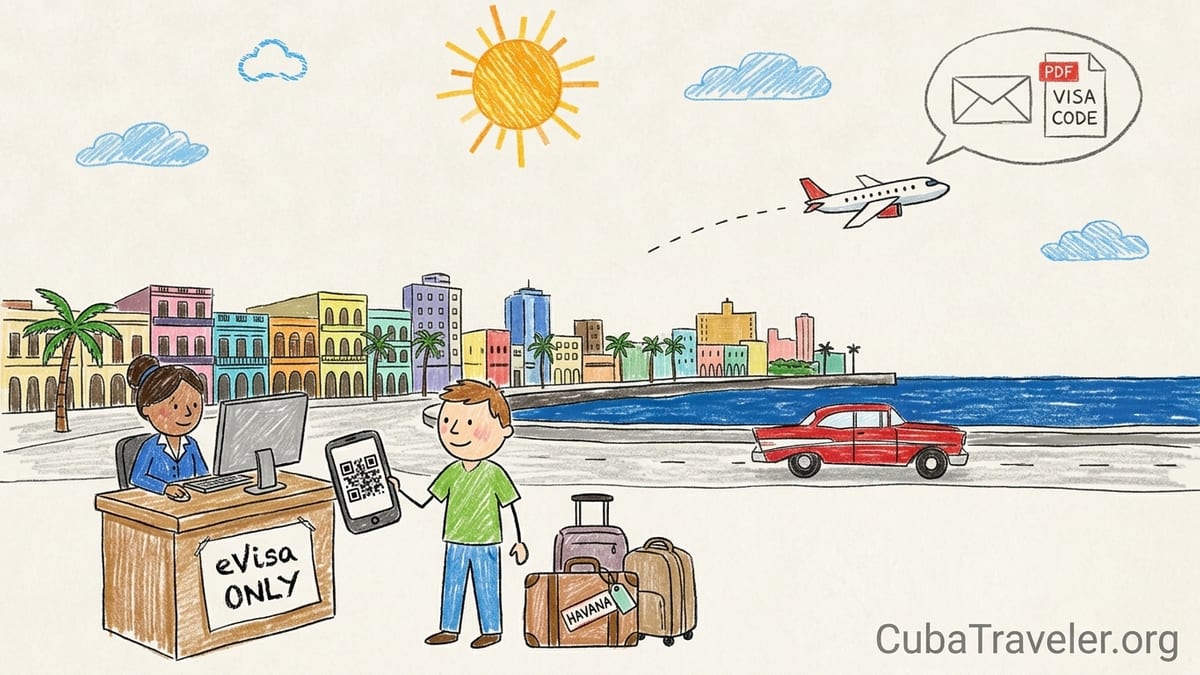
The electronic visa is tied to your passport details and delivered by email as a PDF or confirmation page that shows a ten-character authorization code. Airlines and travel providers describe this code as mandatory for tourists who require a visa. The same code must then be entered into Cuba’s D’Viajeros digital entry form, which generates a QR code that border officials scan at arrival. The physical green or pink tourist cards that were once issued at check-in desks are being phased out, with official Cuban and foreign government sites setting clear sunset dates for their validity between 2024 and 2025.
D’Viajeros itself is a separate online form run by the Cuban transport ministry. It combines general information, health, immigration and customs questions into a single pre-arrival declaration, and several consulates and airlines now state that completion is compulsory rather than optional. After you submit the form, a PDF with a QR code is emailed to you. Travelers report that airlines frequently check for this QR code at departure, not only at Cuban immigration, so treating D’Viajeros as an essential boarding document is the safest approach.
On top of the visa and D’Viajeros requirements, Cuba requires travelers to have medical insurance that covers care in Cuba. Official tourism and consular sites state that you may be asked to show proof of coverage at the border, and that you might be required to buy a Cuban policy at the airport if you arrive uninsured. That makes it important to carry a certificate or email from a recognized insurer in English or Spanish that clearly lists Cuba as a covered destination.
Key Dates: From Six Weeks Out to Airport Check-in
Instead of thinking in terms of rigid deadlines, it is more helpful to treat your Cuba trip as a timeline with a series of checkpoints. Between six and eight weeks before departure, most travelers will still be choosing routes and accommodation. This is the moment to verify whether you actually need a tourist visa or whether you are covered by a visa waiver because of your nationality or residence. Official visa policies list several countries whose citizens may enter without a visa or obtain different categories of permits, while most others are directed to the tourist eVisa. At this early point you should also confirm that your passport will be valid for at least six months after entry, a requirement that appears consistently on consular guidance from European and Latin American governments.
Two to four weeks before departure is usually the optimal time to submit your eVisa application if you are applying online. The official Cuban eVisa portal and airline briefing documents typically describe a processing expectation of around 72 business hours, but that figure is clearly presented as a target rather than a guaranteed turnaround. In busy periods, or if there is a typo in your data, approvals can take longer and you may need to resubmit. Applying at least two weeks ahead gives space to correct errors and to switch to a consulate or airline desk solution if the electronic process stalls.
One week before departure your focus shifts to confirming that the eVisa approval email has arrived and that the ten-character authorization code exactly matches what you will enter into D’Viajeros. Some operators warn that if the code is entered incorrectly, the D’Viajeros system will not accept the form or the QR code generated may be rejected at check-in. This is also the time to recheck your flight reservations, accommodation confirmations in Havana, Varadero, Viñales or Trinidad, and any internal bus or car hire bookings so that the itinerary you enter on D’Viajeros reflects reality.
The final 72 hours before departure are important because this is the window during which many agencies, tour companies and airlines say the D’Viajeros form can and should be completed. There is some variation in unofficial advice, with different operators mentioning 48, 72 or up to 7 days before arrival, but Cuban and foreign guidance consistently state that the form must be completed in the days immediately before travel and not weeks in advance. The safest practical habit is to complete D’Viajeros as soon as the official window opens for your flight, download the PDF with the QR code to your phone and keep a printout in your hand luggage.
Understanding Validity: Issuance Date, First Use and Length of Stay
One of the main sources of confusion with Cuba’s new eVisa system is the difference between receiving the visa electronically, the first date it can be used and the length of stay that immigration will grant when you arrive. Airline documentation and consular leaflets started to note in 2024 and 2025 that the Cuban tourist eVisa is valid for one year and a single entry, meaning that once issued it may be used to enter Cuba at any point within twelve months. However, that one-year utilization window applies only from the official date that the regulation enters into force, which Cuban authorities have linked to the broader rollout of the eVisa from mid-2024. Any commentary that assumes every eVisa already works this way for every traveler is oversimplifying; the precise wording on your approval email and the current rules on the official portal take precedence.
The earliest date you can actually use the eVisa to board a flight is constrained by two things: your own travel plans and any start date specified on the document. In practice, most tourist eVisas for Cuba show an issuance date and a final date of validity, not a specific activation date. If, for example, you receive your eVisa on 1 February 2026 with validity until 31 January 2027, you could in theory use it on any trip to Cuba that starts within that window, as long as you have not already used it for a previous entry. The fact that you received it months earlier does not extend your stay in Cuba; it simply broadens the time in which you may arrive.
The permitted length of stay is a separate concept decided at the border. Under Cuban migration rules and the most recent official summaries, tourists are admitted for 90 natural days on arrival, and the admission stamp in your passport and digital record reflects that period. If you enter on 1 March 2026, the 90 days are counted forward in calendar days, not working days, bringing you to the end of May. Many nationalities then have the option to request an extension of up to another 90 days from Cuban immigration inside the country, although such extensions can depend on up-to-date medical insurance and fees payable in Cuba.
There is also a practical interaction between visa validity and your outbound flight date. Airlines at check-in routinely check that you will not overstay the maximum tourist period. If you hold a return ticket 110 days after arrival and your nationality is normally limited to 90 days without an extension in advance, the airline may refuse to board you or ask for proof of an onward ticket at or before the 90-day point. In a year marked by aviation disruption and rerouted itineraries, it is important to build your trip around the conservative assumption that your first admission will be no more than 90 days unless you have a written confirmation of a longer initial stay.
Scenario 1: Seven-Day Havana–Varadero Holiday
For a one-week stay focused on Havana and Varadero, the main risk is not overstaying the visa but failing to have the right documents ready at boarding. Imagine a Canadian couple flying Toronto to Havana via Montreal for seven nights. Six to eight weeks out, they choose a route that avoids extremely tight connections, for example building in a three-hour layover in Montreal rather than risking a 55-minute change during a winter when North American flights are routinely delayed. Two to four weeks before departure they apply for the Cuban tourist eVisa through an authorized partner that charges a clear, itemized fee, and they receive the approval email within several days.
One week before departure they review the authorization carefully. The names, passport numbers and dates of birth must match their Canadian passports exactly. They then book a Havana guesthouse for four nights and an all-inclusive hotel in Varadero for three nights, making sure both are cancellable for free up to at least 72 hours out. As soon as the D’Viajeros window opens for their inbound flight from Montreal, usually about three days before departure, they complete the form using the ten-character visa codes from the eVisa approvals and the final accommodation address in Varadero for the last night.
At airport check-in the airline staff ask for passports, proof of the eVisa and the D’Viajeros QR codes. Because their trip is only seven days, there is no question of overstaying the 90-day tourist period. However, medical insurance remains essential. They present a PDF from a Canadian insurer that explicitly lists Cuba as covered, along with coverage limits in Canadian dollars. In Havana they keep printed copies of the eVisa and D’Viajeros confirmation in their day packs in case hotel staff or local officials ask to see them, and they leave a buffer of several hours when traveling back from Varadero to Havana airport by pre-booked taxi so that a road delay does not force them to miss their international flight.
If, due to a snowstorm, their outbound Air Canada flight is cancelled and rebooked 48 hours later, the couple’s documents continue to work as long as they are still within the eVisa validity window and they update D’Viajeros with the new arrival time and flight number. Because D’Viajeros can be resubmitted and generates a new QR code, many recent travelers report updating it after schedule changes rather than trying to reuse an old code with mismatched details.
Scenario 2: Fourteen Days Havana–Viñales–Trinidad
A two-week itinerary that includes Havana, the tobacco-growing valley of Viñales and the colonial town of Trinidad introduces more moving parts and more chances for plans to change. Picture a Spanish traveler flying Madrid to Havana on Iberia for 14 nights. They plan three nights in Havana, three in Viñales, two more in Havana, three in Trinidad and three in Havana to finish. Six to eight weeks before departure they verify on the Spanish foreign ministry website that their passport will be valid for at least six months after entry and that they indeed need a tourist eVisa for Cuba in addition to completing D’Viajeros.
Roughly one month before the trip they purchase their eVisa through the official portal or a Spanish tour operator accredited for Cuban visas. The advertised processing time is around 72 business hours, but to avoid relying on that estimate they submit the documents four weeks ahead. Once the eVisa approval arrives by email, they buy long-distance Viazul or independent bus tickets from Havana to Viñales and Trinidad, leaving at least one full day in Havana between the two provincial segments. This buffer allows recovery time if a domestic bus is cancelled or rescheduled.
A week before departure they finalize accommodation: a guesthouse in Havana, a casa particular on a farm near Viñales and a small hotel in Trinidad near Plaza Mayor. They make sure that the bookings are flexible because energy shortages in Cuba have caused occasional water and power cuts that can prompt last-minute hotel changes. With the itinerary set, they complete D’Viajeros inside the permitted window, entering the eVisa code and listing the first Havana address as their point of stay. If they later decide to swap the order of Viñales and Trinidad, they can still enter Cuba using the same eVisa, but it is wise to keep email confirmations of the new bookings in case authorities ask follow-up questions.
During the trip they monitor messages from Iberia and keep an eye on aviation news. In 2026, staffing shortages and aircraft maintenance delays have led to more frequent schedule changes worldwide. If their return flight is pushed back by several days but still falls well inside the 90-day tourist limit, they do not need a new visa, but they might need to extend their medical insurance or confirm that it already covers the longer stay. If the airline instead pulls the flight forward, cutting the trip to 12 nights, there is no visa problem, but they may need to rework internal bus tickets or shorten their time in Trinidad. In either case the eVisa remains valid as long as the entry date does not change and they do not overstay the 90 days.
Scenario 3: Approaching or Exceeding 90 Days in Cuba
Longer stays are common for retirees escaping winter, slow travelers working remotely and students on Spanish courses or cultural programs. Suppose a German traveler plans to spend 85 days in Cuba, mostly in Havana with side trips to Cienfuegos and Santiago de Cuba. Six to eight weeks out they confirm on the German foreign ministry site that they must hold a passport valid for at least six months beyond the planned entry date and that a tourist visa is required unless they have another immigration status. They also confirm that tourists are normally admitted for 90 days on arrival and that a one-time extension is possible in-country, subject to fees and insurance.
Because their planned stay is so close to the 90-day maximum, the timing of flights becomes critical. When booking tickets from Frankfurt to Havana via Paris, they choose a schedule that gives a three-hour connection in Paris in each direction, reducing the chance that a delay on the first leg forces them to rebook onto a later long-haul flight that could shift the entire stay beyond 90 days. Two to four weeks ahead they apply for the eVisa, again not relying on the 72-business-hour target processing figure in case additional security checks are needed for the long duration of stay.
At one week out they recheck that the return flight arrives home before day 90 of their planned stay. If the airline has quietly moved the return from a Tuesday to a Friday to consolidate services, the trip might now total 93 days. In that case the traveler should either bring the departure forward by several days, arrange a side trip to a third country before day 90 or prepare to visit a Cuban immigration office early in the trip to request an extension. Each of these options has different costs and practicalities. For example, flying Havana to Cancun and back in the middle of the trip might solve flight schedule issues, but if the eVisa is strictly single entry then a new visa approval could be required for re-entry.
Travelers who actually want to stay longer than 90 days in one continuous stretch, such as those renting an apartment in Havana for five or six months, need to go a step further. They should consult the latest Cuban migration rules, speak with their nearest Cuban consulate and consider whether a different visa category, such as a student or temporary residence permit, is more appropriate than relying on successive tourist admissions. While many tour operators mention that a tourist stay can be extended to 180 days inside Cuba, that does not necessarily mean that every traveler will be granted an extension automatically. Insurance that covers the entire intended stay, sufficient funds and proof of accommodation are all typically requested.
Scenario 4: Cuba–Mexico or Cuba–Jamaica Side Trips and Re-entry
Multi-country itineraries are where the single-entry nature of most Cuban tourist eVisas becomes especially important. Consider a British traveler who plans to spend ten days in Cuba, then fly from Havana to Cancun for a week, and then return to Havana for another five days before flying back to London. If they assume, based on old tourist card practices, that a single Cuban visa will cover them for a double entry, they could be refused boarding on the return leg from Cancun. Airline and consular documents that describe the current eVisa framework state that it is valid for one year and a single entry, which in plain language means that once you leave Cuba the visa is considered used.
To avoid problems, travelers planning a Cuba–Mexico or Cuba–Jamaica side trip should check with both the Cuban eVisa portal and any accredited visa providers about multiple-entry options. If the official system only issues single-entry tourist eVisas, the safer strategy is to structure the trip so that Cuba is either the first or last country, not both. For example, the British traveler could start with Havana, continue to Cancun and then fly home from Mexico without returning to Cuba. Alternatively, they could fly London to Cancun, then to Havana, and then back to London, entering Cuba once at the end.
Where re-entry is unavoidable, say for a traveler who needs to attend an event in Havana, detour to Kingston for work and then return to Havana, it may be necessary to obtain two separate Cuban visas. In practice that could mean applying for an eVisa to cover the first entry and then arranging a second visa through a consulate or an authorized agency that can issue another approval specifically for the return leg. Because each eVisa is linked to a single entry within its validity year, using one code twice would create a mismatch between airline systems and Cuban immigration records.
The single-entry rule can also affect cruise passengers and those using open-jaw flights. Someone flying Madrid to Havana, cruising to Jamaica and the Cayman Islands and then disembarking again in Havana before flying home needs to be sure that their cruising pattern is compatible with Cuban entry rules. Cruise lines usually coordinate visa arrangements, but independent passengers should still confirm in writing whether the line is providing separate visas for each Cuban call or whether the initial eVisa or group document will remain valid throughout the itinerary.
Handling Flight Changes, New Passports and D’Viajeros Updates
In 2026, widespread aviation disruption has made long connection buffers and flexible bookings more than just a luxury. When flying to Cuba, particularly from North America and Europe where winter storms and air traffic control issues are common, building in at least a two- to three-hour buffer for connections is prudent. For example, a traveler flying Chicago to Havana via Miami might choose a schedule with a mid-afternoon departure from Miami rather than a tightly timed morning flight that leaves no room for delays. If the first leg is late and the second leg must be reticketed for the next day, the traveler will still be within their 90-day window as long as the overall trip length does not exceed the limit.
Whenever flights change, you should treat D’Viajeros as a living document rather than something you fill out once and forget. If your airline moves your flight from a Tuesday to a Wednesday, or swaps the flight number, you can log back into D’Viajeros, update the new details and generate a fresh QR code. Travelers have reported that some airlines require D’Viajeros confirmation at online check-in, so having the latest version is important. The eVisa itself usually does not need to be reissued as long as the entry date remains within its validity period and you have not used it for a previous entry.
Replacing your passport before travel is more complicated because the Cuban eVisa is tied to the passport number used in the application. If your passport is renewed after receiving the eVisa but before the trip, you should check whether the issuing portal or agency can transfer the visa to the new passport number or whether you must apply again. Arriving in Cuba with a new passport and an eVisa that lists an old number could lead to delays or refusal of entry. Travelers who expect their passport to expire soon should consider renewing it well before applying for the Cuban visa, even if that means bringing forward renewal by several months.
Accommodation changes mostly affect the information you enter into D’Viajeros. If you switch from a large hotel in Vedado to a private guesthouse in Old Havana a few days before travel, you do not need a new visa, but you should update the address in the entry form if time allows. During the stay, Cuban authorities rarely insist that tourists update D’Viajeros for every internal move, but keeping booking confirmations handy in case of spot checks is sensible. For medical insurance, if your trip is extended due to flight disruption, contact your insurer before your original policy end date to extend coverage or obtain written confirmation that unplanned extra days are covered.
The Takeaway
Cuba’s shift to a digital tourist visa and mandatory D’Viajeros form has changed the rhythm of trip planning from a last-minute exercise into a multi-stage process. Starting six to eight weeks out, you should confirm whether you need a visa, check that your passport will still be valid at least six months after entry and choose routes with realistic connection buffers. Two to four weeks before departure is the sweet spot for applying for the eVisa without cutting it too close, remembering that the widely quoted 72-business-hour processing time is an estimate, not a promise.
One week out you should have a confirmed eVisa with a clear ten-character authorization code, flexible accommodation booked for at least the first few nights and medical insurance documents ready to show on request. Within the final 72 hours you can complete D’Viajeros, generate your QR code and print or download all confirmations for airport check-in. At every step, keep an eye on itinerary changes, because new flights, new passports and new hotels can all require updates to your paperwork even when the underlying visa remains valid.
Short trips such as a seven-day Havana–Varadero vacation and two-week tours of Havana, Viñales and Trinidad fit comfortably within the standard 90-day tourist stay as long as connections and re-entry issues are managed carefully. Longer stays approaching or exceeding 90 days demand closer attention to admission limits, possible extensions and the interaction between flight schedules and visa rules. Multi-country trips involving Cuba and Mexico or Jamaica make the single-entry character of most eVisas critical, and often work best when Cuba is placed at one end of the itinerary rather than in the middle.
When in doubt, work through a simple decision tree: if your departure is postponed, check that the new dates still fall within the visa’s validity and the 90-day stay limit; if your itinerary changes country sequence, confirm whether a new Cuban visa is required for re-entry; if the visa expires before travel, apply again before booking non-refundable flights; and if you wish to stay beyond 90 days in one stretch, contact Cuban immigration or your nearest consulate about extensions or alternative status. This practical, time-based approach helps keep your focus on the trip itself rather than on the paperwork that makes it possible.
FAQ
Q1. When should I apply for my Cuba tourist eVisa before a trip?
Most travelers are safest applying between two and four weeks before departure. That allows time for processing, corrections and resubmission if needed, without applying so early that travel plans are still uncertain.
Q2. How long can I stay in Cuba on a tourist visa?
Under current rules, tourists are generally admitted for up to 90 natural days on arrival. Many nationalities can request an extension of up to another 90 days inside Cuba, but this is not automatic and may depend on insurance and fees.
Q3. Does receiving an eVisa months before departure extend my time in Cuba?
No. The date you receive the eVisa and the validity window determine when you may enter Cuba, but the length of your stay is set by the admission stamp at the border, usually 90 days from entry.
Q4. Is the Cuban tourist eVisa single entry or multiple entry?
Tourist eVisas are usually issued as single-entry documents. Once you leave Cuba, the visa is considered used, so you should not rely on it for re-entry after a side trip to Mexico or Jamaica unless you have specific confirmation of multiple-entry status.
Q5. When can I fill out the D’Viajeros form?
D’Viajeros is designed to be completed in the final days before travel. Different operators mention windows between 48 hours and seven days before arrival, so the safest strategy is to complete it as soon as the official site allows it for your specific flight.
Q6. What happens if my flight schedule changes after I submit D’Viajeros?
If your flight number or departure date changes, you can log back into D’Viajeros, update the information and generate a new QR code. The underlying eVisa normally remains valid as long as you enter Cuba within its validity period.
Q7. Do I need new documents if I renew my passport before traveling?
Because the eVisa is linked to your passport number, renewing your passport after receiving the eVisa can cause mismatches. You should check whether the issuing portal can transfer the visa to your new passport or whether you must apply again.
Q8. Can I change my accommodation after submitting D’Viajeros?
Yes. You can usually change hotels or guesthouses without affecting your visa, but it is wise to update D’Viajeros if time permits and to keep confirmation emails for your new accommodation in case officials ask for details.
Q9. How does the one-year utilization window for eVisas work?
Cuban authorities have introduced rules under which an electronic tourist visa can be used for a single entry at any time within a one-year validity period, starting from the date the regulation took effect. This window controls when you may enter, not how long you may stay after admission.
Q10. What should I do if I need to stay longer than 90 days?
If you plan to stay close to or beyond 90 days, you should check extension options with Cuban immigration soon after arrival and ensure your medical insurance covers the full period. For stays of several months, it may be more appropriate to seek another visa category through a Cuban consulate before travel.