


When I planned my last trip to Cuba, I was far more worried about check-in paperwork than about mojitos on the Malecón. Friends had been turned away at the airport for tiny issues with their tourist visa, passport validity or the D’Viajeros form, and I was determined not to be that person rebooking flights at the counter. What follows is the precise document set I prepared, how each item was used at check-in and immigration, and the small details that matter if you want to board your flight without drama.
The Exact Document Set I Carried To Cuba
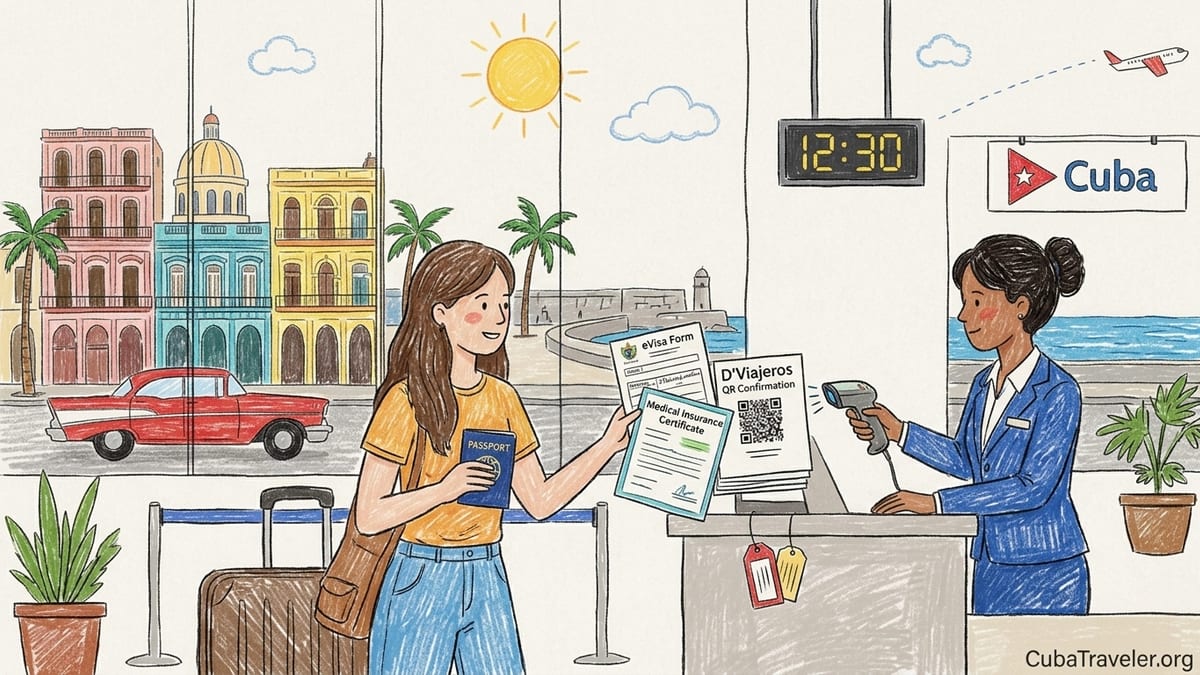
My final Cuba document bundle sounded complicated on paper, but boiled down to a very specific list. Physically in my hand, I carried my passport, a printed copy of my Cuba eVisa, a printout of the email showing my ten-character eVisa authorization code, a printed D’Viajeros QR confirmation, and a paper copy of my return ticket and first two nights of accommodation. In my phone wallet and email, I had the same items stored as PDFs. Separately, I held a certificate from my travel medical insurance showing coverage valid in Cuba, including hospitalization and repatriation.
In terms of format, the passport was obviously physical, but everything else existed in both electronic and printed versions. The eVisa was issued as a PDF attachment that clearly showed my name, passport number and the ten-character authorization code. The D’Viajeros confirmation came as a PDF with a large black-and-white QR code. My airline e-ticket and hotel bookings were accessible in the airline app and booking apps, but I exported them to basic PDFs that could be opened without an internet connection or proprietary apps, then printed them in simple black and white.
Well before the trip, I checked whether my nationality needed any extra documents beyond a standard tourist visa and medical insurance. Some travelers are visa-exempt for short stays, while others must secure an eVisa or physical tourist card in advance, depending on passport and route. Because these rules change often, I confirmed my specific case directly with the Cuban consulate and then cross checked with my airline’s Cuba information page. Only after both matched did I consider my checklist reliable.
By the time I reached departure day, I treated my Cuba paperwork as a layered system. If a QR code failed to load, I had the PDF. If the PDF would not open, I had the printout. If the airline agent questioned a detail, I had the original email from the eVisa platform. That redundancy was what kept the check-in interaction quick and unremarkable instead of stressful and uncertain.
Passport Validity, Damage And Name Issues: What I Confirmed In Advance
The single most confusing part of my preparation was passport validity. Official Cuban tourism information often states that passports should be valid for at least six months from the date of entry. Some foreign governments repeat that six-month recommendation. Others, like the Government of Canada, currently state that Canadian passports must be valid for at least the expected duration of stay in Cuba, without mentioning an extra six-month buffer. Faced with these apparently conflicting statements, I refused to simply assume the more convenient rule would apply at my departure airport.
Instead, I phoned my airline, provided my exact routing and citizenship, and asked what minimum passport validity they were instructed to apply for Cuba. The agent placed me on hold, checked their internal Timatic-based entry requirements system and came back with a clear answer: for my passport and itinerary, they would require at least six months’ validity beyond the date of entry. That was slightly stricter than the Canadian guidance but matched the more conservative interpretation used in many airline systems. I then emailed the airline to get this confirmed in writing, so if a check-in agent later misread the rule, I could reference their own documentation.
While checking validity, I also addressed physical passport condition. Cuban border officers, like those elsewhere, can refuse passports that are torn, water damaged or heavily delaminated, even if they are technically still valid. My passport had a faint coffee mark on the corner of one page from an old trip. To be safe, I visited my country’s passport office and asked whether it could be considered “damaged.” They confirmed it was still acceptable but advised that for any visible tearing, peeling laminate, or pages partially detached from the binding, I should renew before traveling. That guidance matches stories from travelers who were denied boarding with noticeably damaged documents, even though the chip and data page were readable.
Two other scenarios came up while I was preparing. The first was a friend who had recently changed her legal name after marriage. Her airline ticket and Cuba eVisa were issued in her new name, but her passport still showed her birth name. The airline insisted that ticket, visa and passport must all match exactly. She ended up either needing a new passport in the new name or reissuing the ticket and visa in the old name. What mattered in practice was consistency across all documents, not which version of the name was “more recent.” The second involved emergency or temporary passports. Canadian and several other foreign advisories warn that different and sometimes stricter entry rules may apply when traveling to Cuba with temporary or emergency documents. For those, I would not rely on generic online advice at all; the only safe path is a written confirmation from the Cuban consulate plus your airline’s acceptance.
From eVisa Authorization Code To D’Viajeros QR: How The Flow Really Works
The practical heart of the Cuba entry process today is the link between your eVisa and the D’Viajeros digital entry form. My eVisa came as a simple PDF sent by email from an approved visa service. On page one, it listed my full name, nationality, passport number, validity dates and a unique ten-character authorization code. That code, not the PDF itself, was what eventually fed into the D’Viajeros system and told Cuban authorities that my visa was genuine and ready to be activated for entry.
About four days before departure, my airline sent a reminder that completion of the D’Viajeros form was mandatory before check-in. The reminder did not include a link, just the instruction to visit the official platform and select the correct language. Once inside the form, I entered my flight details, personal data and Cuban address, and then reached the section specifically asking for my visa number or authorization code. The ten-character code from my eVisa slotted perfectly into this field. After a final review screen and a sworn declaration confirming that my answers were truthful, I submitted the form and waited for the confirmation email.
Within a few minutes, an email arrived containing a PDF titled with my name and flight date. Opening it, I saw a page dominated by a large black-and-white QR code plus smaller text sections listing my personal details, flight number and destination airport in Cuba. This single QR code represented the completed D’Viajeros form, plus the link to my visa details from the authorization code. I saved the PDF into my phone’s files app, flagged the email, and exported a copy to cloud storage in case my device failed. Then I printed two copies at a local copy shop and tucked them into my passport.
One practical lesson here is timing. D’Viajeros can typically be completed in the days before travel, and some airlines treat it as a requirement to check in online or even at the airport. I chose to complete it 72 hours before departure, early enough to fix any errors but late enough that my flight and accommodation details were final. If I had mistyped my passport number or visa code, I could have resubmitted a new form with the correct data. The system generated a fresh QR code, and I simply kept the latest version and discarded the incorrect printout.
What Airlines Actually Check Versus Cuban Immigration
Arriving at my departure airport three hours ahead of time, I watched the airline’s Cuba process unfold passenger by passenger. At the economy check-in line, the agent requested my passport first, then asked whether I had completed the D’Viajeros form. I handed over my printed QR confirmation. She scanned the QR code with a handheld device, which briefly displayed my details and a green checkmark. Only after that did she ask to see proof of my Cuba visa, which in my case was the printed eVisa showing the ten-character code I had already used in D’Viajeros.
The agent did not keep any of my documents. She simply verified that the passport details matched the D’Viajeros data and that a valid visa existed, and then she focused on standard airline checks: my return ticket, the exact length of my stay, and that my passport validity met the airline’s internal rules. She glanced at my printed hotel confirmation to confirm a local address in Cuba and looked at my travel insurance certificate long enough to see “Cuba” and “emergency medical and repatriation.” Importantly, the airline was less interested in where I bought the insurance and more in the fact that some form of coverage existed.
At Havana immigration, the pattern shifted slightly. Officers there had access to their own systems and were more interested in my passport and D’Viajeros QR than in the printed eVisa. The officer took my passport, looked me in the eye, and asked about the purpose and length of my stay. Then he requested the D’Viajeros QR, which I showed on my phone. He scanned it from behind the glass, compared the screen with my passport details, and stamped my passport with an entry stamp that reflected the initial period authorized by my visa. He did not ask to see printed airline itineraries or hotel vouchers, though I know other travelers, especially those staying in private casas particulares, have occasionally been asked which address they would go to first.
What became obvious from watching other passengers is that the airline is the stricter gatekeeper. Immigration may ask for fewer papers on arrival, but if the airline cannot validate your D’Viajeros submission, confirm your visa, or satisfy themselves that you meet passport validity and return ticket rules, they can and will deny boarding. For that reason, every document that “belongs” to immigration effectively has to be ready for the airline first.
Medical Insurance As A Separate Requirement
Cuba’s authorities have required visitors to hold medical insurance that is valid on Cuban territory since 2010. The official tourism portal and several foreign ministries explicitly list travel insurance with medical coverage as a mandatory entry requirement alongside passports, visas and return tickets. In practice, enforcement can vary, but planning as if you will be asked for proof at both check-in and immigration is the safer strategy.
In my case, I purchased a dedicated travel insurance policy that named Cuba explicitly as a covered destination. The certificate stated three things very clearly: emergency medical coverage in a foreign country, hospitalization costs and medical evacuation or repatriation. I avoided policies that excluded Cuba because of sanctions or advisory levels and confirmed with the insurer’s call center that treatment in Cuban hospitals was included. Some airlines bundle basic Cuban medical coverage into the ticket price, which can appear automatically on your boarding pass or in the fare rules, but I did not rely on that because inclusion varies by carrier and route.
At check-in, the airline agent simply glanced at my printed certificate, checked that the policy dates covered my full trip, and that the country list did not exclude Cuba. On arrival, no one asked for it, but I was ready. Friends who flew through other hubs have reported the reverse experience: minimal questions at departure and a request for proof of insurance from Cuban officials at immigration or when extending their stay at an immigration office. There are also reports of travelers who arrived without any insurance and purchased a local policy from Cuban provider desks near the arrivals area, usually priced in a modest per-day range and valid only during the visit.
The lesson I drew was that medical insurance is best treated as an independent, non-negotiable requirement, separate from the visa or D’Viajeros form. It is not a mere formality. Cuba’s medical system expects foreign visitors to have proof of coverage or the means to pay, especially in private international clinics used for tourists. In a serious emergency, having a policy that covers ground transportation to a suitable hospital, hospital stays and medical evacuation back home can make an enormous financial difference.
Yellow Fever, Children, Dual Nationals And Other Special Cases
For my own itinerary, which connected through a major North American hub directly to Havana, I did not need any yellow fever documentation. Cuba’s concern with yellow fever vaccination certificates typically arises when travelers arrive from, or transit through, countries where yellow fever transmission is present, especially if that transit is long enough to count as entry. Since my route started and stayed in countries without yellow fever risk, there was simply no place in the process that asked about the vaccine. Had I routed through an endemic region, I would have checked whether a World Health Organization yellow card was needed and kept it with my passport.
Traveling with children to Cuba adds a few extra layers, depending on nationality. I was traveling alone on this trip, but ahead of time I asked another family who had flown the same route recently. They carried the child’s passport, a Cuba visa issued in the child’s name, a D’Viajeros form submitted separately for the child, and written consent from the non-traveling parent authorizing the trip. Airline agents were mostly interested in seeing that the child had his own visa and QR code, while Cuban immigration focused on the passport and the fact that the child left and entered Cuba with the same accompanying adult named in the consent letter. Each child, regardless of age, needed their own document set rather than riding on a parent’s forms.
Dual nationals with ties to Cuba face a different situation. Cuba considers many people born in Cuba, or to Cuban parents, as Cuban nationals, even if they now hold a foreign passport. Some advisories warn that such travelers may be required to enter and leave Cuba on a Cuban passport or with documentation proving they have formally renounced Cuban citizenship. At my check-in, I watched an agent redirect a passenger whose foreign passport listed Cuba as place of birth. She was told she needed to clarify her status with the Cuban consulate because airline systems flagged her as potentially subject to Cuban nationality rules. The key for dual nationals is that what matters is not only your current passport but the way Cuban law may still view you.
Emergency travel documents and one-way tickets are also worth mentioning. I met one traveler in line who had lost his passport abroad and was flying on an emergency travel document issued by his embassy. The airline could not find a clear entry for Cuba in their systems under that document type, so they initially refused to check him in until he produced an email from the Cuban consulate explicitly authorizing travel on that emergency document. Likewise, a traveler without a return or onward ticket had to buy a fully refundable return segment at the counter before being issued a boarding pass because airline rules required proof that she would exit Cuba within the allowed stay.
Why Backups Matter: Electronic Versus Printed Copies
On this trip I experienced both sides of the “phones and QR codes are enough” argument. In theory, you can travel with only electronic documents: eVisa in your email, D’Viajeros QR in your phone’s files, boarding passes in airline apps and hotel vouchers in booking apps. In practice, a dying battery, an app that logs you out without connectivity, or a cracked screen at the wrong moment can derail check-in.
My rule for Cuba was simple. If a document was essential to boarding or entry, I carried it in three forms: original email saved offline, PDF stored in a generic file app, and one printed copy in my hand luggage. For the D’Viajeros QR, for instance, I first opened the PDF while still on Wi-Fi and used my phone’s “save to files” function to ensure it was stored locally. Then I renamed the file with my name and the travel date so I could recognize it quickly at the counter. Finally, I printed it in A4 size at a copy shop, which made the code easy to scan even if the check-in agent’s handheld reader struggled with my phone’s brightness or reflections.
The same logic applied to my medical insurance certificate and eVisa. Even though these were technically electronic-only documents, every official or airline staff member who saw the paper version accepted it without complaint. The printouts acted as low-tech, highly reliable fallbacks that removed any chance of getting stuck behind someone trying to reload an email on airport Wi-Fi. Every time I moved between airports, hotels and immigration offices, I kept that thin folder in my personal item, not in checked luggage, so it was always within reach.
Backups were equally important on the return journey. When extending stays or dealing with questions from local authorities, having a printed visa or insurance certificate can shorten conversations that might otherwise be slowed by language barriers or technical issues. In Cuba in particular, where internet access can be slower and less stable, depending entirely on cloud-based storage feels unnecessarily risky.
Check-in Walkthrough, Visa Validation Problems And D’Viajeros Errors
On the morning of departure, I arrived at the airport three hours before my flight, chose the regular economy line and watched what documents each passenger ahead of me was asked for. Consistently, agents requested passports first, then inquired specifically about the Cuba visa or eVisa, and finally about completion of the D’Viajeros form. As I approached the counter, I placed my passport on the desk and waited for the agent’s questions rather than handing over a thick stack of papers unprompted.
She asked, “Have you completed the Cuba D’Viajeros form?” I answered yes and offered the printed QR confirmation. She scanned it, nodded, and asked, “Do you have your visa?” I passed her the printed eVisa PDF. She typed for a moment, likely checking details against the airline’s internal system, then returned it and asked about my return date. Only after I showed my return itinerary did she ask whether I had medical insurance. I presented the printed certificate, which she looked at briefly before handing it back. The entire exchange lasted less than five minutes.
I saw what happened when things went wrong with visa validation for the passenger two places ahead of me. His D’Viajeros QR produced an error on the agent’s handheld device, likely because the visa authorization code entered into the form did not match a valid record. The agent quietly set his passport aside, asked him to step out of line, and called a supervisor. The supervisor explained that without a properly validated visa tied to D’Viajeros, the airline could not board him. They suggested he contact his visa provider via phone or email from the terminal to correct the issue or obtain the correct code, then redo the D’Viajeros form and return with a fresh QR code. In other words, the airline would not take the risk of carrying a passenger whom Cuban authorities might refuse at the border.
If you ever face a D’Viajeros error yourself, the safest response is to avoid sharing personal data loudly at the counter. Instead, step aside, open the D’Viajeros confirmation email and carefully verify the spelling of your name, passport number and visa authorization code. If you spot a mistake, complete a new D’Viajeros form from your own device on the airport Wi-Fi, using the correct code and details. Once you receive a new PDF and QR code by email, test opening it on your phone, then return to the counter with the updated version. If the problem stems from the eVisa itself, call your visa issuer and ask them to re-send the authorization email or confirm the ten-character code verbally while you quietly take notes.
This check-in experience underlined a simple truth about Cuba travel paperwork. Problems are usually caught before boarding, not at Havana immigration. Airlines are cautious because they bear the cost of flying you back if you are refused entry. By preparing a careful document set, double-checking passport validity rules with both the consulate and the airline, keeping physical backups of electronic documents, and knowing how the eVisa code links into D’Viajeros, you give staff every reason to wave you through without drama.
FAQ
Q1. Do I really need both an eVisa and the D’Viajeros QR code to fly to Cuba?
Yes, they serve different purposes. The eVisa or tourist card is your actual permission to enter, while the D’Viajeros form is an advance information and health/customs declaration that generates the QR code airlines and Cuban immigration scan before allowing boarding and entry.
Q2. How far in advance should I complete the D’Viajeros form?
Most airlines suggest completing it within 72 hours of departure so your flight and accommodation details are final. That still gives you time to correct errors and receive a fresh QR code if something was entered incorrectly.
Q3. What happens if my passport has less than six months’ validity when I travel to Cuba?
You need to check with both the Cuban consulate and your airline. Some official guidance focuses on validity for the duration of your stay, while many airlines apply a six-month-from-entry rule in their systems. The airline’s interpretation often controls whether you are allowed to board.
Q4. Can I travel to Cuba with a damaged or very worn passport?
It is risky. Even if the chip and data page are readable, visible tears, peeling laminate or water damage can lead airline staff or Cuban immigration to refuse the document. If in doubt, renew your passport before traveling.
Q5. Do children need their own D’Viajeros forms and visas?
Yes. Each child typically needs an individual passport, visa or tourist card, and a separate D’Viajeros form that generates a unique QR code. Airline agents may also ask for consent letters when only one parent is traveling.
Q6. Is medical insurance for Cuba really mandatory, or just recommended?
Official Cuban information lists medical insurance as a requirement for entry, and several foreign governments repeat this. Enforcement may vary, but you should expect to be asked for proof and plan to have coverage that explicitly includes Cuba, hospitalization and medical evacuation.
Q7. Does my travel insurance automatically cover Cuba?
Not always. Some policies exclude Cuba for regulatory or sanctions reasons. Before traveling, request written confirmation from your insurer that Cuba is covered and that emergency medical treatment and repatriation are included for your dates of travel.
Q8. When is a yellow fever certificate required for Cuba?
Only when your route involves departure from, or significant transit through, a country where yellow fever is present and subject to international health regulations. Direct routes from many North American and European airports usually do not trigger this requirement.
Q9. What if the airline cannot validate my Cuba visa at check-in?
If the airline cannot match your eVisa or tourist card details to their entry rules, they will likely refuse to board you. You may need to contact your visa issuer or the Cuban consulate immediately, correct the problem, obtain a new authorization code and redo the D’Viajeros form before the flight closes.
Q10. How can I correct a mistake in my D’Viajeros form at the airport without exposing sensitive data?
Use your own device on airport Wi-Fi, re-open the official platform, and submit a new form with the correct details. Keep your passport and eVisa visible only to you, then present the new QR code to the airline agent once you receive the updated confirmation email.