


I booked my first Cuba trip in the new eVisa era with a one-way ticket to Havana, a loose plan to wander through Matanzas and Viñales, and exactly one firm night reserved in a casa particular. That seemed fine until I hit the online visa application and D’Viajeros form and realized every blog and Facebook group disagreed about one basic question: do you actually need a hotel booking to get into Cuba, or even to get the visa approved in the first place?
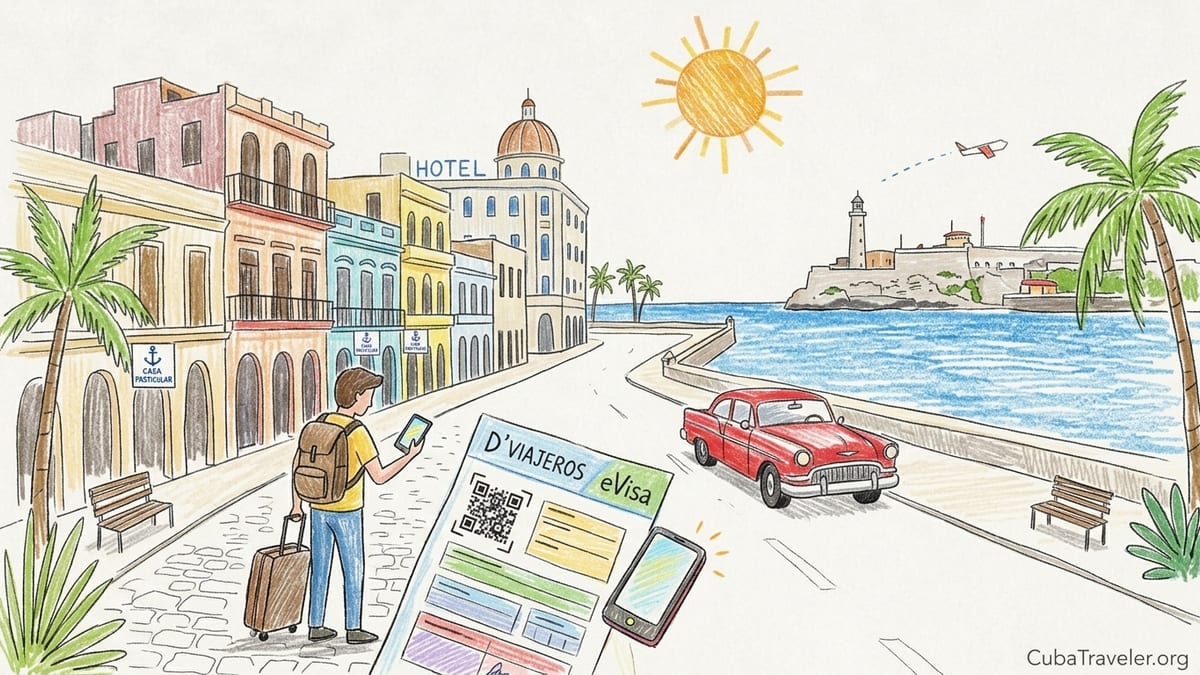
How Cuba’s Entry Process Really Works Today
Since 2025 and into 2026, most visitors arriving from third countries now deal with three separate layers of Cuban formalities: the electronic visa (or tourist card, depending on route), the D’Viajeros advance information form, and whatever an immigration officer may ask you at the booth on arrival. These layers overlap, but they are not identical, and that is where a lot of confusion about hotels and reservations begins.
On paper, Cuban authorities and partner governments describe the basic entry requirements in simple terms: a valid passport, a tourist visa or eVisa, proof of health insurance and a return or onward ticket. Canada’s official travel advice, for example, explicitly lists proof of accommodation as something you may be asked for at the border, alongside proof of funds and onward travel, but it does not say that a fully prepaid hotel stay is mandatory for every traveler or that you must stay in a hotel rather than a private home.
The practical reality at Havana’s José Martí International Airport has been more flexible. In my own checks, airlines and visa agents cared most about whether I had a valid visa number and had completed D’Viajeros. Cuban immigration, in turn, cared that I had somewhere specific to stay that night, whether that was a hotel, a licensed casa particular or a family address. They did not ask to see a printed hotel voucher, but the officer did carefully confirm my accommodation address matched what I had entered online.
This is the key distinction that shapes everything about planning where you will sleep in Cuba: the systems and officers want a verifiable place and contact details for you, not necessarily a big resort booking. You need to be able to show where you will be, rather than prove you prepaid a week at an all inclusive.
The eVisa Application: What You Actually Enter About Accommodation
The newer Cuban eVisa system, used by many travelers connecting through third countries, has replaced the older, colour coded paper tourist card on several routes. Travel agencies and airlines that sell the eVisa walk you through an online form that asks for your personal details, travel dates and an address in Cuba. In my case, the visa agent’s form would not let the application proceed without a full accommodation address that included city and province.
Crucially, the visa interface did not ask me to upload a hotel confirmation or proof of payment. It simply asked where I planned to stay first. I entered my reserved casa particular in central Havana: the street name, building number, municipality of La Habana Vieja and the province of La Habana. The agency cross checked that the address matched a registered rental on their internal list and submitted the application. Within a short time, I received an approved eVisa PDF with that address printed in a generic “place of stay” field.
Other travelers have reported successfully using the address of a friend or relative, a different registered casa particular or even a provincial resort as their initial stay, as long as the details are complete and plausible. The underlying pattern is consistent: the eVisa asks for one concrete starting address, not a complete day by day accommodation plan and not documentary proof that you have paid for everything in advance.
If you are applying in person at a Cuban consulate, staff can be stricter and may want to see a tour booking or hotel reservation as part of an overall package. Several embassies advise that independent travelers bring at least the first night’s confirmed accommodation. But that is a consular policy choice rather than a hard coded national rule that every tourist must be in a hotel rather than a casa particular or private home.
D’Viajeros: How the Digital Form Handles Hotels, Casas and Homes
Once your visa is in hand, the D’Viajeros digital form is the next hurdle. You complete it within the final days before flying, and airlines increasingly require the QR code it generates at check in. Official instructions and airline help sheets clarify that D’Viajeros has a dedicated section for “Place of accommodation,” where you pick a type of lodging and specify where you will be staying on arrival.
When I filled D’Viajeros for a Havana to Cuba flight in early 2026, the accommodation section first asked me to choose a category. The options included hotel and house or room for rent. Selecting hotel brought up a long dropdown list of registered properties, from big names like Hotel Nacional to midrange city hotels and beach resorts. Choosing house or room to rent, by contrast, opened free text fields for address, municipality and province. There was also enough space to add a host’s name and Cuban phone number.
For my first night, I selected house or room to rent and entered the full address of my booked casa particular: “Calle Compostela 312, entre O’Reilly y Obispo, Habana Vieja, La Habana.” I also wrote the registered host’s full name and the mobile number printed on my booking confirmation. The form validated the municipality as La Habana Vieja within the province of La Habana and accepted the entry without asking for an upload of the booking itself.
One important nuance is that D’Viajeros is designed primarily to capture where you will be immediately after arrival. It does not expect you to list every city on a three week itinerary. When I later continued to Matanzas and Viñales, I did not have to update D’Viajeros. At the border, the immigration officer glanced at the QR code, confirmed the Havana address verbally and stamped my passport without asking about the rest of the trip.
What Immigration Can Request at the Border
Arrival experiences still vary from one Cuban airport to another, but recent government and partner country guidance gives a fairly consistent picture of what immigration officers are empowered to ask for at the booth. They may ask for proof of health insurance valid in Cuba, a return or onward ticket, and proof of accommodation for at least the beginning of your stay. Some travelers have also been asked, especially on longer itineraries, to show evidence that they have access to enough funds in cash or on cards for their time in the country.
In my observation and in more recent traveler reports, immigration has focused more on clarity and plausibility than on rigid documents. In Havana, the officer asked a few straightforward questions: where I was staying that night, how long I intended to remain in Cuba, and whether I had insurance. I carried a printed casa particular confirmation and a screenshot of my eSIM policy on my phone. The officer did not ask to see them, though it was clear from his questions that he could have done so if anything sounded vague.
Officials and foreign ministries have signaled that upcoming migration rules will allow Cuban authorities to more routinely request confirmation of hotel or registered private accommodation reservations, proof of funds and onward travel, particularly in response to broader regional migration pressures. However, these powers show up in practice as targeted checks and general discretion, not as an automated system that rejects your entry if you have chosen a casa particular or the home of a friend instead of a major resort.
The most practical takeaway at the border is simple. Have one properly documented place to sleep when you land, and present it confidently. A printed or offline confirmation for a casa particular in Centro Habana, complete with the owner’s name, exact street address, municipality and province, satisfies that expectation in the same way a city hotel voucher would. What causes problems is not choosing a hotel but failing to know exactly where you plan to go after leaving the terminal.
Casas Particulares, Hotels, Resorts and Real Itineraries
Cuba recognizes several types of accommodation for tourists, and they are not treated equally in the systems. International chain hotels and large state run properties, especially in areas like Vedado, Miramar and Varadero, appear in official drop down menus in D’Viajeros. Registered casas particulares operate as licensed private rentals. They are often listed on booking platforms or promoted through local agents, and, importantly, their registration is tied to a precise residential address. Unlicensed informal stays, by contrast, exist in a grey zone that can complicate both insurance and any official questions.
On my first trip under the new eVisa regime, I deliberately mixed a registered casa in Havana, a seaside casa in Santa Marta just outside Varadero, and a few nights in a midrange hotel in Matanzas city. The visa application and D’Viajeros only captured the first Havana casa. At check in for my Havana flight, the airline agent cared that I had completed D’Viajeros and carried my eVisa printout. No one asked to see the later hotel booking for Matanzas or the Varadero area casa particular.
Where the distinction does matter is when authorities or consulates talk about “registered private accommodation.” A legal casa particular has a visible blue anchor sign or another current emblem and is recorded as a rental with the local tax office. If you stay with friends or unlicensed hosts, you will likely write their address into forms as a private home, not as a rental. That is allowed, but you should still be prepared to give full details and understand that authorities are trying to ensure you can be contacted if needed.
Resort hotels in places like Varadero also carry their own wrinkle. Varadero is the name of the beach town and resort cluster on the Hicacos Peninsula, but administratively it falls within Matanzas Province. When D’Viajeros or an eVisa form asks for the province, you would select Matanzas even if the hotel markets itself simply as “Varadero.” Failing to make this distinction can lead to rejected entries and confused airline agents, particularly if your paperwork says Matanzas while your reservation only says Varadero without further detail.
Why Full Addresses, Municipalities and Provinces Matter in Havana
Havana’s layout and administrative geography make it a perfect example of how specific you need to be when entering accommodation details. The city is divided into municipalities such as Habana Vieja, Centro Habana, Plaza de la Revolución, Playa and Diez de Octubre, each with their own local offices and neighborhood structures. Immigration and public health authorities use these divisions when they need to locate travelers, follow up after an incident or respond to emergencies.
When I entered my Havana casa particular on D’Viajeros, I could not simply write “Old Havana apartment near Obispo.” The system required a street name, number, cross streets and the municipality of Habana Vieja. My host’s printed confirmation helped: it showed “Calle Compostela 312, entre O’Reilly y Obispo, Habana Vieja, La Habana, Cuba” plus a mobile phone number. At the border, the officer compared what I said verbally with what he saw tied to my QR code. The match clearly reassured him that this was a registered and reachable address.
I repeated the exercise when planning a later trip starting in Centro Habana. The new casa’s details looked very different on paper despite being only a short walk away: “San Rafael 108, entre Consulado y Prado, Centro Habana, La Habana.” Changing just the neighborhood label would have been incorrect, because Centro Habana is a separate municipality from Habana Vieja. Had I mixed those up, the D’Viajeros system might still have accepted the entry, but any later attempt by authorities to contact me would have been misdirected.
Real world examples in Havana show how even casual sounding address differences matter. A stay in Miramar, which falls under the Playa municipality and is popular for embassies and some higher end casas, would need to be entered as Playa, La Habana Province. Vedado, known for mid century hotels and wide streets, belongs to the Plaza de la Revolución municipality. A hotel labeled “Vedado” in marketing material but actually located across the boundary in Centro Habana should be registered with its true municipality and that is what you should copy into forms, even if it feels overly bureaucratic.
Changing Plans After Visa Approval and Multi City Routes
Few travelers keep their Cuba itinerary frozen from the day they apply for a visa until the day they fly home. Rooms fall through, power cuts affect services, and friends invite you to switch cities. The good news is that, in practical terms, Cuba’s systems have tolerated reasonable changes as long as the information they have at the point of entry remains accurate for your first nights.
On my own trip, I originally applied for the eVisa listing a Havana Vieja casa. Two weeks later, that host wrote to say ongoing power problems in the building were getting worse, and she suggested I move to her cousin’s licensed casa in Centro Habana instead. I kept the original address on the eVisa because it was already issued, but when I completed D’Viajeros I used the new Centro Habana address. At the border, I presented the QR code tied to that new address and told the officer I was staying in Centro Habana. There were no questions about the mismatch with the older eVisa entry.
On a subsequent visit, I started in Havana and then moved on to a resort in Varadero and a few nights in Matanzas city itself. Knowing that Varadero is a destination inside Matanzas Province, I treated the paperwork carefully. I listed my Havana casa on D’Viajeros, because that was where I would sleep on arrival, and kept my later Varadero resort confirmation in print and on my phone. When moving to Matanzas city, I simply carried the details of my hotel there in case anyone local ever needed them. No system required me to log these subsequent moves in advance.
If you completely change your arrival city, for example by rebooking your first nights from Havana to Holguín, it is wise to update both your airline and your D’Viajeros entry before travel. In practice, travelers have been able to refill the form and generate a new QR code with the corrected destination address. The key is to ensure that the accommodation you actually go to after landing matches what you show immigration, even if your original visa application imagined a different first stop.
What you should not do is treat the address fields as a place for fiction. Inventing a hotel booking that you never intend to use, or copying the name of a well known resort just because it appears in a dropdown list, can backfire if an officer asks a follow up question or notices inconsistencies. Cuban authorities are accustomed to flexible travel, but they also expect candour. A real casa particular or a genuine friend’s home is always safer than a made up resort stay.
Staying With Friends or Partners in Cuba
Plenty of visitors stay not in hotels or casas particulares but with Cuban partners, relatives or long standing friends. Cuban rules do not forbid this, but it can be more administratively delicate, because informal hosting intersects with local registration and tax obligations. The critical choice for your paperwork is to describe where you will be in language that is both truthful and clear.
If your host’s home is not a licensed casa particular, then you will usually list the address simply as a private residence. On an eVisa form, that may look like a standard street address and apartment number with the city and province fields completed. On D’Viajeros, you can use the house or room to rent category only if the property is indeed registered as such. When staying at a purely private home, some travelers instead describe the place as a private home in the free text, add the host’s full name and phone number, and be ready to answer straightforward questions like how you know them.
In my own planning, I once split time between a registered casa and my partner’s unlicensed family apartment in the Diez de Octubre municipality of Havana. For entry purposes, I used the casa particular as my official arrival address on D’Viajeros and the eVisa, because that was where I truly planned to sleep for the first stretch. Once I moved to the family home, my connection to the city was already established and my details were known. I still carried the full address and a local phone contact written down, knowing that any serious incident might prompt questions.
What I have never done, and what I do not recommend, is fabricating a hotel booking to make private stays seem tidier on paper. Cuban rules are evolving, and some hosts may prefer that you list a casa particular instead of their family residence. Those conversations should be handled honestly between you and your Cuban contacts. If you decide to present a casa as your address, then you should really stay there at least initially, and the casa should genuinely exist and expect you.
U.S. Travelers, Restricted Lists and “Valid but Prohibited” Hotels
Travelers under United States jurisdiction face an extra layer that sits on top of Cuban entry rules. Cuban immigration does not enforce U.S. sanctions, but the U.S. government prohibits its own citizens and residents from lodging at, paying for or booking certain Cuban properties that are owned or controlled by specific state entities or officials. These properties appear on two related tools: the Cuba Restricted List, which targets entities connected to the security apparatus, and the Cuba Prohibited Accommodations List, which focuses on lodging.
The Prohibited Accommodations List names hundreds of hotels and resorts across Cuba, from heritage properties in Old Havana to large beach complexes in Varadero and beyond. U.S. law, specifically the Cuban Assets Control Regulations, bars people subject to U.S. jurisdiction from staying at or arranging stays in any property on that list. At the same time, many of those same hotels remain entirely legal and even encouraged for Canadians, Europeans and others not bound by U.S. sanctions. A booking can therefore be perfectly valid in Cuban law and still off limits for a U.S. traveler.
This matters when completing eVisa and D’Viajeros forms. A U.S. citizen could, in theory, enter the name of a prohibited Havana hotel that appears in the D’Viajeros dropdown and still pass Cuban checks, because Cuban systems are not judging compliance with U.S. sanctions. The problem arises later if U.S. authorities ever review that person’s Cuba travel under the “Support for the Cuban People” or other general license categories and see that they chose a banned hotel. The safest course for U.S. travelers is to cross check all potential hotels against the latest U.S. Prohibited Accommodations List and restricted entities list before booking.
In 2025 and 2026, several additional hotels were added to U.S. restricted lists, and some long standing properties saw management changes that affected their status. That means a hotel which was acceptable for a 2023 trip may no longer be acceptable now, even though it remains open and bookable. Casas particulares that are privately owned and not tied to government entities generally do not appear on these lists and have become a common accommodation choice for U.S. travelers trying to align their stays with the “Support for the Cuban People” category while still presenting clear, truthful addresses to Cuban authorities.
The Takeaway
Looking across the current Cuban systems and my own experience using them, the reality is more nuanced than the myths. You do not need a fully prepaid hotel booking in a state run resort to obtain a Cuban tourist eVisa, to complete the D’Viajeros form or to be admitted at the border. What you do need is a clear, real world plan for where you will stay at least for your first nights, backed up by a full address, the correct municipality and province, and a phone contact if possible.
Casas particulares, registered private rentals and the homes of friends or partners are all compatible with that expectation, provided you present them accurately. For multi city trips that start in Havana and continue to Varadero, Matanzas or beyond, focus on the first address for D’Viajeros and carry offline copies of later reservations in case anyone asks. Remember that Varadero is a destination nestled within Matanzas Province, not a separate province of its own, and that Havana’s neighborhoods map to specific municipalities like Habana Vieja, Centro Habana and Playa.
If plans change after visa approval, update D’Viajeros with your actual arrival address rather than clinging to an outdated booking, and do not be tempted to invent a hotel or borrow a famous resort’s name just to fill a box. For travelers under U.S. jurisdiction, there is an extra homework step of checking Cuba hotel names against the latest U.S. prohibited accommodation and restricted lists, because Cuban acceptance does not automatically translate to U.S. legality.
Ultimately, Cuba’s documentation demands around accommodation are designed for traceability and basic migration management, not to steer every traveler into a particular kind of lodging. Treat the address fields as a chance to show that you are organized, reachable and honest about your stay. A well chosen casa particular in Havana, a correctly labeled Varadero resort in Matanzas Province or a carefully described family apartment can all satisfy that goal as long as the information you provide matches the trip you actually take.
FAQ
Q1. Do I need a fully prepaid hotel to get a Cuba tourist eVisa?
In most recent cases, you need to provide a concrete address for your first stay, but not proof that you have fully prepaid a hotel. An approved casa particular or a verified private home address has worked where the details are complete and plausible.
Q2. What accommodation details does the D’Viajeros form require?
D’Viajeros asks you to select a type of lodging, such as hotel or house or room to rent, and then give the full address, municipality and province of where you will stay immediately after arrival. A phone contact and host name are useful but not always mandatory.
Q3. Can Cuban immigration ask to see my hotel or casa booking at the border?
Yes, officers are allowed to ask for proof of accommodation, and some travelers have been asked to show confirmations, especially on longer trips. In practice, many are simply asked to confirm their address verbally, but it is safer to carry printed or offline confirmations.
Q4. How are casas particulares treated compared to hotels in the forms?
Casas particulares that are legally registered can be entered using the house or room to rent option, with their full street address and municipality. Hotels and resorts often appear by name in dropdown lists, but both types are acceptable as long as they are genuine, traceable places to stay.
Q5. What if I change my accommodation after my eVisa is approved?
If your first night address changes, you can usually reflect the new address when you fill or refill D’Viajeros before travel and then present that updated QR code on arrival. The important thing is that the address you give immigration matches where you actually plan to sleep on your first nights.
Q6. How should I list Varadero on forms that ask for a province?
Varadero is a resort destination located within Matanzas Province. If your hotel is in Varadero, enter the town or resort name in the address field but select Matanzas as the province and give the closest accurate municipality if asked.
Q7. Can I say I am staying in a hotel if I am actually with friends?
You should not invent a hotel stay you do not intend to use. If you are staying with friends or a partner in a private home, it is better to give that real address and host contact, or to spend your first nights in a registered casa particular and list that casa truthfully.
Q8. What extra rules apply if I am a U.S. citizen or otherwise under U.S. jurisdiction?
You must avoid hotels and other lodgings on the U.S. Cuba Prohibited Accommodations List and be able to explain how your trip fits one of the authorized travel categories. A hotel that is acceptable to Cuban authorities can still be off limits under U.S. sanctions.
Q9. What should I do if my original hotel or casa closes before I arrive?
First secure a new booking or confirmed place to stay, then update your D’Viajeros accommodation details with the new address if time allows. Carry both the original and new confirmations so you can explain the change calmly if any official asks.
Q10. How can I check that my accommodation details are good enough?
Before travel, confirm you have the street name and number, cross streets if available, correct municipality, province and at least one working phone contact. If you read the address aloud to a Cuban taxi driver and they know where to go, it is usually detailed enough for your forms too.