


In early October 2026 I set out to answer what sounds like a simple question: how much does a Cuba tourist visa actually cost now? After several evenings combing through the new consular tariff, talking to agencies and checking real booking quotes in different countries, I discovered that the official fee and the price most travelers pay can be very different numbers.
The New 2026 Consular Tariff: What Cuba Officially Charges
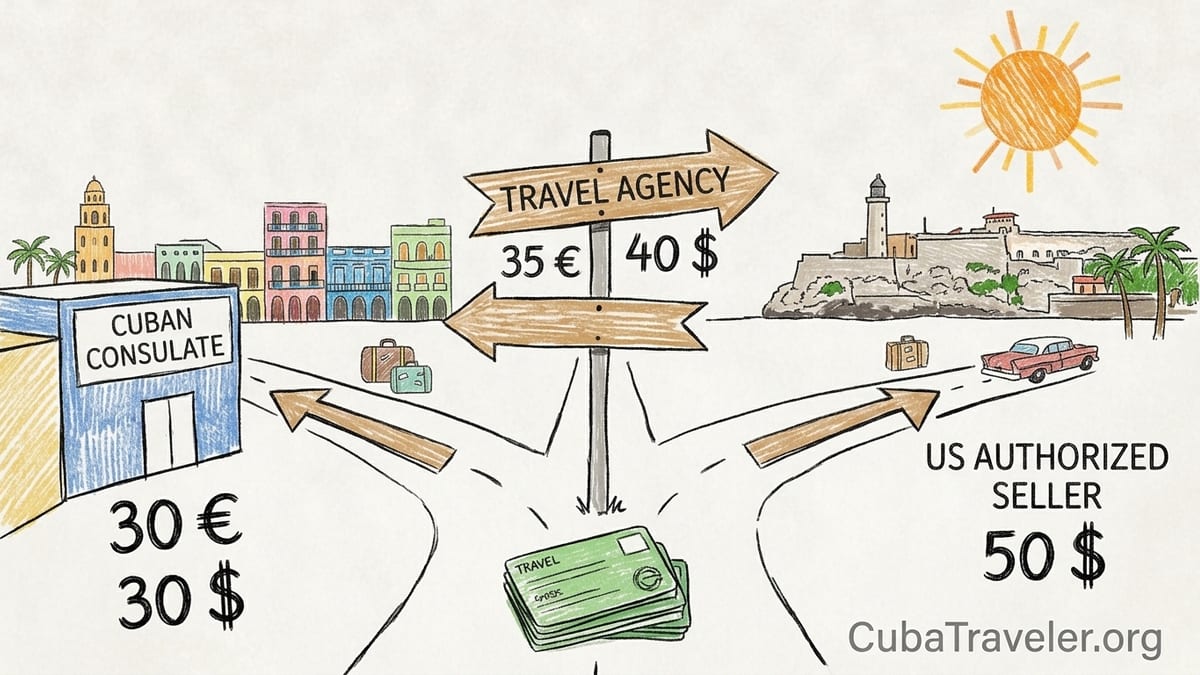
The starting point for any cost investigation in 2026 is Resolution 37/2026 of Cuba’s Ministry of Foreign Affairs, published in the Official Gazette on 30 September 2026 and applied from 1 October. The resolution approved a new consular tariff that, among many other services, sets standardized prices for tourist visas issued abroad. In euro-area countries, the tariff lists a fee of 30 euros for an individual tourist visa sold directly to users. In the rest of the world, the equivalent base fee is 30 US dollars in consular offices that are not part of the special United States arrangement.
The same resolution also confirms a separate price point for the United States. For tourist visas “sold directly to users or through authorized agencies and airlines” in US territory, the tariff is set at 50 US dollars. That higher figure codifies what many US-based travelers had already experienced in practice over the last few years, but it is now expressly written into the consular tariff instead of being just a market outcome.
Alongside those retail figures, the new tariff maintains a distinct wholesale charge for agencies and airlines outside the United States. Several specialist consular information services that track Cuban fees summarize this as 25 euros or 25 US dollars when tourist visas are sold in bulk to intermediaries, compared with the 30 euro or 30 dollar retail price at the counter. In other words, the Cuban government itself gives a small margin to tourism companies that distribute tourist cards on its behalf.
This is where much of the confusion starts. Travelers see 30 on an official consulate table, yet routinely pay 35, 45 or even 80 in their local currency when the card is bundled with flights or sold online. To understand why, it helps to separate the government fee that goes back to Cuba from the various layers of service and convenience fees that intermediaries charge on top.
Government Fee vs Agency Margin: What You Really Pay For
When I looked at Spanish-language consular sites in Madrid and Barcelona in October 2026, the figure was clear: 30 euros for a standard tourist card issued in person to a user at the consulate window. The same fee appears in updated consular tables circulating among Cuban diplomatic missions across the euro area. If you live in a city with a Cuban consulate, have time to go in person during weekday hours and are comfortable dealing with the paperwork yourself, that is as close as you can get to the pure government price.
Step away from the consulate and you immediately encounter the 25 euro or 25 dollar wholesale rate that Cuban rules apply to agencies and airlines. Most travelers never see that number. It appears in internal invoices between the consulate and the intermediary, not on the receipt in your hand. The agency then layers its own service fee, card handling, credit card processing and, often, a margin to cover currency fluctuations.
In practice this means that in the same city you may find three different prices for the exact same green Cuban tourist card. A walk-in Cuban consulate in a euro-zone capital might charge 30 euros. A small Latin American specialist travel agency around the corner could quote 35 or 40 euros because it buys the cards at 25 and needs to cover staff time and rent. A large online visa service that advertises in English might charge the equivalent of 50 or 60 euros once you convert from US dollars, because it has built an “express eVisa platform” on top of what is, behind the scenes, the same consular product.
The United States has its own structure. Under the new tariff, a US traveler buying directly from a Cuban consulate or an authorized US-based agency or airline will see a base government fee of 50 US dollars for the tourist visa. Agencies in the United States do not enjoy the 25 dollar wholesale rate; they pay and pass through the 50 dollar official price, then add whatever handling fee they deem appropriate. This helps explain why US travelers are often quoted figures from 85 to over 100 dollars per person for the “Cuba visa” when booking online, even though the government itself only receives 50.
Method 1: Direct Consulate or Official eVisa Application
To see how the numbers worked in practice, I started with the purest channel: applying through a Cuban consulate or its online system where available. In Madrid, the updated consular information for late 2026 lists a 30 euro fee per person for the standard tourist card, payable in cash or by specified local methods. Similar figures appear in consular schedules referenced by community sites that track Cuban consular fees across Europe. The process is rarely frictionless. Most consulates still require appointments, restricted morning opening hours and, in many cases, a second visit to collect the document.
For a solo traveler based near a consulate, the arithmetic is straightforward. You pay 30 euros and perhaps 5 to 10 euros in public transport or fuel to get there. Your real cost is around 35 to 40 euros, plus your time. For a couple, the consular fee doubles to 60 euros, but the transport cost is shared, so the total might be in the 70 to 80 euro range. A family of four would spend 120 euros in official fees and still only around 10 euros in transport, so perhaps 130 to 135 euros in total. On a strict cash basis, this is almost always the cheapest route.
The trade-off is convenience. I spoke to one family in Germany that had budgeted to visit the Cuban consulate in Berlin from another city, only to discover there were no appointments left in the weeks before their holiday. They ended up using an agency that charged 45 euros per card, including courier delivery both ways, because they simply ran out of time. Cases like this underline that the consular price is optimal only if you have flexible schedules, live in or near a major city and are planning your trip well ahead.
Outside Europe, some Cuban consulates have experimented with semi-digital processes sometimes described by agencies as “eVisa” channels. In essence, these still result in a traditional tourist card, but you submit information and payment online instead of appearing in person. Where these are operated directly by the consulate, the fee is typically anchored around the 30 dollar equivalent laid out in the new tariff, converted into local currency at the official rate. However, payment by international card often involves bank conversion spreads or service charges, so the amount that hits your statement can be a few dollars higher than the bare tariff.
Method 2: Authorized Travel Agencies in Europe and Latin America
The second route I examined was buying the tourist card from authorized brick-and-mortar or online travel agencies outside the United States. In Spain and France, for example, a number of long-established Cuba specialists continue to sell physical tourist cards to independent travelers who are not booking a package. In October 2026, several of these agencies were quoting roughly 35 to 40 euros per card in Spain and 40 to 45 euros in France, inclusive of postage within the country.
On the agency side, the breakdown usually looks like this: the intermediary pays the Cuban consulate around 25 euros per card under the wholesale tariff. It then adds a 5 to 10 euro service charge to cover its staff preparing the application lists, visiting the consulate in bulk, pre-printing the cards, checking for obvious errors and mailing them out. Some agencies also charge a small premium if you want tracked courier shipping or same-week dispatch, on top of the base price.
For a single traveler in Europe, paying 37 euros to an agency instead of 30 at the consulate might feel like an unnecessary extra. But if you live hours away from the nearest Cuban consulate, the picture changes. By the time you factor in train tickets or parking and the value of a lost working day, an extra 7 to 10 euros can be a rational trade. For a couple, the agency total might be 74 euros compared with a pure consular fee of 60 euros, and for a family of four perhaps 148 euros instead of 120. The difference is real but typically far less than the cost of a long trip into a capital city.
In Latin American capitals where Cuba remains a popular destination, similar patterns emerged. Agencies in Mexico City and Bogotá that bundle tourist cards with flights were quoting figures around 35 to 45 US dollars equivalent in local currency in late 2026. Given that the wholesale consular fee they face is approximately 25 dollars, the implied service margin is 10 to 20 dollars per traveler. That covers queueing at the consulate on behalf of dozens of clients, quality checks on passport details and, often, bilingual email support when travelers get nervous about the paperwork.
Method 3: Commercial Online Visa Intermediaries
The widest price dispersion I found was among commercial visa intermediaries that market Cuban tourist cards as an “eVisa” service. These are private companies that position themselves between the traveler and the consulate. A few are long-established firms that work directly with Cuban missions and airlines; others are generic visa platforms that handle applications for multiple countries. When I sampled prices visible to users in Europe and Canada in October 2026, quotes often ranged from around 45 to 80 US dollars for a standard tourist visa outside the United States, and from roughly 90 to 110 dollars for US-based travelers.
Stripping those figures back to the underlying government fee makes the business model clear. Outside the United States, the intermediary typically pays the consulate 25 or 30 dollars per card and then charges the traveler 50 or 60 dollars. The resulting 20 to 30 dollar spread covers several layers of cost: a multi-language website with credit card processing, customer support by email or chat, automated reminders to fill out Cuba’s separate D’Viajeros entry form, and sometimes an optional “priority” or “express” queue for late applications. In some cases, intermediaries add a flat service fee plus a hidden currency conversion mark-up if you pay in a different currency from the one they advertise.
In the United States, visa intermediaries and Cuba-specialist tour operators have to start at the higher official base of 50 dollars per card. Their public prices often land near 95 to 110 dollars once handling and credit card charges are added. One US-focused trip report from 2025 described paying around 80 dollars total through a smaller intermediary that undercut the big airline offers, compared with airline prices roughly 50 dollars higher. Even if individual figures shift over time, the underlying pattern persists in 2026: the more marketing and handholding an intermediary provides, the further you move away from the official consular fee.
It is worth stressing that not all of this spread is unjustified profit. When I looked more closely at terms and conditions, several reputable intermediaries explicitly included live chat access, multi-step email guidance, document storage and, in some cases, limited assistance if a consulate rejects your application due to minor errors. For anxious first-time visitors who are confused by mixed messages about Cuba’s rules, that reassurance can be valuable. The risk lies more in the small print: some sites look almost like official Cuban platforms, use words like “government-approved” in their branding, and still treat all service fees as strictly non-refundable even if you never end up traveling.
Method 4: Canadian Flight and Package Deals with Visa Included
The fourth route I researched was the inclusive model that remains common in Canada, where many charter-style packages to Cuba quietly incorporate the tourist card. Several Canadian tour operators and holiday brands that specialize in Caribbean all-inclusive resorts state in their package information that the tourist card fee is included with the flight or with the package, sometimes with specific exclusions for infants under two. The cost is buried in the overall holiday price rather than itemized as a separate visa line.
This makes it harder to reverse engineer the exact amount being attributed to the tourist visa. However, by comparing similar packages to Cuba and other Caribbean destinations with no visa requirement, travel agents in Toronto and Montreal broadly estimate that operators assume a per-person Cuba visa cost in the 25 to 35 Canadian dollar range at wholesale level. For the traveler, the marginal cost feels like zero because the visa comes in an envelope at the airport check-in desk or is handed out onboard the flight.
For a single Canadian traveler, this bundled approach can be excellent value, provided you are happy with a package-style trip. A couple flying from Toronto to Varadero on a winter charter week might each have their tourist card included in the package price, avoiding any separate administrative task. For a family of four, inclusive packages can be even more efficient. Four individual consular visas bought in advance would translate to around 160 Canadian dollars equivalent at 30 US dollars each, while a package that quietly absorbs the wholesale 25 dollar fee per person spares both the cash outlay up front and the worry of filling in forms.
The main risk with package inclusion is miscommunication. Several Canadian travelers writing about their 2024 and 2025 trips reported being unsure until check-in whether their airline would supply the tourist card, even though the package fine print said it was included. When travelers are nervous, they sometimes buy an extra tourist card online “just in case,” only to find a stack of cards waiting at the gate. By that point, most visa intermediaries will not issue a refund, because from their perspective the card is already printed and valid.
What Intermediary Fees Actually Buy: Service, Speed and Support
Looking across all four methods, three big components emerge on top of Cuba’s official consular fees: agency service charges, priority processing premiums and payment or currency-conversion costs. Understanding these helps you decide whether the extra money is worth it in your situation.
Service charges are the most visible. An agency that handles everything for you is not simply passing on the Cuban government fee. It prepares application batches, queues at the consulate or liaises with its contact there, checks your passport data, prints the card and gets it to you by post. In Europe or Latin America, this often adds 7 to 20 euros or dollars per person. In the United States, where the official fee is higher and regulatory risk is greater, the service component can easily reach 40 or 50 dollars per traveler.
Priority or express processing is the next layer. Several online intermediaries prominently advertise 24- or 48-hour dispatch for late-booking travelers, at a higher price than their standard turnaround. In practice, they are not speeding up the Cuban government decision so much as prioritizing your file in their own queue and using premium courier services. If a basic 50 dollar US fee becomes a 95 dollar “express visa,” roughly half of that total may be the intermediary’s rush margin and shipping.
Finally, payment and conversion costs quietly inflate prices. Very few consulates accept international credit cards directly at the 30 euro or 30 dollar rate set in the tariff. Instead, agencies and intermediaries process card payments through their own merchant accounts. Their advertised prices often include a built-in spread to cover bank interchange fees and currency risk. If you see a service quoting a tourist visa at 60 US dollars but then giving you only a weak exchange rate from euros or pounds, part of what you are paying for is simply the convenience of clicking “pay now” in your own currency.
Common Pitfalls: Double Purchases, D’Viajeros Confusion and Lookalike Sites
During this investigation I was struck by how many travelers pay for more than they need, often because of confusion between different Cuban requirements. One recurring story is the accidental purchase of a second tourist card. A traveler books a Canadian or European package that already includes the visa but is uncertain whether the card will appear at check-in, so they buy another one through an online intermediary a few weeks before departure. At the airport they receive the airline-issued card as part of their packet, and the extra one bought online goes unused.
In most of the terms and conditions I examined, intermediaries make it clear that tourist visas are non-refundable once issued. From their point of view, the card is a numbered migration document that remains valid for entry to Cuba for a defined period, even if you choose not to use it. Unless the intermediary explicitly markets a refund option for duplicate purchases, you are unlikely to recover that second fee. This is one of the strongest arguments for reading your flight or package documentation carefully and, if in doubt, asking your airline whether the tourist card is included before you buy an extra one.
A second, more subtle pitfall involves the D’Viajeros form. D’Viajeros is a mandatory digital entry form run by the Cuban authorities, which all travelers must complete shortly before arrival. Official Cuban tourism and government sites describe it as a free form that generates a QR code you present at boarding and immigration. Despite that, some commercial platforms blur the line by advertising “Cuba eVisa and entry form assistance,” bundling a free D’Viajeros completion guide with a paid tourist card service. A few even charge separate “form support” fees that can look, to a rushed traveler, like a second visa requirement.
The third problem area is lookalike visa websites. When I searched English-language queries such as “Cuba eVisa official” or “Cuba D’Viajeros visa,” many of the top results were commercial intermediaries with official-sounding names and extensive use of Cuban flags and seals in their branding. Some are perfectly legitimate private companies; others appear more opportunistic. The risk is not usually outright fraud but overpaying for a simple document because the site never makes it clear that it is not an official government portal. If you cannot easily find a physical office address and clear explanation of what portion of the fee is the Cuban government charge, you are almost certainly on an intermediary site.
Refunds, Mistakes and Cancellations: How Much Protection Do You Have?
Another area where travelers often misunderstand costs is what happens when plans change or details are wrong. The Cuban consular tariff itself is silent on refunds, and most consulates treat tourist cards in the same way as visas for other countries: once issued, they are normally non-refundable. If you buy directly from a consulate and later cancel your trip, you should not expect to get your 30 euros or 30 dollars back. In the absence of explicit refund language on the consulate’s site, the assumption is that fees are retained to cover administrative work already done.
Commercial agencies follow broadly similar logic, although individual policies vary. Some large online visa platforms have general conditions that allow you to request a partial refund if your application has not yet been submitted to the consulate. Once the tourist card is printed or the consulate has confirmed issuance, however, the fee becomes non-refundable in almost all cases. If you cancel your flight after that point or change destination, the card simply becomes an unused document. Given that many intermediaries submit applications in batches several days or weeks before departure, that “no refund” moment may arrive earlier than you expect.
Incorrect passport details are a more complicated scenario. Cuban border officers expect the tourist card to match the traveler’s passport exactly. If an agency or intermediary makes a typo in your name or passport number, some will reissue the card at their own expense, acknowledging it as their error. If you supplied incorrect information on the form, the responsibility usually lies with you, and any reissue fee can be close to the full original price. Few companies guarantee free corrections after printing, so carefully checking draft documents before final confirmation is one of the easiest cost-saving steps a traveler can take.
Flight cancellations add a further layer of uncertainty. If your airline cancels the flight and rebooks you to a later date, most tourist cards are still valid for a defined window, so you can often reuse the same card. However, if your entire trip is abandoned and you claim a refund from the airline, that reimbursement almost never extends to consular visa costs paid separately. Package tour operators that bundled the visa within a holiday price may handle things differently, sometimes absorbing the visa loss themselves as part of a broader customer-service decision, but they are not usually legally required to do so. The overall pattern is clear: the closer your visa is tied to a specific third-party booking, the more you depend on that company’s goodwill rather than any general rule.
The Takeaway
By the time I finished comparing the 2026 consular tariff with what travelers actually pay, one key conclusion emerged. Cuba’s government has, on paper, simplified its tourist visa pricing to a small set of clear numbers: 30 euros in euro-area consulates, 30 dollars in most other countries, a 25 euro or dollar wholesale rate for agencies outside the United States, and 50 dollars for tourist visas sold directly to users or via authorized sellers in the United States. Yet the real cost to travelers still scatters widely, from around 30 to well over 100 in various currencies, depending on how much convenience and reassurance they buy on top.
For independent travelers who live within easy reach of a Cuban consulate, the most cost-effective and transparent route in late 2026 remains the direct application. A solo traveler in a European capital can usually secure a tourist card for 30 euros plus a small transport cost. A couple pays 60 euros, and a family of four pays 120, all without agency mark-ups. The downside is time: appointments, queues and daytime visits that do not suit everyone.
For those further from consular cities or traveling on tight schedules, a reputable agency can be a rational mid-priced option. An extra 7 to 15 euros or dollars per person is the typical premium over the consular fee in Europe and Latin America, which buys you postal delivery, language support and someone else to stand in line. In the United States, where the official fee is already 50 dollars, the gap between consular price and market price is harder to keep small. Here, the best-value options in 2025 reports tended to be specialist agencies that kept their total around 80 to 90 dollars rather than airline offers closer to 100 or more.
Inclusive Canadian-style packages sit in a category of their own. If you were already planning a resort holiday, having the tourist card silently included in your flight or package can offer the best balance of cost and convenience. It shields you from both consular bureaucracy and the risk of overpaying standalone intermediaries. The main caveat is to confirm in writing that the visa is genuinely included, to avoid buying a duplicate out of uncertainty.
In my own assessment, after weighing official documents, agency quotes and real traveler experiences, the “best” route in 2026 depends less on hunting for the absolute lowest number and more on aligning your choice with your circumstances. If you value saving every possible dollar and can reach a consulate, go direct. If you live far away or dislike administrative chores, pick a transparent agency that clearly separates the Cuban government fee from its service charge and avoids pushing unnecessary extras like paid assistance for the free D’Viajeros form. Above all, before you pay anyone, read your flight or package confirmation to see whether you already have a tourist card included. The cheapest visa is still the one you do not accidentally buy twice.
FAQ
Q1. What is the official Cuba tourist visa fee in 2026?
The new consular tariff that took effect on 1 October 2026 sets a fee of 30 euros for tourist visas issued in euro-area countries, 30 US dollars in most other consulates, and 50 US dollars for tourist visas sold directly to users or through authorized agencies and airlines in the United States.
Q2. Why do some agencies charge much more than 30 or 50 for the same visa?
Agencies and online intermediaries add their own service and handling fees on top of the Cuban government tariff. Outside the United States they often buy tourist cards at a 25 euro or 25 dollar wholesale rate and then add margins for staff time, customer support, postage, payment processing and, sometimes, priority handling. In the United States they start from the higher 50 dollar official fee and layer similar costs on top.
Q3. Is it always cheaper to buy my tourist card at a Cuban consulate?
On a pure cash basis, the consulate is usually the cheapest option, especially in Europe where the tariff is 30 euros. But when you factor in travel to the consulate, time off work and the risk of limited appointments, an agency that charges a modest premium can work out cheaper or at least more practical for travelers who live far from a consular city.
Q4. Do Canadian packages really include the Cuba tourist card?
Many Canadian charter-style packages and some scheduled airline holidays do include the tourist card in the overall price, and operators say so in their package information. In those cases the cost is built into the holiday rather than itemized, and the card is usually handed out at check-in or onboard. It is still important to confirm this with your airline or tour operator before you travel to avoid accidentally buying a second visa.
Q5. Is the D’Viajeros form a paid visa service?
No. D’Viajeros is a free digital entry form run by the Cuban authorities that all travelers must complete shortly before arrival. It generates a QR code required at boarding and immigration, but it is not a visa and does not replace the tourist card. Some intermediaries bundle “help” with D’Viajeros into paid packages, which can give the mistaken impression that the form itself has a fee.
Q6. What happens if my tourist card has a mistake in my name or passport number?
The information on the tourist card should match your passport exactly. If an agency or intermediary made the error, some will issue a corrected card at their own expense. If you supplied the wrong details, you may have to pay for a new card, and intermediaries are not always able to offer discounts. Checking draft documents carefully before they are printed is the best way to avoid extra costs.
Q7. Can I get a refund if I cancel my trip after receiving the visa?
In most cases, no. Cuban consulates generally treat tourist visa fees as non-refundable once the card is issued, and commercial intermediaries adopt similar policies. Some online services will consider partial refunds only if they have not yet submitted your application or printed the card. Package operators that included the visa in a holiday price may make discretionary decisions when a trip is cancelled, but there is rarely a formal right to a visa refund.
Q8. How much more should I expect to pay if I use an online intermediary?
Outside the United States, many online intermediaries charge around 45 to 80 US dollars for a standard tourist visa, compared with an official base of 30. In the United States, where the government fee is 50 dollars, total prices through intermediaries often reach 90 to 110 dollars. The exact premium reflects the level of service, speed and payment convenience on offer.
Q9. Is one tourist card enough for a family, or does everyone need their own?
Every traveler who requires a visa needs their own individual tourist card, including children. When you see package deals or agency quotes, the underlying assumption is usually a per-person card. A family of four, for example, would pay four times the applicable fee, whether that is 30 euros at a consulate, a slightly higher agency rate or a bundled cost in a Canadian package.
Q10. What is the safest approach to avoid overpaying for a Cuba tourist visa?
The safest approach is to check first whether your airline or package already includes the tourist card, then compare the direct consular cost with one or two reputable agencies if you need to buy it yourself. Make sure you understand which part of any quoted price is the Cuban government fee and which part is the agency’s service charge, and remember that the D’Viajeros form is free. If a site looks official but does not clearly explain its role as an intermediary, treat its prices with caution.