


I arrived in Trinidad just after sunrise, when the cobblestones of Plaza Mayor still held the night’s cool and the pastel mansions glowed softly in the first light. Bougainvillea spilled over wrought-iron balconies, a man swept dust from a portico, and the bells of the Iglesia Parroquial de la Santísima Trinidad rang across the square. It was the sort of scene that fills postcards and guidebooks. Yet I had come not only for the beauty, but to understand the darker engine that made this elegance possible: the sugar plantations of the Valle de los Ingenios and the thousands of enslaved Africans whose labor paid for every carved door and marble-floored salon.
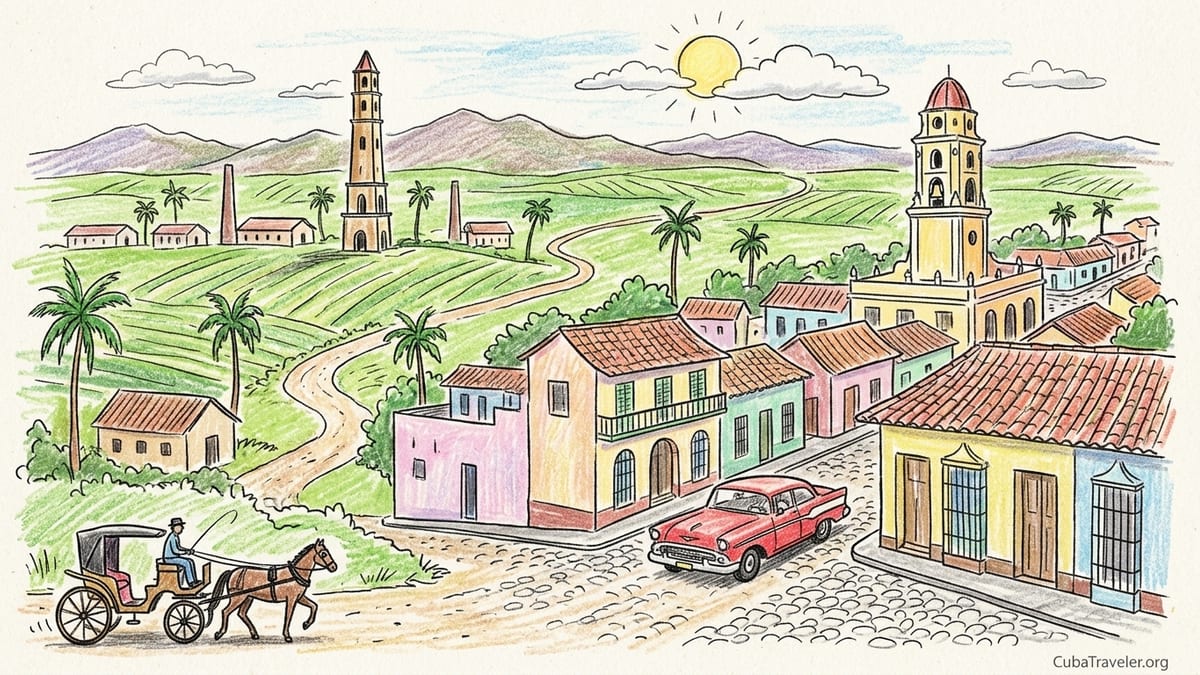
Arriving in Trinidad’s Picture-Perfect Heart
My first steps into Trinidad were over the uneven cobbles that climb toward Plaza Mayor, the historic center that UNESCO inscribed together with the Valley de los Ingenios as a single World Heritage property in 1988. The square is small, framed by low, pastel houses and grand mansions, with clipped hedges and white cast-iron benches in the middle. At a glance, it feels like a self-contained colonial dream, a “museum city” frozen in time. Yet even in this first walk I kept noticing how much of that museum had been paid for in sugar.
On the western side of the square, I paused before the façade of the Palacio Brunet, home to the Museo Romántico. Its ochre walls, tall shuttered windows and wrought-iron grilles announce it as the residence of people who could afford luxury in an era when most of the valley worked under compulsion. According to Cuban and UNESCO documentation, families like the Brunet amassed their fortunes from sugar estates in the valley just east of the town, investing plantation profits in town houses that showed off their status. You cannot separate the elegance of this square from the cane fields outside it.
Across the plaza, the Palacio Cantero rises in pale yellow, anchored by a square tower that looks over the tiled roofs of Trinidad. Today it holds the municipal history museum, but its origins lie with another sugar-rich lineage. Historical records link the property to powerful local families, among them the Sánchez Iznaga clan, whose name also appears out in the Valley at the Manaca Iznaga estate. The physical line between town house and plantation house is not metaphorical. It runs along the road from this square into the valley itself.
From the bench where I sat to drink a small espresso bought from a woman with a thermos and stack of tiny cups, I could see the different layers of the town’s past. A horse-drawn carriage clattered by, a reminder of older transport. The white bell tower of the former convent of San Francisco, now the Museum of the Fight Against Bandits, rose at the end of the street. It was easy to be seduced by how pretty it all looked in the morning light. But I had already decided that before I left Trinidad, I would follow that historical line outward, to see what remained of the plantations that financed these façades.
Inside Palacio Brunet and Palacio Cantero: Sugar Money in Marble and Mahogany
I began my deeper exploration at Palacio Brunet. After paying a modest admission in Cuban pesos at the entrance desk, I stepped into a cool, high-ceilinged hall paved with patterned tiles. The Museo Romántico presents itself primarily as a decorative-arts collection. Glass-fronted cabinets display porcelain imported from Europe, crystal chandeliers hang above inlaid tables, and massive mahogany beds anchor bedrooms that once looked onto the family courtyard. Walking through, it is hard not to feel the intended message: refinement, taste, wealth.
The museum labels, however, only occasionally mention the origin of that wealth. Some panels refer generally to “sugar trade prosperity” in the 18th and 19th centuries and to Trinidad’s boom years when dozens of mills operated in the nearby valley. They do not go into detail about enslaved Africans or name specific estates where the Brunet family held interests. For that, you have to read between the lines and bring outside knowledge. UNESCO’s own statement of significance for Trinidad and the Valley of the Ingenios notes that at the industry’s peak more than fifty sugar mills operated in the valley, and that in 1827 more than 11,000 enslaved people were recorded there. Those figures give scale, but they do not tell you which human stories filled these rooms with furniture and porcelain.
A few blocks away, the Palacio Cantero offered a slightly different emphasis. The ground-floor rooms of the museum cover the history of Trinidad from its foundation in the early 16th century through the sugar boom, wars of independence and revolutionary period. Here, wall panels explicitly reference slavery and the brutal conditions in the mills. One room includes illustrations of cane-cutting gangs and overseers, with concise explanations of how enslaved people were bought, transported and forced to work. Still, the treatment is brief, almost compressed into a single section, while the broader narrative moves quickly on to architecture and political events.
I climbed the wooden steps and then the tighter iron spiral up into the Palacio Cantero tower. From the top, the plaza spread out below: the tiled roofs in rufous waves, the pale curve of church walls, the distant line of the Escambray Mountains. It is a view celebrated in every travel article on Trinidad. Knowing that many of the grand houses in sight were built or expanded during the height of sugar production changed the way I read that panorama. It was no longer just picturesque. It was the material expression of a plantation economy that had pulled wealth from thousands of coerced laborers in the valley beyond.
Understanding Why UNESCO Links Town and Valley
Outside the museums, I sat on another bench in Plaza Mayor and reread the summary of Trinidad’s World Heritage inscription that I had saved on my phone before coming. UNESCO does something important here: it lists the historic center of Trinidad and the Valley de los Ingenios as a single property, not two separate sites. The explanation is clear. The organization describes Trinidad as an exemplary colonial city whose existence and built environment are “shaped by the region’s 18th- and 19th-century sugar industry.” The valley, in turn, is presented as a living museum that preserves the remains of about 75 former sugar mills, plantation houses, barracks and industrial structures that together testify to that industry and the slavery bound up with it.
That figure of 75 sites does not mean that 75 full mills still stand with chimneys and machinery intact. Many are partial: foundations, scattered bricks, an isolated tower, a few walls, or the footprint of former barracks. Nor does the count of more than 11,000 enslaved people recorded in 1827 capture everyone who ever labored there. Those numbers come from official enumerations that often undercounted or ignored the humanity behind the statistics. Enslaved children, people who died before being registered, and individuals moved between estates can be invisible in the surviving records. The numbers give a sense of scale, but not of the daily fear, resistance and survival that filled the valley.
Still, seeing those figures in an official heritage document matters because it anchors the pretty streets around me in something real. Without the valley, Trinidad might have remained a modest coastal settlement. With sugar, it blossomed into a town dense with churches, mansions and civic buildings. The same text that praises its architecture also insists that this wealth had a human cost. That framing encouraged me to make what became the key transition of my trip: leaving the plaza behind and traveling east, into the Valley de los Ingenios itself.
From Cobblestones to Cane Fields: Reaching the Valley in a Fuel Crisis
Planning that journey in 2026 meant thinking not only about historical routes but also about Cuba’s present-day fuel emergency. The country has faced a prolonged shortage of diesel and gasoline as oil supplies have fallen and shipments from traditional partners became less reliable. News agencies have reported how the government has drastically restricted state-run intercity transport, while fuel on the informal market can reach several US dollars per liter, far beyond what most Cubans earn in a day. For visitors, this translates into fewer buses, long queues at petrol stations and higher prices for taxis and day trips.
Before the current crisis, many travelers reached the valley using a heritage diesel train that runs from Trinidad’s small station out toward estates like Guaímaro, or by booking a classic-car taxi for a few hours. Official tourism information still lists the tourist train and notes panoramic schedules, but on the ground services can be irregular, or suspended for days when fuel or spare parts are lacking. Several local guides I spoke with in Trinidad advised me not to rely solely on the train in 2026. Instead, they recommended combining whatever transport is currently running with more modest, flexible options such as shared taxis and, where safe, walking between closer sites.
I ended up arranging a half-day excursion through my casa particular, pooling with two other guests to make the price bearable. Our driver, using a modern sedan rather than one of the iconic 1950s American cars, explained that his company had secured access to imported fuel, a strategy that has allowed some organized private taxi services to continue operating even while state buses are cut back. It was significantly more expensive than pre-crisis rates, but still one of the only reliable ways to reach the valley and get back in the same day.
As we left Trinidad, the cobbles gave way to a paved road lined with modest houses and small farm plots. The air grew hotter as the sun climbed. Within half an hour, the town’s bell towers receded and flat fields opened up on each side, dotted with scattered palms and the occasional chimney stump. My guide pointed toward one abandoned structure and said it had once been part of an ingenio, a sugar mill complex. The ride itself became part of the story. Historically, carts pulled by oxen and horse-drawn wagons would have followed similar paths, carrying cane inward and luxury goods outward. Today, visitors move along these roads in fuel-hungry cars whose scarcity is reshaping tourism.
Manaca Iznaga: Looking Past the Landmark Tower
Our first major stop was Manaca Iznaga, arguably the most well-known surviving plantation site in the Valley de los Ingenios. Approaching from the road, the 45-meter tower dominates the scene, its pale vertical shaft marked by a series of arched openings. Around it lie the remains of the estate: a big house that now functions as a restaurant and craft market, and low buildings that once formed part of the ingenio complex. Tour buses used to line up here in more predictable seasons. On the day I visited, only a handful of vehicles sat in the dusty parking area, a sign of how the fuel crisis and broader economic difficulties have thinned visitor numbers.
Most guidebooks repeat a powerful but simplified story about the tower: that it was built solely to monitor enslaved workers in the surrounding cane fields. Enslaved people were certainly subject to close surveillance, and bells could call them to work or signal punishments. But historians have pointed out that towers like this also had other functions. They provided a lookout for fires in the cane, which could devastate crops and buildings, and they allowed overseers to observe the progress of work spread across the landscape. The bell that once hung at the top would have marked shifts, mealtimes and emergencies. So while control was integral to its design, the tower was part of a broader management and industrial system, not a one-note watchtower in the modern cinematic sense.
Climbing the tower required a small additional fee paid to a caretaker at the base. The spiral staircases are steep and worn, and in the midday heat the interior felt like a vertical oven. As I ascended, pausing at each level to catch my breath, I thought about who would once have made this climb. Plantation owners and overseers, certainly. Perhaps some enslaved workers sent up to ring the bell. The view from the top, when I finally emerged into the glaring light, unfurled the valley in all directions: patched green fields, a scatter of trees, distant lines of hills. It was beautiful and unsettling at the same time, precisely because I knew that this vista once helped coordinate a system built on coerced labor.
Back at ground level, I walked past the former slave barracks, now used for small souvenir stalls. Unlike in town, where museum labels tend to be discreet, several information boards here reference slavery directly. One panel explains that the Iznaga family were among the largest slave owners in the region, and that work days in the cane fields could stretch long into the night during harvest. The texts are short, and they still focus more on dates and ownership than on personal stories, but they do not entirely gloss over the violence that underpinned the estate’s prosperity. That balance matters. It prevents the site from becoming just a photogenic backdrop while still leaving room for deeper interpretation that, for now, visitors must seek in books and external research.
Traces of Sugar Mills and What the Ruins Can (and Cannot) Say
From Manaca Iznaga, our driver took us slowly along the valley road, stopping at publicly accessible spots where traces of other mills remain. At one point we pulled over by a tall, cylindrical chimney rising alone from a mat of grass. Nearby, low stone foundations marked the footprint of the mill buildings. There were no ticket booths or guards here, just a simple sign indicating the name of the former ingenio. I stepped carefully among the stones, aware that this quiet ruin once throbbed with the grinding of cane crushers and the hiss of boiling juice in iron cauldrons.
These scattered remains are part of the roughly 75 mill and plantation sites cited in UNESCO documentation. Some, like Manaca Iznaga, have been partially restored and integrated into the tourism economy. Others linger as archaeological sites, visited mostly by locals, school groups or the occasional traveler with a car and time to explore. They testify to the industrial scale of sugar production, but on their own they reveal little about the daily lives of the people who lived and worked here. Rusted machinery and crumbling walls do not easily tell stories about families separated by sale, acts of resistance, or the rhythms of songs sung in African languages while cutting cane.
Because I only had a half day and because of fuel constraints, I did not make it to more remote estates such as San Isidro de los Destiladeros, which lies further up a side valley and is often visited on specialized heritage tours when transport is available. Responsible writing requires acknowledging those limits. I cannot describe buildings or restoration work I did not see with my own eyes. What I can say is that the more sites you visit, the more you understand how completely the valley was once filled with sugar infrastructure. That density, rather than any single chimney, is what gives weight to those figures from the 1820s.
As the afternoon heat intensified, we stopped at a roadside café near one of the more accessible ruins. The menu was short: strong coffee, bottled water, a few simple sandwiches and seasonal fruit juice. Here, too, Cuba’s current economic difficulties were visible. The owner explained that deliveries of some ingredients had become unreliable and that he sometimes closed early when he could not get enough fuel to power his small generator during blackouts. Yet he still welcomed the few tourists who made it out, because every cup of coffee sold helped bridge gaps in household income left by the decline in mass tourism.
Returning to Trinidad: Seeing the Streets Differently
By the time we drove back toward Trinidad, the light had softened and a thin haze hung over the valley. Entering the town again, we passed through newer neighborhoods before rejoining the cobbled streets of the historic center. The same pastel façades I had admired that morning now looked altered, as if a new, sharper layer had been added to their colors. I knew that the money that paid for thick doors of imported hardwood, elaborate ironwork and Italian floor tiles had come from the profits squeezed out of valley estates like the ones I had just visited.
That awareness changed how I experienced even simple pleasures. The cool interior of a restored café near Plaza Mayor, with its high ceilings and vintage photographs, felt less like a neutral aesthetic and more like a repurposed social space shaped by a visibly unequal past. When I visited the church again, I noticed the silver and gilded elements on the altars and wondered which harvests had paid for them. The sound of a troubadour’s guitar in a side street mingled with the knowledge that Afro-Cuban cultural forms brought by enslaved people had, over time, transformed the town’s music and religious practices even as official histories often centered European lineages.
Back in my room at the casa particular, I talked with my host about the day. She spoke frankly about how Trinidad’s identity as a heritage destination cuts both ways. On the one hand, it brings vital income in a period when the country is struggling with shortages of fuel, electricity and imported goods. On the other, it sometimes encourages visitors to focus only on surface beauty, or to see the valley as just another excursion. For her, the challenge is to keep telling guests that the story of those cobblestones runs from Africa through the cane fields to the doorsteps of the mansions around Plaza Mayor.
That conversation lingered with me as I walked one last loop around the square after dinner. Streetlights cast a golden wash over the façades. A group of teenagers laughed on the church steps, and a few tourists drifted between live-music venues. The town looked peaceful, almost suspended. Yet now I could imagine the very different sounds that once filled these streets when the mills ran at full tilt and enslaved workers passed through town under guard, or when rebellions and wars shook the sugar economy. Understanding the valley had not made Trinidad less lovely. It had made it more honest.
A Practical Half-Day Route Linking Town and Valley Today
For travelers who want to follow a similar path in 2026, combining the historic town and the Valley de los Ingenios in a thoughtful way is still possible, but it requires flexibility because of Cuba’s ongoing fuel crisis. The outline that follows reflects both the historic logic of the landscape and the actual conditions I encountered or confirmed with local guides, rather than an idealized pre-crisis itinerary.
Start early in Trinidad. Spend your first hour around Plaza Mayor while the light is soft and temperatures are manageable. Visit Palacio Brunet and Palacio Cantero as soon as they open, budgeting at least 45 minutes for each. Let the rooms and displays give you a sense of how plantation wealth materialized in urban form. Climb the tower of Palacio Cantero for a view that helps orient you toward the valley you will visit later in the morning.
Before leaving town, arrange your transport. In 2026, the most reliable option for a half-day circuit is to book a private taxi or small-group excursion through your casa particular or a local agency that has secured access to fuel. Expect to pay significantly more than pre-crisis rates, and confirm in advance that the driver has enough fuel not just for the outbound leg but also for the return. If the heritage tourist train is operating during your visit, you can consider it as a scenic alternative for part of the route, but treat any schedule as provisional rather than guaranteed, and be prepared to adapt if services are suspended due to fuel or maintenance problems.
Once on the road, aim first for Manaca Iznaga, which lies roughly a half hour from Trinidad by car when traffic is light and fuel shortages have not closed sections of road. There you can visit the main house, walk through the grounds, and, if conditions allow, climb the tower for a view of the valley. Take time to read the on-site panels about slavery, however brief, and to reflect on the broader context provided by UNESCO and historical scholarship. If your driver agrees and fuel allows, stop at one or two additional publicly accessible mill sites on the way back, where chimneys and low ruins illustrate just how many ingenios once dotted this landscape.
Return to Trinidad by early or mid-afternoon to avoid getting stranded by evening fuel distribution problems. Back in town, use your remaining hours to revisit Plaza Mayor with new eyes. Sit on a bench, look up at the balconies of Palacio Brunet and Palacio Cantero, and imagine the valley you have just seen feeding wealth into those buildings. That mental link between town and valley is the core of what UNESCO recognized when it designated Trinidad and the Valle de los Ingenios together. In a period when fuel shortages are visibly reshaping travel, choosing even a modest, carefully planned outing like this can still honor that connection while respecting the realities faced by local residents.
FAQ
Q1. Why does UNESCO treat Trinidad and the Valley de los Ingenios as one site?
UNESCO considers Trinidad’s historic center and the Valley de los Ingenios a single World Heritage property because the town’s preserved architecture and the valley’s plantation remains are two sides of the same sugar economy. The mansions and churches around Plaza Mayor were financed by profits from sugar mills and enslaved labor in the valley, while the valley’s industrial ruins make little sense without the urban elite who directed and spent that wealth.
Q2. How many sugar mills and enslaved people once operated in the valley?
Historical and UNESCO documentation notes that at the industry’s peak more than fifty sugar mills were active in the Valley de los Ingenios, and that in 1827 records mention over 11,000 enslaved people working there. Other Cuban sources refer to roughly 75 former mill and plantation sites when you include chimneys, house remains and barracks. These numbers indicate scale but do not capture every individual or site, since historical records were incomplete and often minimized the human reality behind the statistics.
Q3. What is the best way to reach the Valley de los Ingenios from Trinidad in 2026?
Because of Cuba’s current fuel crisis and restrictions on state-run transport, the most reliable way in 2026 is to arrange a private taxi or small-group excursion through your accommodation or a local agency that has assured fuel supplies. A heritage tourist train sometimes runs from Trinidad toward the valley, but services can be irregular or reduced, so it is safer to treat it as an optional extra rather than your only plan. Always confirm schedules locally just before your trip.
Q4. What should I know about visiting the Manaca Iznaga tower?
At Manaca Iznaga you pay a small fee to access the estate and an extra fee to climb the tower. The staircases are steep and it can be very hot inside, so bring water and take your time. The tower once housed a bell used to mark work rhythms, mealtimes and emergencies on the plantation, and it gave overseers a vantage point over fields and buildings. It is important to see it not just as a scenic viewpoint, but as part of a system that organized and controlled enslaved labor.
Q5. Are there clear explanations about slavery in Trinidad’s museums?
Trinidad’s museums vary in how directly they address slavery. Palacio Cantero, the municipal history museum, includes panels that mention enslaved people and describe the sugar economy, but the coverage is concise. Palacio Brunet, home to the Museo Romántico, focuses more on decorative arts and the lifestyle of wealthy families, with only brief references to the origins of their wealth. Visitors who want deeper context should supplement museum information with independent reading or guided tours that center the experiences of enslaved Africans.
Q6. Can I visit other plantation sites like San Isidro de los Destiladeros on a short trip?
Some more remote estates, including San Isidro de los Destiladeros, are accessible on specialized heritage excursions when transport is available, but they are harder to include in a simple half-day outing, especially under current fuel constraints. If you have limited time or are traveling during a period of acute shortages, it is more realistic to focus on closer sites such as Manaca Iznaga and a few roadside ruins, and to plan a longer dedicated day with a reliable driver if you want to explore further.
Q7. How is the fuel crisis affecting daily life and tourism in Trinidad?
Cuba’s fuel crisis has reduced state-run bus services, increased blackouts and pushed up the cost of transport for residents and visitors alike. In Trinidad this means fewer day-trippers, smaller crowds at popular sites, and higher prices for taxis and organized excursions. Many locals working in tourism have seen their incomes fall as visitor numbers drop, even as their own transport and food costs rise. Travelers need to budget extra for transport, stay flexible and recognize that some services may be curtailed at short notice.
Q8. What should I wear and bring for a town-and-valley heritage day?
For a combined visit to Trinidad’s historic center and the Valley de los Ingenios, wear light, breathable clothing, sturdy sandals or shoes suitable for cobblestones and uneven ground, and a hat for sun protection. Carry plenty of water, sunscreen and some snacks, since food options in the valley can be limited or run out early. A small amount of cash in local currency is useful for museum admissions, tower fees and small purchases at roadside cafés or craft stalls.
Q9. Where is a good place to stay to explore both the town and valley?
Staying in a casa particular within walking distance of Plaza Mayor works well if you want to explore Trinidad’s historic center on foot and arrange early departures into the valley. These family-run guesthouses can help organize taxis or small-group excursions and often provide breakfast, which is useful when shops face intermittent shortages. Larger hotels on the outskirts or near the coast may have more stable power and services, but you will rely more on taxis to reach the old town.
Q10. How can I explore Trinidad’s beauty responsibly, given its history?
Responsible visitors can acknowledge the role of slavery and sugar in creating Trinidad’s architectural charm by seeking out historical context, reading museum panels carefully, and asking guides about the experiences of enslaved Africans, not only about elite families. Choosing locally owned accommodations and services, being patient with shortages, and treating places like Manaca Iznaga as sites of memory rather than just photo stops are concrete ways to honor both the town’s beauty and the difficult history beneath it.