


I arrived in Viñales with the slightly dusty feeling that comes from a Cuban highway in the dry season and a head full of clichés about cigars. By the end of the day, walking back into the low-rise village with red earth on my shoes, I understood that the valley’s famous tobacco is less about smoke than it is about soil, patience and people whose lives are tied to one demanding crop.
Arriving in the Valley of Mogotes and Red Earth
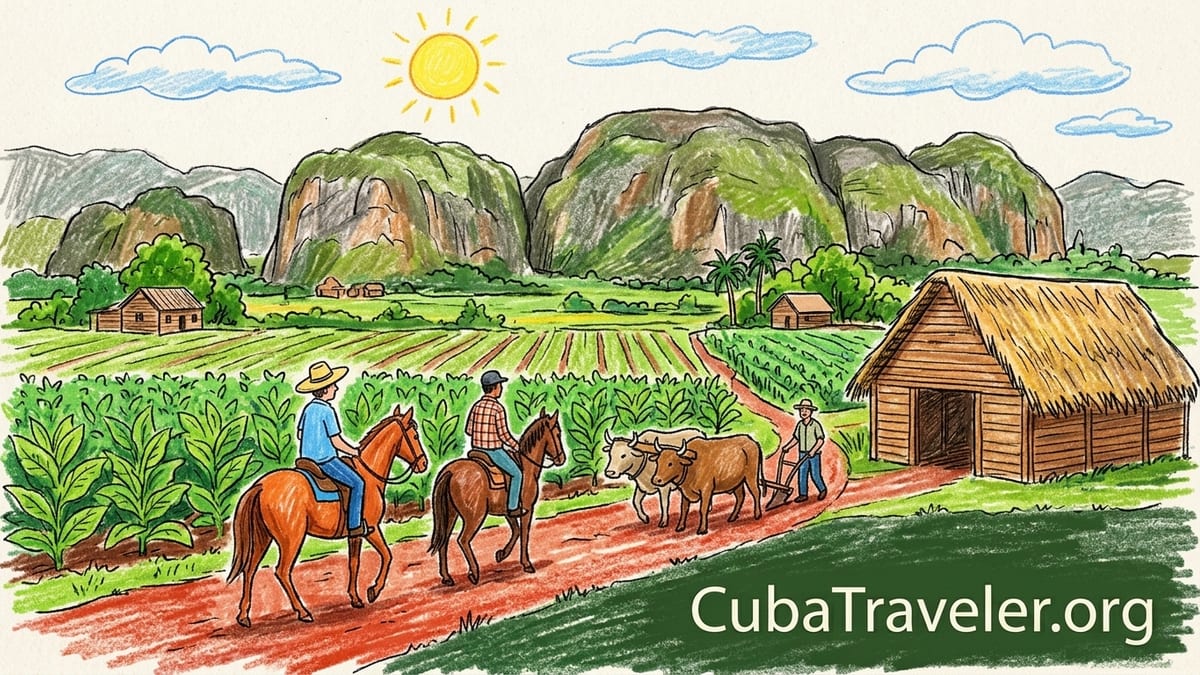
The shared taxi from Havana dropped me on the main street of Viñales just after 9 a.m., following a three-hour drive west that cost 25 US dollars in cash for my seat in a four-passenger car. Around me, the village felt more like an oversized countryside hamlet than a tourist hub: single-story concrete and wooden houses painted turquoise and pink, rocking chairs on porches, and a row of modest cafes where locals and visitors shared the same espresso machine. To the north, the land opened in a broad green bowl punctuated by the famous mogotes, steep-sided limestone hills that rise abruptly from the valley floor like giant, forested boulders.
I had seen photos of Viñales, but standing there I understood why UNESCO inscribed about 132 square kilometers of this valley as a cultural landscape in 1999. Officially, it is recognized not only for the dramatic karst scenery but also for the way traditional agriculture, vernacular farm houses and small-scale village life still shape the land. The straight tobacco furrows, the oxen-drawn plows and the simple wooden drying barns are part of the heritage just as much as the cliffs and caves.
My guide for the day, Alejandro, met me outside my casa particular. We had arranged the tour the night before through my host, who called a cousin and quoted a clear price: 20 US dollars in cash for a half-day horseback trip including a tobacco farm visit, not including drinks or optional purchases. In 2026, that was squarely within the going range of 15 to 25 dollars per person for three to four hours on horseback in Viñales, as confirmed by several local operators I checked in advance. I paid Alejandro directly in Cuban pesos equivalent to 20 dollars at the informal street rate we both agreed on after checking that morning’s offers along the main street, a reminder that in Cuba even a simple farm visit is entangled with the country’s complex currency reality.
On Horseback Into the Fields
We walked to a small paddock behind the stadium at the edge of town, where four horses waited in the shade. My mount was a compact, chestnut Cuban criollo with a calm eye and a slightly faded mane. I checked his ribs and shoulders out of habit; he was lean but not bony, hooves trimmed, and I could see no sores under the simple Western-style saddle. The tack was functional rather than pretty: a worn leather saddle, thick woolen blanket, rope halter with a snaffle bit and improvised reins fashioned from braided cord. Alejandro adjusted my stirrups carefully and insisted I try getting on and off once before we left, a reassuring nod to safety rather than just posing for photos.
We set off at a slow walk along a red-dirt track that left the pavement within minutes. The route took us past small plots of cassava and beans, then gradually into wider tobacco fields where the plants stood about knee-high, a lush green against the iron-colored soil. It was mid-January, peak growing season in this part of western Cuba, and Alejandro explained that what I was seeing would not be visible in July or August, when the fields lie bare or host rotation crops. It was my first clear reminder that a visitor cannot expect green fields, curing barns full of leaves and active cigar-rolling all at once; tobacco is seasonal, and each stage dominates a different part of the year.
The horses picked their way around puddles from a recent shower while the mogotes grew larger, rising in broken walls of limestone streaked with gray, orange and deep green. A few farmhouses appeared, wooden structures on stone or concrete footings with palm-thatch roofs or rusted tin sheets, smoke drifting from outdoor kitchens. There were no fences between “tourism” and “real life” here; schoolchildren walked the same tracks we rode, and oxcarts carrying feed passed our little caravan as if we were just another part of the daily traffic.
Meeting the Farmer and Understanding the UNESCO Landscape
After about forty minutes, we turned into a small property marked only by a hand-painted sign with the farmer’s family name. This was not an official cigar factory but a mixed farm, or finca, producing tobacco under contract to the state along with some food crops and homemade cigars for visitors. A pair of oxen dozed under a mango tree, harnessed to a wooden yoke and a simple plow made from welded scrap metal. Nearby stood the unmistakable silhouette of a casa de tabaco, the tall, narrow drying barn that defines so many photos of Viñales.
The farmer, a man in his fifties with a straw hat and mud-stained pants, greeted us with a handshake and introduced himself simply as a veguero, the word Cubans use for tobacco growers. Over a strong, sweet coffee he gave me a version of the UNESCO description in his own words: that his valley was protected not only because of the mogotes but because “we still work like our grandfathers did,” with animal traction, hand planting and sun-curing, even if fertilizers and state planning now play a larger role than in earlier generations.
He explained that his family did not own the land in the way a foreign visitor might imagine. After the Revolution, large estates were broken up and today many tobacco farmers work through state-linked cooperatives or long-term use rights. In practice, he said, this means he must sell most of his tobacco to the state at a fixed price and can keep only a small percentage, often quoted at around 10 percent, to use or sell privately. I did not see a contract, but this matched what I had read about Cuba’s agricultural system, where farmers are required to meet acopio quotas for the state and only the surplus can be commercialized more freely.
Walking between his traditional farmhouse and the drying barn, I could see how all the elements UNESCO cites as a “living cultural landscape” still coexist: karst cliffs in the background, small fields in front, vernacular architecture and working agricultural infrastructure like oxen sheds and simple irrigation channels. The valley was not a museum or a theme park. It was a place where school uniforms dried on clotheslines beside tobacco seedlings.
From Seedbed to Harvest: What I Actually Saw
Our host led me first to a small, fenced area where tobacco seedlings grew under a thin mesh shade. This, he said, was the semillero, the nursery where seeds are started before being transplanted into the main field. At this time of year the seedbeds were nearly empty, since most of the plants were already in the fields, but he pointed out the delicate young tobacco he would use for a later planting. I actually watched two workers carefully lifting seedlings with their fingers and placing them into small bundles, ready to be taken out for transplanting. They worked bent at the waist in the bright sun, an image that stuck with me far more than any glamorous cigar advertisement.
Out in the field, I saw rows of plants in different stages of growth, some just above ankle height, others nearly up to my hip. The farmer showed me how workers break off the flowering tops by hand to concentrate the plant’s energy in the leaves, an action called topping. I watched one man move down a row, deftly snapping the buds and leaving a trail of pale petals on the soil. The lower leaves, he explained, would become fillers for milder cigars, while the higher, more sun-exposed leaves would be stronger and could become wrappers or part of richer blends depending on how they were cured and fermented.
We did not witness a full-day harvest in real time, but I did see two men cutting mature leaves in the lower part of the field. They cut each leaf by hand, gathered them into bunches and stacked them carefully in a wooden crate. Those crates, the farmer told me, would be taken to the casa de tabaco within hours, because fresh leaves bruise and spoil easily. He emphasized that tobacco is one of the most labor-intensive crops he grows, with many passes through the field to plant, weed, top, harvest in stages and monitor for disease. Without state support and guaranteed purchase, he was not sure his family could afford the risk.
Inside the Casa de Tabaco: Curing and Ventilation
The drying barn was a long, narrow structure built of rough wooden posts and beams, clad in palm thatch with small gaps between the leaves. Inside, the light was filtered to a soft, dusty gold. The air smelled of sweet hay, fermenting leaves and a faint hint of smoke from a small, controlled fire in a corner stove. This was the part of the process I could directly observe: the physical arrangement of leaves, the ventilation and the slow transformation from green to golden brown.
Bundles of leaves, already strung by their stems onto long poles called cujes, hung in parallel rows from floor to roof. Near the entrance, freshly harvested leaves were still pliable and greenish; farther back, the leaves deepened in color through shades of yellow, ochre and rich brown. The farmer explained how he adjusted the slats and small openings in the walls to let air circulate without admitting too much direct sun or sudden rain. In the dry season, he said, the natural breeze through the valley combined with the tall, narrow design of the barn creates a chimney effect that helps moisture escape upward, an example of low-tech ventilation perfected over generations.
I did not see any industrial fans or high-tech equipment, only a simple thermometer and the farmer’s own experience guiding decisions. He talked about opening more vents after a rain to prevent mold and about briefly closing gaps on particularly hot, dry days to slow the process. Although I could not watch weeks of curing in a single visit, the color gradient on the hanging leaves made his explanation vivid. He said the curing phase generally lasts around 45 to 60 days, but he was careful to stress that timing depends on weather, leaf thickness and desired flavor.
At ground level, I saw workers threading fresh leaves onto strings with a curved needle, two by two through the stems, then hanging them on the lower rungs. This threading and hanging was something I actually watched from a few meters away, not a staged demonstration only for tourists. Their hands moved quickly but gently, and one of them showed me how a poorly pierced stem would tear and let the leaf fall, wasting hours of work in the field.
What I Was Told About Rolling and Cigar Anatomy
Once we stepped out of the curing barn, the farmer and Alejandro invited me to a shaded table where a relative sat hand-rolling cigars. It was important to me to separate what I really saw from what I was only told. I genuinely watched him roll several cigars from start to finish, but some of the deeper explanations about tobacco anatomy and blending were verbal, based on their account rather than something I could independently verify on the spot.
On the table lay three types of leaf, which they introduced as filler, binder and wrapper. The filler, they said, came from different positions on the plant and was used in a blend to control strength and flavor. I saw broken pieces and smaller leaves being bunched by hand in the center. Around this, the roller wrapped a slightly larger leaf, the binder, to hold the bunch together. Finally, he selected the smoothest, most flexible, unblemished leaves as wrappers, stretching one around the outside in tight spirals to give the cigar its finished appearance. Whether these exact leaves corresponded to the same classifications used in state factories, I cannot claim with certainty, but the practical demonstration made the concept of wrapper, binder and filler much easier to grasp.
The farmer also spoke about fermentation, describing how, after curing, leaves are piled in stacks and their natural moisture and sugars trigger a slow heating process that transforms harsh green flavors into more complex aromas. We did not see fermentation that day; the pilones were already completed for the season and tucked away. He pointed to a corner of the barn where, in earlier weeks, he said the leaf stacks had been monitored, rotated and covered. Here I had to take his word for it, supported by what I had previously read about tobacco processing. The important point was that he framed fermentation as an art guided by touch and smell, not just by thermometers.
When it came time for the inevitable tasting offer, he rolled a fresh cigar and dipped the end in honey, claiming that the farm tobacco contained no chemical additives and that the honey tip was a local tradition to soften the first puffs. I chose not to smoke, telling him honestly that I wanted to understand the plant and his work without lighting up. He accepted this without pressure, a relief for any traveler who might fear the experience is only for smokers.
Farm Cigars, State Factories and Questions of Authenticity
Over another coffee, I asked a question many visitors quietly carry: how do small farms like his fit into the world of official Cuban cigars such as Cohiba or Montecristo, which are produced under strict state brands through Cubatabaco and Habanos? He answered without defensiveness. Most of his best tobacco, he said, must be delivered to the state through the cooperative. That leaf disappears into the centralized supply chain, where it is sorted, fermented on a larger scale and eventually rolled in licensed factories under export brands. What he keeps and rolls at the farm uses the same soil and often the same seed varieties, but does not pass through the same industrial quality control or branding system.
His informal cigars, commonly called “farm rolls,” are therefore a different category. They are legal for him to produce from his own retained leaf and sell domestically, but they are not authorized export products. Several cigar experts and official documents I had consulted before the trip confirmed that Cuba maintains a state monopoly on official cigar manufacturing and international marketing. That means the polished boxes you see in duty free shops come from a tightly controlled pipeline, whereas the rustic cigars sold at farms and in private houses are more like artisanal, local products tied to individual growers and rollers.
I did not catch him making extravagant claims about faking top brands or smuggling factory cigars, something travelers are often warned about elsewhere. Instead, he consistently described his cigars as campesino or veguero cigars, a distinct category. Prices at the farm were straightforward: the day I visited, he asked the equivalent of 3 US dollars per cigar or 25 dollars for a bundle of ten, strictly cash. I bought a single cigar as a gift for a friend back home, aware that taking quantities into other countries can be restricted and that rules change often, so I later checked my own country’s import limits separately.
Talking through the differences in person helped me see that not every farm seller is inherently dishonest. There are certainly scams in Cuba involving counterfeit boxes and fake factory labels, but in Viñales I also met growers who are transparent about what they produce and how it fits into a broader system: agricultural production primarily for the state, and a small side stream of informal cigars that support their families directly.
Health, Ethics and Enjoying Tobacco Without Smoking
At some point in any conversation about cigars, health hangs unspoken in the air. I asked the farmer quietly whether he smoked his own cigars every day. He laughed and said that he did, but “menos que antes,” less than before, now that doctors visit the community more frequently to warn about lung and heart disease. Cuban public health campaigns, like those in many countries, are clear that any form of tobacco use increases the risk of cancer, cardiovascular problems and chronic lung conditions, regardless of whether the smoke is inhaled deeply or not.
Alejandro, my guide, added that more visitors now tell him they are interested in agriculture and culture but do not want to smoke at all. Far from being offended, the farmer saw this as an opportunity to sell coffee, honey and small bags of ground tobacco for use as natural pest control in home gardens abroad, where regulations allow. He repeated several times that understanding tobacco does not require smoking it. Watching the work behind each leaf made that message ring true. The craftsmanship, physical effort and cultural weight of the crop were impressive without needing to test the end product with my lungs.
From an ethical standpoint, I also reflected on whether my visit genuinely supported local people. The 20 dollars I paid for the tour, the single cigar and the drinks stayed in the valley, divided between guide, farmer and my casa host’s small commission. Compared with joining a large bus tour booked through a foreign package operator, where much of the money may leak out of Cuba, this felt closer to the “support for the Cuban people” principle that many travelers from the United States aim to follow within their legal framework. However, I remain cautious about claiming that tourism automatically solves rural struggles; I saw enough patched roofs and worn clothes to know it is only one strand in a difficult economic web.
Timing, Costs and Practical Details of the Visit
The logistics of the day were simple, but every detail depended on cash and planning. The taxi from Havana to Viñales I arranged through my Havana guesthouse the evening before, paying 25 US dollars for my seat in a shared classic car, which matched the 20 to 30 dollar range I had seen quoted by reputable local taxi cooperatives for 2026. We left Havana at 6 a.m. and arrived at about 9 a.m., with one coffee stop along the highway. No credit cards changed hands; international cards still fail more often than not in Cuba, so I had brought a mix of euros and dollars and changed small amounts to Cuban pesos with my hosts in both cities based on the informal market rate, which they checked via local contacts.
In Viñales itself, the horseback tobacco farm tour came to 20 US dollars equivalent for three and a half hours, including the visit to the casa de tabaco. If I had chosen to walk or cycle instead, several agencies in town offered guided walking tours between 10 and 15 dollars per person and bike rentals for around 10 dollars per day, again payable almost exclusively in cash on the day of the activity. Transport to and from the farm was simply on horseback from the edge of town, so there were no extra transfers.
We did not visit Cueva del Indio or Mirador de Los Jazmines during this particular excursion, although both are popular stops on combined valley tours and taxi day trips. I had considered adding them, but with only one full day in the area I preferred to focus on the slower rhythm of the fields. Other visitors I spoke to that week paid around 15 to 20 dollars for a taxi circuit including the viewpoint and the cave, plus separate entry fees at each site. Choosing one focus for the day made the experience less rushed and gave me more time to talk to the farmer without glancing at a watch.
At the end of the tour, I tipped both Alejandro and the farmer a few extra dollars each. Those sums are still significant in rural Cuba, where official salaries remain low and access to freely convertible currency can determine a family’s ability to buy imported goods. Before leaving, I asked permission to take and later publish photos showing the fields and the exterior of the casa de tabaco. Both hosts agreed, on the condition that I not post close-ups of children or interiors of the family house. It was a small but important reminder that responsible storytelling starts with consent.
The Takeaway
When I rode back toward Viñales village in the late afternoon, long shadows stretching from the mogotes toward the tobacco barns, I realized that the most powerful part of the day was not the idea of a “perfect Cuban cigar” but the layered relationship between landscape, agriculture and people. If I had to rank the value of the experience, the cultural interaction with the hosts came first, closely followed by the agricultural insight and only then by the romantic image of the valley itself.
Talking with the veguero and his family in their kitchen, watching how his children moved effortlessly between tending animals and checking a smartphone, gave me a sense of contemporary rural Cuba that no factory tour could match. Learning how many hands touch each leaf, how ventilation in a simple palm-thatched barn can make or break a harvest, and how the state’s monopoly on official cigar production shapes what ends up in a farm-rolled cigar, all added layers that will stay with me longer than the smell of tobacco on my clothes.
If you are choosing a tour in Viñales and want to travel responsibly, start by asking who gets paid and how. Look for experiences booked directly with local guides or through your casa particular rather than only through large foreign intermediaries. Clarify the price in advance, in writing or at least by message, and bring cash in small denominations to avoid awkward change situations. Ask guides about the route, whether you will actually see active agricultural work given the season and how many other visitors will be present.
Above all, be honest about your interests. You do not need to smoke to appreciate tobacco farming. Tell your guide if you prefer to focus on agriculture, photography, or conversation with farmers rather than tastings. Respect the animals if horseback riding is involved by quietly observing their condition and refusing rides if horses appear injured, overly thin or covered in sores. If walking or cycling suits you better, say so; there are plenty of routes that reach farms on foot or by bike. In a valley where UNESCO recognition ties natural beauty to living tradition, the most meaningful souvenir you can take home is not a box of cigars, but a deeper understanding of how ordinary Cuban families coax demanding plants from extraordinary land.
FAQ
Q1. Do I need to smoke cigars to enjoy a tobacco farm visit in Viñales?
Not at all. Many visitors focus on the farming side: planting, curing barns, conversations with vegueros and landscape photography. Farmers are accustomed to non-smokers and usually offer alternatives such as coffee, honey or simply more time to ask questions.
Q2. How much does a horseback tobacco farm tour in Viñales cost?
In 2026, small-group horseback tours that include a tobacco farm visit typically range from about 15 to 25 US dollars per person for three to four hours, paid in cash. Prices can vary with season, route length and whether drinks or tastings are included.
Q3. Is horseback riding the only way to reach the farms?
No. You can walk or cycle from Viñales village to many nearby farms on flat dirt tracks. Several local guides offer walking tours, and bike rentals are widely available. Horseback riding is popular but not essential to experience the agricultural landscape.
Q4. What time of year will I see green tobacco fields in Viñales?
Planting and growing usually take place in the cooler, drier months roughly from November to February, with harvesting and curing following through late winter. By summer, many fields are bare or planted with rotation crops, so visitors at that time will see fewer green tobacco plants.
Q5. Can I see planting, harvesting, curing and cigar rolling all on the same day?
It is unlikely to see every stage active at once because tobacco is highly seasonal. You might see green fields and curing barns in one month, and more rolling or field preparation at another. Guides often explain the full cycle using whichever stages are visible during your visit.
Q6. Are farm-rolled cigars in Viñales the same as official Cuban brands?
No. Farm cigars are handmade from the grower’s own retained leaf and sold informally. Official export brands such as Cohiba or Montecristo are produced in licensed factories using tobacco delivered to the state. Farm rolls can be enjoyable but do not carry the same quality control or branding.
Q7. Is it ethical to buy cigars directly from farmers?
Buying a modest amount of cigars, coffee or honey directly from farmers can provide valuable income for rural families. It is wise to avoid large-scale purchases or anything that feels like smuggling, and to check your home country’s import rules before traveling.
Q8. How can I tell if a horseback tour treats animals responsibly?
Look at the horses before committing: they should be alert, not extremely thin, without open wounds under the saddle or around the mouth. Ask how many hours per day they work, whether they get rest days, and decline a ride if you are uncomfortable with what you see.
Q9. Can I pay for Viñales tours by credit card?
Most small operators, guides and farms in Viñales still operate in cash, often preferring euros or US dollars. International cards are inconsistent in Cuba, so bring enough cash for transport, tours, tips and small purchases, and change only what you need into local currency.
Q10. How do I choose a responsible tobacco farm tour in Viñales?
Ask who owns the business and who gets paid, confirm group size and itinerary, and prioritize tours that spend real time on working farms rather than only at souvenir stops. Recommendations from your casa particular, other independent travelers and locally based operators are often more reliable than anonymous street touts.