


In early 2026, I tried to plan what guidebooks still describe as the “classic” Cuba loop: Havana to Viñales, then down through Cienfuegos and Trinidad, cutting back via Santa Clara before returning to the capital. On paper it looked elegant and manageable. In reality, during Cuba’s fuel and energy crisis, the itinerary collapsed long before I boarded a plane. What failed was not just my plan, but the entire idea that public schedules, fuel deliveries and rental-car bookings still mean what older travel advice says they mean.
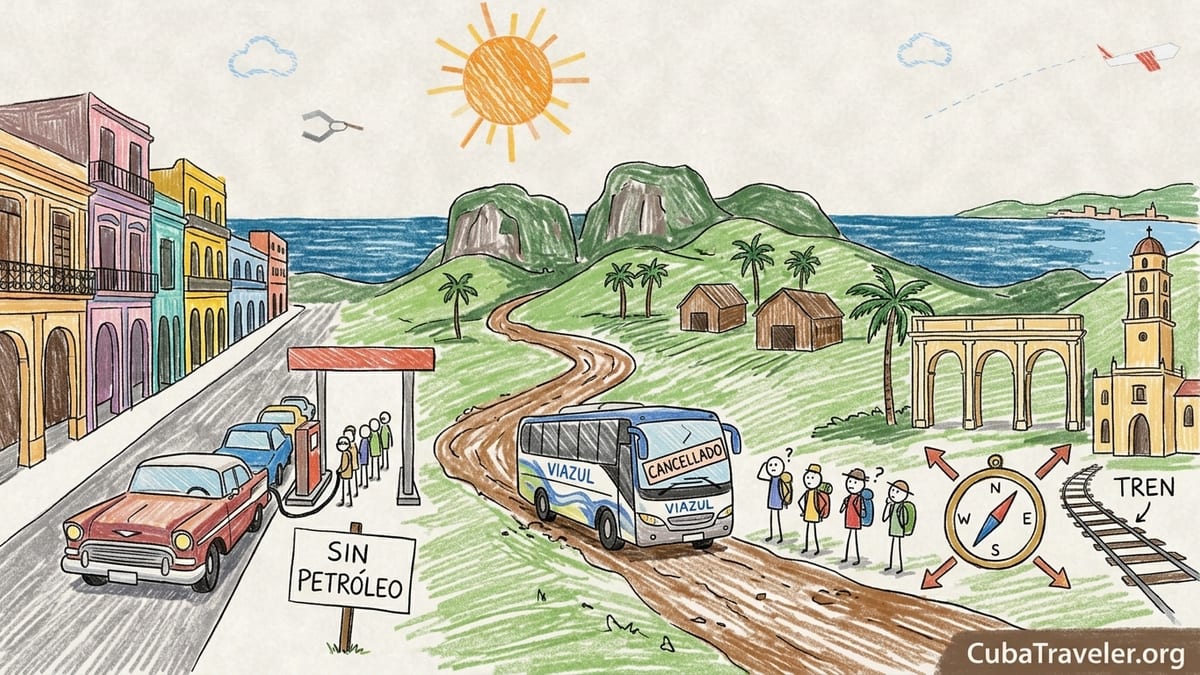
Planning a Classic Cuba Loop in an Unclassic Year
I started planning in March 2026 for a two-week trip in late May, aiming for a loop that many guidebooks and blogs still promote as the ideal first-timer route: Havana–Viñales–Cienfuegos–Trinidad–Santa Clara–Havana. I picked specific dates, checked distances on the map, and then did what every independent traveler is taught to do. I cross-referenced bus timetables, rental-car agencies, and casa particular availability. The problem was not a lack of data. It was that almost none of it described what was actually operating in the middle of a fuel blockade.
In January and February 2026, new US sanctions on shipments of oil to Cuba triggered what local and international reports now describe as an unprecedented fuel squeeze across the island. Cuban officials have spoken openly about deep cuts to public transport capacity, and independent analysis suggests that interurban services in 2026 are running at a fraction of previous levels. At the same time, European and North American media have documented widespread power outages, long fuel queues and reduced domestic flights. All of this is public information. Yet when I opened popular travel sites and print guidebooks in March, most still framed Cuba as a slightly awkward but fundamentally workable place to travel overland.
My planning notes for the first week read like any pre-2020 itinerary: Viazul bus from Havana to Viñales, another from Viñales east toward Cienfuegos, then on to Trinidad, with a rental car collected or returned somewhere along that arc if schedules did not line up. I even penciled in a side trip from Trinidad to Topes de Collantes in the Escambray mountains. The distances looked modest and the road network, while basic, still formed a neat loop on the map. The assumption was simple: if there is an official bus schedule and an advertised rental-car network, then with enough persistence I could stitch together a trip. That assumption turned out to be wrong.
What the Official Warnings Say, and What the Guides Ignore
The first real sign that my plan was out of step with reality came not from a guidebook, but from government travel advisories. By February 2026 the UK Foreign, Commonwealth and Development Office had updated its Cuba advice to note severe and sustained disruption to basic services, explicitly including transport, due to low fuel reserves. The language is unusually blunt. It warns that shortages are affecting infrastructure, healthcare, communications, water supply and street lighting, and that power cuts are frequent and sometimes prolonged. The US State Department’s advisory, refreshed in May 2025 and still current in 2026, also highlights Cuba’s energy crisis, long-running fuel shortages and their impact on transportation and daily life.
In parallel, humanitarian assessments published in spring 2026 describe how the fuel blockade has compounded earlier shocks from hurricanes and disease outbreaks, leaving public services under intense strain. A recurring theme is that energy scarcity is forcing authorities to prioritize essential sectors, which in practice means cutting deeply into transport capacity and leaving both Cubans and visitors scrambling for remaining seats, taxis and rental cars. When Reuters reported in October 2026 that Cuba’s own transport minister expected public passenger journeys to drop sharply this year, with interurban services particularly affected, it simply put into numbers what travelers and residents had been observing on the ground.
Older guidebooks, written before this phase of the crisis, rarely acknowledge any of this. Many still present Viazul as a reliable backbone for tourists, suggest that rental cars can be picked up in most major cities with advanced booking and treat power cuts as occasional inconveniences rather than structural features of daily life. Blogs and vlogs that surface first in search results repeat the same narrative: buses sell out in high season, but the system “works”; fuel can be scarce, but “you will get some eventually”; rental cars are “expensive but straightforward.” None of that matches what official sources or 2023–2026 traveler reports describe.
This gap between official warnings and popular travel guidance matters, because it shapes how travelers allocate risk. I was prepared for slow internet, patchy ATMs and delayed buses. I was not prepared for the notion that a published intercity bus route might simply not operate for lack of diesel, or that a confirmed rental car could be meaningless if the designated gas stations in a province received no deliveries for several days. When basic movement between cities becomes uncertain, the entire logic of chaining non-refundable bookings across a country falls apart.
Reconstructing the Itinerary: From Confident to Impossible
The planning timeline for my route tells the story. In mid-March I blocked out dates: three nights in Havana, three in Viñales, two in Cienfuegos, three in Trinidad, one in Santa Clara, then back to Havana for an onward flight. I looked up Viazul’s network, which still advertises Havana–Viñales, Havana–Cienfuegos–Trinidad and other classic tourist routes. On the official tourism portal, Viazul is presented as the foreign visitor’s intercity option, air conditioned and bookable online. Screenshots of the timetable show a morning and afternoon bus from Havana to Viñales, plus services connecting Havana to Cienfuegos and Trinidad.
When I tried to book specific tickets for late May, the picture changed. On some days the Havana–Viñales route appeared with seats available in the morning only, on others it showed as sold out or not bookable at all. Havana–Cienfuegos–Trinidad tickets frequently returned “no availability” errors weeks in advance, even on normally quiet weekdays. On travel forums, people who had just returned from Cuba in early 2026 reported that some Viazul routes were still running, particularly between Havana, Varadero and Trinidad, but that last minute cancellations and schedule changes were common. Crucially, they stressed that online listings did not always match what actually left the station.
To salvage the plan, I mapped out alternatives. For Havana–Viñales, shared taxis quoted directly by hosts in Havana came in around the equivalent of 25 to 35 US dollars per person, based on recent traveler reports, for a four-hour journey. Private transfers for two people ranged from roughly 100 to 140 dollars one way, sometimes in older classic cars, sometimes in modern sedans. For Viñales–Cienfuegos or Viñales–Trinidad, however, the situation was different. The direct bus options that pre-crisis guidebooks mentioned were no longer visible. Most hosts suggested first returning to Havana and then taking another bus or shared taxi east, effectively doubling both the time and cost.
By early April I had a spreadsheet full of conditional routes. If the Havana–Viñales bus on day three actually ran, and if I could then find a private driver willing to make the eight- to ten-hour run from Viñales to Trinidad a few days later, then the loop might still work. If not, I would need to cut Viñales or skip Cienfuegos. Every leg came with similar ifs. At that point the itinerary was already fragile. It finally snapped when I reached the question no guidebook had seriously addressed: what happens if a power cut or fuel shortage stops you getting back to your departure airport on time.
The Illusion of Distance: Why 180 Kilometers Can Be Harder Than 400
Looking at the map, my chosen loop seems modest. Havana to Viñales is roughly 180 kilometers, mostly on the Autopista Nacional. Viñales to Cienfuegos by road is longer and indirect, but still within a long day’s drive. Cienfuegos to Trinidad is only about 80 kilometers along the south coast, and Trinidad to Santa Clara a similar distance north across the Escambray foothills. In a country with stable fuel supply and predictable transport, this would be a relaxed two-week circuit. In Cuba in 2026, distance on the map has become a poor predictor of actual difficulty.
Havana–Viñales is the least problematic sector, because it links the capital to a flagship rural destination. Even during fuel shortages, authorities and tourism operators have tried to keep a basic flow of buses and tourist taxis between the two. Recent visitors report that Viazul or equivalent tourist buses still run several times per week when fuel is allocated, and that shared taxis are often available from Havana, sometimes at short notice. But those same reports mention situations where services were scaled back or suspended in the days after sudden fuel distribution cuts, forcing travelers to delay or improvise.
Contrast that with Viñales–Trinidad or Cienfuegos–Trinidad. Both pairs are much closer in pure kilometers than Havana–Viñales, yet they have become significantly harder to move between without backtracking. The problem is not the roads themselves, but how fuel and vehicles are allocated. In 2026, official and anecdotal sources alike suggest that buses and state taxis are concentrated on a few priority corridors: Havana to major resorts, provincial capitals and key tourist centers. Cross-country diagonals that once worked with a single change now often require detours through Havana or another hub, simply to find operating buses or drivers who can justify the fuel.
Then there is Trinidad–Topes de Collantes, a day trip that many guidebooks sell as a straightforward excursion into the Escambray for waterfalls and coffee farms. The distance from Trinidad to the main trailheads in Topes is less than 25 kilometers, yet recent traveler and operator reports describe excursions canceled or consolidated at short notice due to a lack of fuel for minibuses. In some cases, travelers waited days for their host to find a driver with enough gasoline to make the climb and return. In others, they were offered a much more expensive private jeep tour because only a few higher-margin vehicles had fuel. On my dates, I could not find any operator willing to confirm a Topes trip more than 24 hours in advance.
Viazul, Transtur and the Difference Between a Network and a Bus
The heart of the problem is the gap between Cuba’s advertised tourist transport network and what operates on any given day. Official tourism portals still describe Viazul as a nationwide system that connects Havana with major destinations like Viñales, Varadero, Cienfuegos, Trinidad and Santiago de Cuba. Transtur is presented as a complementary network of transfers and tours with its own bus fleet, feeding package tourists to and from airports and resorts. On paper, this looks like redundancy. In a fuel crisis, it becomes a competition for scarce diesel.
Travelers who passed through Havana and central Cuba in 2024, 2025 and early 2026 describe a pattern. Viazul’s online system lets you search and, in some cases, pay for tickets in hard currency. Buses do run many of the flagship routes, especially on days when charter flights arrive. At the same time, authorities have had to cut total public transport by large margins to match limited fuel imports, with Cuban officials themselves citing sharp declines in passenger journeys. In practice that means fewer buses, less frequent departures, and more last-minute changes.
For my dates, I could find a Havana–Trinidad bus listed twice a week, but no guarantee it would run if fuel deliveries fell short. Contacts in Havana warned that it was common for buses to be consolidated, with two scheduled departures becoming one if passenger numbers and fuel supplies did not justify separate runs. The line between Viazul and Transtur has also blurred. Some operators allocate seats on route buses to both package tourists and independent travelers, while others use Transtur coaches for what look like public runs when Viazul units are in maintenance or idle for lack of fuel.
From a planning perspective, the key distinction is not between Viazul and Transtur, or between tourist and local buses. It is between a schedule that exists in an online database and a specific bus that has confirmed fuel and a driver on a given day. Many guidebooks still treat the published timetable as a promise. In 2026 Cuba, it is closer to a best-case scenario. That subtle shift has profound implications. It means that booking a non-refundable casa particular in Trinidad because you see a bus scheduled two days earlier is now a gamble, not a rational decision.
Rental Cars: Deposits, Fuel Queues and the Mirage of Independence
Faced with messy bus options, I turned to rental cars, assuming that paying more would buy control. Official tourism sites list several brands under the Transtur umbrella, including Cubacar, Havanautos and Rex, with pick-up points in major cities and some hotels. Pre-crisis, it was possible to secure a car in advance through international brokers, pay a large deposit and then drive the classic loop with relative independence. Recent traveler reports, however, paint a more difficult picture long before 2026, and the fuel blockade has only intensified existing issues.
First, availability. For 2024 and 2025, specialist tour operators that still work with Cuba have been frank that rental fleets are small and bookings effectively “on request,” with no guarantee until a local partner confirms a specific vehicle. By 2026, increased pressure on that limited fleet from both domestic needs and tourists meant that for my dates in May there was no way to secure a car at a normal daily rate through a mainstream broker. The few offers that did materialize through niche agencies in Europe quoted prices that, once converted, approached several hundred dollars per day, plus hefty deposits payable on arrival in hard currency, not in local pesos.
Second, fuel. Since early 2024, Cuba has shifted many service stations for tourist rental cars to cashless payments in foreign currency. Separate pumps exist in some cities for state fleets, local private drivers and foreign renters. Even at these priority stations, travelers in 2023–2025 described waiting hours in line for gasoline, sometimes visiting multiple stations in a day before finding supplies. By mid-2026, humanitarian and diplomatic briefings describe even tighter fuel rationing, which logically makes private self-drive the most fragile option of all. A rental car with an empty tank in a small town without deliveries is simply a parked asset.
Finally, support. Several travelers in recent years have reported significant wear and tear on rental vehicles, with unreliable tires and weak suspension on secondary roads. Insurance policies often exclude damage to wheels and undercarriage, leaving renters liable for pothole-related costs. Roadside assistance is limited outside major corridors, and during widespread fuel shortages tow trucks and mechanics face the same scarcity as everyone else. None of this is reflected in older guidebooks that still frame rental cars as a convenient upgrade. I could have wired a deposit to hold a car through a foreign intermediary. What I could not obtain was a credible assurance that I would be able to refuel it consistently on my chosen route without losing full days to queues.
In some online spaces, a few travelers suggest carrying extra fuel in jerrycans as a workaround. In the Cuban context of 2026 that advice glosses over both safety concerns and regulatory uncertainty. Transporting significant quantities of gasoline in a private vehicle on hot, often poorly ventilated roads is not a responsible solution to a systemic shortage. It also does nothing to address what happens if blackouts affect card terminals at tourist gas stations, or if provincial authorities temporarily redirect limited fuel away from private vehicles altogether.
When Lodging, Excursions and Connectivity Depend on a Bus That May Not Exist
Once it was clear that neither buses nor rental cars could be treated as dependable, the rest of my plan began to unravel. I had originally intended to book a chain of casas particulares in advance, paying deposits or committing to minimum stays. In pre-crisis Cuba that could be risky if you missed a bus, but owners were usually able to fill rooms at short notice. In 2026, with far fewer tourists and many locals depending on dwindling visitor income, hosts understandably push for firmer commitments. That increases the financial impact when travel falls through.
Several hosts in Viñales, Cienfuegos and Trinidad responded candidly when I asked what would happen if I could not arrive on the expected day because a bus did not run or fuel was not available. They explained that they might hold the room for one night without payment, but could not do so indefinitely. One described recent guests who had to cancel their provincial stays from Havana at the last minute when an excursion company pulled its departures due to fuel allocation cuts. The guests lost part of their accommodation payments and some prepaid tours. The host, who had stocked food and prepared for their arrival during a period of shortages, lost income as well.
Excursions suffer from the same fragility. Day trips from Viñales to more remote tobacco farms and viewpoints, or from Trinidad to the Valle de los Ingenios and Topes de Collantes, require vehicles that can climb hills or handle rougher tracks. Guides in both regions told me that they could not guarantee any specific excursion date more than a day or two in advance, because they did not know how much fuel would be allocated to cooperatives or taxi collectives each week. They recommended that I plan to decide everything on arrival, limiting myself to what was running at the time. That advice directly contradicts older guidance that encourages travelers to pre-book popular excursions weeks before departure.
Even basic connectivity and charging cannot be assumed. Official advisories mention frequent power outages across Cuba, and traveler reports from the last three years confirm that blackouts often hit in the late afternoon or evening for several hours at a time, especially outside tourist zones. This affects not just air conditioning and lighting, but also the ability to recharge phones and laptops, access mobile data and use Wi-Fi hotspots. In the context of unpredictable transport, this becomes more than an inconvenience. If you cannot reliably check for schedule changes, call a driver or receive messages from a host while power is out, your ability to react to disruptions shrinks.
The most serious risk, though, is temporal rather than technological. Every Cuban I spoke to about my plan asked a version of the same question: how many days will you leave in Havana at the end before your flight out. Their concern was simple. In a fuel crisis, a traveler who ends a trip in Trinidad or Viñales with only one buffer day before an international departure is taking a meaningful risk. If a bus is canceled, a taxi cannot get fuel or a highway accident diverts limited traffic, there may be no straightforward way to reach the airport on time. Official advisories do not spell this out in capital letters, but the implications of their warnings about transport disruptions are clear. Ending a loop far from the airport without a generous cushion is no longer a brave optimization. It is a hazard.
Five Ways Older Travel Advice Now Fails in Cuba
Looking back at my guidebooks and saved blog posts, I can see at least five recurring assumptions that 2026 Cuba no longer supports. The first is that intercity buses will run roughly as scheduled. Schedules still exist, and some routes do depart, but fuel allocation and maintenance bottlenecks have transformed them from reliable infrastructure into provisional offers. Planning multi-leg itineraries that hinge on specific buses now carries a level of risk that most writers do not acknowledge.
The second failed assumption is that fuel is generally available, with occasional shortages. In reality, Cuba has struggled with chronic fuel scarcity for years, and the 2026 oil blockade intensified that pattern. Reports from residents, humanitarian agencies and recent visitors converge on the image of long queues, rationing and occasional dry pumps even at tourist-focused stations. This is not a scenario where you might wait an extra twenty minutes. It is one where you might wait several hours or find no fuel at all on a given day.
The third shaky piece of advice is that remote excursions from tourist hubs are straightforward add-ons. A decade ago, day trips from Trinidad to Topes de Collantes or from Viñales into the countryside could be arranged easily at local agencies. Now, many of those trips depend on a shrinking pool of vehicles with guaranteed fuel allocations. Operators may cancel or consolidate departures at short notice, and some have quietly dropped longer or less profitable routes altogether. The assumption that you can simply book a jeep tour tomorrow morning and go is no longer safe.
The fourth outdated notion is that night driving is an acceptable way to make up time. Multiple official advisories and long-standing traveler wisdom already warn against driving after dark in Cuba due to poor lighting, livestock on the road and limited emergency services. Add aggressive fuel rationing, rolling blackouts that can knock out street lights, and general strain on public order, and the idea of solving scheduling problems by driving at night in a rental car becomes even less sensible.
The fifth, and perhaps most damaging, failure is the belief that chaining non-refundable hotel bookings across the island is safe as long as you allow a day or two between long jumps. That logic presumes a baseline of reliability that 2026 Cuba does not offer. With interprovincial transport reduced and fuel supplies precarious, a broken link in the chain can strand you hundreds of kilometers away from a prepaid booking. It can also threaten your ability to reach an onward flight that airlines may be reluctant to change without fees, especially as some carriers reassess their own schedules to Cuba in light of the crisis.
The Takeaway
In the end, I did not ticket the trip. I canceled my tentative casa holds and left the spreadsheet as a record of a plan that collapsed under the weight of its own assumptions. My decision was less about fear of discomfort and more about the mismatch between the level of uncertainty on the ground and the way most English-language travel information still frames Cuba. When official government advisories, humanitarian analyses and on-the-ground reports all highlight severe fuel shortages, power cuts and transport reductions, while mainstream travel content still talks in terms of fixed bus routes and simple self-drive loops, something has to give.
That does not mean independent travel in Cuba is impossible in 2026. People are still visiting, particularly to Havana, Varadero and a few resort areas. Some succeed in piecing together longer itineraries through a mix of patience, flexibility, local contacts and luck. But the margin for error has shrunk dramatically. For those contemplating a classic road trip loop like Havana–Viñales–Cienfuegos–Trinidad–Santa Clara, the bar for acceptable risk should be much higher than it was a decade ago.
Before recommending such a trip again, I would want to see measurable changes, not just hopeful anecdotes. Public transport data would need to show sustained increases in interurban services over multiple months, not year-on-year declines. Government advisories would need to soften their language on fuel shortages and power cuts, indicating structural improvements, not temporary patches. Traveler reports would need to converge on experiences of booking buses and rental cars with a reasonable expectation that they operate as sold, without multi-hour fuel queues or last-minute cancellations due to lack of diesel.
Until then, any honest account has to say that Cuba’s 2026 fuel and energy crisis has broken the old relationship between distance on the map and ease of travel. It has also rendered much preexisting travel guidance untrustworthy for longer independent circuits. For now, if you go, consider shorter, hub-based stays with generous time buffers, avoid building chains of non-refundable bookings across provinces, and recognize that in Cuba today, a published bus schedule is not a promise. It is a hope.
FAQ
Q1. Is it still possible to travel between Cuban cities by bus in 2026?
It is sometimes possible, especially on major routes such as Havana to Varadero or Trinidad, but services have been reduced and are vulnerable to fuel shortages. Travelers report that timetables do not always match what actually runs, and last-minute changes or consolidations are common, so you should not base tight connections or non-refundable bookings on a single scheduled departure.
Q2. How reliable is the Havana to Viñales route right now?
Havana to Viñales remains one of the better-served corridors because it links the capital with a key rural destination. Tourist buses and shared taxis do still operate, but frequency can drop when fuel allocations are cut, and seats may sell out quickly on days when flights arrive. Treat it as workable with flexibility, not guaranteed on a specific time or date.
Q3. Why is Viñales to Trinidad so much harder than Havana to Viñales?
The challenge is not the distance but network design and fuel allocation. Authorities prioritize radial routes from Havana and other hubs, while cross-country diagonals like Viñales to Trinidad often require backtracking to the capital or another city to find operating buses or fuel. That can double travel time and costs compared with what older guidebooks suggest.
Q4. Are rental cars a practical solution to the transport crisis?
Rental cars offer theoretical freedom but come with serious drawbacks in 2026: limited fleet availability, very high prices, large deposits, long fuel queues even at tourist stations, and uncertain roadside support. They shift some control back to the traveler but do not solve the underlying scarcity of gasoline or the risk of delays caused by fuel rationing.
Q5. Can I rely on day trips from places like Trinidad and Viñales?
Many classic excursions, such as trips to Topes de Collantes or remote farms around Viñales, now depend on a smaller pool of vehicles with confirmed fuel. Operators may only confirm departures 24 to 48 hours in advance, cancel runs if allocations change, or raise prices when only a few vehicles can operate. Planning these trips far ahead is increasingly difficult.
Q6. How do blackouts affect travel planning on the ground?
Frequent power cuts affect lighting, charging, internet access and card payments. During outages you may not be able to check bus updates, contact drivers or pay electronically for fuel and services. This makes it harder to react in real time to schedule changes and forces travelers to build wider timing margins into every intercity move.
Q7. Is it safe to finish a trip far from my departure airport?
In current conditions it is risky to end a trip in a provincial city with only a short buffer before an international flight. Fuel shortages and reduced interprovincial transport mean that disruptions on your return leg could leave you unable to reach the airport on time. Many experienced travelers and locals now recommend keeping at least several spare days in Havana before departure.
Q8. Are non-refundable hotel and casa bookings a good idea in Cuba now?
They carry more risk than in the past. With buses and transfers harder to predict, missing just one intercity move can cause you to forfeit multiple prepaid nights. Flexible or partially refundable bookings, especially outside Havana, better reflect the current level of uncertainty and help protect both travelers and small accommodation owners from sudden changes.
Q9. How much do private transfers and shared taxis cost compared with buses?
Prices fluctuate with fuel availability and local demand. In recent years travelers have reported shared taxi prices on popular routes that are several times a bus fare, with private transfers significantly higher still. Since fuel costs and scarcity change frequently, it is wise to request up-to-date quotes from hosts or agencies close to your travel dates rather than relying on past averages.
Q10. What conditions should improve before planning a classic Cuba road trip?
Key indicators would include documented increases in intercity bus capacity, fewer official warnings about fuel shortages and power cuts, more consistent availability of rental cars at predictable prices, and multiple recent traveler reports describing successful multi-stop routes without major disruptions. Until those factors align, long independent road trips remain a high-risk choice.