


Cuba’s coastline is long, complex and changing, and in 2026 there is no single “best” beach. Instead, travelers are choosing between three very different kinds of coastal experience: a long and busy mainland peninsula with easy city access, self-contained resort islands reached by causeway, and quieter Caribbean coves linked to historic towns. Add in Cayo Largo’s remote reef-ringed sands and you have a country where how you reach the beach matters almost as much as the color of the sand. This guide compares Cuba’s headline stretches of coast, focusing on what they are really like on the ground right now and what you should verify before booking.
Varadero: Long Mainland Peninsula With the Easiest Logistics
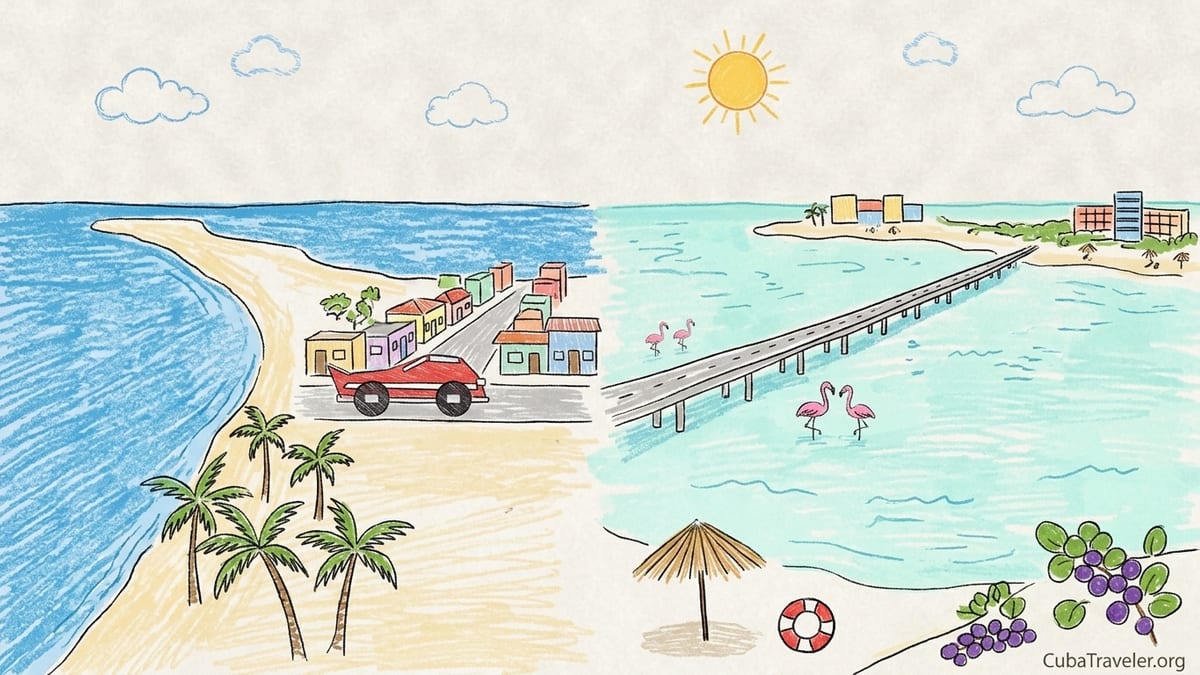
Varadero occupies the Hicacos Peninsula on Cuba’s north coast, a narrow finger of land running roughly 20 kilometers into the Straits of Florida with an almost uninterrupted band of pale sand along its ocean side. The beach itself is public along its entire length under Cuban law, so you can walk from one hotel zone to another without hitting a fence, even if the loungers and bars behind the sand are reserved for guests. In the central strip near the town streets, there are marked public access points between hotels, while farther out near the big all-inclusives the beach feels more like a continuous resort front.
Sand at Varadero is fine and light with a gentle slope into the sea, which usually means easy barefoot entry and waist-deep water extending several meters offshore. In calm weather this is one of the best beaches in Cuba for hesitant swimmers and families who want to stand comfortably in the shallows. Atlantic swells and winter cold fronts can bring bigger waves and stronger shore break between December and March, when red flags sometimes close parts of the beach and lifeguards are more vigilant. Along most hotel zones you will find lifeguard posts, basic first-aid equipment and flag systems, while some public stretches near town have lifeguards only during busier hours.
Facilities in Varadero range from simple public showers and beachside kiosks near the town center to full-service all-inclusive complexes farther up the peninsula. Many travelers split their stay between a casa particular in Havana and an all-inclusive in Varadero, taking advantage of the relatively straightforward transfer: by road it is about 140 kilometers, often sold as a two-and-a-half to three-hour shuttle with hotel pickup in Havana and drop-off at Varadero resorts. In 2026, fuel shortages and bus fleet issues can extend that journey time, so it is wise to ask your tour operator or casa host what transfer they actually have confirmed, and on which company’s coach, before you pay.
Varadero’s trump card is that it delivers a big-resort beach holiday without completely cutting you off from Cuban town life. The built-up area between roughly Calle 10 and Calle 62 has local restaurants, small supermarkets and independent bars where you can pay in pesos as well as hard currency. You can visit Havana, Matanzas or the Bay of Pigs on organized day trips, something that is much less practical from the remote cays. For 2026, the most important checks before booking in Varadero are whether your chosen resort has stable electricity backup, how often buffets are being resupplied with imported items, and whether the hotel is operating all of its pools and restaurants or only a core set due to staffing and supply constraints.
Cayo Coco and Cayo Guillermo: Jardines del Rey Causeway Resorts
Cayo Coco and neighboring Cayo Guillermo sit off Cuba’s north-central coast in the Jardines del Rey archipelago, linked to the mainland by a 27 kilometer causeway across the Bahía de Perros. This road is the defining feature of independent travel here: there is no town in the classical sense on the cays, only hotel clusters, service compounds and a small worker settlement. You arrive either via Jardines del Rey International Airport on Cayo Coco or by driving from Morón on the mainland, paying a causeway toll and passing an immigration-style checkpoint where passports and bookings are often checked.
The reward for this remoteness is a run of beaches that feel more natural than Varadero’s coastal strip. Playa Flamencos on Cayo Coco has wide, soft sand and shallow turquoise water that stays knee to waist deep a long way out at low swell, popular with families and non-swimmers. Playa Larga offers a similar white-sand arc with a slightly steeper entry in places and more seagrass patches that attract fish, which makes it interesting for casual snorkeling right from shore when the water is clear. Over on Cayo Guillermo, Playa El Paso is broad and often windier, attracting kiteboarders, while Playa Pilar, backed by high shifting dunes, is frequently described as one of Cuba’s most photogenic beaches, with clearer visibility and a nearby reef accessed by boat excursions.
Because almost every bed on Cayo Coco and Cayo Guillermo is in an all-inclusive resort, your choice of hotel has an outsized impact on your experience. In 2026 many properties are open but operating with adjustments: some specialty restaurants rotate opening nights, buffet variety leans on domestic produce, and guests report that power cuts do occur but are often bridged by generators at the larger international-brand resorts. Independent dining options are limited to a handful of government-run ranchón-style seafood spots and hotel “shopping villages,” which can feel repetitive on a long stay. Public beach access theoretically exists because the foreshore is public, but realistically you will be using the stretch in front of your resort unless you rent a scooter or take the tourist bus that loops the hotel strip.
Transport constraints shape non-package travel here. Without a pre-arranged transfer, getting from Havana or Camagüey to Cayo Coco can involve piecing together a Viazul or Transtur bus to Morón and a taxi across the causeway, which requires fuel and a vehicle willing to make the trip. In the current environment you should not assume you can arrive in Morón without a booking and easily find a reasonably priced taxi waiting. Ask your accommodation or tour agency to lock in both arrival and departure transfers, confirm whether they are using shared coaches or private cars, and build in extra time to connect to domestic flights if you are chaining destinations.
Cayo Santa María, Cayo Las Brujas and Cayo Ensenachos: Beautiful But Isolated
Farther west along the north coast, the Cayería Norte de Villa Clara includes Cayo Santa María, Cayo Las Brujas and Cayo Ensenachos, another cluster of resort islands connected to the mainland by a long causeway that leaves from near Caibarién. In contrast to Varadero, there are no regular Cuban neighborhoods or small cities anywhere on the cays, only resorts, service zones and construction yards. You come here for isolation, white sand and a turquoise horizon, not for street life or independent nightlife.
The beaches themselves are worthy of the reputation. Cayo Santa María offers several named stretches, most with powdery sand and an easy sandy entry. On calm days the water is clear and gently shelving, though northern cold fronts can bring chop and increased currents, and in the rainy season seaweed may line parts of the shore. Cayo Las Brujas has a mix of longer beach arcs in front of resorts and smaller coves with rockier sections that can add interest for snorkeling when visibility cooperates. Little Cayo Ensenachos, almost entirely occupied by a single large resort, has two postcard-perfect coves with shallow, pool-like water that suits children and less confident swimmers very well.
What sets these cays apart from Cayo Coco and Varadero is how little contact you have with ordinary Cuban life once you are checked in. There are practically no stand-alone local paladares or peso shops on the islands, and most staff commute long distances from Santa Clara or Caibarién. All meals are likely to be inside your resort, and if the property is facing food-supply challenges you will feel them directly. Reports from late 2025 and early 2026 suggest that larger international chains here keep a reasonable base level of service, but imported items like certain spirits, snacks or fresh fruit are not guaranteed, and some hotels consolidate guests into a subset of buildings and restaurants during low occupancy periods.
From a logistics perspective, reaching Cayo Santa María usually means a three to four hour road transfer from Havana or about an hour and a half from Santa Clara’s Abel Santamaría Airport, depending on traffic and fuel availability. There is no airport on the cays themselves currently handling international schedules widely marketed overseas, so most visitors arrive on package coaches. If you hope to travel independently, you need to confirm in advance that buses are actually running on your travel dates, and that your accommodation can secure a taxi over the long causeway both ways. In 2026, this is not a destination where you want to improvise transport on the day of travel.
Cayo Largo del Sur: Remote Island With Different Access
Cayo Largo del Sur, in the Canarreos archipelago off Cuba’s south coast, offers a very different kind of beach trip. The island itself is about 25 kilometers long and is ringed by white sandy beaches such as Playa Sirena and Playa Paraíso, with offshore cays like Cayo Iguana and Cayo Rico reached by day boats. The sand here is remarkably fine and pale, the water entry generally gentle, and the surrounding reef and seagrass beds support good marine life for snorkeling and diving excursions. Unlike the northern cays, Cayo Largo feels more like a compact island resort destination where most beaches are a short shuttle away rather than directly in front of every hotel.
Access is the key difference. Cayo Largo is not linked to the mainland by a causeway; instead, visitors arrive via Vilo Acuña International Airport or occasionally by yacht into Marina Cayo Largo. After a period of closure and renovation, tourist flights resumed and Canadian and European tour operators again offer seasonal packages that combine charter flights with stays at resorts managed by foreign brands. Domestic connections from Havana and other Cuban cities have been reintroduced in a limited way but are subject to aircraft availability and fuel considerations, so travelers should be prepared for schedule changes and to spend a night in Havana on either end if flights are retimed.
On the ground, Cayo Largo is a pure tourism enclave. There are no traditional Cuban towns, only hotels, small villa complexes and service areas for staff. Food, fuel and electricity are brought by ship and coordinated in bulk, and tour operators emphasize that properties have generators and water-treatment systems, though short interruptions are still possible. For 2026, the most crucial checks before committing to Cayo Largo are which specific hotels are currently open, whether all-inclusive services are fully restored after refurbishment, and how your tour operator handles contingencies if weather or operational issues cause a temporary airport closure. Because alternative exit routes are limited, it is wise to avoid tight onward flight connections out of Cuba when planning a Cayo Largo stay.
For divers and snorkelers, Cayo Largo’s appeal lies in boat trips to reefs and drop-offs with relatively light coastal development. Many packages sold through agencies in Canada, Europe and Latin America include a set number of dives with the local dive center or daily snorkeling excursions to nearby cays. Before booking, ask which dive boats are operating this season, what equipment is available on site versus what you need to bring, and how fuel constraints are affecting the frequency of marine excursions. This is not an island where you can easily arrange completely independent diving on arrival.
Caribbean South Coast: Playa Ancón and the Bay of Pigs
On Cuba’s southern shore, the Caribbean has a different character to the open Atlantic and the sheltered northern cays. Waves are generally smaller, the sea can feel slightly warmer, and rocky sections alternate with small sand coves. Playa Ancón, a few kilometers from the colonial city of Trinidad, is the south coast’s best-known resort strip: a several kilometer arc of light sand that shelves gently into typically calm, clear water. A handful of established hotels sit directly on the beach, but there are also public access points and simple services used by residents of Trinidad on weekends.
Sand at Playa Ancón is coarser than Varadero’s and the sea floor can have coral rubble in places, so reef shoes make entry more comfortable for sensitive feet. Once in, the gentle depth profile is friendly for swimmers who like to wade out gradually. Winds are usually moderate, with choppier days when weather systems move through the Caribbean, but strong surf is less common than on the north coast in winter. There are lifeguard posts at the main hotel fronts; on the quieter ends of the beach lifeguard coverage may be minimal, so independent travelers should swim conservatively when there are few people around.
Playa Ancón’s great advantage is its proximity to Trinidad. Many visitors stay in colonial-era casas particulares in town and visit the beach by taxi, shared truck or bicycle, skipping the all-inclusive model altogether. This opens up far more dining choice than on the cays: Trinidad has a dense mix of private restaurants serving everything from simple home-style Cuban dishes to higher end tasting menus aimed at foreign visitors. In 2026, as occasional shortages affect certain ingredients, being in a city with multiple suppliers and entrepreneurs can mean more consistent meals than relying on a single resort buffet.
Farther west along the south coast, the Bay of Pigs area around Playa Larga and Playa Girón offers a very different beach mood. Here small strips of sand sit between mangroves and low cliffs, and the shore often drops off more steeply into clear water above limestone. This geology creates excellent conditions for shore diving and snorkeling: within a few fin kicks of entry you can find coral, sponges and schooling fish. The area’s modest hotels and dive centers offer packages that pair simple half-board accommodation with daily dives or cenote-style freshwater swims in sinkholes just inland. Historical interest adds another layer, as the 1961 Bay of Pigs invasion museum and memorials are within easy reach, making it one of Cuba’s few places where you can combine immersive history with serious underwater time in a compact radius.
Holguín North Coast and Playas del Este: Beaches Without Full Isolation
In Cuba’s east, the resort areas near Holguín such as Guardalavaca, Playa Esmeralda and Playa Pesquero provide a compromise between isolated cays and heavily urban beaches. These coves sit on the mainland but are separated from large cities by stretches of countryside, so the hotel zones feel self-contained yet are a manageable drive from Guardalavaca village and the city of Holguín. Beaches here tend to be smaller than Varadero’s but deeply curved, with white to golden sand and a quick transition from shallows to deeper water that appeals to confident swimmers.
Guardalavaca itself has a public beach widely used by Cubans from the region, with a mix of state-run and private eateries behind the sand offering grilled fish, pizza and simple cocktails. Playa Esmeralda and Playa Pesquero are more dominated by large all-inclusive resorts, but there are still public paths that allow day visitors onto portions of the beach. Winds on this coast can be brisk, which is good for sailing and windsurfing programs at resorts, but can stir up waves and reduce snorkeling visibility on some days. Reef patches just offshore provide worthwhile snorkeling on calmer mornings, often accessed via kayak or small boats arranged through hotel water-sports desks.
Holguín’s Frank País Airport receives international charter and package flights from several Canadian and European cities, and domestic links connect it to Havana in some seasons. Transfers to the resort strip are typically one to one-and-a-half hours by coach, and in 2026 travelers should check carefully whether their chosen hotel includes airport transportation and whether night arrivals are being serviced by regular buses. Reliability of power and water service in this region has been somewhat better than in more isolated outposts because infrastructure is on the mainland grid, but resort operators still sometimes reduce the number of open facilities in low occupancy months.
For visitors who want beach time but prefer to be anchored in Havana, the Playas del Este string of beaches east of the capital is an important option. These beaches, including popular Santa María del Mar, are less pristine than Varadero and have more basic facilities, but they allow you to swim in turquoise water during the day and be back in a Vedado or Old Havana casa for dinner. Sand conditions vary from coarser, shell-flecked stretches to softer sections watched by lifeguards in summer. In high season, public buses and shared taxis shuttle between central Havana and Playas del Este; given current fuel realities, it is smart to confirm schedules locally the day before and to carry cash for on-the-spot taxi negotiations if buses are full.
How 2026 Operating Conditions Should Shape Your Choice
In 2026, choosing a Cuban beach destination is not just a matter of comparing photos of white sand. Fuel availability, power stability, food supply chains and transport reliability all differ between Varadero, the northern cays, Cayo Largo, the south coast and the Holguín region. Before committing, travelers should think about their tolerance for service interruptions and their desire for independence versus resort containment, then match that to the destination’s realities.
Varadero benefits from its proximity to Havana and Matanzas, larger local population, and status as a flagship tourism zone. That translates into relatively frequent transfers, multiple bus routes, and greater redundancy if something goes wrong: if one hotel has an issue, you can often move, and if a buffet is short on items you can sometimes eat in town restaurants instead. On the other hand, Varadero is the busiest and least secluded of the options. Travelers who want a sense of escape, minimal vendors on the beach and darker night skies may find the northern cays or the Bay of Pigs area more appealing, accepting that these come with reduced independent dining and more dependence on prearranged logistics.
The causeway-linked northern cays and Cayo Santa María cluster are most vulnerable to disruptions in centralized supplies but also best placed to maintain pools, air conditioning and basic service through their relationship with large international hotel groups that invest in generators and water systems. They suit travelers who value a predictable all-inclusive experience above flexibility. Cayo Largo ups the remoteness factor: services are curated by a small number of operators who fly guests in and out on bundled packages. This can feel delightfully simple when all goes well, but requires patience if weather or aircraft changes ripple through the schedule.
Mainland Caribbean beaches like Playa Ancón and the Bay of Pigs, as well as Holguín’s resort strip and Playas del Este, are more interwoven with surrounding communities. That brings the chance to support local businesses and to adapt in real time if a particular hotel has an issue, but also demands more self-management. If a bus you expected is canceled, you may need to negotiate a taxi or hitch a ride in a shared truck. If a particular restaurant is short on ingredients in Trinidad or Holguín, you can walk to another, an option that package guests on a remote cay seldom have.
Decision Matrix: Matching Beaches to Different Travelers
For families with small children who prioritize shallow water, lifeguards and smooth logistics, Varadero and selected resorts on Cayo Coco or Cayo Santa María are the top candidates. Varadero offers the extra advantage of public medical facilities nearby and the option of pediatric services in Havana within a half-day’s travel. Families considering the cays should check that their chosen hotel’s kids’ club and shallow pools are operating this season, and that there is a working system for stocking diapers, baby food and medicines, which may not be easily found in off-site shops.
Couples looking for quiet walks, sunsets and minimal commercial noise might gravitate towards Cayo Guillermo’s less crowded beaches, Cayo Ensenachos, or small properties near Playa Ancón that sit away from the main hotel line. For these travelers, the key question is how much they care about independent restaurants and evening strolls in historic streets. If café-hopping and live music are part of the dream, staying in Trinidad or Havana and using nearby beaches as daytime excursions can be more satisfying than committing to a week on a remote cay.
Divers and serious snorkelers will likely find the best match on Cayo Largo, in the Bay of Pigs area, or at selected Holguín resorts with strong dive-center reputations. Cayo Largo combines resort comfort with structured marine excursions to outer reefs. The Bay of Pigs, by contrast, offers budget-friendly shore dives with casas and small hotels that cater almost entirely to divers, plus tangible Cold War history. Before deciding, underwater enthusiasts should contact dive operators directly, ask which sites are currently being visited regularly, and confirm fuel availability for boats and compressors.
Independent diners and culturally curious travelers are generally better served by Varadero’s town section, Playa Ancón out of Trinidad, Holguín city paired with Guardalavaca, or Havana plus Playas del Este. These combinations allow you to sample private restaurants, buy snacks and fruit in local markets, and interact with residents beyond resort staff. Guests who choose the cays or Cayo Largo trade much of this spontaneity for ease: meals and logistics are wrapped into the resort package, which can be exactly what some visitors want after complex long-haul journeys.
The Takeaway
Seen as a whole, Cuba’s beaches in 2026 are less about a single dream shore and more about distinct coastal lifestyles. Varadero is a long, lively peninsula with the easiest access to Havana and a mix of public and resort spaces. Cayo Coco, Cayo Guillermo, Cayo Santa María and their sister cays offer quieter, mostly all-inclusive zones that feel separate from everyday Cuba and rely heavily on causeways and centralized supplies. Cayo Largo introduces island-style remoteness, with flights and marine logistics shaping every stay. The Caribbean south coast and Holguín’s mainland coves, meanwhile, weave sea and sand into nearby historic cities and towns.
Whichever you choose, make 2026 operating status part of your decision. Before booking, verify which hotels are open, what level of food and bar service is currently being offered, how stable the local power grid is, and exactly how you will get there and back. With realistic expectations and up-to-date information, Cuba still delivers some of the Caribbean’s most compelling beach experiences, whether you are floating over a coral wall in the Bay of Pigs, watching flamingos from a Jardines del Rey causeway, or walking Varadero’s sand at sunset on your way back from a day trip to Havana.
FAQ
Q1. Which Cuban beach area is easiest to reach from Havana in 2026?
Varadero is generally the easiest, with frequent package buses and private transfers covering the roughly 140 kilometer trip, followed by Playas del Este, which you can reach by public bus or taxi for a day trip.
Q2. Where can I combine good beaches with historic towns and independent restaurants?
Playa Ancón plus Trinidad, Varadero’s town section, Holguín paired with Guardalavaca, and Havana with Playas del Este all let you enjoy beaches while staying in cities with varied private dining options.
Q3. Are the northern cays like Cayo Coco and Cayo Santa María suitable for independent travelers?
They can work for independent travelers, but you will depend heavily on pre-arranged transfers and resort facilities because there are no real towns, limited public transport and few stand-alone local restaurants.
Q4. Which area is best in Cuba for snorkeling and diving right now?
The Bay of Pigs around Playa Larga and Playa Girón, Cayo Largo del Sur, and selected resorts near Holguín with established dive centers are strong choices, thanks to nearby reefs and clear entry points.
Q5. How important are current power and fuel conditions when choosing a Cuban beach in 2026?
They are very important. Fuel affects transfers and boat trips, while power stability shapes air conditioning, water pumps and restaurant operations, so you should ask hotels or tour operators for recent, specific information.
Q6. Can I visit Cuban beaches without staying in an all-inclusive resort?
Yes. In Varadero town, Trinidad for Playa Ancón, Bay of Pigs villages, Holguín city and Havana for Playas del Este, you can stay in casas particulares and use beaches by day while eating in independent restaurants.
Q7. Which beaches are most suitable for small children and cautious swimmers?
Varadero’s gentle, sandy entry, sections of Cayo Coco and Cayo Santa María with shallow shelves, and the protected coves on Cayo Ensenachos and some Holguín beaches are generally good for children and less confident swimmers.
Q8. How does Cayo Largo differ from the causeway-connected northern cays?
Cayo Largo is reached mainly by plane or yacht, has no causeway to the mainland, and functions as a compact island resort system with marine excursions, so logistics and schedules are more tightly controlled by tour operators.
Q9. Are there truly public beaches near the big resort areas?
Yes. Cuban law maintains public access to the foreshore, and in practice Varadero town beach, Guardalavaca, parts of Playas del Este and some access points near resort zones are used by locals and visitors not staying in resorts.
Q10. What should I verify before finalizing a Cuba beach booking for 2026?
You should confirm that your chosen hotel is fully open, which restaurants and pools are operating, how transfers will work, whether generators back up power cuts, and what recent guests report about food supply and service levels.