

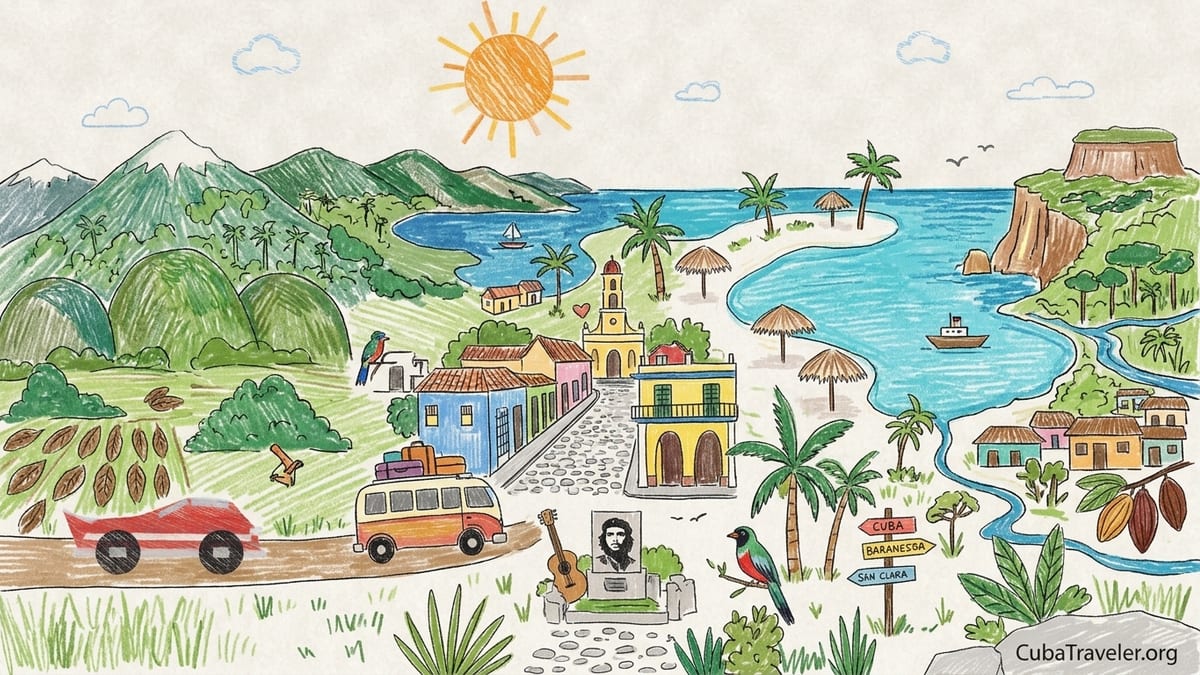
Cuba is far more geographically diverse than many visitors realise. Behind the familiar images of Havana’s classic cars and Varadero’s mega-resorts lies an island of limestone valleys, bird-filled wetlands, pine-clad mountains and surf-lashed Atlantic headlands, threaded together by a chain of colonial and revolutionary cities. In late 2026, however, Cuba is also grappling with severe fuel shortages, rolling power cuts and disrupted internal transport, which means that what looks appealing on a map is not always simple to reach in practice. This guide sets out the country’s major destinations beyond Havana and Varadero, combining their enduring attractions with a frank look at how easy they are to visit right now.
Cuba’s Geography and 2026 Travel Reality
Cuba stretches more than 1,200 kilometres from the limestone hills of Pinar del Río in the west to the rainforest-cloaked cliffs of Baracoa in the east. The western third is dominated by fertile tobacco valleys and the protected Sierra del Rosario biosphere reserve. Central Cuba is a corridor of sugar-era cities such as Cienfuegos, Trinidad, Santa Clara and Camagüey, while to the north lie strings of cays like Cayo Santa María and Cayo Coco with long, pale beaches and shallow turquoise seas. The south coast is very different, shaped by wetlands like the Ciénaga de Zapata, mountainous interiors around Topes de Collantes and the Sierra Maestra, and deep natural bays flanked by cities such as Santiago de Cuba. The far east has a more tropical, almost Caribbean coast feel, especially around Baracoa and the national parks in Guantánamo and Holguín provinces.
As of October 2026, Cuba’s tourism infrastructure is under unusual strain. An acute fuel shortage has triggered transportation shutdowns, strict rationing and frequent power outages, affecting everything from long-distance buses to airline refuelling and hotel generators. International carriers have reduced or re-routed services, and government and independent assessments describe a country facing regular blackouts, disrupted logistics and declining tourism numbers. In practice this means that trips which once combined several regions in a single visit now demand more time, contingency planning and flexibility, and some remote nature sites may be very difficult to reach consistently.
For most international visitors, José Martí International Airport in Havana remains the principal entry point, with additional long-haul and charter traffic focused on Santiago de Cuba, Holguín, Varadero, Santa Clara and Cayo Coco. In the current context, places with strong local economies or a concentration of tourist beds, such as Havana, Viñales, Trinidad and Guardalavaca, tend to maintain better services and more reliable local transport. More isolated parks and eastern mountain areas can be rewarding but require careful assessment of access once you are on the ground, ideally via local tour operators and casa particular hosts who know the current state of the roads, fuel availability and local guides.
The sections that follow profile each major destination regionally, balancing their long-standing appeal with how they function right now. For every place you will find defining attractions, the closest practical airport, suggested length of stay, the level of transport effort currently involved, typical accommodation style, options for independent travel and the main drawback in late 2026.
Havana: Essential Hub and Urban Base
Havana is still the island’s main gateway and the most practical base for understanding Cuban life in 2026. Old Havana remains the visual highlight, with its four principal plazas surrounded by restored baroque churches, arcaded mansions and small museums. The colonial fortifications that once guarded the harbour survive in the form of the Castillo de la Real Fuerza and the sprawling Morro-Cabaña complex across the bay, which hosts cultural events and viewpoints back over the city. In the late afternoon, the Malecón seawall fills with locals sitting, socialising and fishing when the weather is calm, while Vedado offers a mixture of 20th-century apartment blocks, embassies, music venues and private restaurants in repurposed mansions.
The nearest and most logical airport is José Martí International, around 30 to 40 minutes from central Havana by taxi in normal traffic. With fuel shortages, travellers report that queues for official taxis and state fuel stations can be lengthy, but there are still plenty of licensed private drivers serving the airport, especially around international arrivals. In 2026, an ideal stay in Havana is at least three nights, allowing time for walking tours of Old Havana, a circuit along the Malecón, and a day for neighbourhoods like Vedado or excursions to nearby beaches if conditions allow. Because internal transport is so unpredictable, many visitors are now choosing to extend their Havana stay and use it as a base for one or two well-planned side trips rather than attempting ambitious cross-island loops.
Accommodation in Havana ranges from state-run hotels on the Malecón and in Old Havana to thousands of casa particulares, which function like licensed homestays or guesthouses. In the context of power cuts, casas with their own generators or solar backup have become particularly attractive, and hosts often provide practical information about which ATMs are working, where food is available and how to arrange transport to the bus station or airport. Independent travel is very feasible within Havana itself, thanks to walkable districts and a concentration of services, though even here visitors may face intermittent mobile data coverage, occasional water interruptions and fluctuating restaurant opening hours.
The main disadvantage in Havana in October 2026 is the broader national crisis that lies just below the city’s photogenic surface. Travellers may experience power outages that affect air conditioning and lifts, empty supermarket shelves, and intermittent shortages of essentials such as bottled water. While tourist areas are prioritised to some extent, the city’s old classic-car taxis are less numerous than in the past because of high fuel consumption, and traffic can thin out dramatically during acute shortages. Visitors who arrive prepared for these realities, and who spend money in locally run businesses, can still find Havana a deeply rewarding place to start or end a Cuban journey.
Western Cuba: Viñales, Las Terrazas and the Tobacco Valleys
West of Havana, the province of Pinar del Río is dominated by mogotes, the rounded limestone hills that frame the Viñales Valley. Viñales town has developed into the main rural tourism hub, surrounded by small tobacco farms, red-earth fields and caves that can be explored with local guides. Horseback rides through the valley, visits to drying barns where leaves are still cured for export cigars, and hikes up to viewpoints at sunrise remain classic activities. Despite agricultural damage from recent storms, tobacco culture continues, and many farmers now supplement their income through tourism, inviting visitors into family homes for coffee, meals and improvised lessons in traditional cigar rolling.
Most visitors reach Viñales overland from Havana, around 2.5 to 3 hours by private taxi or a scheduled tourist bus when fuel is available. In the current fuel-constrained environment, group transfers organised through Havana guesthouses or local agencies tend to be more reliable than last-minute individual bookings, as they can pool demand and secure fuel in advance. A stay of two or three nights allows time for at least one full day in the valley plus an excursion to nearby caves or coastal areas if roads are passable. There is no nearby international airport, so Havana remains the necessary gateway.
Accommodation in Viñales is almost entirely based on casas particulares, from simple spare rooms to multiroom guesthouses with small terraces and rooftop views of the mogotes. Many now invest in small inverters, batteries or generators to keep fans, lights and water pumps running during outages, although hot water can still be inconsistent when power cuts stretch for many hours. Independent travellers can arrange hikes and horseback tours directly with their hosts or at informal stands around the main square, which helps ensure money stays in the community. The main disadvantage is that public transport is very limited, and if state-run tourist buses are cancelled due to fuel shortages, reaching or leaving Viñales can require patience and flexibility or the expense of private transfers.
Closer to Havana, the eco-community of Las Terrazas in the Sierra del Rosario offers a contrasting glimpse of Cuban environmental policy. Established as a reforestation and sustainable development project, it is centred around a small lake and low-rise buildings set among secondary forest, with birdwatching, zip-lines, hiking and visits to artists’ studios. Las Terrazas is typically visited as a day trip or one-night stay from Havana or Viñales, again reached by road. The area has a cluster of accommodation that mixes a state-run hotel with casas. Its small size and self-contained nature can make daily life there more stable than in some rural areas, although the same national fuel and electricity problems still apply. The main disadvantage is limited evening activity and the fact that if fuel shortages intensify, access from Havana can temporarily become difficult, leaving travellers reliant on pre-arranged tours instead of spontaneous visits.
Central Colonial Cities: Cienfuegos, Trinidad, Santa Clara and Camagüey
Central Cuba’s cities trace the arc of sugar, slavery and railroads, and remain some of the island’s most atmospheric destinations away from Havana. On the south coast, Cienfuegos sits on a broad bay and is known for its French-influenced 19th-century street grid and neoclassical architecture. The central Parque Martí, framed by the Tomas Terry Theatre and an ornate cathedral, showcases this urban planning, while Punta Gorda to the south features eclectic mansions, once owned by sugar barons, that look out across the bay. Cienfuegos is also a useful gateway for excursions into the nearby Escambray foothills and the coastal section of the Ciénaga de Zapata to the west, conditions permitting.
Further east, Trinidad offers perhaps the best-preserved ensemble of colonial-era streets in Cuba, its cobbled lanes and pastel houses concentrated around Plaza Mayor. Behind the historic core lies the Valle de los Ingenios, where ruined sugar mills and lookout towers recall the industry that made the city wealthy. Museums, live-music venues and artists’ workshops fill many historic buildings, while nearby beaches and the Topes de Collantes nature reserve in the Escambray Mountains add variety for longer stays. In normal times, travellers would often divide a week between Cienfuegos and Trinidad. In 2026, with transport unpredictable, many now travel directly from Havana or Varadero area resorts to Trinidad and base there for several days, adding a day trip to Cienfuegos if fuel and drivers are available.
Santa Clara, inland in Villa Clara province, is best known for its pivotal role in the Cuban Revolution. The city’s main attraction is a monumental memorial complex honouring Ernesto “Che” Guevara, which includes a statue, a mausoleum and a museum explaining his life and the decisive 1958 battle that took place in and around Santa Clara. The city also has a modest but lively centre with theatres, bars and a university population. Santa Clara’s Abel Santamaría Airport is one of the smaller Cuban airports with limited international services, used primarily by some charter flights serving the nearby cays and central resorts, but current schedules are very fluid and should be checked close to travel dates. Given the transport context, many travellers now visit Santa Clara as a stopover on a road transfer between Havana or Varadero and Trinidad rather than as a primary base.
Camagüey, further east again, is a labyrinthine colonial city whose irregular street pattern was historically designed as a defensive feature. Its many plazas, churches and restored facades have led to a UNESCO World Heritage listing. In recent years, a growing number of boutique-style casas and small hotels have opened in its centre, often converted from old mansions with interior courtyards. Ignacio Agramonte International Airport serves Camagüey, but as of late 2026 only a handful of international routes are operating, and these can be suspended at short notice if fuel for refuelling or ground operations is constrained. Ideally, visitors should allow at least two nights to appreciate the city’s plazas, markets and emerging arts scene.
Across these central cities, accommodation is a mix of state hotels and private guesthouses. Independent travel remains possible, especially for those with Spanish, but the main disadvantage is that all rely on overland transport links that are sensitive to fuel supply. National and tourist bus timetables can change quickly; some visitors report needing to buy tickets as soon as they arrive in a city and still being moved to different departure times. Private drivers may charge noticeably more than a few years ago to cover black-market fuel costs. Travellers who prize flexibility and local contact may still find these cities among the most rewarding in Cuba, but should build in extra time and budget.
Southern Wetlands and Mountain Retreats: Ciénaga de Zapata, Playa Girón and Topes de Collantes
On the south coast between Havana and Cienfuegos lies the Ciénaga de Zapata, one of the Caribbean’s largest wetlands. This sparsely populated region of mangroves, marshes and karst features is important for birdlife, including endemic species, and has long drawn specialist nature tours. The villages of Playa Larga and Playa Girón, at opposite ends of the Bay of Pigs, provide basic beach access, small dive centres and a handful of casas and modest hotels. The area also holds historical significance as the site of the failed 1961 invasion, with a small museum in Playa Girón commemorating the event.
Reaching the Ciénaga de Zapata currently requires road travel from Havana or Varadero, typically three to four hours depending on fuel queues and road conditions. There is no nearby commercial airport, and limited public transport makes independent access challenging when tourist buses are disrupted. For those able to get there, two or three nights allows a mix of diving or snorkelling, birdwatching and historical visits. Accommodation is largely in casas particulares and a few older state-run beach hotels, some of which have had intermittent maintenance due to the economic situation. The main disadvantage in 2026 is isolation: if fuel shortages worsen or storms damage roads, getting in or out could be slow, and power cuts can last longer than in cities, potentially affecting water pumps and refrigeration in small properties.
Inland from Trinidad, Topes de Collantes is a nature reserve spread across the northern slopes of the Escambray Mountains. It offers cooler temperatures, waterfalls such as Salto del Caburní, coffee plantations and well-marked walking trails, along with several large, state-run hotels and a scattering of casas. In more stable years, shared trucks, minibuses and guided excursions made day trips or overnight stays straightforward. Under current fuel constraints, many of these services run less often or only when group numbers justify the journey. Travellers based in Trinidad often arrange a day hike with a local agency that can confirm, shortly before departure, whether transport up the mountain is viable.
Independent travellers who reach Topes find that the main activities, such as walking and swimming in river pools, cost relatively little once on site compared with long-distance travel. However, the main disadvantage is again reliability. Storms and heavy rains can trigger temporary trail closures or landslides, and when combined with national fuel rationing this can mean cancelled excursions with little notice. Visitors who are strongly nature-focused and flexible with timing will find Topes a refreshing counterpoint to the lowland heat, but it should not be your only planned highlight given present uncertainties.
The Eastern Highlands and Afro‑Cuban Cities: Santiago de Cuba and Baracoa
The far east of Cuba feels culturally and geographically distinct, closer to the older Caribbean world of small bays, forested slopes and powerful musical traditions. Santiago de Cuba, the island’s second city, sits beside a deep natural harbour backed by hills. It is known for its important role in both the wars of independence and the 1950s Revolution, as well as for its strong Afro‑Cuban cultural presence. Key attractions include the fortress of Castillo del Morro guarding the bay entrance, the leafy Parque Céspedes with its historic cathedral, and the Santa Ifigenia cemetery, where national figures are buried with elaborate honour guards. Live music spills from Casa de la Trova and neighbourhood venues, especially around Carnival season.
Antonio Maceo International Airport serves Santiago and remains one of Cuba’s more connected regional airports, with a small cluster of international routes that have persisted even as others have been cut back. Nonetheless, fuel shortages have led to schedule changes and occasional cancellations, so travellers should treat any onward domestic connection as provisional until close to departure. Given the distance from Havana, a direct international arrival in Santiago, when available, is the most practical route. An ideal stay is at least three nights, balancing historical visits with time to experience the city’s musical life and nearby beaches or hill villages.
Accommodation in Santiago includes older state hotels and an expanding network of casas in the historic centre and residential districts. Given the pressures on the national grid, visitors should ask in advance about backup power and water systems, since eastern provinces have been particularly affected by blackouts in recent years. Independent travel within the city is manageable using taxis and walking, but overland links to the rest of the island have been heavily impacted by fuel rationing. Long-distance buses can be delayed, and securing reliable private transport for journeys across provinces is both time consuming and costly.
North of Santiago, the town of Baracoa lies at the end of a winding mountain road and has a very different atmosphere. Surrounded by rivers, cocoa plantations and flat-topped mountains, it feels more like a tropical outpost than a traditional Cuban city. The region is famous for its cacao traditions, with local households producing dense chocolate sauces and sweets, and for dishes such as fish cooked in coconut milk. It is also a common base for exploring nearby sections of Alejandro de Humboldt National Park, where dense forests shelter a range of endemic species. Historically, Baracoa appealed to travellers seeking off‑the‑beaten‑track experiences and multi-day hikes.
In late 2026, Baracoa remains one of Cuba’s most logistically challenging major destinations. There is no sizable international airport; visitors usually arrive via Guantánamo or Holguín provinces by road, or via limited domestic flights subject to change. Fuel shortages and storm‑damaged roads have made these journeys slower and less predictable. Accommodation is mostly in casas and a few modest hotels, where services can fluctuate with the power supply. Independent travellers who reach Baracoa are rewarded with strong local culture and scenery, but the main disadvantage is that sudden disruptions to fuel or weather can significantly complicate exit plans, so it should only be attempted with generous time buffers.
National Parks and Remote Nature: Sierra Maestra, Desembarco del Granma and Alejandro de Humboldt
Cuba’s mountain ranges and remote coasts protect some of its most important ecosystems. The Sierra Maestra, straddling Granma and Santiago de Cuba provinces, combines rugged peaks with historical sites related to the guerrilla war of the 1950s. Trails in the region around Pico Turquino, the island’s highest peak, and the preserved rebel hideouts have long attracted domestic hikers and foreign visitors interested in both nature and history. In more stable periods, excursions could be arranged from Bayamo or coastal bases, with local guides and park authorities coordinating access and overnight stays in simple shelters.
Desembarco del Granma National Park, on the southeastern coast, covers a landscape of marine terraces and cliffs where the yacht Granma landed in 1956 with Fidel Castro and his fellow revolutionaries. The park is valued for both its geological formations and its symbolic role in Cuban history. Visiting typically involves boat trips or rough coastal roads, guided walks and very basic accommodation or camping, with services coordinated through local tourism offices. Alejandro de Humboldt National Park, located in the northeastern corner of the island, protects one of the Caribbean’s most significant tracts of humid tropical forest, with complex geology and high levels of endemism. Access points near Baracoa have offered guided hikes and river excursions, often marketed through specialist nature operators.
In 2026, the operating reality for these remote parks is particularly fluid. Official and independent reports highlight that fuel is being prioritised for essential services such as hospitals and food production, and that eastern provinces were heavily affected by Hurricane Melissa in 2025, which damaged infrastructure and agriculture. As a result, park access roads, ranger posts and small visitor facilities may not receive regular maintenance, and transport providers face difficulty refuelling vehicles and boats. Some organised tours continue on a small scale, especially from better-served gateways like Santiago de Cuba and Holguín, but departures are more likely to be cancelled or shortened when blackouts or shortages intensify.
For nature‑focused travellers prepared to accept uncertainty, it can still be worth enquiring with reputable local operators upon arrival in cities like Santiago, Holguín or Baracoa about the current situation in specific parks. However, it is prudent to treat visits to Sierra Maestra, Desembarco del Granma and Alejandro de Humboldt as optional additions rather than central pillars of a tight itinerary. The main disadvantage at present is not the intrinsic difficulty of the terrain, which has always required a basic level of fitness, but the fragility of transport and services supporting any excursion. Travel insurance that covers missed connections and itinerary changes is particularly important for those venturing into these areas.
Northern Cays and Beach Regions: Varadero, Cayo Coco, Cayo Santa María, Cayo Largo and Guardalavaca
Cuba’s northern cays and beach belts are often grouped together, but in practice they differ notably in accessibility and atmosphere. Varadero, on the Hicacos Peninsula, is the best‑known resort area and retains an international airport with at least some ongoing long‑haul and charter flights, though overall traffic has dropped and is subject to change in response to fuel availability and demand. The peninsula is dominated by large, mostly all‑inclusive resorts lining a long, sandy beach, with a small town area where independent restaurants and casas cater to travellers seeking a less packaged stay. Being relatively close to Havana by Cuban standards, Varadero also functions as a practical fall‑back base when internal flights or buses are disrupted.
Further east, Cayo Coco and its neighbour Cayo Guillermo form part of the Jardines del Rey archipelago. They are reached via causeways from the mainland and served by Jardines del Rey Airport, which traditionally handled charter flights from Canada and Europe. The resort areas on these cays are almost entirely composed of self‑contained complexes, with very limited local population outside the tourism workforce. In the current context, this means that when resorts are operating, essential services inside them can be relatively insulated from shortages compared with surrounding provinces, but access remains vulnerable to flight reductions and the availability of fuel for transfer vehicles. Travellers choosing these cays in 2026 should confirm with their tour operator or hotel not only flight schedules, but also how they will be transported between the airport and their accommodation if there are fuel-related disruptions.
Cayo Santa María, reached by a long causeway from the mainland in Villa Clara province, is another cluster of predominantly all‑inclusive resorts. Historically it has been marketed heavily in package deals, with most visitors arriving via Santa Clara’s airport or, in some cases, domestic links routed through Havana. The beach itself is attractive, and resorts provide the usual mix of pools, bars and nightly entertainment. However, there is minimal independent-travel infrastructure on the cays themselves. With fuel tight and domestic flights reduced, some packages have been reconfigured to include longer overland transfers from more reliable gateways, which can make arrival days lengthy. The main disadvantage for independent travellers is the lack of public transport or local services beyond the hotel zone, which can make the experience feel disconnected from wider Cuban life.
Cayo Largo del Sur, located off the south coast, once relied heavily on charter flights to its small airport combined with seasonal ferry links. These links have been among the most sensitive to national fuel supply issues, and schedules have fluctuated sharply in recent years. As a result, while the island still appeals on paper with its quiet beaches and diving, it is one of the least predictable destinations to include in a short trip in 2026 unless travelling on a tightly coordinated package where the tour operator assumes responsibility for any changes. By contrast, the Guardalavaca region in Holguín province, served by Holguín’s Frank País Airport, offers relatively easier access. It combines mid‑sized resorts with some opportunities for independent stays and excursions inland. Holguín remains one of the more active regional airports, with several international routes still operating, although here too travellers have reported occasional last‑minute adjustments driven by fuel and demand.
Across all these beach destinations, an ideal stay for a pure resort holiday is around five to seven nights, with Havana or another city added on if transport allows. Accommodation is primarily in large resorts, though Varadero and parts of the Holguín coast also have casas and small hotels for those seeking more contact with local life. Independent-travel options are strongest where there is a nearby town, such as Varadero’s older centre or fishing villages near Guardalavaca, and weakest on self-contained cays like Cayo Coco and Cayo Santa María. The main disadvantage in October 2026 is that reduced flights and fuel shortages can turn what appears to be a simple beach escape into a trip with unexpected logistical complications, so travellers should be comfortable with possible schedule changes.
Designing a Trip in 2026: Suggested Combinations and Conditions
Given Cuba’s current context, trip planning needs to start from what is realistically reachable rather than from a wish list of every appealing name on the map. For first‑time visitors, a conservative and resilient combination is Havana plus one additional destination that lies within a manageable overland journey. For example, a ten‑day itinerary could include five nights in Havana and four in Viñales or Trinidad, with one flexible night kept in Havana at the end in case buses or transfers are delayed. Travellers arriving on package holidays to Varadero or Guardalavaca can invert this pattern, using the resort as a base and adding a carefully organised overnight excursion to Havana or a nearer city, booked through an operator that can adjust plans if fuel supplies tighten.
History‑oriented visitors might focus on a Havana, Santa Clara and Santiago de Cuba triangle, again only if flight schedules between Havana and Santiago are operating reliably close to departure. This would allow time in Old Havana, a stop at the Che Guevara memorial in Santa Clara and several days in Santiago, visiting revolutionary sites and museums. However, any island‑wide itinerary that relies on internal flights or long overland stretches should be considered explicitly conditional on the current transport situation. Travellers should monitor official travel advisories and airline announcements, book flexible tickets where possible, and be prepared to adapt on the ground, potentially spending more time in one region and dropping distant segments.
Nature enthusiasts could combine Havana with Viñales and a limited foray into Topes de Collantes from Trinidad or into sections of the Ciénaga de Zapata from Playa Larga, chosen based on up‑to‑date local advice. For those willing to accept higher uncertainty, adding Santiago de Cuba as a second hub for exploring nearby mountainous areas and coastal parks can be very rewarding, though visits deeper into the Sierra Maestra, Desembarco del Granma or Alejandro de Humboldt should be treated as optional side trips subject to local confirmation. Investing in a few practical items, such as a small torch, a power bank and some snacks for long travel days, will improve comfort when delays or outages occur.
Beach‑focused trips in 2026 work best when anchored around airports that still see relatively consistent international traffic, such as Varadero, Holguín or, to a lesser degree, Cayo Coco, and when travellers are content to spend most of their time within resort areas. Those who also want cultural immersion can allocate three or four nights to Havana either at the start or end of their trip, travelling overland by pre‑arranged transfer. Packages that include guaranteed transfers and onsite resort support can reduce stress compared with assembling everything independently, though they also limit direct engagement with local communities. Whatever the style of travel, it is wise to carry some hard currency in euros or other widely accepted forms, keep expectations flexible and be ready for a trip where the human and political context is as present as the beaches and music.
FAQ
Q1. Is it safe to travel to Cuba in October 2026?
Travel advisories from several governments currently urge caution or advise against non‑essential travel due to fuel shortages, frequent power outages and pressure on essential services. Many visitors who do go still report rewarding experiences, particularly in Havana and major resort areas, but also note visible shortages and infrastructure problems. Prospective travellers should check their own government’s latest advice, ensure they have comprehensive insurance and be prepared to adapt plans on the ground.
Q2. Which Cuban airports are the most reliable entry points right now?
Havana’s José Martí International remains the primary and generally most reliable gateway, with Santiago de Cuba, Holguín, Varadero and, on a smaller scale, Santa Clara and Cayo Coco also handling international flights. However, the number of routes and frequencies has fallen compared with pre‑pandemic years, and some carriers have temporarily suspended or reduced services. Flight schedules can change at short notice when fuel supplies tighten, so travellers should monitor airline communications closely.
Q3. Can I still travel independently around Cuba by bus?
Independent travel by bus is possible but has become noticeably more complicated. Long‑distance tourist buses and some national services are still running, yet timetables may be reduced and departures affected by fuel availability. Tickets often need to be purchased well in advance, and even then schedules can change. Many visitors now mix buses with shared taxis or private transfers arranged through guesthouses. Those on tight schedules should allow extra buffer days between key connections.
Q4. How badly do power cuts affect hotels and guesthouses?
Power cuts are common across the island, including in major cities and resort zones. Larger hotels and some well‑equipped casas particulares have generators or battery systems that keep essential services running for part of an outage, such as lighting, basic water pumps and sometimes Wi‑Fi. However, long or repeated blackouts can strain these backup systems, affecting air conditioning, lifts and hot water. When booking, it is worth asking properties how they manage outages and whether they have any form of backup.
Q5. What is the best region for nature and hiking given current conditions?
For most visitors in 2026, the most realistic nature destinations are those relatively close to major hubs, such as Viñales near Havana, Topes de Collantes above Trinidad and sections of the Ciénaga de Zapata accessible from Playa Larga or Playa Girón. These areas offer a mix of hiking, birdwatching and rural landscapes, with infrastructure that, while basic, is supported by established tourism circuits. More remote parks like Sierra Maestra, Desembarco del Granma and Alejandro de Humboldt are still of high ecological value but require greater flexibility and should be approached as optional extras once in the country.
Q6. Where should I go in Cuba for music and Afro‑Cuban culture beyond Havana?
Santiago de Cuba is the standout destination beyond Havana for live music and Afro‑Cuban cultural traditions, with venues such as casas de la trova and neighbourhood peñas showcasing son, rumba and related genres. Carnival and other local festivals further highlight this heritage when conditions allow them to run. Smaller cities like Camagüey and Trinidad also have lively music scenes on a more modest scale, particularly in their historic centres.
Q7. Are Cuba’s northern cays like Cayo Coco and Cayo Santa María operating normally?
Resorts on cays such as Cayo Coco and Cayo Santa María continue to receive guests, especially through package holidays that bundle flights and transfers. Inside the resort zones, management typically prioritises power and water to keep core services running. However, the wider context of reduced flights and fuel rationing means that operations are not entirely “normal.” Travellers should expect possible adjustments to flight times, occasional shortages of imported goods and limited options for independent exploration beyond the resort compounds.
Q8. How long should a first‑time visitor plan for Cuba under current conditions?
In light of possible transport delays and schedule changes, many travellers find that 10 to 14 days is a comfortable window for a first visit. This allows at least four or five nights in Havana and one additional region, with buffer time built in for disrupted bus or flight connections. Shorter trips are possible, especially to a single resort area plus a brief city stay, but leave less room to adapt if services are suddenly reduced.
Q9. What practical items should I pack given blackouts and shortages?
Useful items include a small but bright torch or headlamp, a high‑capacity power bank, any essential medicines in sufficient quantities, basic snacks for long travel days, and a refillable water bottle with purification tablets or a filter if you plan to move beyond major cities and resorts. Having some hard currency in euros or another widely accepted form can also help when card systems or local ATMs are offline. Lightweight clothing that tolerates heat without relying entirely on air conditioning is also important.
Q10. Is it ethical to visit Cuba while the country faces a humanitarian crisis?
This is a personal decision. Many Cubans who work in tourism emphasise that responsible visitors provide vital income for families and small businesses at a difficult time. At the same time, the country is experiencing severe shortages and strained public services, and visitors should avoid putting additional pressure on limited resources, follow local guidance and be sensitive to the hardships people face. Travellers who choose to go can maximise their positive impact by staying in locally owned accommodation, eating in private restaurants and treating Cuban partners as collaborators rather than service providers.