


Cuba in late 2026 is a very different mosquito landscape from the island many travelers remember. Dengue is surging, chikungunya has established sustained transmission, Oropouche virus has moved from curiosity to concrete threat and Zika still matters for pregnancy planning. In October 2026, the U.S. Centers for Disease Control and Prevention (CDC) formally classified Cuba as a high-transmission dengue destination after detecting at least 10 recent infections in returning travelers, and the Pan American Health Organization (PAHO) reported concurrent circulation of dengue virus serotypes DENV-2, DENV-3 and DENV-4 in the country. Against that backdrop, the usual packing-list advice to “bring mosquito spray” is not just simplistic. It is inadequate.
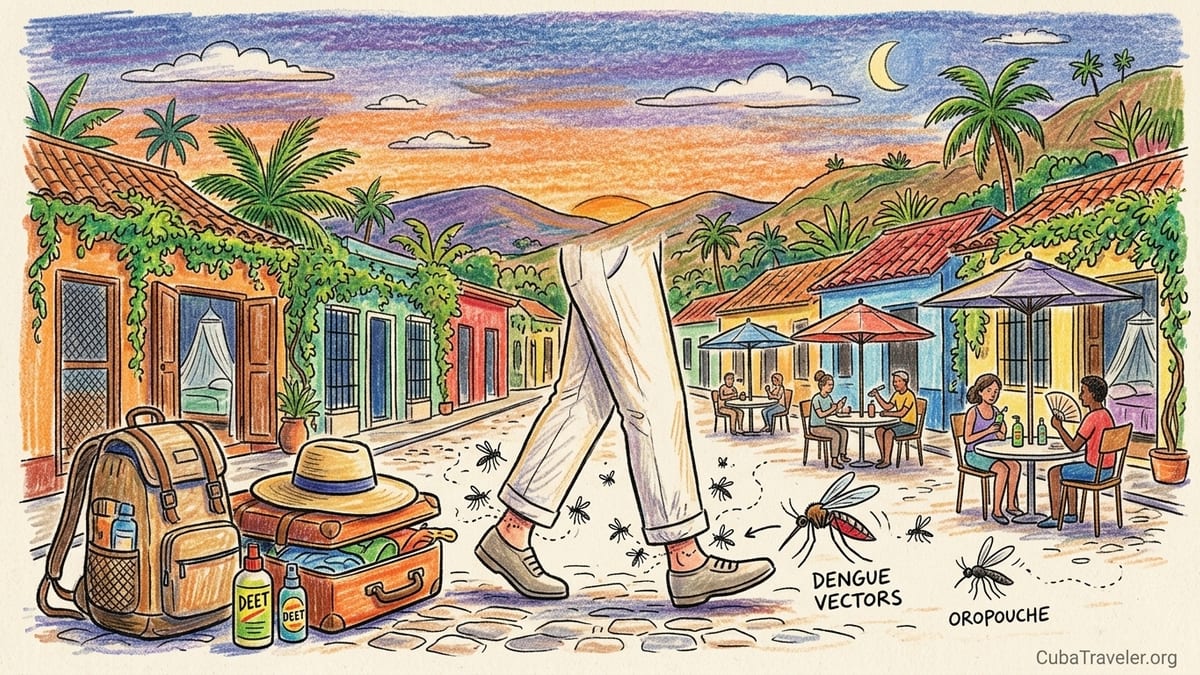
The 2026 Arbovirus Picture in Cuba
Public health agencies now treat Cuba as part of a wider regional arbovirus crisis rather than an isolated hotspot. The CDC’s dengue risk map moved Cuba into its high-transmission category on October 7, 2026, after a spike in infections reported among travelers in the prior three months and evidence of sustained local spread. At the same time, PAHO’s regional dengue situation reports indicate that Cuba is experiencing circulation of dengue types 2, 3 and 4, meaning that residents and repeat visitors can be exposed to multiple distinct infections over time.
Chikungunya, which had not historically been a major problem on the island, changed that picture starting in mid‑2025. PAHO’s Cuba-specific health situation report describes an outbreak beginning around July 2025 that produced more than 51,000 suspected chikungunya cases by the end of that year, with just under 2,000 laboratory confirmations and 46 reported deaths. Transmission did not simply burn out with the new year. In the first four weeks of 2026, Cuban surveillance still counted over 1,400 additional suspected cases and more confirmed infections, a clear sign that chikungunya had joined dengue as an established risk rather than a one‑off scare.
Oropouche virus, once thought of as a niche Amazonian curiosity, is now firmly on Cuba’s map. PAHO documented the country’s first recognized Oropouche cases in 2024, and a subsequent regional update in 2025 listed Cuba among countries with dozens of confirmed infections. A 2026 seroprevalence study by researchers collaborating with a major European university group found that Oropouche antibodies, virtually absent in Cubans earlier in the decade, were detectable in more than one in ten residents tested after the 2024–2025 outbreak, highlighting how quickly this virus has spread across the island.
For travelers, this means that Cuba in 2026 is not a destination where “dengue happens sometimes.” It is a setting where several mosquito-borne and midge-borne viruses are simultaneously circulating, health services are managing overlapping outbreaks, and diagnostic capacity can be stretched. A practical travel-health strategy needs to take that layered reality into account.
Dengue, Chikungunya, Oropouche and Zika: How They Differ
Although dengue, chikungunya, Oropouche and Zika often begin with a similar flu-like picture, they are caused by different viruses and spread in different ways. Dengue, chikungunya and Zika are all primarily transmitted by Aedes mosquitoes, especially Aedes aegypti. These mosquitoes thrive in Cuban cities such as Havana, Santiago de Cuba, Holguín and Camagüey, breeding in small collections of fresh water: a bucket on a balcony in Centro Habana, an uncovered rooftop tank in Santa Clara, or a discarded tire behind a casa particular in Trinidad. They tend to bite during the day, with peak activity in the early morning and late afternoon, not just at sunset.
Oropouche virus is different. It is closely linked to biting midges of the Culicoides genus, sometimes called “no-see-ums,” which are far smaller than mosquitoes and can pass through some standard window screens. Certain mosquito species can also transmit Oropouche, which complicates control. In practical terms, a traveler watching the sunset at Varadero, assuming risk only appears when big mosquitoes buzz around at dusk, may still be exposed to Oropouche-carrying midges in mid‑afternoon shade or during a humid evening when they do not even notice being bitten.
Incubation periods and symptom patterns also vary. Dengue typically incubates for 4 to 10 days before sudden onset of high fever, severe headache, eye pain, muscle and joint aches and sometimes a rash. Chikungunya’s incubation is usually 3 to 7 days, and in addition to fever it is notorious for intense joint pain that can become disabling and, in some people, last for months or even years. Oropouche often incubates for 4 to 8 days and causes fever, headache and muscle pain that can mimic dengue but tends to have more pronounced neurological symptoms in a small fraction of cases. Zika’s incubation is generally a few days to a week, with many infections asymptomatic; when symptoms occur, they are often mild fever, rash, conjunctivitis and arthralgia.
Complications differ in ways that matter for travel decisions. Dengue can progress to severe dengue with plasma leakage, bleeding and organ impairment, particularly in those who have had a different dengue type before. Chikungunya’s headline complication is persistent joint pain, which can leave an otherwise healthy adult struggling to walk up the steps of a Havana guesthouse weeks after the fever settles. Oropouche has been associated with meningitis and encephalitis in some outbreaks, and although most infections are self-limited, reports of neurological involvement have increased as more cases are recognized. Zika, finally, is most feared for its effects on pregnancy, including congenital malformations when infection occurs during gestation, and for its association with Guillain–Barré syndrome.
Why “Just Bring Mosquito Spray” Fails in 2026
Many well-meaning articles still reduce vector protection to a single line in the packing list: “Bring a good insect repellent.” That might have been naive even ten years ago. In the context of contemporary Cuba, it is genuinely misleading. First, not all repellents are equal. A perfumed “tropical” spray from a beach shop on the Malecón with low concentrations of active ingredient is unlikely to deter determined Aedes mosquitoes in a shaded courtyard in Vedado or midges in the mangroves near Cayo Coco.
Second, timing matters. Because the main dengue and chikungunya vectors bite predominantly during the day, the strategy many travelers still follow to “spray up for sunset” misses some of the highest-risk hours. A Canadian visitor staying in Old Havana in August, who applies repellent only at 7 p.m. before heading out for dinner, may already have been bitten repeatedly on bare ankles during a late-morning walking tour through Habana Vieja when she wore shorts and sandals without any protection.
Third, Oropouche shifts the equation again. Travelers often assume that if they do not see clouds of mosquitoes they are safe. Biting midges can be almost invisible, especially at dusk on breezy beaches. Their small size lets them slip through standard window screens in older buildings. A backpacker relying only on a thin sheet and open jalousie windows in a budget casa in Baracoa to stay cool during a blackout, with a nearly empty can of repellent bought from a local market stall, is not applying a serious prevention approach.
Finally, social and infrastructure realities in Cuba complicate the ability to “just buy more spray if needed.” While some higher-end hotels in Havana and Varadero sell international brands like OFF! Deep Woods (containing DEET) or Autan (picaridin-based) in their small shops, availability is uneven elsewhere and supply chains are volatile. During peaks of dengue or chikungunya reporting, local pharmacies may run short of repellents, and tourists arriving with only a small carry-on-sized bottle can find themselves rationing it between several people. In other words, repellent is essential, but it is only one part of an integrated vector-avoidance strategy.
Vector Behavior, Blackouts and Why Screens and Nets Matter
A proper prevention plan in Cuba hinges on understanding that Aedes mosquitoes are urban, container-breeding insects that live alongside humans. They like shaded, indoor or semi-indoor spaces and bite during the day, often around legs and ankles, so they thrive in the exact locations travelers spend their time: hotel lobbies, cafe terraces, bus stations and rental apartments. The biting midges associated with Oropouche favor humid, vegetated areas and can be abundant near rivers, mangroves and poorly drained urban green spaces. Both can be active in the late afternoon and early evening, so “only worrying after dark” is a recipe for exposure.
Electricity reliability adds another critical layer. Cuba has experienced recurrent blackouts in recent years, including during hot, mosquito-heavy months. For a visitor used to relying on sealed, air-conditioned hotel rooms as an insect barrier, an evening power cut can change the environment in seconds. Without air conditioning, travelers may open windows and balcony doors in a Havana hotel or resort in Varadero to alleviate the heat. If those openings lack intact, tightly fitted screens, or if sliding doors are left ajar, mosquitoes and midges can enter and bite through the night.
In practice, that means that when you book a casa particular in Trinidad or Cienfuegos, simply asking “Is there air conditioning?” is no longer sufficient. A travel-health-aware guest will also ask if windows have good screens, whether bed nets are provided in the event of power cuts and if rooms can be adequately ventilated with fans while still keeping insects out. Larger hotels may have generators that keep air conditioning and elevators running during outages, but smaller guesthouses often do not, and their response to outages might be to open every window and door, increasing dengue, chikungunya and Oropouche exposure at exactly the time guests are in bed and unprotected.
Real-world examples illustrate the gap. In early 2026, reports from travelers on various forums described staying in otherwise comfortable Havana apartments where, during scheduled evening outages, hosts encouraged guests to sit out on the rooftop terrace to “catch the breeze.” Without repellent, long sleeves or nets, those two or three hours outside every night across a week-long stay become a series of additional exposure windows layered on top of daytime sightseeing.
Building a Serious Prevention Plan: Repellent, Clothing, Screens and Nets
Effective personal protection in Cuba begins with choosing a repellent with a proven active ingredient and sufficient concentration. Products containing DEET in the 20 to 30 percent range or picaridin (also called icaridin) around 20 percent are recommended by multiple travel-medicine authorities for destinations with dengue and chikungunya. These formulations, when applied correctly, can provide several hours of protection. A practical approach for a two-week trip for one adult is to bring at least one 100 ml bottle per week of travel, more if you sweat heavily, swim frequently or share with others, because application needs to be repeated throughout the day.
Clothing choices are the second pillar. Aedes mosquitoes preferentially bite exposed skin around the ankles, calves and forearms. Lightweight, loose-fitting trousers and long-sleeved shirts made of breathable cotton or technical travel fabrics make a tangible difference, especially during city touring or long bus journeys when feet and legs would otherwise be bare. Many travelers now pack one or two sets of insecticide-treated clothing, or pre-treat outfits with a permethrin spray before departure, following manufacturer instructions. While permethrin products may not be available in Cuban shops, they can often be applied at home in North America or Europe before the trip, giving several washes of residual protection.
Accommodation details are the third and often overlooked layer. When checking into a casa particular in Havana’s Vedado district or a colonial guesthouse in Camagüey, take a few minutes to inspect window and door screens for holes, ensure bathroom windows close properly and check whether a fan can be positioned to blow across the bed, which both cools and makes it harder for mosquitoes to land. If bed nets are provided, examine them for tears and tuck them fully under the mattress at night. In mid-range resort hotels in places like Varadero or Guardalavaca, nets may not be standard in all rooms, so travelers concerned about dengue sometimes pack a lightweight, self-supporting net for use above the bed or crib.
Environmental habits fill in the remaining gaps. Avoid leaving glasses of water, plant saucers or buckets of standing water on balconies or patios where you are staying, even for a few days, as these can rapidly become breeding sites. If you rent a car to drive the central provinces, avoid leaving windows open when the car is parked near vegetation in the late afternoon. For children who nap during the day, try to have them sleep in screened rooms or under a mosquito net, since day-biting Aedes can be active even in shaded indoor spaces.
When Fever Strikes in Cuba: What To Do and What To Avoid
Despite meticulous precautions, infections can still occur. What matters next is how quickly and appropriately a traveler responds. If you develop an acute fever during your time in Cuba or within two weeks of returning home, especially if it is accompanied by headache, joint pain, muscle aches, nausea or a rash, you should seek medical evaluation rather than attempting to self-diagnose dengue, chikungunya, Oropouche or Zika. These illnesses overlap so much clinically that even experienced clinicians cannot reliably distinguish them without laboratory testing and knowledge of current local transmission.
On the island, that usually means attending an international clinic or a well-regarded hospital in major cities like Havana, Varadero or Santiago de Cuba. Many package-tour operators have arrangements with specific clinics and can arrange transport. Solo travelers staying in casas can ask their host to call the designated tourist medical service. Carry a written list in Spanish of your symptoms, travel dates and any medications you have taken to help the doctor, especially if language is a barrier.
There are two critical points about medicines to consider while waiting to be seen. First, avoid taking non-steroidal anti-inflammatory drugs such as ibuprofen or naproxen if dengue is possible, unless a healthcare professional specifically advises otherwise. Dengue can affect platelet counts and blood clotting, and some anti-inflammatory medicines may increase bleeding risk in that context. Many travel-medicine services suggest using paracetamol (acetaminophen) for fever and pain relief until dengue has been excluded, but dosing and suitability always depend on individual medical history, so guidance from a clinician is important.
Second, do not rely on home rapid tests purchased online before your trip as a substitute for professional evaluation. While some combination dengue and chikungunya or dengue and Zika kits are sold directly to consumers, their accuracy varies, they can give false reassurance if performed too early, and they do not evaluate for Oropouche. A negative self-test performed in a Havana guesthouse after one day of fever is not a green light to resume full activity or start taking any medication you choose.
Special Populations: Healthy Adults, Families, Pregnant Travelers and Those With Medical Needs
For healthy adults without major underlying conditions, Cuba remains a destination that can be visited with thoughtful precautions and a realistic understanding of health system constraints. The key change in 2026 is that personal responsibility for vector avoidance and prompt care-seeking matters more than ever. A solo traveler in their 30s staying in air-conditioned hotels in Havana and Trinidad, who uses DEET or picaridin throughout the day, wears long trousers for city walks, keeps windows closed during evening blackouts and seeks prompt care if fever develops, can substantially reduce their risk of severe outcomes even in a high-transmission context.
Families with young children face additional practical challenges. Children often resist long sleeves and insect repellent, and they nap during peak Aedes biting hours. Parents planning a beach holiday in Cayo Santa María or Varadero should realistically consider whether they can maintain diligent repellent application for toddlers, keep them under shade and nets for naps and prevent them from playing barefoot in courtyards at dawn and dusk. Bringing child-appropriate formulations of repellent from home is important, since specific brands and concentrations suitable for infants or small children may not be available on local shelves.
Pregnant travelers or those trying to conceive deserve a separate and more cautious discussion. Zika virus circulation in the Americas has declined from its peak, but it has not disappeared, and Cuba has reported past transmission. Even low-level Zika circulation carries implications for fetal development if infection occurs during pregnancy. Dengue itself can also be more complicated during pregnancy. Many national travel medicine authorities advise pregnant women to consider postponing non-essential travel to any area with active Zika or significant dengue transmission. For those who still choose to travel to Cuba, consultation with an obstetric provider or travel-medicine specialist before booking is strongly recommended to discuss timing, insurance, contingency plans and enhanced protective measures.
Finally, people who require dependable medical access, such as travelers on dialysis, those with significant cardiac or respiratory disease or those taking medications that affect the immune system or blood clotting, should think carefully about whether this is the right moment to visit a destination managing simultaneous arbovirus outbreaks. Even in the best Cuban facilities, laboratory reagents, imaging and specialist referrals can be constrained during peaks of dengue and chikungunya activity. For some, it may be more prudent to defer travel or to choose less affected destinations in the region until the current wave of transmission abates.
The Takeaway
Cuba in 2026 offers rich music, culture and landscapes, but also a complex set of mosquito and midge-borne health risks that are measurably higher than in earlier years. Dengue has reached a level that prompted the CDC to classify the island as a high-transmission destination in October 2026, chikungunya has re-emerged with tens of thousands of suspected cases and dozens of recorded deaths since 2025, and Oropouche virus has moved from academic footnote to a real, documented presence with serological evidence of substantial spread.
In this context, simplistic travel advice to “bring mosquito spray” does not serve visitors well. Serious preparation means understanding that day-biting Aedes mosquitoes and tiny biting midges can expose travelers in city streets, hotel courtyards, blackout-darkened guest rooms and breezy seaside terraces. It means bringing adequate quantities of effective repellent with DEET or picaridin, choosing and using clothing and bed nets intelligently, and checking the physical realities of screens, doors and power reliability in the places you stay.
Equally important is a plan for what happens if you fall ill. Fever in or after a trip to Cuba should trigger prompt medical evaluation and cautious use of medications, not self-diagnosis via internet forums or over-the-counter anti-inflammatories grabbed from a suitcase. Travelers who are pregnant, traveling with young children or living with complex medical conditions need even more careful pre-trip counseling and, in some cases, should consider deferring or redirecting their travel.
With realistic risk awareness and layered protection, it is possible to enjoy Cuba’s plazas, beaches and music while respecting the viruses that now circulate alongside them. What no traveler should do in 2026 is treat mosquito-borne disease prevention as an afterthought or a single spray can on a checklist.
FAQ
Q1. Is it still safe to travel to Cuba given the dengue and chikungunya situation?
Travel safety depends on your health status, risk tolerance and how rigorously you can apply protective measures. Many travelers still visit Cuba, but in 2026 it requires more planning, including bringing effective repellent, choosing screened or air-conditioned accommodation and being prepared to seek medical care quickly if you develop a fever.
Q2. Are mosquitoes only a problem at sunrise and sunset in Cuba?
No. The Aedes mosquitoes that spread dengue, chikungunya and Zika are most active during the day, especially in the early morning and late afternoon, and they thrive indoors and in shaded areas. Relying on sunset-only precautions leaves you exposed during many of the hours you are out sightseeing.
Q3. Can I just buy mosquito repellent when I arrive in Cuba?
Availability of quality repellent in Cuba is inconsistent, and during outbreaks local supplies can run short or be limited to low-strength products. It is wiser to bring enough repellent from home containing DEET or picaridin in appropriate concentrations for each traveler in your group.
Q4. Do beach resorts in places like Varadero have fewer mosquitoes than cities?
Some beach resorts have active vector-control programs and air-conditioned rooms, which can reduce exposure, but they are not mosquito-free. Aedes mosquitoes can breed in resort landscaping and water features, and biting midges linked to Oropouche may be present near coastal vegetation. You still need repellent, protective clothing and attention to room screens and doors.
Q5. How worried should pregnant travelers be about Zika in Cuba now?
Zika activity has decreased from its peak years, but prior transmission in Cuba and ongoing regional circulation mean some level of risk remains, particularly for pregnancy. Many health authorities advise that pregnant people consider postponing non-essential travel to areas with dengue and possible Zika circulation, and those who do travel should seek personalized medical advice beforehand.
Q6. What should I do if I get a fever while I am in Cuba?
If you develop a fever, especially with headache, joint or muscle pain or rash, seek medical evaluation promptly at an international clinic or reputable hospital. While waiting to be seen, rest, drink fluids and avoid taking non-steroidal anti-inflammatory medicines like ibuprofen unless a clinician advises otherwise, because of potential issues if dengue is the cause.
Q7. Are children at higher risk from these mosquito-borne diseases?
Children can be particularly vulnerable because they may not verbalize symptoms clearly, are harder to keep covered and protected and often play outdoors during peak biting times. Families should bring child-suitable repellents, use nets for naps and nights and pay attention to any sudden fever or behavior change so they can seek care quickly.
Q8. Do standard window screens stop the insects that carry Oropouche?
Standard mosquito screens can reduce bites but may not fully block the very small biting midges associated with Oropouche, especially if screens are old or torn. Combining intact screens with repellent, fans and bed nets provides a stronger barrier than relying on screens alone.
Q9. How does the risk in Cuba compare with other Caribbean destinations?
The wider Caribbean has seen increases in dengue, chikungunya and Oropouche, but Cuba’s recent classification as a high-transmission dengue destination and its documented chikungunya and Oropouche outbreaks place it among the more affected islands at the moment. Specific comparisons depend on current surveillance data, which change over time.
Q10. Should people with chronic illnesses cancel trips to Cuba because of dengue and chikungunya?
Not everyone with a chronic condition must cancel, but people with significant heart or lung disease, immune suppression or other complex medical needs should discuss plans with their healthcare provider. Given Cuba’s current outbreaks and periodic strain on health facilities, some higher-risk travelers may decide that postponing or choosing a destination with lower arbovirus activity is the safer option.