


In 2026, asking which part of Cuba is “safest” feels a bit like asking which cabin you want on a ship with engine trouble. As a travel writer who has moved between central Havana, Varadero’s resort strip, the northern cays like Cayo Coco and Cayo Santa María, and smaller hubs such as Trinidad and Viñales, I no longer accept the easy claim that “the resort is safer than the city.” Crime matters, yes, but so do blackouts, fuel shortages, access to doctors and your ability to get out quickly when things go wrong. On those measures, the safety picture across Cuba is more complicated and far less reassuring than many package brochures suggest.
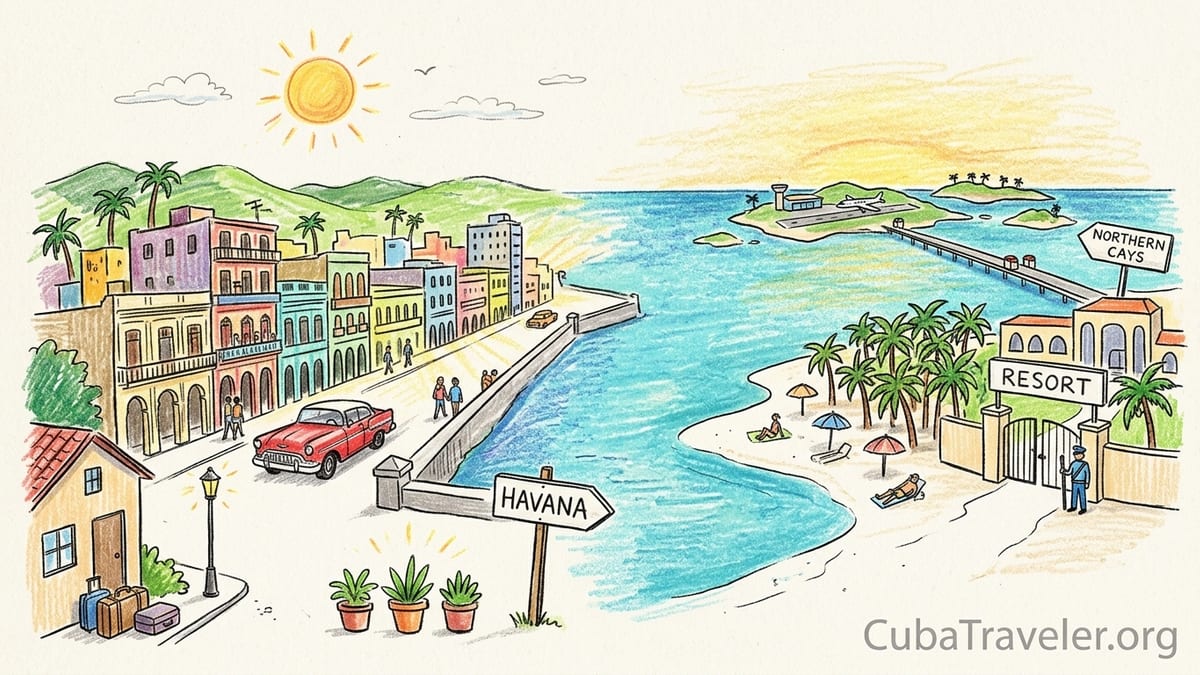
Why “Just Go to a Resort, It’s Safer” Is a Flawed Assumption
When I talk to nervous first-time visitors to Cuba, I often hear the same advice repeated as fact: “Skip Havana, go straight to an all-inclusive, everything is safer there.” On paper, it sounds logical. Resorts have gates and guards, buffets and generators, and are physically separated from the big city where protests and blackouts make the news. Yet the conditions defining risk in Cuba in 2026 are national in scope. Foreign ministries from Canada, the United Kingdom and Australia now advise against non-essential or reconsidering travel to the island primarily because of severe fuel shortages, frequent power cuts and shortages of food and medicine, not because of an explosion of violent crime.
Blackouts sweeping across provinces, fuel restrictions limiting buses and taxis, and an overstrained public health system do not stop at the gate of a four-star hotel. Reports from 2025 and 2026 describe nationwide electricity deficits and hours-long outages that have affected Havana and tourist zones alike, driven by aging power plants and tightening supplies of imported fuel. Several analyses in 2026 describe Cuba’s security situation as unstable largely because essential infrastructure can no longer be assumed to work reliably. That reality dictates a different way of thinking about safety: not “city versus beach,” but “how quickly can I reach decent medical care, alternative accommodation and an airport if the lights go out or protests flare?”
In this article I compare four types of Cuban destinations I have experienced in person: central Havana, Varadero, the northern resort cays such as Cayo Coco, Cayo Guillermo and Cayo Santa María, and smaller towns popular with visitors, especially Trinidad and Viñales. I look at them across several risk dimensions: personal security, medical access, transportation, infrastructure resilience and your ability to leave during disruption. Instead of assigning scores or naming a single “safest” spot, I want to show how each place trades strengths and vulnerabilities, and why you should be skeptical of any promise that a resort bubble can fully insulate you from Cuba’s wider unraveling infrastructure.
Havana: More Services, More Friction
Havana is still where most international flights land, where the densest concentration of doctors and major hospitals is found, and where the most varied accommodation exists, from international chains in Vedado and Miramar to thousands of licensed casas particulares. Government and independent assessments alike note that medical facilities in Havana are better than elsewhere in Cuba, even if they remain constrained by shortages of medicine, equipment and reliable electricity. For a traveler facing a serious injury or heart issue, being within 20 or 30 minutes of Havana’s larger hospitals is an undeniable safety advantage compared with being hours away on a remote beach.
On the ground, though, Havana’s safety equation is complicated. On my last visit, the Malecón at sunset still felt relaxed, with families and couples out despite rolling blackouts that left whole blocks dark. Most travelers I spoke with described the same pattern I have seen over the years: relatively low levels of violent crime against tourists but a constant background of petty theft, pickpocketing and opportunistic scams, especially in Centro Habana and Habana Vieja. Energy shortages have worsened this. Extended nighttime power cuts mean that even usually busy streets can suddenly be in near-total darkness, and local and international reports have documented periods when Havana, once somewhat shielded from the worst blackouts, began experiencing outages of many hours in line with the rest of the country.
Even basic logistics are affected. Fuel scarcity has repeatedly cut the number of circulating taxis and intercity buses since 2024. During one stay in 2025, it took me more than an hour to find a taxi from Vedado to the airport because lines at state gas stations stretched around the block and many private drivers had parked their cars for lack of fuel. The risk in Havana is not usually that someone will violently rob you, but that you may be stuck walking long distances in the heat, queuing in the dark for a ride, or finding that your pre-booked transfer simply cannot get fuel. When protests over blackouts and shortages have erupted since 2024, they have often been met with a heavy security presence and, at times, temporary disruptions to mobile data. For a visitor, that means that a night that begins with mojitos in Habana Vieja can, on rare but real occasions, end with no internet, no power, many streets without lighting and no easy way to reach your accommodation unless you plan carefully.
The flip side is that Havana offers redundancy. If your guesthouse loses water for a day, there are usually nearby alternatives. If your casa owner’s generator fails, you can move to a hotel that has one. If the airport experiences a disruption, there are at least multiple airlines and consular services present to help you reroute. That redundancy is not glamorous, but it is a key safety asset that people often underestimate when they rush to escape the capital for more idyllic-looking beaches.
Varadero: A Tourism Machine With Hidden Dependencies
Varadero is Cuba’s classic answer to the package beach holiday: a long peninsula of mostly all-inclusive resorts about two hours by road from Havana. On the surface, it feels like the safest place a nervous traveler could choose. Security staff control access to most properties, the main strip is heavily patrolled, and crime against tourists tends to be low-level theft rather than violent attacks. The resort infrastructure here is dense: large hotels, private clinics that cater to foreigners, tour desks, and a steady flow of buses and transfer vans connecting to Havana and the international airport in Varadero itself.
Yet Varadero’s strengths come with hidden weaknesses. While there is an international airport serving some Canadian and European charters, long-haul connectivity and many regional links still route through Havana. Serious medical emergencies often require transfer either to better-equipped facilities in Havana or to the more specialized clinics tied to major hotel groups. In a context where severe fuel shortages have already forced reductions in internal transport services, that reliance on road transfers is a critical vulnerability. During periods of acute fuel scarcity in 2025 and 2026, tour operators quietly consolidated transfers, delayed departures and, in some documented cases, had to cancel excursions because buses could not be guaranteed fuel.
Power and water supplies in Varadero also reflect the national picture. Some resorts have invested in their own generators and water systems, but they still depend on diesel and the broader grid. Travel advisories in 2026 explicitly warn that blackouts can affect tourist areas and that even private clinics may operate with limited resources. I have stayed at Varadero properties where a scheduled two-hour outage became six hours and where only some buildings were kept fully lit, while non-essential services like Jacuzzis and some elevators were quietly taken offline to conserve generator capacity.
In personal security terms, the resort model does reduce certain risks. Walking the beach at night in Varadero feels very different from crossing parts of Centro Habana during a blackout. But this apparent safety can encourage complacency. If you assume that the resort’s brand equals invulnerability, you may neglect basic contingency planning: storing some drinking water, carrying a flashlight, confirming that your travel insurance covers medical evacuation from Varadero to Havana or out of the country. And if a widespread disruption forces you to leave quickly, you will face exactly the same bottleneck as everyone else on the peninsula, relying on buses and cars that may or may not have fuel.
The Northern Cays: Beautiful, Isolated and Logistically Fragile
The northern cays, especially Cayo Coco, Cayo Guillermo and Cayo Santa María, are often sold as Cuba’s most secure spaces. They are connected to the mainland by long causeways with checkpoints, host mostly all-inclusive resorts, and see little of the street-level hustle that makes some new visitors uneasy in Havana. On my first drive across the causeway to Cayo Coco, the isolation felt like a luxury: turquoise water on both sides, almost no non-tourist traffic, the sense of entering a self-contained world designed entirely for relaxation.
In 2026, that same isolation is my biggest safety concern. Each of these cays has limited accommodation options dominated by a handful of resort groups. If your hotel suffers a generator breakdown, water contamination or a staffing shortfall, there are only so many places you can move, and many share the same vulnerabilities. During one recent winter season, travelers reported resorts on the cays scaling back buffet variety, reducing air conditioning in some wings and even closing sections of properties because the combination of fuel constraints and supply problems made full operations unsustainable.
Geography also matters in emergencies. Cayo Coco has an airport, as does the Santa Clara region that serves Cayo Santa María, but these are smaller facilities with fewer airlines and flights. If your flight is canceled due to fuel scarcity or equipment issues, there may not be a same-day alternative. Diversions can send planes to Havana or to other regional hubs, which then raises the problem of moving hundreds of passengers by bus across provinces experiencing fuel rationing. Long causeways that give a sense of security in calm weather can become chokepoints during storms or evacuations. There are historical examples of Cuban authorities evacuating tourists from the cays ahead of major hurricanes by sending convoys of buses along these causeways. With today’s reduced fuel availability and fragile power grid, repeating that operation at scale would be significantly harder.
Medical access on the cays is the most limited of all the destinations considered in this article. There are international clinics and first-aid posts, and hotel doctors can handle routine travel illnesses, minor injuries and some chronic conditions. For anything more serious, you are looking at transfer to the mainland, often several hours by road and then another trip to a larger hospital. In a context where some foreign governments now highlight severe national shortages of medicine and equipment, it is unrealistic to expect a small clinic on Cayo Guillermo to offer a fundamentally different level of care than what is available in nearby provincial capitals. The resorts can add comfort and English-speaking doctors, but they cannot conjure ventilators, specialist surgeons or an uninterrupted power supply out of thin air.
Trinidad and Viñales: Charm, Community and Thin Safety Margins
Smaller destinations like Trinidad and Viñales offer a very different experience of Cuba, one that many independent travelers, myself included, cherish. Trinidad’s historic center is a cobbled time capsule of pastel houses and live music, framed by the Ancón Peninsula beaches and the Topes de Collantes hills. Viñales is all limestone mogotes and tobacco fields, a rural valley where you can stay in family homes and cycle between farms. In terms of street crime, both places feel relatively calm. I have walked back to my casa at 11 p.m. in Trinidad watching neighbors chat on doorsteps and children playing with far less of the edge I sometimes feel in the darker corners of Havana.
What these towns lack is redundancy. Trinidad officially lists one surgical hospital, several smaller rural hospitals, polyclinics, a dedicated international clinic for tourists and dozens of family doctor consultorios spread across the municipality. On paper that sounds impressive. But visitors and consular reports alike describe the same systemic problems seen elsewhere: lack of essential medications, intermittent water, power cuts that disrupt diagnostic equipment, and thin specialist coverage. If you suffer a complex fracture or cardiac event in Trinidad, the local hospital may stabilize you, but you will likely still need transfer to Santa Clara or Havana for higher-level care.
Viñales sits within driving distance of Pinar del Río and Havana but faces similar constraints. When fuel shortages peak, the classic shared taxis and tourist buses linking Viñales to Havana run less predictably. On a recent trip, my planned three-hour transfer to the airport turned into a six-hour odyssey, including a one-hour stop at a gas station where our driver waited to see if a promised diesel delivery would actually arrive. From a safety standpoint, the danger was not crime but simply missing my international flight because rural fuel logistics had collapsed for the day.
Smaller towns are also more vulnerable to shocks. If a key transformer fails or a local fuel depot runs dry, there is less backup capacity than in Havana or Varadero. Casas particulares in Trinidad and Viñales are often family homes converted for tourism, which I love, but they typically have smaller generators if any, and water storage that might last a day or two in an outage. Hosts routinely perform miracles improvising meals when food deliveries falter, yet those miracles have limits. When national reports speak of hours-long blackouts and widespread shortages of basic goods outside Havana, they are often describing realities that places like these feel most acutely.
Hotels vs Casas Particulares: Safety Lies in Systems, Not Stars
Many travelers equate safety with property category. A four-star international hotel in Vedado or on Varadero beach must surely be safer than a family-run casa particular on a side street in Trinidad, the logic goes. After the past two years in Cuba, I look less at the star rating and more at tangible systems: backup power, water storage, staff training, security presence and emergency plans.
On one Havana stay, I split my time between a well-known international hotel and a licensed casa. When a scheduled afternoon blackout hit, the hotel’s generator kicked in quickly, maintaining lights, air conditioning in common areas and at least one working elevator bank. However, staff admitted that diesel deliveries had become irregular and that if outages stretched from hours into days, they would have to prioritize only essential systems. At the casa, my host had a small generator that kept a single fan, one light and the fridge running, plus large water tanks on the roof. She also had a prearranged agreement with a neighbor who drove an official taxi, a kind of informal redundancy if I needed urgent transport to a clinic.
Security showed similar nuances. The hotel had uniformed guards, CCTV and keycard elevators that felt reassuring. Yet in the blackout, the lobby filled with non-guests seeking light and Wi-Fi, and bag checks at the entrance became rushed. In Trinidad and Viñales, most casas rely on social cohesion as much as locks, with neighbors noticing unfamiliar faces and owners sleeping just a few meters from the guest rooms. Petty theft still happens, and complacency is a mistake anywhere, but the reality is that some casas have thought more concretely about how to keep water flowing and guests informed during blackouts than mid-range resorts that assumed state infrastructure would handle everything.
The conclusion I keep coming back to is that “international hotel” is not a guarantee of superior resilience, and “casa particular” is not a synonym for vulnerability. When I assess a place in Cuba in 2026, I ask specific questions: Do you have a generator and how many hours a day can you run it with current fuel? How much drinking water do you store on site? What happens if the main road is blocked or public transport stops? The most reassuring answers have come from both polished hotels and modest guesthouses, and the least convincing from both as well.
A Multi-Criteria Risk Matrix: How the Destinations Compare
Instead of declaring a single safest destination, it is more honest to think in terms of a risk matrix where each place trades strengths in some dimensions for weaknesses in others. In personal security terms, central Havana carries the most exposure to protests and to poorly lit streets during blackouts, but it also has the most people around and the most police presence. Varadero’s resort bubble greatly reduces street-level hassle and opportunistic crime, though off-resort areas and staff communities can be less polished, and you still need to guard against room theft and beach bag snatches.
The northern cays are physically controlled spaces with limited access points, so random street crime is rare, but that same isolation magnifies every other category of risk. If transport stops, there are no alternative routes. If the resort’s systems fail, there are only a handful of neighbors who may be in the same situation. Trinidad and Viñales sit somewhere in between: generally calm, community-oriented towns where crime against tourists is relatively uncommon, but where local economic stress can increase petty theft and where you should still take standard precautions with cash, electronics and documents.
On medical access, Havana is clearly at the top of the matrix, followed by Varadero and Trinidad, which have international clinics and at least one hospital each, then Viñales and the northern cays. The cays’ on-site clinics are useful for minor issues but depend heavily on transfer to mainland hospitals for anything serious. Transport and evacuation capability similarly form a spectrum. Being within easy reach of Havana’s main international airport, serviced by multiple carriers, is a major asset when fuel shortages or technical issues start cascading through the system. Varadero comes next, with its own airport and road access to Havana. Trinidad and Viñales depend heavily on overland transport, while the cays are the most exposed to any interruption of either air or causeway access.
Infrastructure resilience cuts across all of these. In 2024 through 2026, Cuba has endured an unprecedented series of blackouts and fuel shortages that have affected tourism directly. Reports describe some communities experiencing average outages approaching 19 hours per day during 2025, with a notable leveling effect as Havana began to suffer longer cuts instead of being partially shielded. In that context, the main difference between destinations is not whether blackouts occur, but how many layers of backup exist. Havana simply has more layers: more hotels with generators, more private hosts with water tanks, more vehicles in absolute terms, more consulates and airline desks. Varadero has some of that redundancy within the tourism sector. The cays have very little beyond the resorts themselves.
The Takeaway: Matching Destination Risks to Traveler Needs
So which is safer in 2026: Havana, Varadero, the cays, or smaller towns like Trinidad and Viñales? After reading government advisories, human rights reporting and infrastructure analyses, and after talking with travelers who have recently navigated fuel queues and hours-long blackouts, I am convinced that this is the wrong question. The more useful question is: which combination of risks can you manage, and how much redundancy do you want around you when the national systems falter?
If you have significant health concerns, need reliable access to medication, or simply want to maximize your chances of reaching an international flight even during disruptions, staying closer to Havana is, in my view, the least risky option. That might mean basing yourself in Vedado or Miramar, using reputable casas or well-prepared hotels, and taking day trips or short overnights to places like Viñales rather than spending a week on a remote cay. You still face the reality of nationwide blackouts, protests sparked by shortages and occasional internet cuts, but you are also near the country’s best hospitals, most consular services and the airport with the greatest number of flight options.
Varadero is a reasonable compromise for travelers who value a quieter environment and resort-style security but still want road access to Havana and a secondary airport nearby. In exchange, you accept partial dependence on fuel-intensive transfers for serious medical care and for some flight connections. The northern cays, by contrast, are best reserved for travelers who understand and accept the logistical fragility that comes with geographical isolation. The beaches are gorgeous and personal security concerns are relatively low, but you trade that for vulnerability to any shock that affects causeways, local power plants, fuel deliveries or the limited flight schedule.
Trinidad and Viñales reward those willing to tolerate thinner margins. They offer culture, landscapes and human encounters that no resort can match, yet their health facilities, transport links and backup systems are modest. For some travelers, particularly those who are young, healthy and travel with flexible schedules, that trade-off is worth it. For others, especially families with small children, older travelers or anyone with chronic medical needs, basing in or near Havana and visiting these places in shorter bursts may be the more prudent approach.
The most dangerous myth in Cuba in 2026 is that stepping inside the walls of a resort automatically escapes the island’s broader safety issues. It does not. What it does, at best, is add one or two layers of comfort and predictability on top of a national context defined by failing infrastructure, fuel scarcity and an overburdened health system. To travel responsibly and safely, you need to think like a systems analyst: map out how you would get to medical care, how you would leave in a hurry, and how your accommodation would function during a 12-hour blackout with limited fuel. Only then decide whether your safest place is a city hotel in Havana, a big resort in Varadero, a secluded cay, or a guest room in a Trinidad side street, knowing that no choice can insulate you completely from the realities of Cuba in 2026.
FAQ
Q1. Is Havana too dangerous to stay in compared with the resorts?
Havana has more visible economic stress, protests and infrastructure problems than resort areas, but violent crime against tourists remains relatively uncommon. The main risks are blackouts, transport disruption and petty theft, not constant physical danger. At the same time, Havana offers the best access to hospitals, consulates and flight options, which are critical safety factors many travelers undervalue.
Q2. Are Varadero’s all-inclusive resorts safer than casas particulares?
Varadero’s resorts do offer controlled access, on-site security and some backup systems, which can reduce certain risks. However, many licensed casas particulares have robust practical preparations such as water storage, small generators and reliable local contacts. Safety depends more on specific infrastructure and management than on whether a place is a resort or a guesthouse.
Q3. What is the biggest safety concern on the northern cays like Cayo Coco and Cayo Santa María?
The main concern is geographic isolation. These cays depend on long causeways, limited flights and a small number of resorts. If power, fuel or transport are disrupted, options for alternative accommodation, medical care or rapid departure are much more limited than in Havana or Varadero, even though day-to-day street crime is low.
Q4. How reliable is medical care for tourists outside Havana?
Tourist centers such as Varadero, Trinidad and the cays have international clinics that can treat many routine problems. However, national shortages of medicines and equipment mean that serious cases often require transfer to larger hospitals, usually in Havana. Travelers with significant health needs should not assume that a resort clinic can substitute for a fully equipped hospital.
Q5. Do blackouts really affect tourist areas, or just local neighborhoods?
Recent reporting and traveler accounts confirm that blackouts affect both local neighborhoods and tourist zones, including parts of Havana, Varadero and the cays. Resorts and some hotels can run generators for a time, but they still depend on scarce fuel. Long outages can reduce air conditioning, water pressure and food service quality even in high-end properties.
Q6. Is it safe to move between Havana, Varadero, Trinidad and Viñales by road?
Road travel between these destinations is generally safe from a crime perspective, particularly when using reputable transfer companies or official taxis. The real risk lies in transport reliability, since fuel shortages have led to delayed or canceled buses and transfers. It is wise to allow extra time, especially when traveling to catch international flights.
Q7. Are protests a major risk for tourists in Havana?
Protests in Cuba have increased in response to power cuts and shortages, and they often draw a strong security response. Tourists are not usually targeted, but being near demonstrations can expose you to crowd-control measures and temporary disruptions to transport or mobile data. The safest approach is to avoid gatherings and leave the area calmly if you encounter one.
Q8. Which destination is best for families with children concerned about health and logistics?
For families, basing in or near Havana usually offers the best balance of risk and support. You remain close to the country’s main hospitals and the airport with the most flights, and you can take organized day trips to beaches or towns like Viñales. A well-managed hotel or highly rated casa with clear backup plans can be safer than a remote all-inclusive where evacuation or hospital access is slower.
Q9. How should I evaluate the safety of a specific hotel or casa in Cuba?
Ask concrete questions about backup power, water storage, security arrangements and emergency procedures. Inquire how long they can run a generator, what happens during blackouts, how they would help you reach a clinic or airport in an emergency, and whether they have recent experience managing disruptions. The quality of these answers is often a better safety indicator than the brand name or star rating.
Q10. Is it realistic to visit remote cays or smaller towns safely in 2026?
It can be, provided you understand and accept the increased logistical risk. Healthy, flexible travelers who carry good travel insurance, allow extra time for transfers and stay informed about local conditions can still enjoy the cays or towns like Trinidad. The key is to avoid assuming that remoteness equals safety and to plan for how you would handle power cuts, transport delays and limited medical access before you arrive.