

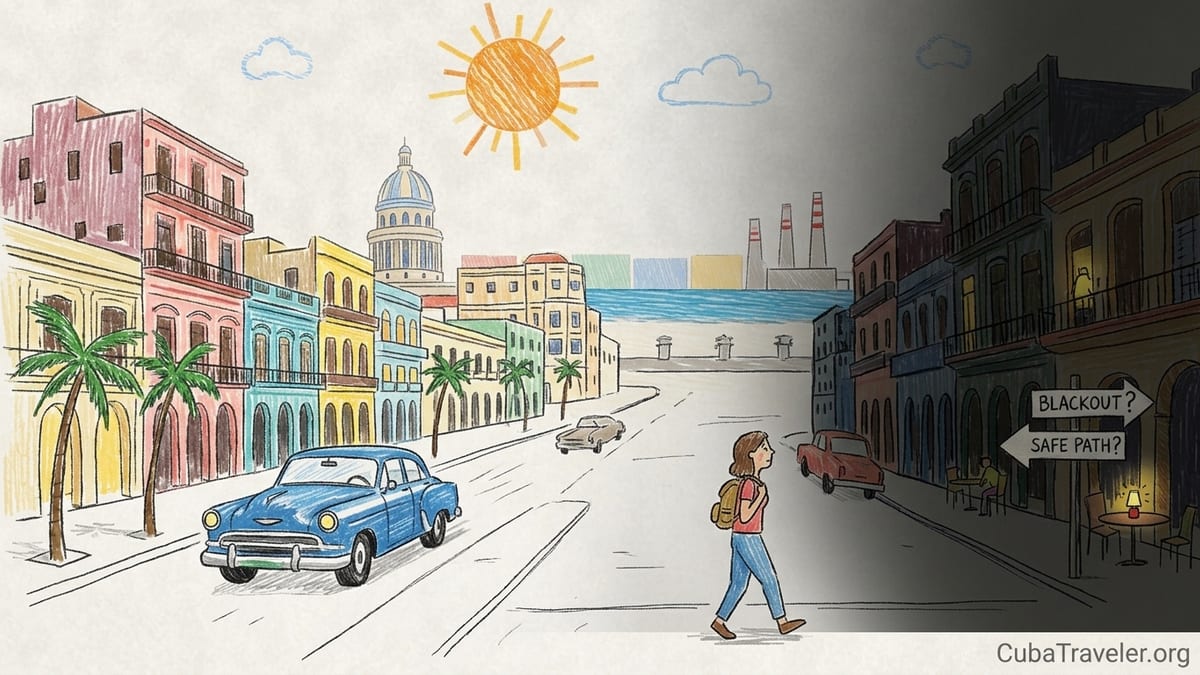
When I first backpacked through Latin America a decade ago, Cuba had a reputation as a slightly scruffy but fundamentally comfortable destination for solo women: an easy smile from your casa host, salsa on every corner, petty theft if you were careless, yet a sense that everyday Cubans would look out for you. Returning to research this piece in the middle of Cuba’s 2024 to 2026 economic and energy crisis, I walked into a country where rolling nationwide blackouts, fuel shortages, protests and a weakened health system have eroded that cushion. It is still possible to move through Cuba without serious incident as a solo woman, and many do. But the combination of opportunistic crime, more aggressive hustling, patchier transport and slower emergency response means the margin for error has shrunk in ways you cannot ignore.
Cuba’s New Reality: From Laid-Back Destination to Crisis Backdrop
To understand solo female safety in Cuba now, you have to understand what has changed. Since 2024, the island has been hit by repeated large-scale blackouts linked to fuel shortages and failures at the ageing Antonio Guiteras power plant and other infrastructure. Several total or near-total nationwide outages were recorded between 2024 and 2026, including events that left Havana and western Cuba in the dark for hours or overnight. Parallel to this, a United States fuel blockade announced in early 2026 deepened the energy crisis and sharply curtailed tourism, with tour operators and local guesthouse owners reporting mass cancellations as power cuts and transport disruptions became routine.
As oil shipments dwindled, the government began rationing fuel for essential services, leaving buses idle, domestic flights disrupted and intercity transport unreliable. Local and international analyses describe a cascading effect: food and medicine shortages, water pumps failing without power, and ambulances and medical flights limited by fuel. Public frustration has spilled into some of the largest protests since records began, with hundreds of demonstrations in early 2026 over blackouts and scarcity and a heavier security presence on the streets. All of this forms the backdrop to your trip. Safety in Cuba is no longer only about whether a street is well lit, but whether the power will be on, whether your transfer actually has fuel, and whether an ambulance can come if something goes wrong.
Official travel advisories have followed this deterioration. Canada’s government warns that individuals, including women and LGBTQ+ travelers, have been subject to harassment or verbal abuse and also flags shortages of essential services, from food to healthcare. France updated its Cuba advice in mid September 2026 to reflect increased security concerns, highlighting reports of theft, opportunistic crime and incidents of sexual harassment and assault. These warnings are not saying that every woman who goes to Cuba will be harassed or attacked. They are saying that the risk profile has risen and that emergency backstops that used to work more reliably, such as consular help or medical evacuation, may now be hampered by outages and fuel scarcity.
At the same time, it is important to acknowledge that many solo women continue to report largely positive trips. On traveler forums you can still find recent reports of women walking around Old Havana by day, dealing with catcalls and relentless sales pitches but never feeling physically threatened, and enjoying conversations with curious locals. Others describe serious problems: being relentlessly followed, aggressively propositioned, or, in a few cases, alleging drink spiking and assault in resorts around Varadero. Safety in Cuba is now deeply uneven. The challenge for a solo woman is to plan as if you will encounter the worst of the current conditions, while knowing you might experience only the best.
Arriving in Havana: Airport Realities, Taxis and First Contacts
Your first encounter with modern Cuba is likely José Martí International Airport in Havana, and this is where the gap between brochure and reality hits quickly. Power cuts can affect baggage belts and lighting, slowing down arrivals. You may find long, hot lines at immigration if the air conditioning is off, and public Wi-Fi in the terminal can drop without warning. None of this is inherently dangerous, but it sets the stage: expect delays, crowding and moments when systems simply stop working.
The most sensitive moment for a solo woman is walking out of customs into a sea of men holding signs, calling “Taxi, amiga?” and trying to take your bag. Fuel shortages have made every fare more valuable, and several recent travelers describe a more aggressive scramble for passengers than in the past, including drivers insisting the official taxi line is closed or that your prebooked driver is not coming. To keep control, arrange a transfer in advance with your casa particular or hotel and agree on a simple way to identify each other, such as the driver showing a photo of your passport name on their phone and you confirming the license plate they sent beforehand. When you exit, ignore the chorus of offers, step to the side, check that the plate and name match and only then follow the driver.
If your driver is not there, do not let anyone “call them for you” on an unmarked phone. Head back inside the terminal where there is at least nominal CCTV and ask at the official taxi desk or information counter to call your accommodation. With international cards harder to use since mid 2026 and mobile data patchy, you cannot assume you will have roaming or be able to message your host. This is where a printed backup of your accommodation details and the number for your embassy or consulate matters. If you do choose a taxi on the spot, insist on a registered yellow or blue state taxi, confirm the approximate price to central Havana with a staff member inside the building, and take a photo of the license plate and driver ID before you get in. Most drivers are simply trying to work under impossible conditions, but in a crisis economy, protecting yourself from the outliers is non-negotiable.
Even at this early stage, set a communication pattern with someone you trust at home. Let them know when you land and when you expect to reach your accommodation, and decide what they should do if you go silent for more than, say, 12 hours. This is not about dramatizing everyday risks. It reflects the very real possibility that a blackout or network outage could knock you offline, making it harder to call for help if a taxi detours or a prebooked driver never appears.
Where You Sleep: Casas, Hotels and Blackout Preparedness
Cuba’s iconic casas particulares, the family-run guesthouses licensed to host foreigners, have long been part of its charm. For solo women, they can provide exactly what you want: a watchful eye, home-cooked meals and a local “auntie” who insists you message when you get back at night. In the current crisis, though, you have to be brutally pragmatic about infrastructure. Many casas are in multi-story walk-ups with no backup generator, thin security gates and stairwells that go pitch black during outages. If the power and water cut for 12 hours, you could find yourself in a sweltering room with no fan, no running water, no way to charge your phone and a dark stairwell that feels unsafe to navigate alone.
By contrast, mid-range and higher-end hotels in Havana and Varadero are more likely to have generators, on-site security staff, functioning safes and front desks that stay open during blackouts. They are not immune from the crisis, and there are documented cases of serious incidents even in big resorts, including a Canadian woman who publicly alleged being drugged and assaulted at a well-known Varadero property, as well as earlier reports of sexual assault at a neighboring resort. These cases underline that paying more does not grant immunity. What you are buying instead is a degree of structure: someone to call at 3 a.m., a receptionist who can knock on your door if your family raises an alarm, and security cameras that at least record comings and goings when the power is on.
A hybrid approach can work. In Havana, you might book a hotel in Vedado or near the Malecón for your first and last nights, when you are dealing with jet lag, luggage and airport transfers. In between, you might move to a well-reviewed casa in Habana Vieja where the owner explicitly mentions planning for blackouts with battery lamps, water storage and a clear check-in process after dark. When you message potential hosts, ask direct, practical questions: How often do you lose power? Do you have a generator or battery backups? Is there staff on site 24 hours? How secure is the front door, and who has keys?
Wherever you stay, mentally walk through a blackout scenario. If the electricity cuts at midnight, could someone easily see into your room from the street? Can you lock your door from the inside without relying on an electronic keycard? Do you have a small headlamp or flashlight to reach the bathroom or emergency exit? These are not paranoid questions. In a country where blackouts of many hours are now common, they are basic risk management for a solo guest.
Walking Havana by Day and Night: Neighborhoods, Blackouts and Street Hassle
Most solo women start in three Havana neighborhoods: Habana Vieja, Centro Habana and Vedado. By daylight, each has a distinct feel. In Old Havana, the UNESCO-listed core around Plaza Vieja and Obispo is dense with tourists and police, and much of the hassle is commercial. You will be approached constantly by men offering cigars, “the best mojito,” salsa clubs, classic car tours or simply conversation that segues into a sales pitch. Some women describe it as exhausting but ultimately manageable, especially if they speak some Spanish and respond firmly but politely. Others report that the frequency and persistence of the hassle, worsened by the economic desperation of recent years, made them avoid walking alone for long stretches.
In Centro Habana, especially along streets running inland from the Malecón, the tourist presence thins and daily life takes over. Here, harassment can feel more personal. Several recent female travelers mention being trailed by men who comment on their bodies, stand too close at street corners, or offer to “accompany” them in a way that is hard to shake. One Argentine traveler whose video reports went viral in early 2026 described “five or six people on the block offering you things” and said that the harassment in Havana was among the worst she had experienced in Latin America. That does not mean you will experience the same, but it gives a sense of how the crisis has intensified street-level hustling.
Vedado, with its wider avenues, embassies and 1950s apartment blocks, often feels calmer. There are fewer tourists on foot, more middle-class families and students, and more modern cafes. By day, many solo women say they felt relatively at ease walking along Avenida 23 or around the University of Havana, dealing mostly with occasional comments and stares. The difference now is what happens when the lights go out. In several blackouts documented in 2025 and 2026, parts of Havana suddenly lost traffic lights and street lighting, throwing whole blocks into darkness. In that environment, even a street that feels fine at 4 p.m. can feel very different at 8 p.m. when only a few generators are humming and most windows are dark.
As a solo woman, your most powerful tool is timing. Whenever possible, do your major walking and exploring between breakfast and late afternoon, before peak blackout hours and after the midday heat. If you go out in the evening for a concert or dinner, map the exact route there and back, note which streets have visible lighting, and pay attention on the outbound walk so you can spot changes on the return. If a blackout hits while you are out, do not force yourself to walk home through unlit alleys just because the restaurant is only a kilometer away. Ask staff to call you a trusted taxi, wait inside with other customers, and send a quick message with the taxi’s plate number to your emergency contact as long as the network is up.
Nightlife, Drink Safety and Getting Back to Your Bed
La Fábrica de Arte Cubano, live salsa at Casa de la Música, rooftop bars in Old Havana: Cuba’s nightlife still pulls visitors out after dark. For a solo woman, this is where the risks cluster most tightly. Alcohol, strangers, patchy lighting and unreliable transport meet a justice system where foreign reports of sexual assault rarely lead to swift or transparent action. Canadian media have documented several serious incidents at Varadero resorts, including allegations of drink spiking and assault, where victims and their families struggled to get clear information or timely support from hotel management and local authorities.
Inside Havana’s bars and clubs, most nights pass without incident, but the cues you might rely on at home are not always reliable here. Security staff may be focused on keeping out locals without foreign currency rather than quietly monitoring predatory behavior. Power cuts can affect refrigeration and lighting, pushing venues to operate by candlelight or close suddenly. If you are dancing and someone insists on buying you a drink, it is not rude to walk with them to the bar, watch it poured, and carry it yourself. If a stranger offers shots they claim to have bought earlier or brings a drink from a dark corner of the bar, decline. Recent traveler reports from popular spots like Fábrica mention bartenders being willing to pour sealed beers or mix cocktails in front of you if you ask.
The bigger question is how you get back. Fuel shortages have pushed up taxi costs and made it harder to flag one down spontaneously at midnight, especially if a blackout has hit and traffic thins. In Old Havana, some women report being followed for several blocks by unofficial taxi drivers or men who claim to be “friends” of their casa owner, pressuring them into a ride. Avoid these conversations entirely by pre-arranging your return with a known driver or with your accommodation. When you go out, tell your host exactly where you are going and what time you expect to be back; ask if they have a trusted driver who can pick you up at a set corner. If the venue has a designated taxi area, use it rather than stepping into the dark to bargain with whoever appears.
Crucially, none of this is about victim-blaming. Criminal behavior, whether it is harassment, robbery, drink spiking or assault, is the responsibility of the perpetrator, not the woman who wanted to dance salsa on her holiday. The goal is to shrink the windows of vulnerability that Cuba’s current conditions have widened. That means pacing your drinking in a place where medical services may be delayed, keeping your phone charged in a city where blackouts can knock out streetlights, and ensuring at least one person, in Cuba or back home, will start asking questions if you do not come back when you said you would.
Money, Unsolicited Guides and Taxi Hustles in a Cash-Strapped Economy
Cuba’s economic collapse is visible on every corner: long queues outside ration shops, pharmacies with bare shelves, and a constant stream of offers from people trying to convert your foreign currency into survival. For solo women, this manifests as a flood of “friendly helpers” who latch on and do not let go. A man might fall into step beside you in Habana Vieja, offer to show you a “local” paladar for lunch, then produce an inflated bill and demand a commission. Another might introduce himself as an official guide, walk you through a museum and then pressure you for a large tip in cash at the exit.
Currency is its own minefield. Cuba operates multiple exchange rates, and the government rate at official Cadeca offices often differs sharply from what people offer on the street. Men in plain clothes may approach you whispering “cambio, cambio” and offering rates that sound too good to be true, sometimes showing you real banknotes as bait and then swapping them for worthless or lower-value bills in the handover. In a situation where your foreign Visa or Mastercard may not work at all inside Cuba, you may be carrying a significant amount of euros or cash dollars. Street exchanges not only risk scams but also attract unwanted attention to the fact that you are holding serious money.
The safest approach is to minimize on-the-street financial interactions. Change only what you need at official desks, bring enough foreign cash in small denominations to cover your stay, and keep it split between a security pouch and a locked bag in your room. When someone offers to guide you, be explicit: “No, gracias, prefiero caminar sola” and keep walking. If you actually want a guide, ask your accommodation to arrange one or use staff at major museums and official tourism offices, who wear visible badges and are less likely to steer you into scams.
Taxis present a similar pattern. In Havana, you will encounter state taxis with meters, classic car taxis that negotiate fixed fares, and unofficial “taxi particulares” that operate more informally. With fuel scarce, drivers have strong incentives to push for higher prices, detours and extra stops. Some solo women have described feeling cornered at the end of a ride by drivers insisting the agreed price was “per person” or claiming sudden fuel surcharges. The solution is dull but effective: agree the fare clearly before you get in, repeat it out loud while you count out the money at the end, and be willing to pay a little over the odds rather than escalate a dispute alone in the street.
When Things Go Wrong: Building a Solo Emergency Plan
In any country, lost phones, stolen passports and injuries are part of travel calculus. In Cuba in 2026, the same incidents play out against a backdrop of outages, fuel scarcity and a strained health system, and the consequences can escalate faster for solo women who do not have local help. Building an emergency plan before you land is as important as booking your first night’s stay.
Start with communications. Assume that at some point on your trip you will lose mobile data and Wi-Fi simultaneously, either because of a blackout, network failure or simple overload. Write down on paper your accommodation addresses, phone numbers for your embassy or consulate, and at least one 24-hour emergency contact at home. Keep photocopies of your passport data page, Cuban visa and travel insurance policy in a separate bag from the originals. If your phone disappears in a crowded bus or bar, you should still be able to walk into a hotel reception, hand over your documents and ask them to place a call on your behalf.
Next, think through specific scenarios. If your passport is stolen, you will need a police report and an emergency travel document from your embassy. In recent years, foreign embassies have warned that blackouts and fuel shortages can affect their own operations, from phone lines to staff travel, which could slow down assistance. That makes it all the more important to report a theft as soon as you can and keep a calm, factual record of what happened. If a prebooked airport transfer is cancelled because there is no fuel, have a backup option written down: a licensed taxi company your hotel recommends, with rates and phone numbers. If your casa closes unexpectedly because the owner emigrates or the building loses power for days, know the names of at least two alternative properties you would be comfortable moving to in the same neighborhood.
Medical emergencies are the hardest scenario. Cuba once prided itself on its health system, but shortages of medicines, equipment and even clean water have been widely documented in recent years. Tourist-focused clinics in Havana and Varadero tend to be better stocked, but they are not immune to the national crisis and may require payment in hard currency before treatment. As a solo woman, carry a basic personal medical kit with any prescription medicines you need, plus pain relief, a course of antibiotics if prescribed by your own doctor before you travel, and menstrual supplies that might be hard to find locally. If you suspect your drink has been spiked, seek medical help immediately and contact your embassy or consulate as soon as you are able, even if you are unsure exactly what happened. Document names of staff and doctors you speak to and, if you feel safe, take photos of any visible injuries.
Finally, agree red lines with your emergency contact at home. For example: if they do not receive a check-in message from you for 24 hours after a planned intercity bus ride, they should attempt to contact your accommodation; if there is no answer, they escalate to your embassy. This kind of plan cannot eliminate risk, especially in a country where state systems are themselves under strain. It can, however, shorten the time it takes for someone to realize you are in trouble and start pushing from outside Cuba for information and support.
Havana vs Varadero and Isolated Resorts: Different Risks, Not Necessarily Safer
Many women who feel nervous about urban street hassle consider skipping Havana altogether and booking an all inclusive resort in Varadero or along Cuba’s northern cays. On the surface, resorts offer exactly what solo women are told to seek: controlled access, in-house entertainment, buffet dining, and on-site security. During a period of blackouts and shortages, they also have advantages like private generators, water storage and food supplies that shield guests from some of the hardship beyond the gates.
However, isolation cuts both ways. Several high profile cases of Canadian women alleging serious sexual assaults in Varadero resorts underline a hard truth: being inside a gated property does not automatically reduce risk. In some reported incidents, the alleged perpetrators were not random intruders from outside but staff or other guests who had easy access to victims’ rooms or drinks. Victims and their families have described long delays in getting clear answers from hotel management, limited medical support and little transparency about any investigation. For a solo woman without a trusted companion on site, that isolation can become terrifying very quickly.
Havana’s risks are more visible and arguably more manageable. You can see who is following you on a busy street, choose your own restaurants, and leave a bar you do not like. If a blackout hits, you can walk into a major hotel lobby and ask for help, even if you are not a guest. In Varadero or a remote cay, especially in a resort that dominates a small area, your alternative is often simply another venue owned by the same chain. Transport off the property may be limited by fuel shortages, and external medical facilities can be hours away on unlit roads affected by outages.
This does not mean you should avoid resorts entirely, but it does mean evaluating them critically. Look for properties with clear, published protocols for guest safety, medical emergencies and handling allegations of assault, and consider phoning in advance to ask how they manage blackouts and staff access to guest rooms. Ask whether there is a staffed clinic on site and what happens if a guest needs to be transferred to a hospital during a fuel shortage. Build your own boundaries into your stay: limit solo drinking at swim-up bars, secure your room with internal locks, and maintain the same communication routines with your contact at home that you would in the city.
The Takeaway
So is Cuba safe for solo female travelers in 2026? It is safer for some women in some contexts than for others, and less safe than it was a decade ago. The combination of severe economic crisis, recurring nationwide blackouts, fuel shortages and a strained health system has eroded many of the informal protections and formal backstops that once made Cuba feel like a relatively gentle introduction to Latin America. Official advisories from countries like France and Canada now explicitly mention harassment, including sexual harassment and assault, and highlight that women, LGBTQ+ people and other travelers may face verbal abuse and a higher risk of opportunistic crime.
At the same time, millions of Cubans remain warm, proud hosts who depend on tourism to survive and who are horrified by high profile cases of violence in their country. Many solo women still walk through Habana Vieja by day, dance at Fábrica, or read on Varadero’s beach without experiencing more than the exhausting street hassle of a struggling economy. Your experience could fall anywhere on that spectrum. Personal precautions help: choosing blackout prepared accommodation, vetting drivers, controlling your drinks, planning for communication failures and setting firm boundaries with unsolicited guides and taxi hustlers. But there are structural risks that no individual woman can solve: a justice system that offers little transparency, under resourced hospitals, power cuts that plunge neighborhoods into darkness and embassies that warn their own ability to assist may be limited.
For travelers with solid Spanish, robust health, flexible dates and strong networks at home, Cuba may still be a destination worth the complexity and moral questions of visiting a country in such deep crisis. For first time solo travelers, those with health vulnerabilities, or anyone who would struggle to advocate for themselves across language and institutional barriers, the elevated travel advice now matters more than ever. It is not about fear mongering. It is about acknowledging that the safety net beneath you in Cuba is thinner than it looks from glossy photos. If you decide to go, go with your eyes wide open, a detailed plan in your pocket, and a clear sense of which risks you are genuinely prepared to carry alone.
FAQ
Q1. Is Cuba currently recommended for first time solo female travelers?
For a first solo trip, especially if you have limited Spanish or travel experience, Cuba’s current crisis conditions make it a demanding choice. Consider starting with a destination that has more reliable infrastructure and easier emergency support.
Q2. Are Havana’s tourist areas safe to walk alone during the day?
Old Havana and parts of Vedado see many solo women walking in daylight without serious problems, though street hassle and persistent sales pitches are common. Stay on busy streets, avoid flashing valuables and pay attention to any sudden change in atmosphere, especially during power cuts.
Q3. How bad are the blackouts, really, and how do they affect safety?
Recent years have seen repeated long blackouts, sometimes affecting much of the island for hours or more. They knock out lighting, traffic signals, refrigeration and sometimes mobile networks, which can make streets feel more threatening and slow down emergency response.
Q4. Is an all inclusive resort in Varadero safer than staying in Havana?
Resorts reduce some risks like street crime and food scarcity but introduce others, including isolation and reported cases of serious incidents within properties. Neither setting is inherently safer; each carries different types of vulnerability for solo women.
Q5. What kind of harassment do women report in Cuba?
Many women describe frequent catcalling, comments on their bodies, persistent invitations and pressure to buy goods or accept guiding. Some also report being followed, and official advisories mention incidents of sexual harassment and, more rarely, sexual assault.
Q6. Can I rely on taxis and transfers at night?
Fuel shortages make transport less predictable and can push some drivers into hard bargaining or aggressive hustling. Prebooked drivers recommended by your accommodation and clearly agreed fares reduce risk, but you should always have a backup plan in case a transfer is cancelled.
Q7. How should I handle money and currency safely as a solo woman?
Avoid street currency exchanges and unsolicited offers to “help” with money. Bring enough foreign cash in small notes, change it at official points and keep it split between a hidden pouch and a secure place in your room.
Q8. What should I do if my drink is spiked or I suspect I have been drugged?
Seek medical help immediately, ideally at a clinic serving tourists, and contact your embassy or consulate as soon as you can. Try to document what happened and who was present, and ask a trusted person at your accommodation to support you in dealing with hotel staff or police.
Q9. How can I prepare for losing my phone or passport in Cuba?
Carry paper copies of your documents and emergency numbers, store digital copies in secure cloud storage and keep passports and most of your cash locked away when not needed. If something goes missing, report it quickly to local police and your embassy, and inform your bank if cards are involved.
Q10. Is it irresponsible to visit Cuba as a tourist while the country is in crisis?
Only you can answer that. Some argue that ethical, well informed tourism that supports small local businesses can help ordinary Cubans, while others feel that visiting now risks normalizing an untenable situation. If you choose to go, do so with full awareness of the context and a commitment to minimizing harm.