


I landed in Varadero in early September 2026 on a discounted all-inclusive package that, on paper, looked indistinguishable from the carefree Caribbean holidays Cuba has sold for decades. The brochure promised 24-hour air conditioning, multiple à la carte restaurants, daily excursions to Havana and “uninterrupted resort services.” Within 24 hours of checking in, I had showered in cold water twice, watched staff quietly move guests out of closed wings of the hotel, and eaten three meals in a row from a buffet where half the serving trays were simply empty. The beach was still beautiful. The system behind it was clearly breaking.
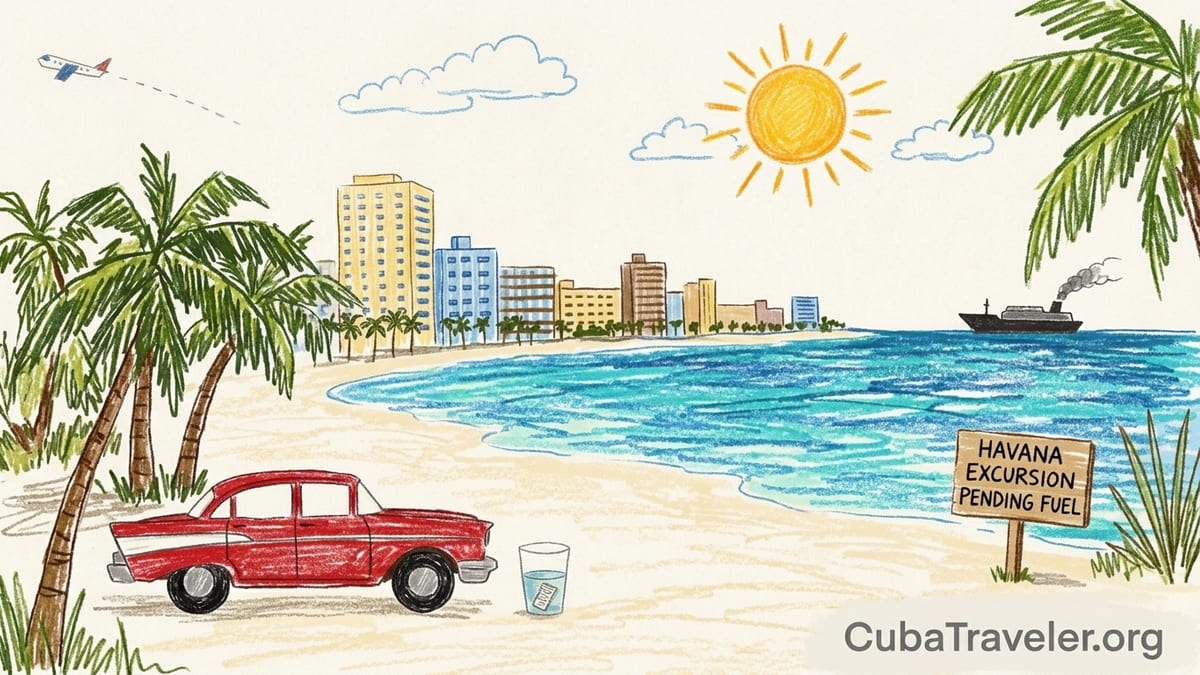
Varadero’s enduring appeal in a very different Cuba
Even in the middle of Cuba’s 2026 crisis, Varadero’s first impression remains disarmingly perfect. The resort strip stretches for roughly 20 kilometers along the Hicacos Peninsula, with pale, fine sand and warm, shallow water that still feel like a postcard come to life. From my hotel’s terrace, the sea was a calm gradient of turquoise to deep blue, and the beach itself was almost empty compared with pre-pandemic images. For a moment, it was easy to believe that everything was fine.
The physical infrastructure of Varadero’s resort zone is also still impressive. Large beachfront hotels line the shore in a long row: tower blocks from Spanish chains that arrived in the 1990s and 2000s, midrise Cuban-run properties, and former foreign-branded resorts now under state management. Access remains relatively straightforward compared with Cuba’s more remote keys. Varadero is on the mainland, connected by road to Matanzas and Havana, and its airport receives what international flights still serve the island. That geographic advantage has kept Varadero operating while some more isolated destinations have gone quiet.
But this reassuring surface sits on top of a country struggling with a deep fuel and electricity crisis. International organizations and independent analysts describe prolonged and unpredictable power cuts across Cuba in 2024, 2025 and 2026, linked to breakdowns at major generating plants and reduced fuel imports. Reports in 2026 note that nationwide blackouts have become frequent, with some months seeing the grid drop to zero megawatts. Tourist areas like Varadero receive priority, but they are still connected to the same fragile system.
That tension defines Varadero today. You can walk from a functioning swim-up bar directly into a conversation with staff about how many hours of power their families had the previous night in Cárdenas or Matanzas. The beach remains the selling point. Everything required for a predictable all-inclusive experience 24-hour electricity, steady fuel, abundant food imports, regular flights and reliable excursions is under strain.
My resort stay: what “all inclusive” looked like in September 2026
I booked a mid-range beachfront property that, until recently, operated under a well-known Canadian-facing brand before shifting to direct Cuban management in 2026. The package, sold through a European consolidator, advertised three specialty restaurants, a main buffet, 24-hour snack bar, nightly shows, non-motorized water sports, daily housekeeping and “guaranteed air-conditioned rooms.” There was no explicit mention of the ongoing fuel crisis in the booking material.
Check-in was efficient and polite, but the first sign of stress appeared when I was handed a printed sheet titled “Temporary Service Adjustments.” Two of the three specialty restaurants were “closed until further notice,” the snack bar would run only from noon to 6 p.m., and housekeeping was offered “on request” rather than daily. The sheet also mentioned that “due to national conditions, short electricity interruptions may occur,” without further detail. None of this had been disclosed at the time of booking.
Over the next five days, I experienced three power cuts inside the resort, each lasting between 45 minutes and two hours. In my room, the air conditioning stopped immediately and the temperature rose sharply in the tropical heat. Elevators were taken out of service during one outage, leaving guests on upper floors to walk down dim stairwells. Hot water was sporadic, especially in the evenings. Staff insisted that generators were available, but fuel supplies were clearly being rationed. Public areas like the lobby and parts of the kitchen regained power faster than guest rooms, suggesting a triage approach.
The buffet told its own story. Breakfast was the most consistent meal, with eggs made to order, bread, some fruit and coffee. By lunch and dinner, variety dropped. Protein options were usually one chicken dish and one fish tray, occasionally supplemented by small amounts of pork. Several metal chafing dishes stayed empty behind their glass sneeze guards. One evening, the dessert table consisted entirely of sliced guava and a plain sponge cake, shared between several dozen guests. Staff were unfailingly friendly and apologetic, but their explanations always came back to the same point: deliveries were irregular, and they could not promise what the next truck might bring.
Why generators do not guarantee comfort in a fuel crisis
On paper, many Varadero resorts advertise backup generators as reassurance against Cuba’s fragile grid. In practice, 2026’s fuel scarcity has made that reassurance incomplete. Cuba depends heavily on imported oil to run its power plants and transport sector. A tightening of fuel supplies in early 2026, driven by external restrictions and declining deliveries from key suppliers, led to severe shortages of gasoline, diesel and aviation fuel. International assessments this year describe multiple nationwide blackouts, long queues at gas stations and a sharp reduction in available fuel for non-essential uses.
Hotel managers in Varadero are understandably reluctant to discuss exact fuel allocations, but staff comments and traveler reports point in the same direction: generators are used selectively. Running full air conditioning, hot water boilers, elevators, refrigeration, kitchen equipment and lighting for a large beachfront complex consumes a significant amount of diesel. When fuel is scarce, resorts face a series of decisions about what to prioritize. Keeping industrial refrigerators cold to avoid food spoilage is non-negotiable. So is minimal lighting in common areas and pumping water to upper floors. Entire wings can be taken offline to reduce consumption, and air conditioning may be reduced or rotated.
During my stay, one evening outage coincided with dinner service. The main buffet area went dark for about fifteen minutes, then partially lit up, while the rest of the building remained without power. The air conditioning did not come back on in the dining room for nearly an hour, and the temperature quickly became uncomfortable. By contrast, the bar near the lobby was powered again within minutes, presumably because it shared a circuit with reception. Guests on higher floors later reported climbing ten to twelve flights of stairs because lifts were halted to conserve generator capacity.
Crucially, generator use also depends on fuel deliveries that are themselves uncertain. International analyses in 2026 link Cuba’s energy crisis to a drop in oil shipments from allies and difficulty sourcing replacement supplies, leading to a systemic shortfall. If a resort’s scheduled diesel delivery is delayed or partially filled, there is no guarantee that backup power can bridge frequent or prolonged cuts. Several recent guest reports from Varadero in 2026 describe hotels where generators covered only a few hours of outages each day, after which facilities simply went dark. The marketing phrase “hotel with generator” hides a more complicated operational reality.
Food, water and what actually appeared on the buffet
Food availability is one of the most sensitive questions for anyone considering an all-inclusive holiday in Cuba in 2026. Cuba has depended on food imports for years, and the current fuel shortage disrupts both imports and internal distribution. International reporting notes that shortages of basic goods, including some food staples and bottled water, have intensified alongside the energy crisis. Tourism still receives priority, but the island’s diminished overall supply means that “priority” does not translate into abundance.
At my Varadero resort, the buffet pattern was clear by the second day. Starches rice and pasta were available at every meal. Bread was present but sometimes limited to white rolls. Fresh vegetables were mainly shredded cabbage, tomatoes and cucumbers, with occasional carrots. Fruit selection depended entirely on deliveries: one morning there were bananas and watermelon, another only guava. Protein was modest. There was almost always chicken, sometimes clearly stretched into stews with lots of sauce. Fish appeared regularly but in small quantities; trays went empty quickly and were not consistently refilled. Beef, which is scarce in Cuba even in better times, appeared once as thin slices in a mixed dish.
The à la carte restaurants, often used by resorts to showcase higher-end dining, reflected the same constraints. The Italian-themed venue offered pasta with tomato sauce and a single meat option. Several items listed on the printed menu were marked “not available today.” Staff suggested ordering early in the week because “by Friday we might not have everything.” Guests who had visited Cuba before remarked that even the much-criticized “Cuban all-inclusive food” of the past felt more varied compared with this season.
Drinking water was a more serious concern. The resort used large jugs of purified water at bars and buffets and supplied one bottle per room per day. When I asked for an extra bottle to take on a day trip, reception hesitated and eventually gave me one more, with a reminder that “bottled water is difficult now.” International travel advisories updated in September 2026 explicitly flag disruptions to water supply and advise travelers that bottled water and purification options cannot always be assumed. In practical terms, anyone with a sensitive stomach or traveling with children would be wise to bring portable water filters or purification tablets, because relying entirely on resort-provided bottles feels far less secure than it did a few years ago.
Hotel consolidation, closures and being moved mid-stay
The 2026 crisis has triggered a policy in Cuba’s tourism sector that officials and industry observers describe as “tourist consolidation.” Faced with low visitor numbers and high operating costs, the state tourism entities have been closing hotels with low occupancy and transferring guests to a smaller number of properties that have better infrastructure or more robust backup systems. Reports from early 2026 mention that visitors have been relocated from closed or partially closed resorts, particularly in Varadero, to hotels considered more capable of withstanding the energy crisis.
Before traveling, I monitored European and Canadian tour operator updates and noticed several familiar Varadero hotels listed as “temporarily closed” or “not available for sale.” A Russian tour operator bulletin in March 2026, for example, listed specific beach properties in Cuba, including at least one in Varadero, as closed. Spanish media in 2026 also reported that some international chains had shuttered part of their Cuban portfolio altogether, including hotels in key resort areas, due in part to the energy crisis and broader economic instability.
On the ground, the effect of consolidation was visible. The resort where I stayed had one entire block closed off, with balcony doors taped and corridors unlit. Staff confirmed that those rooms had been taken out of service to reduce electricity and water consumption. During my week in Varadero, I met two couples who had originally booked different hotels but received emails a few days before departure informing them that their chosen properties were “not operational at this time” and that they had been rebooked at my resort or another open one nearby. They had not been given much detail beyond the vague phrase “operational reasons.”
Being moved to a higher-category hotel without extra cost might sound like a windfall, and in some cases it may be. But it also means that travelers cannot be sure their selected hotel will actually be open by the time they arrive. It complicates independent planning, especially for those with accessibility needs or particular room requirements. For guests already on site, there are accounts in 2026 of mid-stay transfers when hotels shut entire sections or close due to sustained outages. Any current decision to book Varadero should assume that the assigned property may change, and that bed banks or tour operators might consolidate bookings at short notice in response to fuel or staffing constraints.
Flights, cancellations and the risk of getting stuck
Air connectivity to Cuba has deteriorated significantly in 2026. The immediate trigger was the island’s aviation fuel shortage that emerged early in the year, traced by international economic observers to a sharp reduction in oil deliveries. With limited jet fuel available, Cuban authorities prioritized some routes and cut others. Canadian and Russian carriers, which had been crucial for filling Varadero’s resorts, suspended regular flights in early 2026, leaving mainly some U.S. and Latin American routes operating. Travel industry reports connect this loss of lift to a dramatic drop in arrivals and to resorts running at a fraction of their capacity.
One of the most important developments for European travelers came on 18 August 2026, when Iberia extended its suspension of flights between Madrid and Havana through 30 June 2027, citing the energy crisis and operational difficulties. The airline’s own travel notice and flight updates state that the Havana route, already suspended since 1 June 2026, will now remain off the schedule for over a year. Passengers with tickets are being offered refunds or changes to other destinations, but direct Iberia service to Cuba is effectively off the table until at least mid-2027.
This does not mean that all airlines have stopped flying to Cuba. Some U.S.-based carriers still operate limited routes to Havana and, in some cases, Varadero and other airports, subject to evolving regulations. A handful of Latin American airlines continue service as well. However, with key European and Canadian routes gone or drastically reduced, the overall network is fragile. Any new disruption in fuel supply or further deterioration in the grid could lead to additional cancellations. Travelers in 2026 have reported sudden schedule changes and re-routed journeys, including being bussed from one airport to another within Cuba when local operations were cut for lack of fuel.
For someone considering Varadero now, this fragility turns flight logistics into a primary risk factor. A straightforward seven-night package can become complicated if the return flight is delayed for several days because the airline is waiting for fuel allocation or aircraft repositioning. Travel advisories from multiple governments in 2026 emphasize the possibility of transport disruptions within Cuba as a result of fuel shortages and encourage travelers to prepare financially and logistically for unexpected delays. That means extra insurance coverage, flexible work plans at home and enough access to funds to cover unplanned hotel nights, which may or may not be at the all-inclusive rate you initially booked.
Excursions, transfers and the cost of a “cheap” package
One of Varadero’s longstanding attractions is its relative proximity to Havana and Matanzas, which traditionally supported reliable day trips. Under current fuel rationing, those excursions have become less predictable. Coaches and minibuses that once ran daily now operate only on certain days of the week, or are canceled outright when fuel is not allocated. Several recent traveler reports from 2026 describe tour operators canceling Havana day trips on short notice, citing “no diesel,” and offering either a refund or a rebooking that might not fit within a one-week stay.
During my visit, the resort’s in-house tour desk was selling a basic Havana excursion for the equivalent of around 90 to 100 U.S. dollars per person, payable in foreign currency. Two of the four scheduled departures that week were marked “pending confirmation,” with staff explaining that they needed to know how much fuel would be available for buses. When I asked whether the trip might be canceled even after booking, the answer was candid: “If there is no fuel that day, yes. We return your money, but we cannot guarantee.” Transfers between the airport and the hotel were more reliable, but the operator clearly grouped arriving guests to minimize trips, leading to longer waits at the terminal.
When tallying the real cost of a Varadero holiday in 2026, such uncertainties matter. A headline package price from Europe or Canada might look very low compared with other Caribbean destinations, precisely because demand for Cuba has slumped. But once you add private airport transfers to hedge against bus delays, comprehensive travel insurance that covers delays and medical evacuation, on-site purchases of bottled water and snacks to supplement limited buffet offerings, and the risk of paying out of pocket for extra nights if flights are disrupted, the “bargain” narrows. International economic reporting in 2026 notes that while some Cuban hotels have cut rates to attract scarce tourists, their operating costs have risen due to the need for imported fuel and goods, and those costs are often passed on through extras.
Excursions within the province suffer similar constraints. Trips to Matanzas city or nearby caves, catamarans and motorized water sports all require fuel. On my stay, non-motorized activities such as kayaks and stand-up paddleboards were running, but jet skis and parasailing were suspended “until more fuel arrives.” Travelers who have been to Varadero in the past should not assume that the same menu of activities will be available, and those for whom a Havana visit is essential should be prepared for disappointment or to organize a more expensive private transfer that competes with locals for scarce gasoline.
Serious concerns travelers cannot ignore in 2026
Putting these threads together, at least five major areas of concern emerge for anyone evaluating Varadero in late 2026. The first is electricity. Cuba has experienced prolonged and frequent blackouts over the last two years, and 2026 has brought several national outages as fuel supplies tightened further. Tourist infrastructure in Varadero is better protected than in the interior, but resorts cannot fully insulate guests from a collapsing grid. Even where generators exist, their effectiveness is constrained by fuel rationing and the sheer scale of demand from large hotels.
The second is water and sanitation. Municipal water systems suffer from the same power cuts and fuel shortages that affect everything else. When pumps stop, water pressure drops, affecting showers, toilets and pool systems. Resorts try to maintain acceptable standards, but partial outages and reduced housekeeping make it more difficult. Bottled drinking water, once taken for granted in all-inclusive packages, has become less certain. For those with health conditions, the idea of intermittent water supply should not be minimized.
Third is food supply and quality. 2026 has seen Cuba’s already fragile supply chain come under severe stress, with reports of shortages of basic food items for the general population. While tourism still draws a disproportionate share of available imports, that share is smaller in absolute terms when the national pie shrinks. Buffets at mid-range resorts are now significantly more repetitive and constrained than many returning visitors remember, and à la carte promises often outstrip what kitchens can actually serve. Travelers with dietary restrictions, such as vegetarians, vegans or those with allergies, face particular uncertainty.
Fourth is hotel consolidation and closures. The state’s strategy of concentrating tourists in a reduced number of functioning hotels might make sense operationally, but it undermines travelers’ ability to choose and plan. A booking at a favorite beachfront property that you have visited for years may result, in practice, in a stay at a different resort selected on short notice. For guests with mobility needs, sensory sensitivities or simply strong preferences about accommodation style, this unpredictability is not a minor inconvenience but a potential deal-breaker.
Fifth are reduced flights and strained medical services. With major airlines such as Iberia suspending Cuba routes into mid-2027 and Canadian and Russian carriers halting or severely reducing flights earlier in the year, getting to and from Varadero now involves a thinner, more fragile network. At the same time, international advisories updated in 2026 highlight serious constraints on Cuba’s healthcare system, including shortages of medicines, equipment and even basic supplies. Resort clinics can handle minor issues, but anyone with a significant medical event may require evacuation to a third country. The combination of difficult evacuation logistics and limited local resources raises the stakes for what might otherwise be routine travel mishaps.
The Takeaway
So, is Varadero still worth visiting during Cuba’s 2026 crisis? From my own week on the peninsula, coupled with the broad picture painted by official advisories, economic analyses and other travelers’ experiences this year, the answer is heavily conditional. The beach itself is still wonderful. The sea is warm, the sand is soft, and in many ways the coastline has rarely been quieter or more peaceful. If your expectations adjust to long power cuts, reduced food variety, potential hotel changes and the real possibility of flight disruption, you may still find value and human warmth in Varadero, especially if you already know Cuba and feel a personal connection.
But that is a very different proposition from the predictable all-inclusive holiday that mass-market visitors typically expect. The classic package promise 24-hour comfort, reliable flights, abundant buffets, seamless excursions to Havana and zero logistical stress does not match Cuba’s current reality. The 2026 fuel and electricity crisis has turned basic services into variables. Generators do not automatically mean continuous air conditioning. Open hotels today may consolidate or close tomorrow. Flights that appear on schedule can be pulled if fuel fails to arrive. Medical support is stretched. None of this is the fault of the frontline staff in Varadero, who are working with remarkable grace under pressure, but these conditions are real.
Travel advisories from several governments as of late September 2026 explicitly warn against non-essential travel to Cuba, citing widespread fuel shortages, power outages, reduced transport, and constrained healthcare. Those advisories are not symbolic. They reflect the genuine risk that a leisure trip could be transformed, quickly, into a difficult situation. A cheap package price or a nostalgic desire to return to a beloved beach is not, on its own, a sufficient counterweight.
If you are still considering Varadero despite the warnings, there are several things you must confirm directly before booking. Speak to the tour operator or hotel, in writing, about which services are guaranteed and which are “subject to national conditions.” Ask whether your specific hotel is currently open, whether any rooms or wings are closed, and what their current backup power plan looks like. Verify what happens if your property is consolidated or shut mid-stay, and what compensation or relocation is offered. Confirm the airline’s most recent schedule and flexibility policy, especially in light of Iberia’s prolonged suspension of Havana flights. Check your travel insurance fine print for coverage of delays, medical evacuation and trip interruption due to infrastructure failure.
Above all, weigh the combined picture: a beautiful beach in a country facing one of its worst modern crises, limited resources and official advice against non-essential travel. For many readers in 2026, the responsible conclusion will be to postpone Varadero until Cuba’s energy system stabilizes, flights are restored and hotels can once again deliver something close to the all-inclusive predictability that these holidays promise. Admire the turquoise water in your memories or in old photos, keep an eye on developments, and be prepared to return when the island is better able to welcome you safely and comfortably.
FAQ
Q1. Is Varadero currently open to international tourists in late 2026?
Yes. Varadero remains open and some resorts are operating, but with reduced capacity, service adjustments and ongoing infrastructure challenges linked to Cuba’s fuel and power crisis.
Q2. Are all Varadero hotels affected by power cuts?
Most properties are affected to some degree, because they share the same fragile national grid. Some have generators, but fuel limitations mean they cannot always guarantee uninterrupted power in rooms.
Q3. Can I still book a direct flight from Europe to Varadero or Havana?
Options are limited. For example, Iberia has suspended its Madrid–Havana route from June 1, 2026 through at least June 30, 2027. Other carriers may still operate, but schedules can change quickly.
Q4. Will my chosen hotel definitely be the one I stay in?
Not necessarily. Cuba is practicing “tourist consolidation,” closing some low-occupancy hotels and moving guests to others. Travelers can be rebooked before arrival or even transferred mid-stay.
Q5. How bad are food shortages at all-inclusive resorts?
Buffets in 2026 often have fewer choices and more repetition than in the past. Basic items like rice, pasta and chicken are common, but higher-end cuts of meat and varied produce are less reliable.
Q6. Is it still possible to take a day trip from Varadero to Havana?
Yes, but excursions depend on fuel availability. Tours are sometimes canceled at short notice when diesel is not allocated for buses, so departures cannot be guaranteed even after booking.
Q7. How safe is the water to drink at Varadero resorts now?
Tap water is generally not recommended. Resorts usually provide purified or bottled water, but supplies can be limited. Bringing a filter or purification tablets is sensible, especially for sensitive travelers.
Q8. What kind of travel insurance do I need for Varadero in 2026?
You should look for comprehensive coverage that includes medical care, medical evacuation, trip interruption and delays due to infrastructure failures such as power cuts or transport disruptions.
Q9. Are medical services in Varadero adequate if something goes wrong?
Resort clinics can treat minor issues, but Cuba’s healthcare system is under strain, with shortages of medicines and equipment. Serious cases may require evacuation to another country.
Q10. Should I book a Varadero all-inclusive holiday right now if I find a very cheap deal?
Only if you fully understand and accept the current risks. With official advisories against non-essential travel and systemic shortages, postponing your trip is often the more prudent choice.