


On my first afternoon in Havana I found myself walking toward Parque Central with a head full of travel‑poster fantasies. I pictured myself in a cherry‑red 1950s convertible gliding along the Malecón at sunset, salsa on the radio, the city’s history unfolding through the voice of a knowledgeable guide. Friends had raved about “must‑do” classic car tours, and every glossy article I had read about Havana framed those tailfins as shorthand for Cuba itself. What I actually paid for, in 2026, was something very different: an expensive, photo‑driven ride shaped as much by fuel shortages and economic crisis as by nostalgia.
Choosing a Car in the Shadow of Parque Central
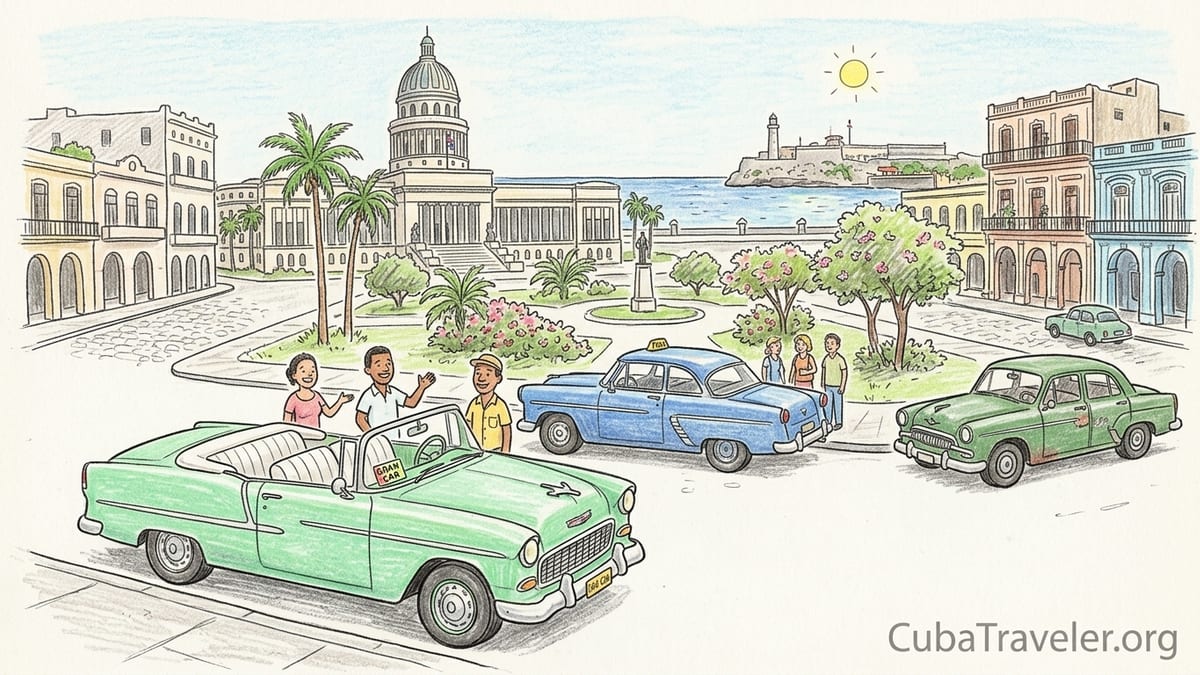
I started my hunt for a classic car tour in the area where almost every guidebook still tells you to go: the ring of streets around Parque Central and the Capitolio, at the edge of Old Havana. In normal years this is where rows of polished Chevrolets, Pontiacs and Buicks wait in a neat line. In April 2026, the scene felt thinner. Several drivers I spoke with blamed the deepening fuel shortage and the fall in tourist numbers. They could not afford to cruise aimlessly and idle in queues when gasoline itself had become both scarce and dollar‑priced.
Instead of a solid wall of gleaming chrome, there were scattered clusters of cars. Some were fully restored convertibles marketed squarely at foreign visitors. Others were workaday classic taxis, hardtops with faded paint that still hustle Cubans across town. A third group looked rougher still: patched‑together daily drivers from the 1940s and 1950s, still in service because there was no realistic alternative. All three categories might show up in the same Instagram frame, but the experience and economics behind each one are very different.
To test the tourist product, I focused on the most typical option: a dedicated sightseeing loop in a convertible hired from Parque Central. Several drivers opened their doors and invited me to sit, pushing hard on the visual pitch. One pointed to the Capitolio dome as his backdrop for a phone photo of me in the front seat. When I tried to discuss route and interpretation, the conversation slid back toward the car’s color and how “muy lindo” the photos would be on the Malecón.
In the end I chose a pastel‑green 1955 Chevrolet convertible, operating under the Grand Car tourist system according to its dashboard plate, and negotiated a 90‑minute ride. The driver and his cousin, who introduced himself as the “guide,” emphasized that fuel was “muy caro” now and that their price had to reflect that reality. Before we moved an inch, it was clear this was a transaction built less around storytelling than around scarcity and the chance to stage a fantasy.
Tourist Convertibles, Classic Taxis and Everyday Old Cars
From the sidewalk, it is tempting to lump every old American car in Havana into one romantic category. Standing by Parque Central, though, the distinctions became obvious. My Chevrolet was a purpose‑built tourist convertible: bright two‑tone paint, chrome polished to a mirror, white vinyl seats, and small touches designed for photographs, like period‑style hubcaps. It was used mostly for short sightseeing laps and hotel pickups. The horn got more use than the speedometer.
Parked a few meters away was a blue 1950s Ford hardtop working as a classic taxi, part of the informal fleet that ferries both locals and visitors between Vedado, Miramar and Old Havana. Its paint was dull, the doors bore the scars of countless repairs and minor accidents, and the interior was a jumble of added switches and patched upholstery. The driver told me that when tourists are scarce, he runs fixed‑route shared services for Cubans at prices that bear no resemblance to what I was about to pay.
Further along the curb I watched an older Cuban couple squeeze into what looked like a pre‑revolution Plymouth with dull green paint, mismatched door handles and a homemade roof rack. This car did not advertise itself to tourists at all. It was simply a family’s everyday transport, the latest incarnation of a vehicle that had survived for seven decades through ingenuity and necessity. These are the cars you see in Reuters and Anadolu images about Havana’s transport crisis, lined up at gas stations or crawling along the Malecón when fuel can be found.
Those ordinary classic cars and hybrid taxis are not props on a film set. They are a symptom of scarcity. Cuba’s American cars from the 1940s and 1950s survived through constant repairs, improvised parts and engine swaps precisely because importing new vehicles and spares has been limited by decades of economic isolation and sanctions, including the 2026 U.S. fuel blockade and earlier trade restrictions. The result is not a country that chose to be frozen in the 1950s, but one that has had to stretch each vehicle’s life far beyond what any manufacturer intended.
What Was Really Under the Hood of “My” 1955 Chevy
Once I stopped admiring the pastel paint and slid into the front seat, the gap between the image and the reality widened quickly. The interior, at first glance, looked smart: white vinyl bench seats, chrome‑look trim and an oversized steering wheel. But as soon as we started moving down Prado, the fantasy rattled. The seat belts in the front were present but loosely bolted and clearly retrofitted long after the car left Detroit. In the back, where most passengers sit to be photographed, there were no functioning belts at all.
The guide explained, almost proudly, that the original V8 had long ago been replaced with a diesel engine from a Soviet‑era truck. This is common in Havana; mechanics have spent decades dropping in Lada, Peugeot or truck engines to keep bodies from the 1950s moving when American parts were impossible to import. With fuel now so scarce and expensive, he said, diesel was the only realistic option. The sound was nothing like the deep, smooth burble you might imagine from a period commercial. Instead the car clattered and vibrated at idle, sending a steady buzz up through the seat.
The convertible roof, folded behind us in a lumpy stack, had clearly seen better days. When I asked whether it could be raised in case of rain, the driver shrugged and said it was “difícil” and better left down. The dashboard bore almost no resemblance to its original layout. Modern rocker switches had been drilled into the metal, the speedometer flickered unreliably, and a small digital voltmeter had been wedged where a radio might once have sat. Nothing about the driving position felt like a careful restoration.
Noise and fumes were impossible to ignore. On the Malecón, with the wind pushing exhaust back into the cabin, diesel smoke curled past my face and left a bitter taste in my mouth. The floorpan had been patched so many times that small gaps near the pedals let in not only dust and hot air but also wisps of exhaust when the car slowed or climbed a hill. I had expected at least a semblance of comfort given what I was paying. What I got was a raw, noisy, sometimes nauseating ride that would be unthinkable as a regulated tourist product in most destinations.
Following the Money: How the Pricing Really Works in 2026
Before committing to the ride, I spent half an hour asking around about prices. Several drivers near Parque Central and outside hotels like the Iberostar Parque Central and Hotel Inglaterra offered an hourly rate for a convertible. The numbers I heard clustered between 30 and 40 U.S. dollars per hour per car, with firm insistence that the price was “por el carro, no por persona” and that payment must be in foreign currency, not pesos. One operator I checked online the day before, a company called My Cuban Taxi, listed a classic cabrio tour from about 35 dollars per hour without a separate guide and about 45 with one, again priced per car.
At the higher end, international agencies and curated experiences have turned the same basic product into something far more expensive. A late‑afternoon two‑hour classic car tour with a guide through a foreign‑based agency was priced in the region of 150 to 200 dollars for up to three people in 2026, once booking fees and commissions were folded in. A full‑day private Havana program in a classic car, sold as an “iconic convertible immersion,” reached 250 dollars or more per car in some brochures. These rates include hotel pickup, a bilingual guide and sometimes a cocktail stop, but the underlying vehicle is not magically different.
The driver of my 1955 Chevy opened at 50 dollars for a one‑hour loop. When I pointed to other cars quoting 35, he immediately dropped to 40 for 90 minutes “with guide” and justified the discount by noting that fuel had “more than doubled” in price since the latest wave of U.S. restrictions early in 2026. Local and international reporting backs that picture of scarcity. Domestic fuel shipments from key suppliers have plunged, and Cuba’s tourism arrivals have fallen sharply after airlines from Canada and Russia cut flights when jet fuel ran low.
In the end we settled verbally at 40 dollars for 90 minutes, guide included. There was no written contract, no printed tariff and no official ticket from the Gran Car desk. Everything rested on trust and the assumption that I knew enough about local rates not to accept an absurd quote. When I later compared notes with other travelers in my guesthouse, several had paid close to double my rate through advance online bookings that promised “guaranteed quality” but used similar vehicles and routes.
The Actual Route: How Much Was Driving and How Much Was Sightseeing?
We set off from Parque Central, drove slowly down Paseo del Prado and turned toward the Malecón, Havana’s seafront boulevard. We cruised west along the seawall for roughly ten minutes, paused at a wide point overlooking the waves for photographs, then continued toward the tunnel that links central Havana with the fortress area on the other side of the harbor. At each stop the guide encouraged me to pose against the car, then against the sea, then again in front of the tunnel entrance while he took photos with my phone.
After emerging from the tunnel, we climbed toward El Morro and La Cabaña, the Spanish colonial fortifications that loom over the bay. The views back across the harbor to the Capitolio and Old Havana are undeniably beautiful, but we did not enter any sites. Instead we parked at a viewpoint dominated by other tour cars and souvenir stands. The guide pointed vaguely toward the skyline and delivered a few lines of memorized commentary about pirates, revolutionaries and Che Guevara’s role at the fortress. When I asked follow‑up questions, the answers quickly dried up.
From there we looped back through the tunnel, angled west into Vedado and made a brief swing past the Plaza de la Revolución, where I was again urged to stand in front of the Ministry of the Interior’s Che mural for more pictures. We did not stop long enough to visit the nearby José Martí Memorial or its museum. Finally we cut through the leafy residential streets of Vedado, rolled past the Hotel Nacional for a brief pause and then returned along the Malecón to Parque Central.
Later I traced the route on an offline map. The total distance was roughly 20 to 22 kilometers. The actual driving time, at Havana’s leisurely pace, was about an hour. The remaining 30 minutes were devoted to three photo stops and a slow initial negotiation while the car idled. In terms of meaningful sightseeing, I would count perhaps 15 to 20 minutes of loosely informative commentary and city views before the experience slid back into repetition. Measured against the price and the way these tours are marketed, that ratio felt poor.
Did the Guide Actually Teach Me Anything?
The presence of a “guide” was one of the selling points that nudged me from a simple taxi ride into a more expensive tour. I wanted to see whether spending extra for commentary and context justified the cost. On this front, the tour was the most disappointing. The guide’s English was workable and he was friendly, but much of what he said sounded rehearsed. He delivered standard lines about “Hemingway’s favorite bar” when we passed the general direction of El Floridita, despite my having told him earlier that I was not looking for bar recommendations.
At the Malecón viewpoint he gestured at the waves and said that storms sometimes threw seawater across the road and into buildings, which is true but hardly surprising. At Plaza de la Revolución he repeated the standard tourist‑brochure facts about Fidel Castro’s speeches lasting for hours and the square holding “a million people,” without explaining how that figure was ever arrived at or what the square means to Cubans living through today’s economic crisis. When I asked about how the 2026 fuel shortage was affecting drivers like him, his answer was more illuminating: long waits at gas stations, borrowing fuel from relatives, and genuine anxiety about how long they could keep operating if tourism did not pick up.
Most of the time, though, the guide’s real focus was on orchestrating images. “Now sit here, arm over the door, look to the sea,” he would say. “Now sunglasses, hair back, like a movie.” At one point he took my phone and lay almost flat on the Malecón to get a low‑angle shot of the car with clouds behind it. The results were undeniably striking, but they added nothing to my understanding of Havana or Cuba. It felt less like a guided tour and more like hiring a driver and a personal photographer for an hour.
There are operators that combine classic cars with genuinely deep guiding, including those that build visits to neighborhoods, historic sites or workshops into the itinerary. Some agencies and independent guides are known for that approach. The problem is that when you hire casually around Parque Central, there is no easy way to tell whether you are getting that richer experience or the thin version I had. In my case, the classic car tour delivered style but very little substance.
Comfort, Emissions and the Physical Reality of Riding in an Old Car
Beyond the price and the shallow commentary, the physical comfort of the ride was a major drawback, especially in Havana’s sticky heat. With the roof permanently down, the late‑afternoon sun burned my knees within minutes despite sunscreen. There was no shade built into the car and no offer of hats or even water. When the car stopped at traffic lights, the heat from the modified diesel engine rose up through the thin floor, mixing with exhaust and the smell of unburnt fuel from other vehicles around us.
The suspension, once designed for American highways, had been patched and improvised over years of uneven Cuban roads. Every pothole sent a sharp jolt up my spine. The brakes felt spongy. When the driver had to make a sudden stop to avoid a cyclist, the car lurched forward with a long, unsettling squeal. I never truly felt unsafe, but the combination of worn mechanicals and the absence of modern safety features made the experience tiring rather than relaxing.
Emissions were impossible to ignore. Each time we accelerated, a visible gray plume trailed behind us. On the Malecón, where the sea breeze sometimes pushed the exhaust sideways, I watched pedestrians wave away smoke from a whole convoy of old taxis. For a destination that increasingly markets its nature and beaches, the contradiction between that environmental message and the reality of badly tuned, heavily modified engines idling for photographs was hard to overlook.
By the end of the ninety minutes I felt more coated in fumes and sweat than filled with wonder. It is one thing to accept a bit of discomfort for an authentic local experience. It is another to pay a premium for a ride that is sold as glamorous nostalgia but delivers very little comfort, especially when Cuba in 2026 is already struggling with energy and environmental stress linked to the same fleet of aging vehicles.
Classic Car Tour vs Walking the City and Visiting Workshops
To check whether my disappointment was simply the result of unrealistic expectations, I spent the following day exploring central Havana mainly on foot. Walking from Old Havana through Centro and into Vedado, I covered much of the ground we had driven but at a human pace. Without the pressure to keep a convertible moving and profitable, it was easier to stop in small plazas, talk with residents who were willing to chat, and pay attention to details like restored facades, improvised street repairs and the way power cuts altered daily rhythms.
Later I visited a small private workshop on the outskirts of central Havana that specializes in keeping both tourist convertibles and ordinary family cars running. The owner showed me a row of engines in various states of disassembly, some from Soviet‑era Ladas, others from Korean compacts, all waiting to be mated to American bodies from the 1940s and 1950s. He pointed out welded suspension arms, custom‑made bushings and hand‑fabricated exhaust manifolds, explaining how sanctions and the broader fuel blockade had turned every serious mechanic into an inventor.
Standing in that workshop, I learned far more about why Cuba’s classic cars exist than I had from an hour and a half in the convertible. The cars are not maintained out of pure love for mid‑century American design, though many owners are proud of their vehicles. They are kept alive because importing a modern fleet at scale has not been feasible and because tourism, when it functions, rewards those who can present the most visually striking machines along the Malecón and in front of major hotels.
Walking and visiting a workshop also helped avoid a subtle problem that often comes with classic car tours: treating residents as background scenery. From the high perch of a convertible, it is easy to photograph people on the sidewalks or at bus stops without engaging with them at all. On foot, I was more likely to buy a juice from a corner stand, step into a bookshop or simply greet people at doorways. In a country where many services are strained by shortages and where tourism is under intense pressure, that felt like a more respectful way to spend both my time and money.
Five Hard Drawbacks of Havana’s Classic Car Tours in 2026
After combining my own experience with conversations on the ground and current reporting about Cuba’s crisis, several concrete drawbacks to Havana’s classic car tours emerged. The first is price. A direct negotiation around Parque Central in 2026 often starts at 35 to 40 dollars per hour for a convertible with a basic guide, which is already significant in a country where average state salaries remain low. Booking through international intermediaries can easily double or triple that number, reaching 150 dollars or more for a two‑hour experience that is not fundamentally different from a street‑hired ride.
The second drawback is comfort. Many of the most photogenic convertibles have had their mechanical hearts and interiors reworked in ways that prioritize appearance over ride quality. Worn suspensions, weak brakes, minimal shade, limited or retrofitted seatbelts and exposure to sun and exhaust all add up to a physically taxing experience. For anyone with respiratory issues, back problems or sensitivity to heat, this is not a trivial concern.
The third is shallow interpretation. While some specialized guides do provide thoughtful commentary, the typical casual tour I encountered focused far more on orchestrating photo stops than on explaining Havana’s layered history or present challenges. Memorized facts about Hemingway, revolution slogans and building dates are no substitute for informed storytelling about how Cubans are navigating 2026’s fuel shortages, economic hardship and evolving private enterprise.
The fourth is the photo‑driven structure that leaves little room for genuine exploration. Because drivers are now acutely conscious of fuel costs and time, they tend to favor a standard loop with a few set viewpoints where they know other cars will be waiting. This produces similar images for every visitor but rarely encourages stopping in less staged neighborhoods, entering museums or spending time in community spaces. You end up collecting shots of yourself with the car rather than developing any real sense of place.
The fifth drawback is the environmental and ethical dimension. Maintaining fleets of heavily modified, fuel‑hungry vehicles in the middle of the worst fuel shortage Cuba has experienced in years raises difficult questions. Reports from 2026 describe long queues at gas stations, public transport grinding to a halt and hospitals and water systems straining under energy cuts, all while tourist cars continue to burn scarce diesel and gasoline for short sightseeing loops. Paying for a classic car tour does put money into drivers’ pockets, which many urgently need, but it also participates in a system that privileges a few visible icons over the broader needs of the transport network.
The Takeaway
Havana’s classic car tours are not a simple nostalgic indulgence. In 2026 they sit at the intersection of economic survival, foreign sanctions, fuel scarcity and a global appetite for images that flatten Cuba into a retro postcard. My own ride in a pastel‑green convertible delivered a handful of admittedly striking photos and a pleasant breeze along the Malecón but fell far short of the rich, immersive experience that the marketing language had promised.
Are they overrated? For many travelers, yes. When an hour‑and‑a‑half circuit costs 40 dollars on the street or well over 100 through an agency, yet yields more fumes and orchestrated poses than meaningful engagement, the value proposition becomes hard to defend. Walking Havana’s streets, visiting a repair workshop or spending time in museums and neighborhood projects can provide a deeper understanding of the city for the same money or less, without using scarce fuel for a choreographed loop.
That does not mean classic cars should be avoided entirely. For some visitors, a short spin in a convertible may still be worth it as a symbolic moment, especially for car enthusiasts or those who grew up with 1950s American automobiles in family stories. If you decide to go ahead, treat the ride as one colorful fragment of your time in Havana, not as its defining experience, and try to balance it with activities that support the city in less extractive ways.
Most importantly, agree on the details in writing before the engine starts. That means confirming the total price, the duration, whether the rate is per car or per person, what route you will take, how many stops you will make, whether a guide is included and in which language, and whether there are functioning seatbelts for everyone. Snap your Malecón photo if it matters to you, then put the phone down long enough to notice the complex, resilient city beyond the chrome. It deserves more attention than any single hour in a convertible can provide.
FAQ
Q1. Are Havana’s classic car tours still operating during the 2026 fuel shortage?
Many classic car tours are still operating in Havana in 2026, but there are fewer cars on the streets and drivers are more selective about when and how far they drive because fuel is expensive and sometimes difficult to find.
Q2. How much should I expect to pay for a classic car tour in Havana now?
A typical negotiated rate on the street around Parque Central is about 30 to 40 U.S. dollars per hour per car for a convertible, while agency‑booked private tours can cost from around 100 to 200 dollars for a two‑hour program depending on inclusions.
Q3. What is the difference between a tourist convertible and an ordinary classic taxi?
Tourist convertibles are usually brightly painted, polished cars used mainly for short sightseeing loops, while ordinary classic taxis are hardtop or less glamorous vehicles that locals use for everyday transport and shared rides across the city.
Q4. Is it true that Cuba chose to preserve cars from the 1950s for nostalgia?
No. Most 1940s and 1950s American cars in Cuba survived because economic restrictions and limited access to imports forced owners to keep repairing and modifying them, often with foreign engines and homemade parts, rather than as a deliberate nostalgic project.
Q5. Are classic car tours comfortable for people with health issues?
Many classic cars lack modern suspension, reliable seatbelts, air‑conditioning and proper shade, and they often emit noticeable exhaust fumes, so they can be uncomfortable or unsuitable for people with respiratory problems, back issues or sensitivity to heat.
Q6. Do guides on classic car tours provide in‑depth historical information?
On casual street‑booked tours, guides often provide only basic, rehearsed commentary focused on famous landmarks and photo stops; more in‑depth interpretation usually requires booking with a reputable company or independent guide that emphasizes storytelling and context.
Q7. How long is a typical classic car sightseeing route in Havana?
Most standard circuits last about one to two hours and follow a loop from Parque Central along the Malecón, up to the fortress viewpoints across the bay and through Vedado and Plaza de la Revolución before returning downtown.
Q8. Is it better to book a classic car tour in advance or negotiate on the spot?
Negotiating on the spot around Parque Central usually gives a lower price and more flexibility, while advance bookings through agencies cost more but may include hotel pickup, a confirmed bilingual guide and clearer terms.
Q9. Are there more meaningful alternatives to a classic car tour in Havana?
Yes. Walking tours with local guides, visits to car restoration workshops, time in museums and neighborhood projects, and simply exploring Old Havana and Vedado on foot can all offer deeper insight into the city with less emphasis on staged photos.
Q10. What should I agree in writing before starting a classic car tour?
Before the ride, clearly agree on the total price, whether it is per car or per person, the duration, route, number of stops, whether a guide is included and in what language, and the presence of functioning seatbelts, and ask the driver to note these details on a card or message so there is less room for dispute later.