

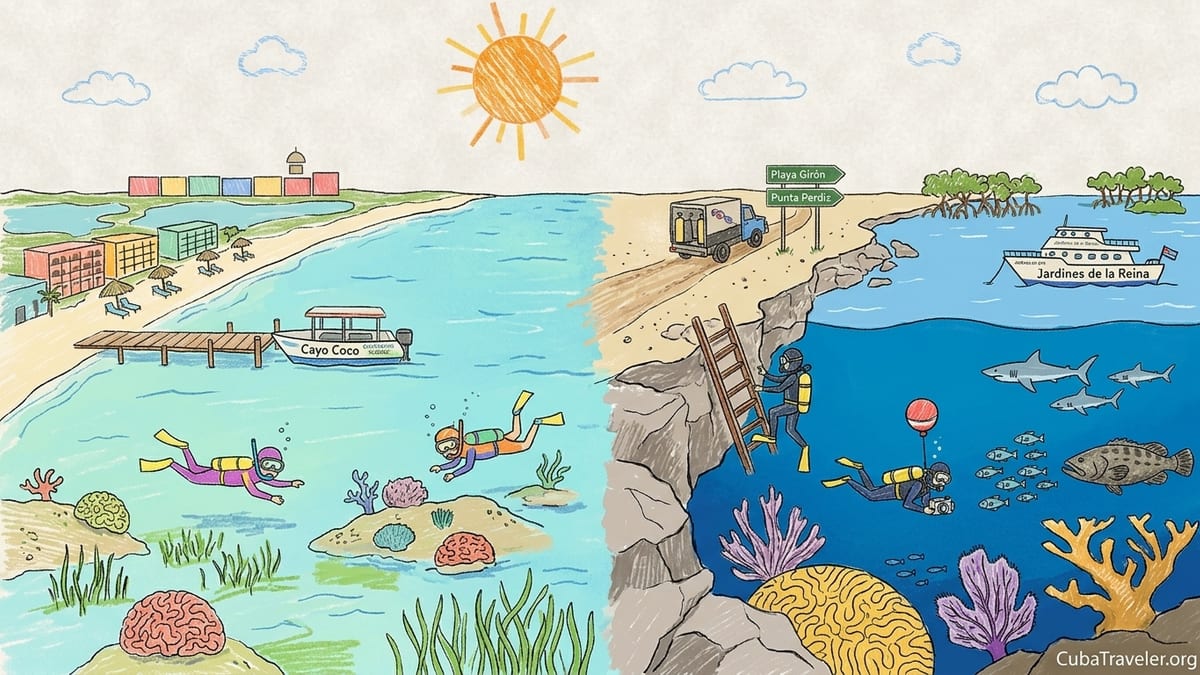
Cuba’s reefs span two very different seas. To the north, Atlantic-facing cays such as Cayo Coco and Guardalavaca feel bright and breezy, with shallower fringing reefs and sandbars that suit families and casual snorkelers. To the south, the Caribbean side from the Bay of Pigs to Jardines de la Reina offers deeper walls, mangrove channels and blue-water pelagics that attract serious divers and liveaboard operators. Navigating these contrasts, while also dealing with Cuba’s 2026 fuel shortages and fragile medical infrastructure, is essential if you want your trip to be memorable for the right reasons.
North vs South: Understanding Cuba’s Two Reef Systems
The north coast of Cuba looks out toward the Old Bahamas Channel and the open Atlantic. Resorts such as Cayo Coco and Guardalavaca sit behind long sandy shelves and lagoons, with patch reefs and seagrass meadows a short boat ride offshore. These areas tend to have slightly cooler water, more wind and chop, and more days when snorkeling trips are cancelled due to waves. Reef profiles are often gradual, with coral heads rising from 3 to 10 meters before dropping off more gently, which suits beginners and mixed-ability groups.
On the south coast, the picture changes. From Playa Larga in the Bay of Pigs to María la Gorda and the remote Jardines de la Reina, the island faces the Caribbean and deeper basins. Here the reef crest often lies very close to shore, sometimes with dramatic walls starting around 5 to 10 meters and plunging to 40 meters or more. Visibility is frequently excellent when seas are calm, and mangrove-lined shores add nurseries for juvenile fish and crocodiles. These southern environments are ideal for experienced divers seeking walls and caverns, but they demand more planning in terms of transport, fuel availability and emergency evacuation options in 2026.
The northern cays are dominated by all-inclusive resorts with packaged snorkeling and introductory dives sold through on-site tour desks. The south leans more heavily on dedicated dive centers, simple lodgings and, in the case of Jardines de la Reina, specialist liveaboard fleets that must coordinate fuel deliveries and limited visitor quotas. Your choice of region should match not only your certification level, but also your comfort with long road transfers and reduced infrastructure.
Another critical difference is access to medical support. Northern resort hubs like Holguín (for Guardalavaca) and Jardines del Rey Airport (for Cayo Coco) have relatively more consistent domestic flights and easier overland routes to larger hospitals. In contrast, a remote western point such as María la Gorda or a liveaboard in Jardines de la Reina is many hours by road or boat from major facilities, which significantly raises the bar for risk management, especially when fuel shortages can delay ambulances or transfers.
Bay of Pigs Basics: Playa Larga, Playa Girón and the Coastal Road
The Bay of Pigs, on the Zapata Peninsula in Matanzas Province, is the most practical entry point into southern Cuban diving for many visitors. By road it lies roughly three hours from Havana, usually reached by private taxi or pre-booked transfer. There is no major airport directly on the bay; most travelers fly to Havana or Varadero, then continue by road. Once at the bay, the dive centers at Playa Larga and Playa Girón offer shore-access diving from a string of marked sites along the coastal road, including Punta Perdiz and Cueva de los Peces, with ladders or steps cut into the limestone for easy entry.
Playa Larga, at the northern end of the bay, appeals to divers who want small guesthouses, mangrove-fringed beaches and easy access to both cenote-style sinkholes and reef walls. Local operators typically run one or two guided shore dives per day, transporting groups by truck or minibus to entry points such as Punta Perdiz or Los Cocos. Depths on the outer wall commonly range from about 10 meters at the top to 30 meters and beyond, with relatively weak currents on calm days. This makes the area suitable for Open Water divers with a few logged dives, but you should still confirm that your operator adheres to conservative depth limits and group sizes.
Playa Girón, further south, hosts a more established state-run dive center with access to at least a dozen named sites along the bay, including El Ebano, El Tanque and multiple cavern and cenote locations. Shore entries here are similarly straightforward, often starting from rocky ledges or small coves where you kit up beside the truck. Some sites offer a short surface swim to the reef crest that drops into a vertical wall. Because these sites are close to shore, there are no lengthy boat rides, which is an advantage when gasoline supplies are uncertain. However, on-site medical support is limited to basic first aid; there is no hyperbaric chamber in Zapata, so a serious dive emergency would require road evacuation toward larger cities such as Cienfuegos or Havana.
For both Playa Larga and Playa Girón, rental equipment is usually basic but functional, often from brands like Scubapro or Mares, with aluminum 12-liter cylinders. In 2026, visiting divers report that gear quality and air fills can vary from day to day, especially when spare parts are scarce. You should inspect rental regulators and BCDs carefully, ask how recently they were serviced, and consider bringing your own mask, computer and even regulators if baggage allowances permit. Expect guided shore dives to be priced per tank with cash payment in hard currencies such as euros or Canadian dollars preferred, as card processing can be unreliable.
Cenotes and Caverns: Punta Perdiz and Cueva de los Peces
The coastal strip between Playa Larga and Playa Girón is dotted with flooded sinkholes connected to the sea by subterranean tunnels. Cueva de los Peces, about 18 kilometers south of Playa Larga, is one of the best-known examples: a narrow, jungle-fringed pool over 60 meters deep that connects to the bay via underwater cracks. Freshwater lenses overlying saltwater create striking haloclines and clear blue water. Shore snorkeling in the cenote itself is popular with tour buses, and many first-time visitors assume that such enclosed pools are automatically safe for beginners.
In reality, any overhead environment or deep sinkhole requires cautious risk assessment. Cuban regulations limit recreational divers to cavern-level penetration near natural light zones, but not all operators enforce strict training prerequisites, especially when fuel and income are tight. Strongly consider reserving cenote-style dives for Advanced Open Water divers with good buoyancy and recent experience. If you have not completed a formal cavern or cave course, you should not venture beyond the cavern zone or into side tunnels. Lack of a direct vertical ascent route, plus the depth potential of cenotes like Cueva de los Peces, can quickly amplify even minor problems that would be manageable on an open reef.
Punta Perdiz itself is a classic Bay of Pigs shore site that combines easy snorkeling with access to a dramatic wall for divers. At the beach club, visitors can pay a day-use fee that often includes sun chairs, lunch and house-reef snorkeling, while divers kit up for a short swim to the drop-off. Snorkelers will find shallow coral heads, sponges and schooling grunts in 2 to 5 meters of water, with patchy seagrass that attracts juvenile fish. Scuba divers cross this zone and descend onto a sloping bank that quickly drops to around 20 to 30 meters, with larger barrel sponges and occasional tarpon.
Conditions at Punta Perdiz are usually calm, with light currents and good visibility when wind is low. This makes it one of the more forgiving places in Cuba for newly certified divers to experience their first wall. Even here, though, the 2026 logistical picture means you must ask hard questions. Confirm that your guide carries a surface marker buoy, that there is oxygen in the support vehicle or at the base, and that the operator has enough fuel for the return to town and, if necessary, for a medical transfer to a larger clinic. A dive bus parked by the roadside is not the same thing as a fully prepared emergency response.
María la Gorda: Remote Walls at the End of the Road
María la Gorda sits on the far western tip of Cuba’s Guanahacabibes Peninsula, in Pinar del Río Province. There is no nearby commercial airport; most travelers fly into Havana’s José Martí International Airport and hire a private transfer or rental car for the roughly five to six hour drive to the resort. The road passes through rural areas and a protected national park, so you should not assume easy access to fuel or mechanics along the way. Some transfer companies still advertise door-to-door services from Havana, but schedules may shift in 2026 as fuel allocations change.
The reward for the long journey is one of Cuba’s most dramatic wall-diving areas. The state-run resort at María la Gorda hosts a dive center that uses comfortable day boats to access dozens of sites strung along the peninsula. Many dives begin on plateaus at 5 to 10 meters before dropping over vertical coral walls to depths well beyond recreational limits. Typical profiles for guided dives stay in the 18 to 30 meter range, suitable for Advanced Open Water or equivalent certifications. Currents are often modest, but blue-water conditions and the possibility of downwellings mean that divers should be comfortable with mid-water ascents and gas planning.
María la Gorda is not ideal for casual snorkelers or families seeking variety. The resort infrastructure is limited, with one main hotel complex and few alternative dining or entertainment options. Shore snorkeling is possible from the beach, but the most impressive corals and sponges lie deeper, which favors certified divers. Rental equipment is generally concentrated at the on-site center, and while staff strive to maintain it, restocking and servicing can be delayed by supply chain issues. It is prudent to bring critical spares such as fin straps, mask bands and computer batteries.
Medical support here is minimal. The resort can provide first aid and oxygen, but any decompression sickness or serious trauma would involve many hours of road transfer back toward Pinar del Río or Havana. There is no nearby chamber with guaranteed 24-hour readiness and fuel constraints in 2026 have occasionally affected ambulance response times on the island more broadly. Because of this, conservative dive profiles, strict adherence to no-decompression limits, and personal dive accident insurance that covers medical evacuation from remote locations are essential. María la Gorda suits experienced divers and underwater photographers who value uncrowded walls and are willing to accept logistical complexity.
Jardines de la Reina: Liveaboard-Only Wilderness
South of Ciego de Ávila, the sprawling mangrove and coral system of Jardines de la Reina is Cuba’s flagship marine reserve. Protected since the 1990s, the area enforces restrictions on fishing and tourism, including caps on annual visitor numbers and controls on which operators can run programs. Access is via the small port of Júcaro, reached by road from Ciego de Ávila or Camagüey airports. From Júcaro, liveaboard yachts and floating hotel barges undertake a navigation of roughly four to five hours to reach the heart of the archipelago, depending on sea conditions and the specific vessel.
Unlike resort diving, Jardines de la Reina is almost entirely a liveaboard destination. Guests sleep and eat on vessels anchored within the mangrove channels and complete several boat dives per day on nearby reefs. Sites typically feature lush coral gardens, vertical walls starting between 10 and 15 meters, and encounters with Caribbean reef sharks, silky sharks, goliath groupers and healthy schools of snapper. Depths for guided profiles usually range from about 15 to 30 meters with modest currents, though blue-water shark dives may involve stronger flow and mid-water safety stops. Operators expect divers to hold at least an Advanced Open Water certification and to be comfortable in open ocean conditions.
In 2026, several long-standing international partners have scaled back direct bookings in Cuba, but Cuban license holders and specialist agencies still promote multi-day Jardines itineraries with prices commonly in the several-thousand-dollar range per week, excluding international flights. Because all logistics, including fuel for generators and dive tenders, must be trucked and shipped into this remote zone, last-minute cancellations or altered itineraries are more likely during fuel shortages. Prospective guests should ask operators in writing how they are managing fuel allocations and what contingency plans exist if a generator or tender cannot operate on a given day.
On-board medical provision varies by fleet, but you should expect, at minimum, several oxygen kits, a full first-aid inventory and satellite or HF radio contact with shore. Cuban regulations require guides and instructors to be licensed, yet external verification of their training agency and current status is important. Ask which agency certifies the staff, whether at least one guide on board holds a rescue or instructor-level credential and how emergency evacuations are coordinated. Liveaboard pre-trip documents often note that dive accident insurance is mandatory; select a policy that includes hyperbaric treatment, boat and helicopter evacuation and trip interruption coverage.
Because Jardines de la Reina lies far from land-based hospitals, decompression management must be conservative. Even though some vessels carry oxygen and can contact shore-based doctors, a chamber treatment will still mean hours of transport back toward the mainland. In 2026, with power and fuel already under strain island-wide, you should not assume that chamber facilities elsewhere in Cuba will always be immediately available. This does not make Jardines inherently unsafe, but it does mean that only divers with good health, recent experience and an appetite for remote travel should consider it.
Other Southern Gems: Cayo Largo, Isla de la Juventud and Playa Ancón
Cayo Largo del Sur, part of the special municipality of Isla de la Juventud, is a low-lying coral island surrounded by clear, shallow seas. Access is typically through domestic flights from Havana to a small airstrip on Cayo Largo, though flight schedules have fluctuated in recent years. Once there, a cluster of all-inclusive resorts lines signature beaches such as Playa Sirena and Playa Paraíso, with tour desks selling catamaran snorkeling excursions and scuba packages. Snorkelers enjoy white-sand bottoms, seagrass areas with starfish and rays, and scattered coral heads in 2 to 5 meters of water, ideal for families and less confident swimmers.
For divers, the Cayo Largo marine reserve offers boat-access reefs with depths usually between about 10 and 25 meters. Currents are usually gentle, and visibility can be excellent when wind is low, making it a good area for Open Water divers and underwater photographers who favor bright, shallow scenes over deep walls. Rental gear is managed through the resort-linked marina, and day boats often combine snorkelers and divers, so this is not the place for highly technical or advanced profiles. Medical backup relies on island clinics and evacuation by boat or aircraft back to the main island, which may be delayed by weather or fuel concerns.
Across the wider Isla de la Juventud, particularly around Punta Francés and El Colony, divers find more pronounced walls, tunnels and canyons reached by day boat from the southern coast. Access involves first reaching the main town of Nueva Gerona by domestic flight or ferry, then transferring to southern resorts or ecolodges. Given recurring fuel shortages, ferry schedules and internal flights can change on short notice. However, those who make it are rewarded with relatively untouched coral, sponges and macro subjects in depths from about 15 to 30 meters, with occasional swim-throughs. At present, these operations are best suited to certified divers with some experience, comfortable with basic Spanish and flexible travel plans.
Near Trinidad on the south-central coast, Playa Ancón sits on a peninsula that juts into the Caribbean with a mix of beach hotels and simple casas particulares in nearby La Boca and Trinidad. The local dive center uses small boats to reach offshore reefs that start around 5 to 10 meters and drop to roughly 30 meters. Currents tend to be light and the short boat rides are a plus in a fuel-constrained year. Playa Ancón is a good compromise destination for couples or groups where some want to dive and others prefer colonial architecture, hiking or nightlife in Trinidad. Snorkeling from the main beach is modest but passable for casual swimmers, with better coral reached by boat.
Across these southern sites, conservation rules are relatively simple but should be respected. National parks and managed reserves generally prohibit touching corals, harassing wildlife or taking marine souvenirs, and guides may brief specific no-anchor or no-fishing zones. While enforcement may appear relaxed, foreign visitors draw attention, so you should follow best practice: wear reef-safe sunscreen, maintain neutral buoyancy and avoid feeding fish. In 2026, Cuban environmental authorities continue to emphasize marine reserves such as Punta Francés and the southern cays as pillars of sustainable tourism, even as they juggle economic pressures.
Northern Reefs: Guardalavaca and Cayo Coco for Snorkelers
On the north coast, Guardalavaca in Holguín Province combines broad sandy beaches with relatively easy reef access. Travelers typically arrive via Holguín’s Frank País International Airport and transfer by road for about an hour to the all-inclusive resort strip. On-site dive centers and excursion desks arrange short-boat trips to nearby reefs and walls that start shallower than in the south, with many sites in the 10 to 20 meter range. The area is well-suited to Open Water divers and confident snorkelers, and several resorts market family snorkeling tours, sometimes using glass-bottom boats.
Guardalavaca’s reef system includes both patch reefs close to shore and deeper outer structures. Snorkelers can see brain corals, soft corals and small barracuda in just a few meters of water, while divers venture to spur-and-groove formations and mini-walls. Currents are usually mild, though winter northers can bring swells that reduce visibility and force operators to cancel trips. Rental gear is often in better supply than in some rural southern locations, simply because container shipments tend to prioritize larger resort hubs. Even so, you should inspect equipment carefully, confirm recent servicing where possible and bring personal essentials.
Cayo Coco, part of the Jardines del Rey archipelago, has its own international airport and is connected to mainland Cuba via a long causeway. Visitors typically stay in large all-inclusive properties where activity desks sell snorkeling outings, introductory dives and two-tank boat trips. Snorkeling excursions often depart directly from hotel beaches or from nearby Playa Pilar, using small boats or catamarans to reach shallow reefs where depths rarely exceed 5 to 8 meters. Glass-bottom boat tours operate when weather allows and are popular with non-swimmers, though they may be cancelled in windy conditions.
Boat diving off Cayo Coco accesses reefs and drop-offs a little farther offshore, typically in the 10 to 25 meter range with manageable currents. These profiles are appropriate for Open Water divers, including those who have not dived in some time, provided they complete a refresher session. Families and mixed groups benefit from the combination of kid-friendly shore activities, easy snorkeling and modest dive depths. Medical care is more accessible than in remote corners of Cuba, with clinics on the cay itself and larger hospitals in nearby cities, though the island’s overall fuel and power issues can still affect response times and transport.
For both Guardalavaca and Cayo Coco, the main risk factors are not extreme depths or currents, but rather complacency and reliance on resort marketing. Before booking, ask whether dive boats have oxygen and radios, what the maximum group size will be, and how many guides are in the water per group. If a resort’s sales staff cannot answer these questions clearly, treat it as a warning sign and keep looking for an operator that can.
Safety, Fuel and Medical Realities in Cuba’s 2026 Dive Scene
Across Cuba in 2026, chronic shortages of fuel and medical supplies create constraints that divers cannot ignore. An advertised dive or snorkeling tour does not guarantee that boats will have enough gasoline to operate as scheduled, or that ambulances will be able to respond quickly in an emergency. Several travelers in recent seasons have reported late-notice cancellations of excursions due to “technical issues” that, on closer inspection, were linked to fuel allocation or mechanical problems that could not be fixed promptly.
When evaluating a dive center, start by asking specifically about oxygen provision. Every boat that intends to take divers deeper than about 10 meters should carry at least one oxygen kit capable of delivering high-flow oxygen to an injured diver for the duration of the ride back to shore. Shore-based operations that drive divers to entry points should have oxygen in the vehicle or ensure that it is available on site. Do not be shy about asking to see the cylinders and regulators; check that the pressure gauge shows a full or nearly full tank and that staff know how to assemble and use the equipment.
Instructor and guide credentials are another key filter. Cuba has its own national training system, but many professionals also hold certifications from international agencies such as CMAS, SSI or PADI. Ask which agencies your guides are certified with, what their highest rating is, and whether their cards are current. A reputable operator will show plastic cards or digital credentials and will be willing to describe their experience at specific sites such as Punta Perdiz, María la Gorda or Jardines de la Reina. If you are newly certified, look for centers that offer smaller groups and explicit check dives rather than pushing you immediately to deeper walls.
Decompression arrangements matter because Cuba’s hyperbaric facilities are limited and concentrated in larger cities. Before diving in a remote area, ask your operator where the nearest functioning chamber is, how patients are typically transported there and how long that process takes. If staff are vague or say “do not worry, nothing happens here,” take that as a cue to be extra conservative or to reconsider your plans. Carry dive accident insurance from a provider that specifically covers Cuba, marine evacuations and hyperbaric treatment, and verify that your policy is valid under your nationality’s regulations for travel to Cuba.
Given these realities, divers should adopt more conservative practices than they might in better-resourced destinations. Use nitrox where available and trained, stay shallower than your maximum allowed depths on early dives, lengthen safety stops and leave generous surface intervals. Bring two independent timing or computer devices if possible, and keep a log of profiles. On liveaboards or multi-day packages, remain hydrated, avoid excessive alcohol, and do not hesitate to sit out a dive if you feel unwell. The relative remoteness that makes Cuba’s reefs attractive also limits the margin for error.
The Takeaway
Choosing the best Cuban dive or snorkel destination starts with an honest look at your experience, your appetite for logistical complexity and your expectations for comfort. For casual snorkelers and mixed-ability families, northern hubs such as Cayo Coco and Guardalavaca, along with southern beach-dive areas like Punta Perdiz in the Bay of Pigs, offer the best balance of access, shallow reefs and backup infrastructure. Here you can combine reef time with beach days and cultural excursions while keeping daily logistics relatively simple.
Newly certified divers will find the Bay of Pigs especially appealing. Shore-access walls at Playa Larga and Playa Girón deliver “big blue” experiences without long boat rides, and cenote-style sites such as Cueva de los Peces add variety, provided you respect conservative limits and avoid true overhead environments. Playa Ancón offers a similar level of challenge with the added charm of nearby Trinidad’s historic streets, though medical support still relies on transfers to larger cities.
Wall-diving specialists and photographers willing to travel farther will get the most from María la Gorda’s vertical drop-offs and the protected reefs of Jardines de la Reina. These areas retain some of the Caribbean’s healthiest coral stands and shark populations but demand strong self-reliance, robust insurance and a tolerance for itinerary changes tied to fuel and weather. For many, the chance to shoot schooling fish against clear blue water in near-pristine reserves will justify the extra cost and complexity.
In 2026, the key to enjoying Cuba’s underwater world is preparation. Book flexibly, verify operators’ safety provisions in detail, travel with essential gear and accept that some things will not run on schedule. If you pair that realism with a respect for local constraints and the marine environment, Cuba can still deliver exactly what divers and snorkelers seek: clear water, vivid reefs and the feeling of being far from crowded mainstream circuits.
FAQ
Q1. Is Cuba safe for scuba diving in 2026?
Cuba offers many safe and rewarding dive sites, but fuel shortages, limited medical resources and variable operator standards mean you must choose centers carefully, verify oxygen and evacuation plans and dive conservatively.
Q2. Where is the best place in Cuba for beginner divers?
The Bay of Pigs around Playa Larga and Playa Girón, plus resort hubs like Cayo Coco and Guardalavaca, are good for beginners because depths are moderate, currents are usually mild and access is straightforward.
Q3. Are cenotes like Cueva de los Peces suitable for first-time divers?
Shallow parts near the entrance may be manageable for supervised novices, but the sinkhole is deep and has overhead sections, so only trained and certified divers with experience should attempt cavern-style routes.
Q4. Do I need Advanced Open Water to dive María la Gorda or Jardines de la Reina?
Most operators expect at least Advanced Open Water or equivalent for deeper wall and shark dives at these sites, and they may require recent logged dives to accept you on more demanding profiles.
Q5. Can families with children enjoy snorkeling in Cuba?
Yes, especially at northern resorts like Cayo Coco and Guardalavaca and at southern spots like Punta Perdiz and Cayo Largo, where shallow sandy areas and boat-supported trips suit families and mixed-ability groups.
Q6. How reliable are domestic flights and transfers to remote dive areas?
Domestic services and long road transfers can be affected by fuel shortages and schedule changes, so you should build flexibility into your itinerary, confirm transport close to departure and avoid very tight connections.
Q7. Is rental dive gear in Cuba good quality?
Quality ranges from well-maintained to heavily worn. Inspect all gear, test inflators and regulators before each dive, and bring your own mask, computer and other critical items whenever possible.
Q8. Do I need dive accident insurance to dive in Cuba?
It is strongly recommended everywhere and often mandatory for Jardines de la Reina liveaboards, because hyperbaric chambers and medical evacuations are limited and can be costly without coverage.
Q9. Are there strong currents at Cuban dive sites?
Many sites, particularly in the Bay of Pigs and northern resort areas, have mild currents, but walls at María la Gorda and blue-water shark dives in Jardines can feature stronger flows and downwellings that require experience.
Q10. Which Cuban destination is best for underwater photography?
For wide-angle reef and shark photography, Jardines de la Reina and María la Gorda are standouts, while macro and colorful reef scenes are excellent at Punta Perdiz, Cayo Largo and Punta Francés on Isla de la Juventud.