


I arrived in Havana on a humid afternoon in late September 2026, checking into a small casa particular on Calle Habana, two blocks south of Plaza Vieja in Habana Vieja. The forecast had promised scattered showers, 31-degree heat and heavy humidity, and I stepped out that first full morning with clothes already sticking to my back and a head full of postcard images of pastel facades, polished plazas and classic cars. My plan was simple: walk from the carefully restored heart of Old Havana out into Centro Habana’s residential streets, see how those two worlds connect on foot, and pay attention to the details you miss from the back of a 1950s convertible.
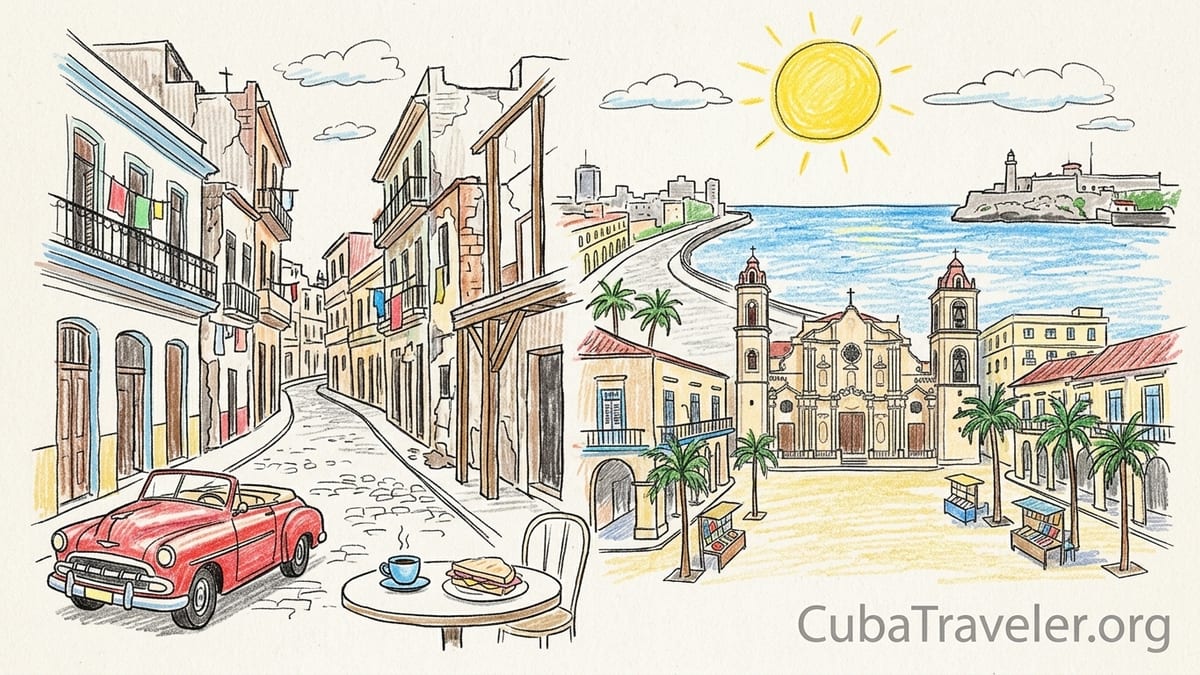
Starting the Day in Habana Vieja
I left my guest room just after 8:30 a.m., when the sun was already fierce but some streets still held pockets of shade. From my casa particular near Plaza Vieja, I could hear metal shutters rolling up, the clink of bottles from a nearby cafetín and the steady murmur of neighbors greeting each other. Habana Vieja is often described as a museum quarter, but that morning it felt lived in: schoolchildren in uniforms cutting down side alleys, someone shouting about fresh bread, and the aroma of strong coffee drifting from a doorway that functioned as both home and informal café.
Breakfast was not an Instagram spread but a practical start: a small coffee and a ham-and-cheese sandwich from a nearby cafeteria that priced in CUP. The posted price was around 120 CUP for the sandwich and about 60 CUP for the coffee, and the cashier was happy to quote an approximate rate in euros and dollars when I pulled out foreign cash. I paid in CUP from a wad I had exchanged the day before at an informal rate, conscious that the value of those notes shifted week by week. With food in my stomach and a reusable water bottle already half-empty, I set out toward my first stop, Plaza de Armas.
The heat shaped my route from the beginning. I stuck to the narrowest streets, hugging walls that threw thin slivers of shade across the cobbles. Habana Vieja is compact on the map, but the combination of humidity and uneven stone surfaces slowed my pace. From my accommodation to Plaza de Armas I walked roughly 900 meters, taking about 15 minutes with photo pauses, enough time for sweat to bead on my forearms and for my shirt to start showing damp patches at the spine.
Plaza de Armas and the Harbor Fortifications
Plaza de Armas, the oldest of Havana’s main squares, felt like a hinge between the city and the sea. I entered from the southwest corner, where the shade of royal palms and the ring of secondhand bookstalls framed the square with color and paper. On one side was the elegant Palacio de los Capitanes Generales, on another the colonnaded Palacio del Segundo Cabo, and at the seaward edge stood the low, stone profile of Castillo de la Real Fuerza. Even before I reached the fort, I could glimpse, across the harbor, the silhouettes of two larger guardians: Castillo del Morro on the rocky headland and La Cabaña stretching back along the ridge.
Castillo de la Real Fuerza itself sits within Habana Vieja on the city side of the harbor channel, a short walk from Plaza de Armas without any need to cross water. Its squat bastions and deep stone ditch make it feel more like a ceremonial ancestor than an active military structure now. Standing on the ramparts, I looked out across the harbor mouth to Morro and La Cabaña on the opposite shore. To visit those, I knew, would require crossing the bay by road via the tunnel or by ferry from the nearby terminal, a commitment of transport and time that did not fit into this day on foot.
From this vantage point the contrast that would define my day was already visible. The line of the Malecón curved away to my right, backed by a mixture of grand hotels and visibly crumbling apartment blocks in Centro Habana. Closer in, the roofs of Habana Vieja showed a patchwork of restoration and neglect: freshly painted cornices beside terraces propped up with improvised wooden supports. I stayed on the fort’s upper level for about 20 minutes, long enough for the sun to bite into my shoulders and for the harbor’s light breeze to dry my sweat just a little before I retreated back under the palms of Plaza de Armas.
From Plaza de la Catedral to Plaza de San Francisco
Leaving Plaza de Armas, I took the shaded streets north and west, following a route that roughly traced the old urban grid that linked Havana’s main historic squares. It was less than 500 meters to Plaza de la Catedral, but the character shifted as I walked. Tourist groups became more concentrated, guides lifted umbrellas, and stalls selling crafts and paintings clustered in side alleys. When the Cathedral’s baroque facade appeared, framed by uneven cobblestones and arcaded buildings, it felt like stepping directly into the classic Havana postcard.
Plaza de la Catedral anchors the religious and ceremonial part of the old city’s layout, its narrow approaches making the square feel almost like an enclosed courtyard that opens suddenly in front of you. I stood in the middle for a few minutes, trying to ignore the solicitations for restaurant menus thrust politely in my direction. Restoration work here has been extensive, and most of the facades gleamed in the mid-morning sun. Yet behind some of the arched ground-floor doorways I could glimpse staircases and inner patios where paint peeled and laundry hung, evidence that these monumental buildings still housed ordinary lives.
From Plaza de la Catedral I dropped south toward Plaza de San Francisco along streets that funneled me downhill toward the harbor. The walk took about 10 minutes and covered roughly 700 meters, passing small currency exchange offices, a handful of private art galleries and corner shops where shelves held limited but carefully arranged stock. Plaza de San Francisco, with its imposing church and the Lonja del Comercio building, plays a more commercial role in Havana’s historic plan. Facing the harbor and the ferry terminal, it historically connected maritime trade with the city’s administrative and religious core. Today, cruise passengers and domestic commuters pass through the same space, though on my visit the international cruise scene remained muted and the activity centered more on local foot traffic and delivery trucks threading the cobbled edges.
Plaza Vieja, Plaza del Cristo and Everyday Errands
By late morning the sun was high and the humidity felt heavier, so I cut back inland to my temporary home turf, Plaza Vieja. Of Havana’s main plazas, this one best shows how adaptive reuse has reshaped the urban layout. Once used for markets and even bullfights, it is now edged by cafes, galleries and a microbrewery, with a restored central space that invites lingering more than transit. Architecturally, the square is a showcase: colonial mansions with arcades and balconies look across at more modest structures with rooftop tanks and patched plaster. I found a table in the shade at a corner café and ordered a coffee and a cold bottle of water. The bill came to the equivalent of a few US dollars at prevailing informal exchange rates, noticeably more than my breakfast despite being less substantial.
Money, here, was an unavoidable part of the experience. The menu prices at this café were listed in pesos, but the waiter was quick to explain options in euros and dollars, reflecting the multiple exchange realities that shape Havana today. I paid in CUP again, watching a stack of notes shrink slightly, and mentally calculated how far my cash would go if I kept to similar places all day. That calculation nudged me to plan a more local lunch later in Centro Habana, where I hoped to find a paladar or cafeteria that catered primarily to residents.
Before heading westward, I made a short detour to Plaza del Cristo, about 600 meters from Plaza Vieja. This smaller square, still in a state of partial restoration, felt distinctly more local. The church of El Santo Cristo del Buen Viaje dominated one side, its facade showing signs of wear, and residents sat on doorstep stoops chatting. Here the urban layout felt more like a neighborhood node than a monumental showpiece, a space where several streets converged and buses rattled past. I noticed open doors leading to dim hallways and interior courtyards, some with sagging balconies and improvised plumbing, visual evidence of the conservation challenges that UNESCO and Cuban authorities themselves acknowledge in official reports about Havana: lots of work done, and a great deal still pending.
Obispo, Parque Central and the Question of Access
From Plaza del Cristo I returned to Calle Obispo, the classic pedestrian spine that links Habana Vieja with Parque Central. The route is roughly one kilometer from the heart of Old Havana to the edge of Centro Habana, and at midday it felt like the city’s main artery. Shops along Obispo offered a mix of souvenirs and practical goods: pharmacies with limited but carefully displayed stock behind counters, small grocery points where shelves held a dozen different items instead of a hundred, and phone centers where locals queued for services. I passed one state-run ice cream outlet with a long line that snaked out the door, a sign that something had been delivered and was worth the wait.
The crowds thickened as I approached Parque Central, and the architecture rose with them. The Gran Teatro de La Habana appeared first, its intricate stone facade looking freshly cleaned in the sun. Beside it, the Capitolio’s dome loomed over traffic, a visual echo of Washington but with a distinctly Cuban setting of palm trees and idling classic cars. Before the pandemic, both buildings were prominent on standard sightseeing routes. When I visited, exterior restoration on the theater appeared complete and its official signage indicated it remained an active venue with performances and guided visits scheduled on select days. The Capitolio, officially the home of Cuba’s National Assembly, offered limited interior access, generally through organized tours or specific visitor hours that can change without much notice.
I checked the posted information outside the Capitolio and asked a guard at the entrance about access that day. He indicated that only prearranged groups and specific tour bookings were entering at that time, and there were no immediate individual entry slots. Interior visits, when available, have in recent years involved paid guided circuits that take in the grand hall and the central statue, but on this particular day the building remained a backdrop rather than an interior experience. The Gran Teatro’s lobby doors were open, allowing a brief glimpse of marble and chandeliers, but full interior access required purchasing tickets for a scheduled performance or a separate guided visit, neither of which aligned with my walking plan and timing.
Stepping into the shade under the colonnades around Parque Central, I paused to cool down. My phone’s pedometer put my distance so far at around 6 kilometers, including detours, and my shirt was fully damp. I bought another bottle of water from a nearby kiosk that accepted CUP, handing over notes that represented a small but noticeable slice of my daily budget. Around me, drivers of polished convertibles called out offers for one-hour circuits that would loop along the Malecón and out to Plaza de la Revolución. Their passengers looked comfortable and dry. I weighed that comfort against my plan to keep walking, and chose to stick with my feet.
Crossing into Centro Habana’s Residential Streets
From Parque Central the transition into Centro Habana took only a couple of street crossings, but socially it felt like a line. I headed north and slightly west, passing Teatro América on Calle Galiano and then turning onto narrower streets lined with mid-rise apartment blocks and ground-floor shops. Classic cars still rolled past, but they shared the road with boxy Chinese-made buses, bicycle taxis and a steady stream of pedestrians carrying bags, water jugs or school backpacks. Street-level life spilled out of doorways: children playing, older residents seated on chairs pulled to the threshold, neighbors leaning across balconies to talk.
The conservation challenges that UNESCO identifies for Havana were visible at almost every corner here. Facades showed layers of paint, exposed brick and rough cement patches. Some balconies were reinforced with fresh concrete and steel, while others leaned at angles that made me instinctively step to the opposite side of the street. I passed at least two buildings where temporary wooden supports held up upper floors above ground-level businesses, a practical solution that signaled both risk and resilience. At the same time, laundry fluttered from lines and music drifted from open windows, reminders that these were not ruins but homes.
Shops in this section of Centro Habana were more focused on residents than visitors. One small market displayed crates of plantains, onions and a few tomatoes, while another had a sparse selection of packaged goods. In front of a bodega, people waited with ration books in hand. It would have been easy, and wrong, to treat these scenes as spectacle. Instead, I concentrated on moving respectfully, not taking close-up photos of queues or interiors, and reminding myself that scarcity is a daily reality here, not a curiosity staged for travelers.
The heat in these streets felt more intense than in the plazas, partly because there were fewer open spaces and more reflecting surfaces. Shade came patchily from overhanging balconies and cables. By early afternoon the temperature had climbed toward its forecast peak, and I was grateful for every side street breeze that funneled in from the direction of the sea. According to my phone, I had walked close to 8 kilometers by the time I started looking seriously for lunch.
Lunch, Cash and Conversations in a Centro Habana Paladar
I found a small paladar on a side street a little north of Neptuno, identifiable by a modest sign and a menu posted by the door. Inside, three tables were occupied by local workers on their lunch break, and a ceiling fan did its best to push the heavy air around. The menu listed dishes in CUP: simple plates of rice, beans, pork or chicken, and a couple of vegetarian options built around seasonal vegetables and eggs. Meat availability in Cuba fluctuates, and that day the waitress explained that pork was off the menu due to supply issues, but chicken and a basic grilled fish were available.
I ordered grilled chicken with rice and beans and a small side of salad, plus a refresco from a plastic bottle. The portion was generous, and the total price, including a modest tip in CUP, came to an amount that was clearly aimed at local salaries rather than foreign visitors paying in hard currency. The waitress spoke candidly about how prices had risen over the past years and how everyone had to juggle between different currencies and shortages. We talked briefly about the humidity and the frequency of blackouts. On the specific day of my visit, there had been no electricity cuts reported in that part of Havana during daylight hours, so fans and refrigerators were running, though she mentioned that outages still occurred some nights.
Paying in CUP again underlined how important it was to carry small notes. The paladar did not accept cards or foreign cash directly, and change in larger denominations could be a challenge. The owners had invested in modest but clear improvements: fresh paint on the interior walls, a functioning fan at each end of the room, and a clean restroom in the back. It was a tangible example of small-scale private enterprise working within a fragile infrastructure, and it made the abstract conversation about economic reform feel very concrete.
After lunch I stepped back into the afternoon glare, feeling both physically heavy from the meal and more grounded in the realities of daily life in this part of Havana. My total spending so far that day, including breakfast, coffees, water and lunch, sat at the equivalent of a mid-range travel day if converted into foreign currency, but the spread between tourist-oriented venues and local spots was stark. It made me more deliberate about where to spend the rest of my cash.
Walking to the Malecón and Turning Toward Vedado
From the paladar I angled north toward the Malecón, Havana’s iconic seafront drive. The distance was roughly 800 meters, and I could feel the air cooling slightly with each block as the sea breeze began to cut through the stagnant heat. Buildings along this stretch of Centro Habana stood directly facing the water, their facades a mix of faded pastel and exposed concrete. Some structures were undergoing visible repairs, with scaffolding and workers mixing cement, while others showed serious deterioration, including missing chunks of cornice and visible reinforcing bars. Official assessments over the years have repeatedly highlighted the impact of salt air, humidity and limited maintenance resources on this part of the city, and seeing those reports reflected in real-world cracks and stains was sobering.
On the Malecón itself, the mood shifted to something more relaxed despite the evident wear of the built environment. Groups of friends leaned against the seawall, couples shared quiet conversations, and children played with a ball close to the edge. Waves slapped gently against the rocks, sending occasional spray up over the wall. Classic cars and newer taxis rolled past, along with the occasional bus spewing diesel fumes. I walked westward for about a kilometer, watching as the skyline subtly transitioned from Centro Habana’s sagging balconies to the more modern outlines of Vedado’s hotels and office blocks in the distance.
I decided to end my westward walk near the edge of Vedado, at a point where the density of large hotels began to increase but before fully entering the neighborhood. This was partly a matter of time and partly of energy. By this point my total distance for the day was nearing 11 kilometers, and even with periodic water breaks and short rests on shady steps, my legs felt heavy. I considered hopping into a shared taxi to ride the rest of the way to Vedado’s central streets but chose instead to cross inland a few blocks to catch a bus back toward Parque Central.
Public transport in Havana is often crowded and subject to schedule uncertainty, and that afternoon was no exception. After waiting about 20 minutes at a busy stop, a bus arrived already packed. I squeezed aboard, paid the modest fare in CUP, and spent the next 15 minutes wedged between students and workers, my backpack pressed against my chest. The ride was short in distance but rich in texture: bursts of conversation, sudden quiet when someone’s music cut out, a brief flurry when a vendor squeezed through selling small snacks. When I stepped off near Parque Central, the contrast with the waiting line of shiny classic cars for tourists could not have been sharper.
Back Through Habana Vieja and Evening Reflections
From Parque Central I walked back into Habana Vieja along a parallel route to my morning path, choosing slightly different streets to see new corners of the district. The late-afternoon sun cast longer shadows, and outdoor tables in the plazas were beginning to fill. I passed by Plaza Vieja again, where a group of visitors filmed a street musician against a backdrop of freshly painted facades. A few blocks away, on a street without any monuments, I saw a crew repairing a water pipe, neighbors watching from doorways as the crew worked around a small, improvised trench. On this particular day there had been no water interruptions in my area of Habana Vieja, but conversations with residents made clear that service inconsistencies were part of normal life.
Near my accommodation, I stopped at a small shop to buy more water and a snack for the evening. Stock on the shelves was limited: some biscuits, a few soft drinks, and basic toiletries. Prices were posted in CUP, and the cashier carefully counted change from a metal cash box. I overheard a brief exchange between two customers about the arrival of cooking oil at another outlet earlier in the week, a reminder that everyday logistics required planning and luck.
By the time I reached my room, my pedometer showed approximately 13 kilometers walked over the course of the day, including all detours and backtracking. My clothes were damp with sweat and faintly salted at the seams, my shoulders slightly reddened despite sunscreen, and my feet tender from hours on stone and concrete. Yet my notebook was full of small observations: the pattern of cracked tiles in a stairwell, the way a child’s plastic toy car navigated a broken sidewalk, the smell of frying onions emerging from a doorway that had no sign but clearly functioned as a food business.
Looking back over the route, it was striking how physically close Havana’s polished plazas and its struggling residential blocks are. From Plaza de Armas to the first visibly deteriorating Centro Habana side street is not a vast distance. The difference lies less in geography than in investment, maintenance capacity and who the spaces are designed to serve. Walking that continuum in a single day made it feel less like two separate cities and more like one place negotiating uneven layers of attention and care.
The Takeaway
Exploring Havana on foot from Habana Vieja’s restored plazas to the working streets of Centro Habana gave me a much deeper sense of the city than I would have gained from a classic-car circuit alone. The cars that circle Parque Central and cruise the Malecón offer comfort, breeze and cinematic views, but they also insulate you from the textures that define everyday life here: the queues outside bodegas, the conversations under cracked balconies, the smell of home cooking drifting from doorways that double as small businesses.
In a single day I moved through spaces that international visitors know well and others that rarely make it into brochures. The historic plazas worked as organizing anchors, each fulfilling a different role in the city’s original layout: Plaza de Armas facing power and defense, Plaza de la Catedral framing religion and ceremony, Plaza de San Francisco linking commerce to the harbor, Plaza Vieja blending market and social life, and Plaza del Cristo knitting together a more modest neighborhood node. Just a short walk beyond them, Centro Habana’s worn but vibrant streets showed how those grand structures exist within a broader urban fabric that has long been under strain.
In terms of neighborhoods, I left feeling that Centro Habana deserved more deliberate, respectful time. Its residential blocks, small paladares and crowded buses taught me more about how Havana functions today than any single monument did. At the same time, I would gladly return to Plaza Vieja and the surrounding streets in the early morning or late evening, when the balance between locals and visitors feels more even and the light softens the contrasts. If your time in Havana is short, a classic-car ride can still be a useful overview, but pairing it with at least one full walking day will almost certainly deepen your understanding of both the beauty and the challenges of this city.
FAQ
Q1. How far did you actually walk during this day in Havana?
The route from Habana Vieja through the main plazas, into Centro Habana, along the Malecón and back added up to roughly 13 kilometers, including detours.
Q2. Did you feel safe walking through Centro Habana’s residential streets?
During daylight hours I felt generally safe, staying on main streets, keeping valuables discreet and moving with purpose. As in any city, common-sense precautions are important.
Q3. Were there any blackouts or water cuts on the day you describe?
On the specific day of this walk there were no electricity or water interruptions in the areas I visited, although locals mentioned that both can still occur on other days.
Q4. How did you pay for food and transport, given Cuba’s currency situation?
I used CUP cash for local cafeterias, paladares, small shops and the bus. Tourist-oriented places often quoted approximate prices in foreign currencies, but local cash was essential.
Q5. Can independent travelers easily visit the interior of the Capitolio and Gran Teatro?
Interior access is possible but not guaranteed. On my visit, the Capitolio only admitted prearranged groups, and Gran Teatro access required performance or tour tickets that did not match my timing.
Q6. Is walking a realistic way to see both Habana Vieja and Centro Habana in one day?
Yes, if you are reasonably fit, used to heat and take regular breaks for shade and water. Distances are short on the map, but humidity and uneven pavements make it tiring.
Q7. How did the economic situation affect what you saw in shops and markets?
Shops in Centro Habana had limited and variable stock, and I saw queues outside some outlets. It was clear that scarcity and fluctuating supplies are part of everyday life.
Q8. Did you feel comfortable photographing residential areas and local people?
I avoided taking close-up photos of people in queues or in vulnerable situations and asked permission when individuals were clearly identifiable. Respect felt more important than getting every shot.
Q9. Which neighborhood would you have liked to spend more time exploring on foot?
Centro Habana. Its mix of modest paladares, street life and visible conservation challenges made it the place where Havana’s current realities felt most concentrated.
Q10. Would you still recommend taking a classic-car tour after doing this walk?
Yes, but as a complement rather than a substitute. A car tour offers breezy views and covers ground quickly, while walking reveals how people actually live and move through the city.