


I landed in Havana in June 2026 with a notebook full of optimistic numbers. For ten days split between Havana, Viñales and Varadero, I had pencilled in 80 US dollars a day, plus a 20 percent buffer. Casas particulares at 30 to 40 dollars, a few cheap intercity buses, street pizzas, museum tickets in Cuban pesos and the occasional splurge mojito. Cuba, I kept reading, was still one of the Caribbean’s “affordable” escapes. By the end of the trip, my neat spreadsheet was wrecked, my backup cash nearly gone and my bank card as useful as a library card in a blackout.
The Myth Of “Cheap Cuba” Collides With 2026 Reality
When I built my budget, I did what many travelers still do in 2026. I skimmed old forum posts, blog entries from 2018 and even some outdated guidebooks that spoke fondly of one dollar pizzas, five dollar taxis and twenty five dollar rooms. I told myself that forty US dollars a night for a room in Havana plus a modest food and transport budget would keep me under 800 dollars for ten days, excluding flights. That assumption was wrong on almost every line.
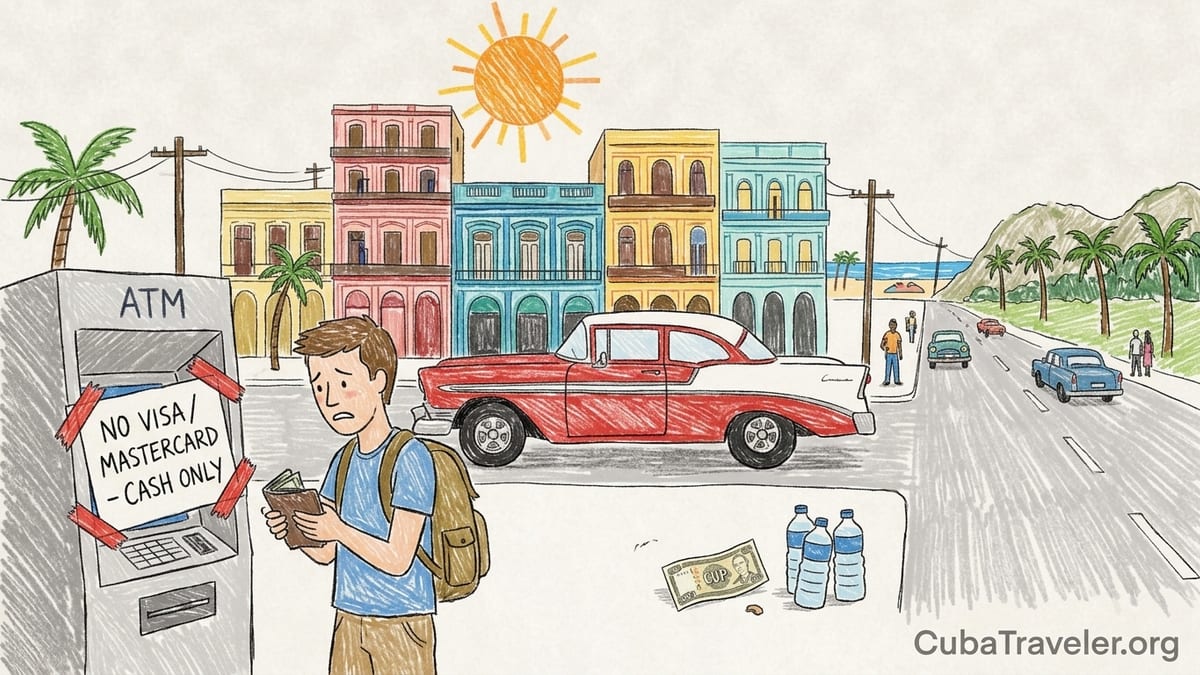
The first shock came before I left. On 3 June 2026, Cuba’s Central Bank announced that Visa and Mastercard transactions on the island would be suspended from 6 June, after an international processing partner pulled out under tightened United States sanctions. News wires showed photos of Havana ATMs with hand-written notices, and the Central Bank warned that transactions with those brands would stop. That single announcement turned my “cards mostly, some cash” plan into “cash or nothing” virtually overnight.
When I arrived, reality was harsher still. Hotels and many casas in Havana were quoting prices in US dollars or euros, payable in clean foreign banknotes. Menus in the more functional restaurants along Obispo and around Vedado listed prices either in foreign currency or at implicit exchange rates that bore no resemblance to official bank screens. Long-distance buses were full, state fuel supplies were visibly strained and “cheap” activities suddenly looked expensive once transport, bottled water and emergency cushions were factored in.
On paper, Cuba can still be cheap compared with other Caribbean islands. In practice, the combination of a distorted currency system, a sudden international card disruption, chronic shortages and fragile infrastructure means that tourists who arrive with 2019 expectations risk being underfunded, stressed and occasionally stranded.
CUP, Not CUC: Understanding Cuba’s Currency Without The Nostalgia
Cuba now has one legal currency for everyday use: the Cuban peso, or CUP. The old Cuban convertible peso, the CUC that tourists used to handle like a local US dollar substitute, was officially abolished in January 2021 when the country moved to a single-currency system. The CUC should not appear in any current budgeting advice. If a blog or forum you are reading still talks about “1 CUC” coffees or rooms, treat it as a historical document, not a planning tool.
Officially, visitors can exchange foreign currencies such as euros, Canadian dollars and others into CUP at banks, CADECA exchange houses and some hotels. Government documents and tourism sites still talk about a fixed official rate for individuals, often quoted around 120 CUP per US dollar. In the real economy, however, the Cuban peso has devalued sharply on informal markets, and many services that matter to tourists have effectively dollarized. Hotel bills, taxi rides negotiated in front of Havana’s Hotel Inglaterra, lobster dinners in Viñales and beach loungers in Varadero are now commonly priced directly in US dollars.
This duality is where the “cheap Cuba” myth persists. If you look only at official CUP prices for certain state-run museums or local cafeterias, the numbers seem absurdly low once converted at official rates. A 200 CUP sandwich looks like a bargain at less than 2 dollars. But many of those places are either out of ingredients, not serving tourists or asking for payment in foreign currency at a private exchange rate. Foreigners who change large sums into CUP at official counters often discover too late that their pesos buy little in tourist-facing businesses, and cannot easily be exchanged back into foreign cash when they leave.
For a realistic 2026 budget, it is safer to think primarily in foreign currency. Treat CUP as something you might use selectively for small local transactions, not as your main budgeting unit. And forget the CUC entirely. It belongs to the same era as cheap cigars in hotel lobbies and full shelves in state stores, not to the Cuba you land in today.
Living In A Cash Island After The June 2026 Card Suspension
The June 2026 suspension of Visa and Mastercard processing has turned an already cash-heavy destination into a near-total cash island for many visitors. Before the announcement, even cautious travelers could tell themselves that European-issued Visa and Mastercard debit cards would probably work in many hotels, higher-end restaurants and some ATMs. Official tourism information still mentions those brands as accepted, but on the ground visitors since June have reported a patchwork of failures, frozen terminals and “cash only” hand-written notes at cash registers.
The Central Bank’s statement made clear that the problem was not limited to any one bank, but to the island’s access to international processing for those brands. That means your Visa card from Berlin and your Mastercard from Toronto are in the same boat as any US-issued card: unreliable at best, rejected at worst. While some other systems such as Russia’s Mir and China’s UnionPay continue to be mentioned as functioning, they are not common products for most Western leisure travelers.
For me, that translated into a forced pre-trip cash strategy. I flew in carrying a mix of euros and US dollars just under the legal declaration threshold, with every bill scrutinized at my home bank for tears, stamps or ink marks that Cuban tellers might reject. On arrival at José Martí International Airport, the CADECA counter was open but offering exchanges into CUP that made little sense for someone who expected to pay many bills in foreign cash. Airport taxis into central Havana were quoting flat rates in US dollars, not pesos.
The risk is not just nuisance. Imagine you planned a family trip on a “cards work fine in most places” assumption, based on pre-2024 guides, and brought only a few hundred dollars or euros in physical notes. You check into a Havana hotel that takes your card for the first night, then discover that their terminal stops working two days later. The bank’s own ATMs are offline for international cards, long-distance buses will not accept your card, and your remaining cash is being eaten by bottled water at 1 to 2 dollars a bottle and taxis at 15 to 25 dollars per ride. Without a deep emergency reserve in cash, a minor disruption quickly becomes a serious problem.
Legal Cash, Prepaid Tourist Cards And Where CADECA Still Fits
Arriving in 2026, I found three legal pillars for managing money: foreign cash, CUP exchanges at official institutions and prepaid tourist cards. Each sounds reassuring in theory. In practice, all carry friction and uncertainty.
First, foreign cash. Cuba allows visitors to bring in foreign currencies accepted by its Central Bank. Euros are widely used, Canadian dollars are common among Canadians and US dollars have quietly become the de facto reference currency in much of the private sector, even though banks have long applied restrictions to handling physical US cash. What matters more than denomination is the condition: Cuban banks and businesses are known to reject notes with tears, writing, stamps or excessive wear. In Havana I watched a couple have three of their fifty dollar bills refused at a hotel front desk because of tiny nicks on the edges.
Second, official exchanges. CADECA offices at airports, some city centers and tourist hotels will convert foreign currency into CUP at the official rate. That makes sense if you have specific peso costs in mind, like state buses or certain museums. It is risky for large sums, because converting CUP back into foreign cash is limited and often impossible outside the airport on departure. Several recent travelers describe leaving with thick bundles of essentially useless pesos after discovering that their Varadero resort bar quoted prices directly in US dollars, and would not accept CUP notes.
Third, prepaid tourist cards. Since 2021 Cuba has offered prepaid cards that foreign visitors can buy in euros or other currencies at banks and CADECA, then use to pay in shops, restaurants and some services without handling piles of CUP. They are a legal, on-system tool and can be refunded at airports when you leave. The catch is that the network behind those cards has been strained by the same external pressures that hit Visa and Mastercard. Cards do not help if a terminal has no connection, if the shop has no electricity that day or if the business simply prefers cash to avoid waiting for settlement.
The common thread across all three pillars is that none remove the need to carry significant physical cash. In 2026, a realistic approach for a ten-day trip that includes Havana, Viñales and Varadero is to bring enough clean foreign notes to cover your entire planned budget plus at least 30 to 40 percent extra for emergencies, and to treat CADECA, banks and cards as optional tools, not pillars you depend on.
Havana: When “Reasonable” Lodging Hides Expensive Friction
I spent four nights in Havana, two on arrival and two before flying home. On paper, this was the cheapest part of the trip. I had budgeted 45 dollars per night for a mid-range casa particular in Centro Habana or Havana Vieja, 15 dollars per day for food and local transport and 10 dollars for museums, drinks and incidentals. That would have been 280 dollars for four days. My actual outlay, counting unavoidable extras, landed closer to 420 dollars.
Current 2026 listings for good casas in central Havana often quote nightly prices between 40 and 120 US dollars depending on location, room size and whether generators and water tanks are included. Well-reviewed private houses that guarantee 24 hour air conditioning and backup power sit at the top of that band, because they need expensive fuel and equipment to cope with Cuba’s ongoing electricity problems. A tourist who opts for a cheaper 30 dollar room to “save money” may find themselves sleeping without air conditioning during outages, showering from buckets and losing perishable groceries with every blackout.
Food in Havana swallows a larger share of the budget than older guides suggest. State-run cafeterias still advertise cheap pizzas and simple plates in CUP, but in practice many are closed, out of ingredients or unappealing to visitors. Paladares and private restaurants in popular areas charge more realistic market prices: 8 to 15 dollars for a main course, 5 to 8 dollars for cocktails, and a breakfast at a casa often priced at 5 to 7 dollars per person. Bottled water is another underestimated line. With tap water not considered safe for visitors, I went through two 1.5 liter bottles a day in the June heat, at roughly 1.50 to 2.50 dollars each in tourist areas.
Transport compounded the costs. Havana’s famous classic taxis are picturesque, but rides within central zones commonly cost 5 to 10 dollars, and trips between Vedado and Old Havana land around 10 to 15 dollars, especially at night. Those prices are negotiable but sticky in a city where fuel shortages mean fewer cars operate every day. Cheap local buses exist in theory, but erratic schedules, crowding and complex routes make them impractical for short visits. Over four days, I spent over 80 dollars on city taxis alone, more than double the figure pencilled into my original plan.
For a realistic 2026 budget, a cautious independent traveler should expect to spend around 90 to 130 US dollars per person per day in Havana, combining a mid-range casa, modest restaurant meals, bottled water, taxis, museum tickets and a basic emergency cushion. It can be pushed lower by sacrificing comfort and flexibility, but only at the cost of resilience when services fail.
Viñales: A “Cheap” Countryside That Depends On Costly Transfers
On paper, Viñales is still presented as the budget-friendly rural interlude. Guides highlight simple casas at 15 to 25 dollars per night, home-cooked dinners, and hikes through tobacco fields that cost little beyond a tip. The difficult part is getting there and back, and ensuring there is still enough water, electricity and cash to enjoy the place once you arrive.
Intercity buses like Viazul used to be the backbone of tourist transport in Cuba, offering relatively cheap fixed-price routes between Havana, Viñales, Trinidad and beyond. As of 2026, travelers report full buses, limited seats and disrupted schedules driven by fuel shortages and maintenance problems. When I visited, the bus options on my dates were either sold out or running at inconvenient hours, and online booking was not functioning reliably. I ended up arranging a shared taxi from Havana to Viñales, paying just under 30 dollars per person one way for a space in a classic car that also carried two European backpackers.
For many visitors now, that kind of semi-private transfer is the default. A family of four might pay 100 to 120 dollars for a car one way, turning what used to be a budget-friendly bus hop into one of the most expensive single items of the trip. The same applies in reverse. Travelers have reported getting “stuck” in Viñales or paying inflated last-minute prices when fuel deliveries have been delayed and fewer cars are willing to make the trip back to Havana without being pre-booked.
Once in Viñales, casas are indeed cheaper than Havana. Rooms listed in late 2025 and 2026 range between roughly 15 and 35 dollars per night, often including mountain views and simple terraces. Breakfast at the casa adds 4 to 6 dollars per person, and home-cooked dinners of fish or chicken commonly cost 8 to 12 dollars. Those numbers feel reasonable until you remember the transfers. On my three-night stay, lodging cost 75 dollars in total, while the return shared taxi rides came to 60 dollars. Add horseback excursions at around 20 to 30 dollars, tips to guides, bottled water and inevitable extra meals on the square, and my “cheap countryside break” averaged roughly 80 to 100 dollars per person per day when transport was included.
The hidden vulnerability in Viñales is cash. ATMs are scarce and were not functioning for foreign Visa or Mastercard when I visited, and casas expected payment in foreign currency notes. Small excursions often wanted to be paid in cash as well. A visitor who arrives with only the minimum cash needed for accommodation may find themselves cancelling activities or borrowing from fellow travelers when card and ATM options fail.
Varadero: All-Inclusive Prices In A Controlled Resort Bubble
Varadero appears in almost every discussion of “cheap Cuba” because tour operators in Canada and Europe still advertise week-long all-inclusive packages at headline prices that undercut many Caribbean rivals. Those package figures, however, conceal the realities that independent travelers face on the ground, and how quickly additional costs mount even inside the resort bubble.
Standalone prices for major Varadero resorts in 2024 and 2025 brochures often span from roughly 70 to 200 dollars per person per night depending on season and brand. That includes meals and local drinks on property, which makes daily budgeting simpler if you never leave the compound. But a string of recent reports by independent travelers describes bars occasionally running out of imported spirits, buffet variety shrinking on low-supply days and certain amenities like premium coffees or non-house drinks carrying surcharges in hard currency.
For visitors who do not take a package with transfers included, getting to Varadero has grown more expensive. Private taxis from Havana to the main hotel strip, a drive of around two hours, often quote flat rates between 80 and 120 dollars per car each way for tourists. That means a couple adding 160 to 240 dollars on top of their room bill just to connect the airport and the beach, unless they secure a rare seat on a functioning bus or share a taxi at the last minute.
Once in Varadero, many basic expenses are baked into the all-inclusive price, but cash still leaks out. Beach vendors selling souvenirs prefer dollars or euros. Off-resort restaurants that manage to keep decent inventories charge close to international prices for seafood and cocktails. Tipping culture inside resorts is now heavily dollarized, with guests leaving one or two dollar notes for bartenders and housekeeping. Over a three or four night stay, a modest but respectful tipping pattern can easily add 50 to 80 dollars to a couple’s budget, and more for longer visits.
For an independent traveler in 2026, excluding flights, a realistic Varadero budget combining three nights in a mid-range all-inclusive, private transfers from Havana and ordinary extras lands somewhere between 550 and 800 dollars for two people, significantly more than the “sun for cheap” narrative suggests. Lower figures are possible with aggressive cost-cutting, but again, at the price of reduced flexibility if services are disrupted or if you suddenly need to change plans.
Hidden Financial Traps: From Water And Buses To Empty Shelves
Across all three destinations, several financial problems keep recurring in traveler reports and in my own notes. The first is simple: bottled water. In a hot, humid country where tap water is not considered safe for visitors, water is not an incidental expense. In Havana and Varadero I rarely found 1.5 liter bottles under 1.50 dollars, and often closer to 2 dollars or more in hotel shops. In Viñales, stocks were sometimes low, and I bought whatever size was available. Over ten days, even at two large bottles per person per day, a couple can quietly spend 40 to 60 dollars on water alone.
The second trap is unpredictable transportation. Fuel shortages and maintenance problems mean that cheap state buses and even some scheduled tourist buses can be canceled or overbooked at short notice. Travelers who assume they can always “just catch a bus” between towns may find themselves forced into a last-minute private taxi at several times the planned cost, simply to make an onward flight. For anyone operating on a tight budget, the difference between a 15 dollar bus seat and a 120 dollar private transfer delivered the day before departure can be ruinous.
The third problem is card acceptance. Even in places that theoretically still take some international or domestic cards unaffected by the Visa and Mastercard suspension, terminals depend on patchy electricity and internet connections. I watched a line of tourists at a Havana restaurant grow more agitated as the card machine failed repeatedly after a thunderstorm, resulting in the manager walking table to table to negotiate cash settlements in euros and dollars. Without an emergency stash of notes, those diners would have faced the humiliating prospect of leaving passports as guarantees or returning the next day.
The fourth issue is product availability. Cuba’s economic crisis and the effects of sanctions and the 2026 fuel squeeze have left many store shelves thin. Items that travelers elsewhere take for granted, such as sunscreen, insect repellent, basic over-the-counter medicines and baby supplies, can be scarce or sold only in foreign-currency stores at high prices. A family that forgets to pack enough sunscreen may discover that replacing it on the island costs three or four times their home price, if they can find it at all.
The fifth and perhaps most destabilizing problem is the need for real emergency funds. In a destination where official prices can change rapidly, services can disappear overnight and international cards are unreliable, an accident, theft or sudden itinerary change can multiply costs quickly. An extra night in a Havana hotel because your bus to the airport never appeared can cost well over 100 dollars in high season. Paying a doctor in foreign currency for an urgent consultation, even with travel insurance, may require cash up front. Travelers who arrive convinced that “Cuba is cheap, so I do not need a large contingency fund” place themselves in a vulnerable position.
Visas, eVisas, D’Viajeros And The Future Cost Of A Cuban Stamp
In financial planning, it is tempting to focus only on accommodation and food. Cuba in 2026 demands a wider lens that starts before you board the plane and extends beyond your return. Three items in particular have direct cost implications: entry formalities, mandatory medical insurance and the long-tail consequence for travelers who usually rely on the United States Visa Waiver Program.
Most visitors need a tourist card or eVisa-type document to enter Cuba, obtained either through airlines, tour operators or consulates. The cost varies by nationality and issuing channel, but for many European travelers it adds the equivalent of 20 to 50 dollars per person to the trip. Airlines sometimes bundle this into ticket prices, but independent travelers booking flights and accommodation separately must factor it in themselves.
In addition, Cuba requires visitors to have valid medical insurance that covers medical expenses on the island. Some travelers are asked to show proof on arrival. Those without compatible policies may be required to buy Cuban insurance at the airport, adding another compulsory line to the budget. Even if your home insurance suffices, you are likely to pay medical providers in cash in the event of an emergency and claim reimbursement later, making your on-trip cash reserves even more important.
All travelers must also complete the D’Viajeros online form, which consolidates customs, immigration and health information. The form itself is free, but failure to complete it ahead of time can lead to delays and, in the worst case, denied boarding, with obvious financial consequences. Completing it properly with accurate lodging information and flight details is a simple, no-cost way to avoid one more unpleasant surprise.
For travelers who are normally eligible for the United States Electronic System for Travel Authorization (ESTA) under the Visa Waiver Program, visiting Cuba on or after 12 January 2021 has another, often overlooked price. United States policy changes mean that most travelers who have been in Cuba since that date are no longer eligible to use ESTA for visa-free short visits, and must instead apply for an appropriate US visa at a consulate if they wish to enter the country in the future. That application process carries direct fees, indirect costs in time and travel to appointments, and the risk of refusal. A “cheap” long weekend in Havana may therefore close off simple future travel to the US, a cost that far outweighs the savings on mojitos.
The Takeaway
By the time I left Havana in late June 2026, my original budget plan looked naive. For a ten day independent trip split between Havana, Viñales and Varadero, I had forecast spending around 800 to 900 US dollars, excluding flights, based on pre-2020 narratives about Cuba’s affordability. My actual or evidence-based projected spending, reconstructed from receipts and current 2026 price ranges, came to roughly 1,400 to 1,700 dollars, broken down as follows.
In Havana, four days at a mid-range casa with reliable electricity and air conditioning, restaurant meals, taxis, bottled water, admission fees, occasional bar visits and a small emergency cushion amounted to approximately 400 to 520 dollars for one person. In Viñales, three days of cheaper lodging but expensive shared transfers, home-cooked meals, excursions and water came to about 240 to 300 dollars. In Varadero, three nights at a mid-range all-inclusive with private transfers from Havana and on-site tips and extras weighed in at around 360 to 450 dollars. Adding preparation costs such as the tourist card, insurance top-ups and airport incidentals easily pushes the overall total beyond 1,500 dollars.
None of this accounts for worst-case emergencies like medical treatment, having to book last-minute flights due to disruption, or replacing lost cash. Nor does it quantify the non-financial stress of watching ATMs go dark, calculating whether you can afford another night if the bus fails, or wondering whether your remaining notes will be accepted because of a faint ink line along one edge.
As of October 2026, many foreign ministries continue to issue strong warnings against non-essential travel to Cuba, citing shortages, infrastructure strain and political and economic uncertainty. Those warnings should carry more weight in your planning than attractive-looking package prices or nostalgic blog posts about cheap cigars and convertible pesos. If you do choose to go, go with your eyes open, with a thick margin of error in your budget, and with the understanding that Cuba’s old reputation as a cheap Caribbean escape no longer survives contact with the realities of currency confusion, card disruptions and fragile services on the ground.
FAQ
Q1. Is Cuba still a cheap destination in 2026?
For short trips, Cuba can look cheaper than some Caribbean islands, but once you factor in cash needs, unreliable transport, bottled water, tips and emergency reserves, total costs are often higher than travelers expect.
Q2. What currency should I budget in for a trip to Cuba now?
Plan your budget in a major foreign currency such as US dollars or euros, since many tourist services quote prices directly in these, and use Cuban pesos only where it clearly makes sense.
Q3. Does the old CUC currency still exist for tourists?
No. The Cuban convertible peso, or CUC, was abolished in 2021. The only legal currency in circulation is the Cuban peso (CUP), although many prices are effectively set in foreign currencies.
Q4. How did the June 2026 Visa and Mastercard suspension change things?
From 6 June 2026, Cuba’s Central Bank stopped processing Visa and Mastercard transactions after a foreign partner withdrew, making international card payments and ATM withdrawals far less reliable for visitors.
Q5. How much cash should I bring for a ten day trip?
The exact amount depends on your style, but many independent travelers now bring enough clean foreign banknotes to cover their entire planned budget, plus at least 30 to 40 percent extra for emergencies.
Q6. Are casas particulares still cheaper than hotels?
Casas are usually cheaper per night, especially outside Havana and Varadero, but savings can be cancelled by the cost of private transfers, buying bottled water, dealing with outages and needing to pay fully in cash on arrival.
Q7. Can I rely on prepaid tourist cards or CADECA for money?
Prepaid cards and CADECA exchanges are legal tools that can help, but they do not replace the need for cash, because terminals can be offline, CUP is hard to convert back and some businesses prefer foreign notes.
Q8. What are the biggest hidden costs that surprise visitors?
Common surprises include the price of bottled water, last-minute private taxis when buses are unavailable, higher than expected restaurant bills, tipping in dollars and having to replace scarce items like sunscreen locally.
Q9. What US travel consequences should I consider before visiting Cuba?
Most travelers who visit Cuba on or after 12 January 2021 are no longer eligible to use the US Visa Waiver Program with ESTA and must apply for a regular US visa for future trips, unless they fall into specific exceptions.
Q10. Is it sensible to visit Cuba now just because prices look low?
Attractive prices should not outweigh the October 2026 warnings many governments issue about non-essential travel to Cuba, nor the financial and practical risks from currency issues, cash dependence and unstable services.