


Cuba in 2026 rewards slow, patient travel. The island’s transport and energy crisis, recurring fuel shortages and blackouts have made long-distance movement unpredictable, but they have also nudged visitors to do what Cuba is best for anyway: stay longer in fewer places. This two-week itinerary focuses on four principal bases in western and central Cuba – Havana, Viñales, Cienfuegos and Trinidad – and explains both the ideal route and what is realistically executable while buses, shared taxis and private cars often struggle to find fuel.
How This Cuba Itinerary Works In 2026
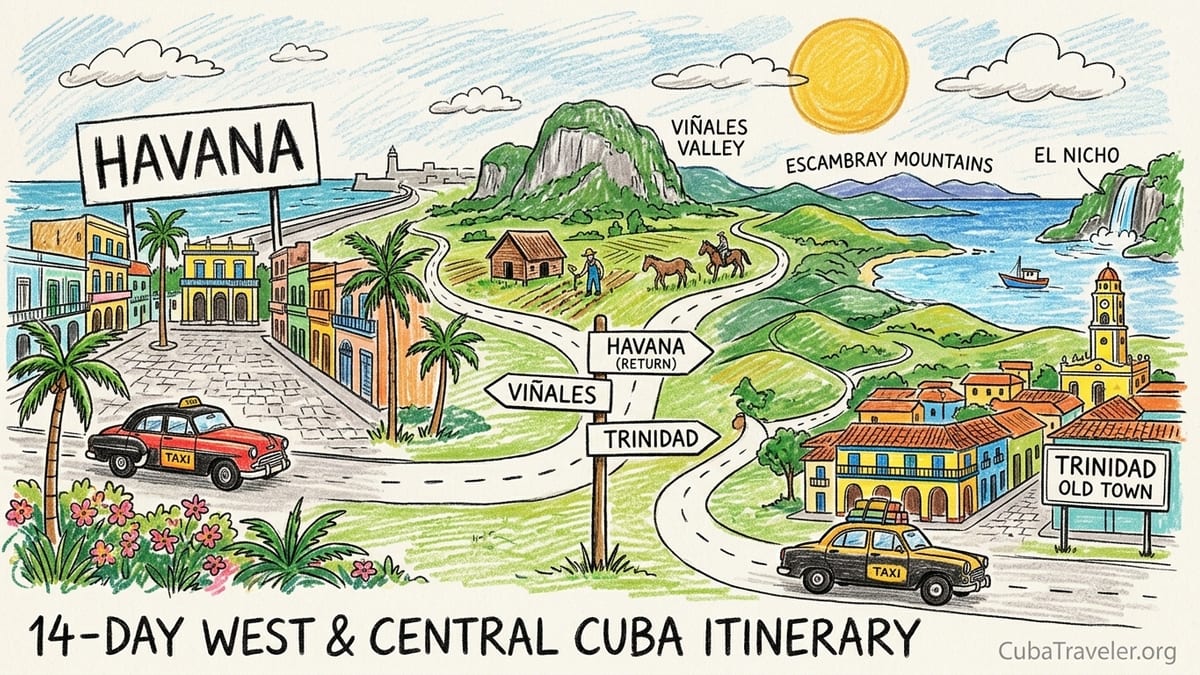
This itinerary is designed as a geographically sensible loop through western and central Cuba rather than an attempt to “see the whole island.” You begin and end in Havana, travel west to Viñales, then cross to the south coast for Cienfuegos and Trinidad. Eastern Cuba, including Santiago de Cuba and Baracoa, is intentionally excluded because reaching them currently involves long journeys that are especially vulnerable to fuel and transport disruptions.
The plan assumes 14 days on the ground. In normal years, this loop would be straightforward on a mix of Viazul buses, shared taxis known locally as colectivos, and occasional private transfers. In 2026, you must treat every intercity journey as tentative until reconfirmed a day or two before departure. Travelers and aid agencies describe chronic fuel shortages since 2024, worsened by Hurricane Melissa in October 2025 and continuing energy constraints, which affect everything from tractors to public buses and medical transport. Transport that exists on paper often cannot operate for lack of diesel or petrol.
To keep this itinerary useful over the long term, the structure focuses on four bases and clusters nearby experiences around each. You sleep several nights in the same casa particular or small hotel in each town and take slow excursions rather than rushing from bus to bus. Where specific routes or excursions depend heavily on current fuel supplies or government decisions, they are clearly marked as requiring up-to-date confirmation on the ground.
Crucially, a timetable or published route does not guarantee movement in 2026. A Viazul bus can appear on the website yet be cancelled on the day because there is no diesel. A local driver might agree to a transfer from Viñales to Cienfuegos, only to spend half a day queuing for fuel and give up. Build contingency days into your plan, keep your accommodation bookings flexible and be prepared to reverse or shorten parts of the route if transport fails.
Days 1–3: Havana’s Plazas, Malecón and an Essential Excursion
Begin in Havana with three nights, ideally in a restored colonial casa particular in Habana Vieja or a midrange hotel in Vedado where blackouts are usually shorter. On your first day, stay mostly on foot. Explore the four principal plazas of Old Havana, a UNESCO World Heritage site: Plaza de Armas with its leafy square and secondhand book stalls, the elegantly colonnaded Plaza Vieja, the cathedral-fronted Plaza de la Catedral and Plaza de San Francisco facing the harbor. Walking between them takes less than 20 minutes, and you can easily spend a full day drifting between museums, cafes and small galleries.
Your second day can stretch along the Malecón and into Vedado. The Malecón seawall runs several kilometers west from Old Havana and becomes the city’s evening living room, with fishermen casting lines, teenagers sharing music and families catching a breeze when the power is out at home. Continue inland into Vedado, where wide streets are lined with 20th-century villas, and visit cultural landmarks such as the Plaza de la Revolución and the Museo Nacional de Bellas Artes’ modern art building. Taxis within Havana still operate, but because fuel shortages are common, you may sometimes wait longer or negotiate payment in euros or another hard currency if drivers are reluctant to accept rapidly devaluing pesos.
On day three, include one substantive excursion that does not depend critically on long-distance fuel supplies. Options include a half-day trip to the beach at Santa María del Mar in Playas del Este, roughly 20 kilometers east, or a guided visit to the Finca Vigía, Ernest Hemingway’s former home, in San Francisco de Paula on the city’s outskirts. Both trips are short enough that drivers can usually secure the required fuel, even when interprovincial routes are disrupted. Join a small group tour arranged through your casa or a trusted local agency rather than a long coastal circuit bus; these groups typically consolidate passengers into one vehicle, which makes fuel use more efficient and keeps prices reasonable.
Public buses and classic-car taxis in Havana remain part of daily life, but energy shortages mean schedules are loose and vehicles are often overcrowded. The safest strategy for visitors is to rely on walking for most central sightseeing, use official yellow taxis or pre-booked transfers for longer hops, and treat any fixed-time commitment, such as a dinner reservation or show at the Gran Teatro de La Habana, as flexible in case transport or power fails.
Days 4–6: Viñales and the Rural West
On day four, leave Havana for Viñales, your base for western Cuba’s mogote landscapes and tobacco farms. In normal conditions, the journey is about 180 kilometers and takes around three to four hours by road. Historically, Viazul operated a direct bus from Havana to Viñales, and shared taxis filled in the gaps. In 2026, that route still appears in schedules, but frequent reports describe last-minute cancellations and buses running only on some days because of diesel shortages. Treat any Viazul booking or shared taxi arrangement as provisional until confirmed on the morning of travel.
For a more reliable trip, ask your Havana host or a reputable local agency to arrange a door-to-door transfer. You may end up sharing a minivan with a handful of other travelers, essentially forming an ad hoc colectivo. Prices fluctuate with fuel availability and are usually quoted in euros or US dollars. Recent examples from independent travelers mention paying a moderate three-figure equivalent per vehicle for the full group. The cost is significant, but splitting it between four people keeps the per-person fare broadly comparable to a tourist bus ticket, and the driver has more incentive to secure fuel for a guaranteed private booking.
Once in Viñales, plan on at least three nights. This valley is not well suited to a rushed day trip from Havana. Spend one full day on a guided walking tour through the red-earth fields to small tobacco farms, where families explain the curing process and show how leaves are hung in traditional drying houses called secaderos. Another day can focus on the karst scenery itself with a hike or horseback ride among the mogotes and a visit to a cave system such as Cueva del Indio. Simple meals at farm paladares and village restaurants often rely on what is currently available, and shortages of fresh products and imported items are frequent, so flexibility with expectations helps.
Because Viñales is compact, most experiences are accessible on foot or horseback from town with only short drives in between. This is an advantage during fuel shortages, when long jeep excursions and distant beach trips to Cayo Jutías or Cayo Levisa may be cancelled or priced steeply to cover scarce petrol. If fuel is flowing and local operators confirm availability, a day trip to Cayo Jutías can be a memorable extra, but in 2026 it should be considered optional rather than a central promise of the itinerary.
Days 7–8: Cienfuegos, Urban History and Conditional El Nicho
Day seven is your pivot from the rural west to the south-central coast. Geographically, the cleanest move is to travel from Viñales back through the outskirts of Havana and then southeast to Cienfuegos on the Caribbean side. This is a long day in any year, commonly eight to nine hours with a break, because there is no direct highway that cuts diagonally across the island from Viñales. Historically, travelers pieced this together with a morning bus or shared taxi to Havana and an afternoon Viazul or transfer onward to Cienfuegos.
In 2026, count on this as one of the most fragile days of your loop. To keep it executable, build in a fallback overnight in Havana in case your Viñales departure is delayed or your onward bus is cancelled. One practical strategy is to book a fully flexible casa particular in Havana for that night that you can cancel without penalty until the same morning, then hold confirmed but cancellable transport options for both legs. If both segments operate smoothly, you still reach Cienfuegos the same evening. If fuel shortages interrupt the plan, you sleep in Havana and continue the next day instead.
Once in Cienfuegos, two nights are usually enough to explore the city’s compact center and waterfront. Start at Parque José Martí, framed by neoclassical civic buildings and the ornate Tomás Terry Theatre. The city’s French-influenced nineteenth-century layout is visible in the grid of wide streets and light-colored facades. From the park, walk down the pedestrian boulevard of San Fernando to the bayfront and on to Punta Gorda, where wooden villas and the domed Palacio de Valle overlook the water. These distances are walkable, and taxis are only occasionally needed, which helps if urban public transport is cut back due to diesel rationing.
El Nicho waterfalls, in the mountains between Cienfuegos and Trinidad, are a classic day trip in normal times. Reaching them requires a vehicle capable of handling winding rural roads and a reliable supply of fuel. In the current crisis, that combination is not always available. Some local agencies continue to offer excursions when they can line up both fuel and a working vehicle; on other weeks, tours simply stop operating. Consider El Nicho a conditional bonus. Only plan it if your accommodation host, a licensed guide or a long-established agency in Cienfuegos confirms that vehicles, fuel and park access are currently available for your dates.
Days 9–12: Trinidad, Sugar Histories and the Caribbean Coast
Your journey from Cienfuegos to Trinidad on day nine is one of the easiest legs logically, but still not immune to fuel disruptions. The distance is around 80 kilometers, following a coastal road that often takes one and a half to two hours in regular conditions. Historically, Viazul has run a short bus service between the two cities, and shared taxis or prebooked transfers provide alternatives. Because it is a short route, local drivers are often more willing to accept the job even when fuel is scarce, but confirmation the day before remains essential.
Trinidad deserves at least four nights in your two-week plan. The UNESCO-listed old town is a dense knot of cobbled streets, pastel houses and tiled roofs shaped by sugar wealth extracted through enslaved African labor in the Valle de los Ingenios. Many grand mansions you visit as museums were financed by plantations where enslaved people worked the cane fields, operated the mills and suffered harsh punishment. When you climb a former watchtower in the valley or admire carved doors in a colonial sala, remember that these were tools of surveillance and symbols of an economy dependent on human bondage.
Devote one full day to the old town itself, including the Plaza Mayor, nearby museums and small private galleries. Another day can be spent in the Valle de los Ingenios, where you visit preserved plantation houses and the Manaca Iznaga tower while engaging with guides who acknowledge the lives and resistance of enslaved Africans, not only the architectural beauty. Look for tours or local historians who explicitly discuss this history rather than treating the valley as a picturesque backdrop.
You will also want time for the sea and the mountains. Playa Ancón, about 12 kilometers from town, offers one of central Cuba’s best sandy beaches and is reachable by taxi or, in some seasons, a simple beach shuttle. In 2026, expect any shuttle services to be irregular and plan to share taxis with other travelers to spread fuel use and cost. For nature excursions, Topes de Collantes in the Escambray Mountains provides cooler air, waterfalls and hiking trails, but reaching it again depends on reliable vehicles and fuel. If energy shortages are acute while you are there, prioritize the closer valley and beach over multiple mountain trips that may not materialize.
Electricity cuts are part of daily life throughout Cuba in 2026, and Trinidad is no exception. Choose accommodation that is open about blackout schedules and, if possible, has backup water storage. Simple casas with rooftop terraces can become social spaces during evening power cuts, with candlelit dinners and acoustic music. Cash remains crucial outside a small number of dollar-priced establishments, and shortages of small change are common, so carry a mix of low-value banknotes in both local pesos and a hard currency accepted by your hosts.
Days 13–14: Flexible Return to Havana or Extra Coast Time
The last two days of the itinerary are deliberately flexible. Under ideal conditions, you would travel directly from Trinidad back to Havana, a road journey of roughly 315 kilometers that typically takes six to seven hours. Routes usually pass near Sancti Spíritus and then rejoin the central highway north of Cienfuegos before approaching Havana. When Viazul buses were running regularly, this was a standard day-time trip. In the current fuel-constrained environment, you should treat this return as provisional and build in at least one contingency day.
If buses or shared taxis are confirmed for your desired day, use day thirteen for the long journey and spend your final night back in Havana, leaving day fourteen for last walks along the Malecón, souvenir shopping or a museum you missed at the start. Alternatively, if you discover on arrival in Trinidad that long-distance services to Havana are unreliable the week you leave, consider splitting the return over two days, stopping in Cienfuegos or even Santa Clara to reduce dependence on a single long ride that might be cancelled.
Travelers with a particular interest in the coast may prefer to stay in the Trinidad area until the final day, adding another night near Playa Ancón or at a rural casa near Topes de Collantes if mountain access is practical. This approach maximizes your time in one region and leaves day fourteen as a pure buffer. You might travel back to Havana that day only if a bus or transfer is clearly running, or remain in Trinidad and pay any necessary change fees if it does not.
Regardless of which version you choose, keep your last full day in Cuba as uncluttered as possible. Avoid booking non-refundable experiences or time-sensitive connections the same day as your final long road journey, and consider travel insurance that covers delays linked to transport failure and power outages. When fuel shortages ease in future seasons, you can compress this section, but in 2026 extra slack in the schedule is one of the best investments you can make.
Why Varadero Is Not “On the Way” and a Resort Alternative
Varadero often appears in marketing materials as an easy add-on to any Cuba trip, but geographically it does not fall neatly between Viñales and Trinidad. Varadero sits on the Hicacos Peninsula on the north coast, east of Havana. To include it after Viñales and before Trinidad, you must travel from Viñales back through or near Havana, then northeast to Varadero, and later return inland via Matanzas and the central highway toward Cienfuegos or Santa Clara. Each leg adds hours on roads already strained by fuel shortages.
On a map, the route Viñales to Varadero to Trinidad looks like a bent triangle, not a straight line. You effectively backtrack past Havana twice. In years with abundant fuel and frequent buses, that detour might still be worth it for several nights of resort relaxation. In 2026, every additional long-distance leg is another chance for a cancelled bus, a driver stuck in a petrol queue or a power cut that freezes online booking systems. Attempting to hit Havana, Viñales, Varadero and Trinidad in one two-week trip multiplies risk for limited extra reward, especially when world-class beaches are already available at Playa Ancón near Trinidad and Playas del Este near Havana.
If a resort experience is a priority, consider a separate, more compact plan instead of forcing Varadero into this loop. One realistic version in the current context is to spend three or four nights in Havana, then travel directly to Varadero for five or six nights, using a pre-booked tourist shuttle or private transfer along the well-known corridor between the capital and the resort peninsula. This route is among the country’s most resilient because tourism authorities and resort chains have strong incentives to keep it supplied with fuel and transport, even when more peripheral routes struggle.
From Varadero, many visitors either return directly to Havana for their flight home or add a simple extension to Matanzas or nearby countryside casas. If fuel conditions improve in future years, you might then bolt on a separate western-and-central loop to Viñales, Cienfuegos and Trinidad. In the meantime, combining everything into one ambitious circuit risks seeing more bus stations and fuel queues than beaches or plazas.
Transport Options: Buses, Shared Taxis and Private Cars
Under normal circumstances, intercity buses such as the national Viazul network offer an economical way to connect Havana, Viñales, Cienfuegos, Trinidad and beyond. Schedules list routes like Havana to Viñales, Havana to Cienfuegos, Cienfuegos to Trinidad and Trinidad onward to eastern cities. Recent unofficial reports, however, suggest that buses sometimes run half-empty because there is not enough diesel to operate every advertised service, or certain routes are quietly suspended for weeks at a time. A published Viazul timetable does not prove that a bus currently has fuel or will operate on the day you need it.
Shared taxis, or colectivos, historically filled many gaps. Drivers with classic American cars or modern minivans wait outside bus stations and in central squares, offering per-seat fares on popular routes when enough passengers gather. In the 2026 fuel and energy crisis, colectivos remain common in tourist corridors but are more selective about where and when they drive. Drivers may demand payment in euros or another stable currency, or they may decline trips they consider unprofitable given long petrol queues and rising spare-part costs. It is still possible to move between your four bases this way, but last-minute spontaneity is riskier than it once was.
Private transfers arranged through casas particulares or local agencies are currently the most reliable, if also the most expensive, way to complete key legs of this itinerary. Booking a full car or van between Havana and Viñales, for example, effectively pays a driver to wait in fuel lines and prioritize your trip over more speculative work. The same applies to transfers between Cienfuegos and Trinidad or Trinidad and Havana. To keep costs under control, ask your host to match you with other travelers following a similar route so that you share the vehicle and split the fare.
Inside cities and towns, walking remains the default, supplemented by bicycle taxis, horse carts in some smaller places and official taxis in Havana and provincial capitals. Urban public buses exist but are designed for residents, often overcrowded and especially vulnerable to diesel shortages. Expect ad hoc solutions such as hitchhiking in the back of trucks or riding informal local taxis to become more visible as Cubans adapt to energy constraints. As a visitor, follow your host’s advice on which options are safe and appropriate in each location.
Entry Requirements, eVisa, D’Viajeros and Medical Insurance
Regardless of itinerary, entering Cuba in 2026 involves a short list of formalities. Most visitors need a visa to enter for tourism, traditionally known as a tourist card. Since 2024, Cuban authorities have expanded the use of a 90-day electronic visa system for many nationalities, allowing travelers to apply online before departure rather than purchasing a paper card. The eVisa or tourist card is usually valid for a single entry and can sometimes be extended in-country, depending on your nationality and current rules. Some citizens of certain countries are exempt from visas for limited stays, but they still complete other formalities on arrival.
Your passport must be valid for at least six months beyond your arrival date, and some governments advise having at least three months’ validity beyond your planned departure as well. Proof of onward or return travel is often requested at check-in. Cuba also requires all visitors to have travel insurance that covers medical expenses in Cuba. Many airlines flying from North America and Europe include a basic Cuban health insurance policy in the price of the ticket, noted on your boarding pass or separate documentation, while others expect you to show your own policy that explicitly lists Cuba as covered.
A digital arrival form called D’Viajeros is now a mandatory step. Travelers complete this online within the week before arrival, enter personal and flight details and then receive a QR code, which is checked at boarding and again at Cuban immigration. Authorities and several foreign embassies stress the importance of having this QR code saved offline as a PDF or screenshot, because airport Wi-Fi may not be available on arrival and power cuts are common. Airlines sometimes refuse boarding if the D’Viajeros form is not completed in advance, so treat it as essential, not optional.
Because requirements can change with little notice, you should confirm details with an official Cuban consulate, your airline or your own foreign ministry’s travel advice shortly before departure. Travelers have reported small but meaningful shifts, such as the shift from the classic pink paper tourist card to an eVisa for many nationalities and occasional extensions of relaxed rules on personal imports of food and medicine. In an economy experiencing shortages of basic goods, these policy tweaks can affect what you are allowed to bring in your luggage.
Critical Note for Future U.S. Travel After Visiting Cuba
One of the most far-reaching consequences of visiting Cuba today has nothing to do with your time on the island, but with your ability to visit the United States in future. Under current U.S. rules, most citizens of Visa Waiver Program countries who have been present in Cuba on or after January 12, 2021 are no longer eligible to travel to the United States using the Electronic System for Travel Authorization, commonly known as ESTA. Instead, they must apply for an appropriate U.S. visa, such as a B1/B2 visitor visa, even if they previously used ESTA without problems.
This restriction stems from Cuba’s designation as a State Sponsor of Terrorism on January 12, 2021 and the subsequent application of existing visa waiver legislation. Official U.S. government guidance explains that, with limited exceptions for certain diplomatic or military travel, time spent in Cuba on or after that date triggers ineligibility for the Visa Waiver Program. Several European governments highlight the same rule in their travel advisories, and travelers who attempted to transit the United States on ESTA after a recent Cuban holiday have reported being turned back or advised to apply for a full visa instead.
The policy applies even if your trip to the United States is a short airport connection or stopover, and it can also affect dual nationals who hold both Cuban nationality and that of a Visa Waiver Program country. Visits to Cuba before January 12, 2021 do not fall under this particular rule, though other ineligibilities may apply for unrelated reasons. If the ability to use ESTA and make short-notice trips to the United States is important to you, consider this carefully before traveling to Cuba and, if in doubt, consult the official ESTA portal or a U.S. embassy for the most up-to-date interpretation.
Importantly, this U.S. policy does not prevent you from visiting Cuba itself; it simply changes how you may need to apply to visit the United States in the future. Many travelers accept this trade-off and apply for a U.S. visa when needed, but processing times and interview backlogs can be long, so factor that into your broader travel plans.
Shorter and Longer Variations: One Week and Three Weeks
Not everyone has two full weeks. A concentrated seven-day version focusing on Havana and Viñales works well in the current transport climate and reduces your exposure to long-distance fuel disruptions. Spend four nights in Havana, using three full days to explore Old Havana, Vedado, the Malecón and a nearby beach or Hemingway excursion, followed by three nights in Viñales for rural walks, tobacco visits and cave exploration. This shorter loop uses a single intercity leg each way, between Havana and Viñales, which can be arranged as a private or shared transfer even when bus services are patchy.
A three-week extension builds on the core 14-day plan while adding margin for delays. One option is to keep the structure identical but stretch each base: five nights in Havana at the start, four in Viñales, three in Cienfuegos and five in Trinidad, with three flexible buffer days distributed between the end and a mid-trip pause. Another possibility is to add a carefully chosen extra stop, such as a night or two in Santa Clara between Cienfuegos and Trinidad, or a rural eco-lodge in the Escambray foothills, but only if you can confirm that local transport and accommodation are functioning.
Those extra days serve two purposes. First, they allow you to absorb unexpected cancellations or power cuts without sacrificing key experiences. If a Viazul bus from Viñales to Havana fails to run one morning, you can shift your onward transport by 24 hours without collapsing the rest of the tour. Second, they create space for unplanned discoveries, such as a community cultural center in Cienfuegos, a local music night in Trinidad or an invitation to a family party in Viñales, which are often the most memorable parts of a Cuban journey.
Regardless of trip length, build in at least one contingency day near the end of your stay. Designate one day that has no hard commitments except moving you closer to your departure airport. In 2026, that slack is a practical tool, not indulgence, especially when airlines, airports and ground transport are all coping with the same national energy constraints.
The Takeaway
Traveling through Cuba in 2026 requires more patience and flexibility than in years when buses ran on time and blackouts were rare. Fuel shortages, energy instability and a fragile transport network have made long-distance travel harder to predict, but they have not erased the island’s appeal. By focusing on four principal bases in the west and center – Havana, Viñales, Cienfuegos and Trinidad – and separating the ideal itinerary from what is reliably executable, you can still experience historic plazas, rural tobacco farms, French-influenced port streets, Caribbean beaches and sugar-country landscapes without spending your entire trip in bus stations.
Plan conservatively, confirm all intercity journeys close to departure and treat published bus routes as possibilities rather than guarantees. Choose centrally located accommodation that can weather power cuts, carry essential medicines and cash, and stay alert to local advice as conditions evolve. Understand that a holiday in Cuba after January 12, 2021 will probably mean applying for a full U.S. visa instead of using ESTA in the future, and decide accordingly.
Done thoughtfully, this two-week loop, or its one-week and three-week variations, offers both depth and resilience. It honors the realities of 2026 Cuba without surrendering the simple pleasures that keep travelers returning: conversations on the Malecón, sunsets over Viñales’ mogotes, music drifting from a Trinidad doorway and the quiet of a Cienfuegos street just after the power blinks back on.
FAQ
Q1. Is it realistically possible to complete this full 14-day itinerary in 2026?
It is achievable, but not guaranteed. The structure is geographically sensible, yet each long-distance leg depends on fuel availability and functioning vehicles. By using private or shared transfers on key routes, adding contingency days and remaining ready to cut or reorder stops if transport fails, most travelers can complete the loop, but you should accept from the outset that changes on the ground may force adjustments.
Q2. How far in advance should I book Viazul buses between these cities?
You can usually book Viazul tickets online or in person several days or weeks ahead, but a confirmed seat does not guarantee that the bus will run if there is no diesel. In 2026, it is wise to hold a reservation, then recheck the status at the bus station or through your host 24 hours before departure and have a backup plan, such as a shared taxi or private transfer, if the service is cancelled.
Q3. What is the safest way to travel between Havana and Viñales now?
The most reliable method is a pre-arranged transfer, either private or shared, organized through a reputable casa particular or local agency. This is more expensive than a public bus, but drivers are more likely to secure fuel for a confirmed, paid booking. If Viazul is operating consistently at the time of your trip, a morning bus remains a comfortable option, but you should still be ready to pivot to a colectivo if needed.
Q4. Can I visit El Nicho and Topes de Collantes under current fuel shortages?
Both excursions are possible but should be considered conditional extras, not guaranteed highlights. Reaching El Nicho from Cienfuegos, and Topes de Collantes from Trinidad, requires vehicles that can handle mountain roads and have enough fuel for the round trip. In some weeks, local agencies run regular tours; in others, trips are scaled back or cancelled. Confirm availability only a day or two in advance and have alternative plans, such as extra time in town, the Valle de los Ingenios or Playa Ancón.
Q5. Why is Varadero not included in this two-week loop?
Varadero lies northeast of Havana on the north coast, so adding it between Viñales and Trinidad requires significant backtracking and extra road hours. In a year with stable fuel supplies, those detours are manageable, but during the 2026 energy crisis every added long-distance leg increases the risk of cancellations and delays. Focusing on Havana, Viñales, Cienfuegos and Trinidad gives you a rich mix of city, countryside and beach with fewer vulnerable transfers.
Q6. What are the current basic entry requirements for Cuba?
Most visitors need a valid passport with at least six months’ remaining validity, a tourist visa or eVisa, proof of medical insurance that covers Cuba and a completed D’Viajeros online form generating a QR code before travel. Some nationalities are visa exempt for short stays, but they still must complete the digital form and carry insurance. Requirements can change, so you should confirm details with a Cuban consulate, your airline or your own foreign ministry shortly before departure.
Q7. How will a trip to Cuba affect my ability to use ESTA for the United States?
Under current U.S. rules, most citizens of Visa Waiver Program countries who have visited Cuba on or after January 12, 2021 are no longer eligible to travel to the United States using ESTA. Instead, they need to apply for an appropriate visa, such as a B1/B2 visitor visa, even for short visits or transit. There are limited exceptions for certain official travel, but ordinary tourism in Cuba usually triggers this ineligibility.
Q8. Are power cuts and shortages severe enough to change where I should stay?
Yes, they influence your choice of base. In Havana, staying in central neighborhoods such as Old Havana or Vedado makes it easier to walk when public transport is disrupted, and some larger hotels or better equipped casas manage blackouts more smoothly. In smaller towns, choose accommodations that communicate openly about water storage, blackout schedules and how they handle food and refrigeration. Location and host support matter as much as amenities in 2026.
Q9. Is it better to carry cash or rely on cards in Cuba now?
Cuba still functions largely as a cash economy for visitors, especially outside major hotels and some higher-end restaurants. International bank cards do not work reliably in Cuban ATMs or payment terminals, and power or connectivity problems can interrupt card processing. Bring a mix of hard currency in small denominations and exchange it gradually. Keep enough local cash on hand to cover several days of food, taxis and accommodation in case of outages.
Q10. What is a realistic alternative if long-distance transport fails during my trip?
If buses and shared taxis between provinces are severely disrupted while you are in Cuba, the most realistic option is to narrow your focus to a smaller region. You might stay entirely in Havana and its nearby beaches, or combine Havana with only Viñales or only Varadero if that corridor remains well served. Reworking your plan on the ground to reduce the number and length of intercity journeys will usually be more satisfying than spending days trying to chase cancelled buses across the island.