


Travel to Cuba in 2026 requires more preparation than a typical Caribbean trip, especially for travelers who cannot postpone for work, family or humanitarian reasons. Infrastructure is strained, official advisories remain cautious, and digital services are unreliable. This guide turns current requirements and on‑the‑ground realities into a chronological safety checklist, so you can prepare thoroughly while still respecting official advice to defer non‑essential travel.
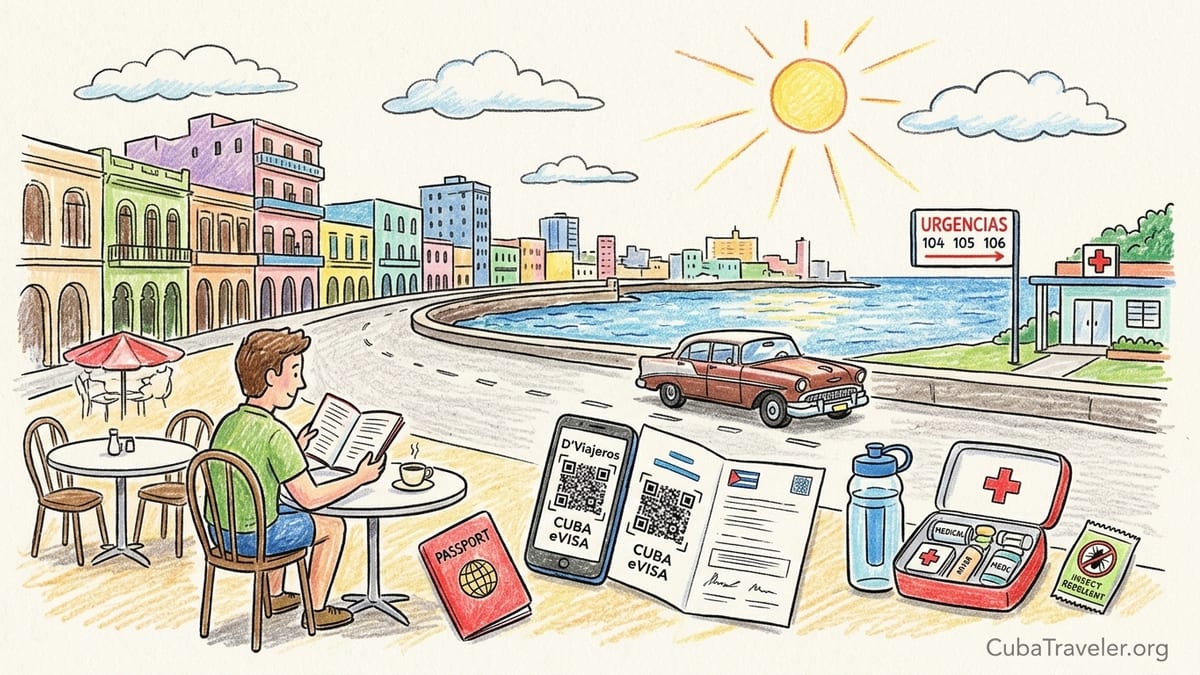
Passports, eVisa, Return Travel and the D’Viajeros Form
Cuban authorities require that your passport be valid for at least six months from the date you enter Cuba. Official tourism guidance confirms that travelers must have a valid passport, tourist visa, travel insurance with medical coverage, a round‑trip ticket and the QR code from the D’Viajeros digital form to enter.([cuba.travel](https://www.cuba.travel/en/useful-information/regulations-and-formalities?utm_source=openai)) In practice, that means a passport expiring in July 2027 is the minimum for an entry date in January 2027. If your passport will be close to the six‑month limit, renew it before you book flights.
Since 2025 many visitors obtain a Cuban eVisa rather than the old paper tourist card, including travelers flying from hubs such as Miami and Toronto. The eVisa is usually purchased through an approved agency or airline partner before departure and is issued electronically instead of as a separate physical card. Travelers report that once issued, you receive a ten‑character visa code, which may include both letters and numbers, and this code is required when you later complete the D’Viajeros form.([cuba.travel](https://www.cuba.travel/destinos/cienfuegos/informacion-turistica-de-cuba?utm_source=openai))
The D’Viajeros online form is Cuba’s advance information, customs and health declaration. Official materials explain that you must complete it in the days just before travel and that it generates a QR code you will need to present on arrival.([cuba.travel](https://www.cuba.travel/en/useful-information/regulations-and-formalities?utm_source=openai)) Many airlines now check for the D’Viajeros QR code at check‑in, so treat it as essential, not optional. The form typically opens for completion within seven days of arrival, and some carriers advise doing it between 72 hours and 48 hours before your flight so the data remains current.([cuba.travel](https://www.cuba.travel/destinos/cienfuegos/informacion-turistica-de-cuba?utm_source=openai))
The eVisa and D’Viajeros QR code are separate but linked. The eVisa is your legal permission to enter, identified by the ten‑character code. The D’Viajeros QR is a digital declaration that uses that code plus your passport and flight details. Because mobile data and public Wi‑Fi in Cuba can fail or be slow, travelers should store both the eVisa confirmation and the QR code offline in multiple forms. That means taking screenshots on your phone, downloading the PDF to an offline folder, and printing at least one paper copy of each to carry in your hand luggage. This redundancy matters if your phone battery dies during immigration queues or if airport scanners have issues reading your screen.
Mandatory Health Insurance and Choosing Real Evacuation Support
Since May 2010 Cuba has required all visitors to hold medical insurance valid in Cuba, with proof of coverage checked at the border.([cuba.travel](https://www.cuba.travel/en/useful-information/regulations-and-formalities?utm_source=openai)) Some airlines, particularly major United States carriers serving Havana and other Cuban airports, include Cuba‑compliant medical cover in the ticket price. Official U.S. government information notes that American Airlines, Delta and Southwest tickets to Cuba include such insurance, which can be evidenced by your boarding pass or ticket receipt.([travel.state.gov](https://travel.state.gov/en/international-travel/travel-advisories/cuba.html?rand=18842&utm_source=openai)) If you are not flying with one of these carriers, or if you want higher limits and evacuation cover, you should purchase a stand‑alone travel medical policy.
When reviewing a policy, do not assume that a large emergency evacuation limit automatically means practical help. Several insurers advertise evacuation cover, but this can be contingent on existing arrangements with providers able to operate in Cuban airspace and coordinate with Cuban hospitals. Before you buy, call the insurer and ask direct questions: will they organize and pay for medical evacuation from Cuba if doctors recommend it, including from provincial cities such as Santiago de Cuba or Holguín, not just Havana? Do they have an assistance partner with Spanish‑speaking staff and experience in Cuba, or would you be reimbursed only if you somehow arranged your own air ambulance?
Government travel advisories for Cuba point out that both public and private hospitals may require upfront payment or clear proof that your insurer will cover bills before admitting you.([travel.state.gov](https://travel.state.gov/en/international-travel/travel-advisories/cuba.html?rand=18842&utm_source=openai)) In a serious accident on the Malecón in Havana, for example, the admitting hospital may fax or email your insurer’s emergency assistance team to confirm payment before surgery. If your insurer delays or refuses confirmation because of policy exclusions or confusion over sanctions and government advisories, that high evacuation limit printed on your certificate will not help you in the critical first hours.
Because several governments currently advise against all but essential travel to Cuba, including the United Kingdom’s Foreign, Commonwealth & Development Office,([gov.uk](https://www.gov.uk/foreign-travel-advice/cuba/getting-help?utm_source=openai)) you must also confirm that your policy covers travel despite such advisories. Some insurers exclude any destination under a “do not travel” or “essential travel only” notice, while others allow coverage if you travel for an essential reason such as visiting an ill relative or critical business work. Have the insurer email written confirmation that Cuba is covered for your specific dates, reason for travel and itinerary, and save this email offline with your policy documents.
Medicines, Vaccinations and Individual Medical Kits
Medication availability in Cuba is uneven. Official advisories warn of shortages in basic medicines and medical supplies, especially outside major tourist areas.([travel.state.gov](https://travel.state.gov/en/international-travel/travel-advisories/cuba.html?utm_source=openai)) Travelers who rely on daily prescription drugs or specific medical devices must plan as if replacements will be very hard to find. Bring more than enough of each medication for your entire stay plus extra for unexpected delays, carried in original labeled containers. Pack copies of your prescriptions that list the generic drug names, not just brand names, in case a local doctor needs to understand what you are taking.
Before you travel, check with the Embassy of Cuba or your own country’s Cuban consulate that all medications you plan to bring are legal to import, particularly controlled substances such as strong painkillers, stimulants for ADHD, sedatives and some psychiatric medications. U.S. government guidance explicitly recommends verifying that your medication is legal in Cuba.([travel.state.gov](https://travel.state.gov/en/international-travel/travel-advisories/cuba.html?utm_source=openai)) Carry a doctor’s letter for any medicine that might raise questions at customs, explaining the diagnosis, dosage and necessity. Keep medicines in your hand luggage during flights so they are not lost with checked bags, and separate a backup supply into a second bag in case of theft.
A robust personal medical kit is invaluable in Cuba, where even common over‑the‑counter items can be scarce in shops and pharmacies. Include oral rehydration salts, paracetamol or ibuprofen, antiseptic wipes, antibiotic ointment, adhesive bandages, blister pads, a thermometer, and any items regularly used by your household. Travelers often add water disinfection options such as chlorine dioxide tablets or a portable filter bottle rated to remove bacteria and protozoa. A typical example is a reputable brand filter bottle that can treat tap water in a Havana guesthouse, reducing your reliance on bottled water that may be hard to purchase outside resort areas.
Insect protection should be a priority. Cuba has a history of mosquito‑borne illnesses including dengue, and authorities require health declarations from travelers arriving from countries with yellow fever or similar diseases.([cuba.travel](https://www.cuba.travel/en/useful-information/regulations-and-formalities?utm_source=openai)) Pack a DEET‑based or icaridin‑based insect repellent, long‑sleeved lightweight clothing and, if you are highly mosquito‑sensitive, a small travel mosquito net. Before departure, book a consultation with a travel‑health specialist who can review your routine vaccinations, discuss any recommended vaccines such as hepatitis A or typhoid based on your activities, and advise on dengue prevention measures.
Emergency Numbers, Police Reports and Key Contacts
Cuba uses a set of three‑digit emergency numbers similar to 911 elsewhere. Both local tourism information and foreign government guidance confirm that you should dial 104 for an ambulance, 105 for the fire brigade and 106 for the national police.([gov.uk](https://www.gov.uk/foreign-travel-advice/cuba/getting-help?utm_source=openai)) These numbers work nationwide, whether you are in central Havana or driving near Viñales.
Save these numbers in your phone under clear labels like “Ambulance Cuba 104” before you depart, and also write them on a small card you keep in your wallet alongside your blood type and any key medical conditions. If you are staying in a casa particular in Old Havana and witness a fire in a nearby building, for example, you or your host can call 105 immediately while others guide firefighters to the narrow street entrance.
Alongside the national emergency numbers, compile a list of other contacts: your embassy or consulate in Havana, your travel insurer’s emergency assistance line, your airline’s local or regional help number, and direct contact details for your booked accommodation. U.S. government advice specifies that travelers may contact their embassy in Havana by phone in an emergency.([travel.state.gov](https://travel.state.gov/en/international-travel/travel-advisories/cuba.html?rand=18842&utm_source=openai)) Store all of these details offline on paper and as a note app entry, in case you lose internet access right when you need them.
For many insurance claims, especially after theft or assault, you will need a Cuban police report known as a Comprobante de Denuncia. This is an official document issued by the Policía Nacional Revolucionaria recording that you have lodged a complaint. To obtain it, you usually must attend a local police station, explain what happened, show your passport and provide details of stolen items. In a real case such as a bag theft in a Vedado café, your insurer may later demand a copy of this report as proof that you notified local authorities promptly. Without it, reimbursement for stolen cash, electronics or passports is often refused. Because the process may take several hours and Spanish is normally used, ask a trusted local, tour guide or hotel staff member to accompany you and help interpret.
Offline Readiness, Power and Communication Planning
Reliable internet and power cannot be assumed in Cuba in 2026. Official advisories describe frequent blackouts, unstable electricity and disruptions to phone and internet service.([travel.state.gov](https://travel.state.gov/en/international-travel/travel-advisories/cuba.html?utm_source=openai)) Before you leave, download offline maps for all areas you plan to visit using a reputable mapping app. Make sure street names in Havana, Trinidad or Santa Clara are cached so you can navigate without mobile data. Write down key addresses in Spanish, including the full address of your accommodation and any clinics or hospitals recommended by your embassy.
Electricity cuts make simple equipment like flashlights and power banks more than conveniences. Pack a small USB‑rechargeable flashlight and at least one high‑capacity power bank, and charge both fully before your travel days. If you rely on a smartphone for boarding passes, maps and communication, adopt a low‑power routine like reducing screen brightness and switching to airplane mode when not in use. Travelers with medical devices that depend on electricity, such as CPAP machines, nebulizers or portable oxygen concentrators, should speak to both their doctor and accommodation provider before booking to confirm that the building’s electrical capacity and backup options are sufficient.
Water and food planning matter as well. During long bus journeys between cities, fuel shortages and limited shop stock can leave you without easy access to safe drinking water or snacks. Carry a refillable bottle along with your water‑purification method, plus a reserve of non‑perishable food items such as energy bars or nuts that can cope with the heat. These reserves become crucial if you are stranded in an airport during a power cut or if your domestic flight within Cuba is significantly delayed.
Set up a communication plan with someone outside Cuba before you travel. Agree on how often you will check in, which channels you might use such as SMS, secure messaging apps or email, and what they should do if they do not hear from you for a set period. Before you go offline on a long intercity bus from Havana to Santiago de Cuba, send a quick message saying when you expect to be reachable again. This basic protocol gives friends or family a clear trigger point for contacting your embassy or insurer if something goes wrong.
Accessibility, Refrigerated Medicines and Special Requirements
Travelers with accessibility needs or medical dependencies must add extra layers of planning for Cuba. Many buildings in Havana and provincial cities were constructed long before modern accessibility standards and may lack elevators, ramps or wide doorways. When booking accommodation, request specific information about step‑free entry, elevator reliability and bathroom layout rather than accepting generic assurances of “accessible.” For example, a central Havana casa particular might advertise a ground‑floor room, but still require guests to climb several steps at the entrance.
Electricity reliability directly affects travelers who use devices such as powered wheelchairs, mobility scooters or medical pumps. Ask prospective hotels or guesthouses what happens during blackouts. Do they have a backup generator, and if so, which circuits does it power? Is there a secure, accessible place where you can charge a wheelchair battery during generator hours? An honest answer will help you decide whether to choose a larger international hotel in Vedado with formal backup systems or a smaller guesthouse where outages may be longer.
Refrigerated medicines, including some insulin types and certain biologic drugs, need special arrangements. Discuss with your doctor how long your specific medication can remain at room temperature and whether alternative formulations are available that tolerate higher temperatures during travel. Contact your accommodation to confirm that an in‑room refrigerator is available, that it actually cools properly and that you can store medicine in a staff fridge if necessary. Because of blackouts, consider insulated pouches with cold packs rated for several hours, and rotate them using freezer time during periods when power is available.
If you travel with hearing aids, cochlear implant processors or visual‑aid electronics, pack extra batteries, spare cables and any proprietary charging bases. In Cuba, finding compatible replacements can be extremely difficult. Store these critical items in separate bags so one lost suitcase does not compromise your entire trip. If you use sign language interpreters, mobility assistants or personal carers, confirm in advance whether your insurer covers their travel and emergency medical needs too, in case an evacuation or extended hospital stay affects them alongside you.
Chronological Preparation Timeline
Careful sequencing spreads the workload and reduces the risk of critical oversights. The following timeline assumes you are traveling for an essential reason and acknowledges that, where official guidance advises against non‑essential travel, deferral remains the safest option. Your preparation does not override that advice, but it can reduce risk when postponement is impossible.
About 30 days before departure, renew or check your passport and secure your eVisa. Confirm that your passport has at least six months’ validity past your expected entry date. Purchase your Cuban eVisa from an approved provider and ensure you receive the ten‑character code.([cuba.travel](https://www.cuba.travel/en/useful-information/regulations-and-formalities?utm_source=openai)) At this stage, book a travel‑health appointment to review vaccinations and mosquito‑borne disease risks, order any additional prescription medicine you will need, and begin assembling your medical kit. Contact prospective accommodations to confirm accessibility, refrigeration and power backup if these are relevant to you.
Around seven days before departure, lock in your insurance, documents and communication plan. By now you should have a confirmed travel medical insurance certificate, written confirmation that Cuba is covered despite current advisories, and saved copies of the insurer’s emergency assistance instructions.([gov.uk](https://www.gov.uk/foreign-travel-advice/cuba/getting-help?utm_source=openai)) Program emergency numbers 104, 105 and 106 into your phone, along with your embassy and airline contacts. Download offline maps, create a simple check‑in schedule with someone at home, and print physical copies of your eVisa confirmation, insurance summary, hotel bookings and important medical letters. If you are traveling with refrigerated medicine or medical devices, reconfirm your arrangements with the accommodation.
Between 72 hours and 24 hours before departure, complete the D’Viajeros form. Official instructions and airline guidance specify that all travelers must complete this online customs and health declaration shortly before arrival, after which you will receive a QR code by email.([cuba.travel](https://www.cuba.travel/en/useful-information/regulations-and-formalities?utm_source=openai)) Enter your ten‑character eVisa code carefully, as errors can prevent the form from validating. Once your QR is issued, save the PDF offline, take screenshots on your phone and print a paper copy. Check your medical kit one last time, ensuring that all prescription medications are in your hand luggage and that you have water‑purification tools, insect repellent and first‑aid basics ready to go.
At the airport check‑in desk, have your documents organized in a simple folder. Staff may request your passport, eVisa, D’Viajeros QR code and proof of onward or return travel. Some may also ask about medical insurance coverage or inspect your policy certificate if your airline does not bundle insurance in the ticket.([cuba.travel](https://www.cuba.travel/en/useful-information/regulations-and-formalities?utm_source=openai)) If airline systems cannot retrieve your D’Viajeros QR easily, presenting a printed copy can avoid lengthy delays while staff troubleshoot internet issues at the gate.
On arrival at your hotel or casa particular in Cuba, run through a focused safety check. Confirm the street address in Spanish and save a pinned location in your offline map app. Ask staff to write the address clearly on a card you can show taxi drivers. Identify the nearest clinic or international medical facility recommended for foreigners, and ask reception which ambulance number they call in emergencies, reinforcing your own knowledge of 104, 105 and 106. Check how to exit the building in a fire, where to find fire extinguishers, and how power cuts are handled.
During your first 24 hours, put your communication and health plans into action. Send a message to your contact at home with your exact address, local phone number if you have one and rough schedule for the next few days. Test your power bank and flashlight during your first evening, in case you experience an early blackout. Begin mosquito precautions immediately rather than waiting for bites to appear, and use only safe water sources or purified water from your own system. Keep your passport, printed documents and a modest cash reserve locked in a secure place within your room, carrying only copies and what you need for each outing. If something goes wrong, seek local help quickly and remember that for many insurance claims you will need that crucial Comprobante de Denuncia police report, obtained as soon as practicable after any incident.
The Takeaway
Cuba in 2026 offers rich cultural experiences, but it also presents infrastructure strain, shortages and safety challenges that demand serious preparation. If your trip is not essential, consider carefully whether postponing is the wiser choice in line with current official advice from several governments.([gov.uk](https://www.gov.uk/foreign-travel-advice/cuba/getting-help?utm_source=openai)) If, however, you must travel for unavoidable reasons, approaching the journey as a structured safety project can meaningfully reduce risk.
Start by securing a valid passport, Cuban eVisa and confirmed return travel, then layer on robust medical insurance that genuinely works in Cuba, not just on paper. Build a medical kit that assumes pharmacies may be bare, verify the legality of each medicine, and obtain expert travel‑health advice on vaccines and mosquito‑borne illness. Memorize and store emergency numbers, understand the role of the Comprobante de Denuncia for insurance claims, and create redundancy for critical digital documents through offline and printed backups.
By combining document readiness, strong health protection, offline resilience and realistic expectations of local services, you can give yourself the best possible foundation for a necessary trip. Preparation cannot eliminate every risk, but it can make the difference between a crisis that spirals out of control and one you can navigate with the help of local services, your insurer and your support network back home.
FAQ
Q1. Is travel insurance really checked when entering Cuba in 2026?
Border officials have the right to ask for proof of medical insurance valid in Cuba, and official guidance still lists it as a requirement. Some travelers report that proof is not always requested, but you should assume it may be and have a printed certificate or an airline ticket that clearly shows bundled Cuban medical coverage.
Q2. How exactly do the eVisa and D’Viajeros QR code fit together?
The eVisa is your legal permission to enter Cuba, identified by a ten‑character code. You enter that code when completing the D’Viajeros online form, which then generates a QR code for customs and health declarations. At the airport, you will typically show both your passport and the D’Viajeros QR, while the eVisa code sits behind the scenes in airline and immigration systems but should still be carried in printed form.
Q3. What happens if my phone dies and I cannot show the D’Viajeros QR?
If your battery fails or your device malfunctions, having a printed copy of the D’Viajeros QR code is the easiest solution. Without either digital or paper copy, you may be delayed while staff try to reaccess your details or ask you to complete the form again at the airport using limited internet terminals, so offline redundancy is very important.
Q4. Can I buy medical insurance on arrival instead of before I travel?
Authorities indicate that travelers without acceptable insurance may be able to purchase a Cuban policy at the airport on arrival. However, that coverage may be limited, and it is not a substitute for a comprehensive plan that includes evacuation and support in your own language. Buying a robust policy before you travel gives you clearer terms and better preparation for serious emergencies.
Q5. How do I make sure my evacuation coverage actually works in Cuba?
Contact the insurer’s assistance provider directly and ask whether they have operational evacuation arrangements for Cuba, including from cities outside Havana. Request written confirmation that they will organize and pay for evacuation if medically necessary, subject to policy limits, and that current government advisories do not void your cover. Keep a copy of this confirmation with your policy documents.
Q6. Are there any medicines I should not bring into Cuba?
Cuba restricts some controlled substances, so items like strong opioid painkillers, certain stimulants and some sedatives can be sensitive. Before travel, check with a Cuban consulate or embassy using a complete list of your medications. Carry prescriptions and a doctor’s letter explaining the medical need, dosage and duration, and keep all medicines in original packaging.
Q7. What should I do if I am robbed in Cuba and need to claim on insurance?
As soon as it is safe, go to the nearest police station and file a complaint, asking specifically for a Comprobante de Denuncia. This document records what happened and is often required by insurers before they will reimburse stolen items. Then contact your insurer’s emergency line, follow their instructions on documentation and keep copies of all receipts and reports.
Q8. How reliable is emergency response when I dial 104, 105 or 106?
Emergency numbers in Cuba connect you to ambulance, fire or police services, but official advisories warn that response times can be slow and resources limited due to ongoing shortages. Calling early, providing clear location details in Spanish if possible and asking hotel staff or local residents to assist with directions can improve the chance of timely help.
Q9. Do I need any special vaccinations to enter Cuba?
Cuba does not usually require specific vaccines from travelers arriving from most countries, but it does expect health declarations for arrivals from regions with illnesses such as yellow fever. A consultation with a travel‑health specialist is strongly recommended to review your routine vaccines and consider additional protection like hepatitis A or typhoid depending on your planned activities.
Q10. Does all this preparation mean it is safe to travel to Cuba for tourism?
No preparation can override official advice. Several governments currently advise against all but essential travel to Cuba because of shortages, infrastructure issues and political concerns. If your trip is not essential, you should think carefully about postponing. If it is essential and cannot be delayed, the preparations described here can reduce, but not eliminate, the risks you may face.