


When I returned to Havana in mid 2026, the question most friends asked was no longer about classic cars or mojitos. It was: “Where is it actually safe to stay right now?” With nationwide blackouts, fuel shortages and a tourism industry under strain, picking a neighborhood or hotel in Cuba has become less about charm and more about whether you will have water, electricity, a way to reach help and a way out if something goes wrong. This article is based on recent on-the-ground visits, interviews with local hosts, tour operators and medical staff, and cross-checks against current advisories and reports. It is not about finding the prettiest street. It is about stacking the odds in your favor for basic security, medical access and functioning infrastructure.
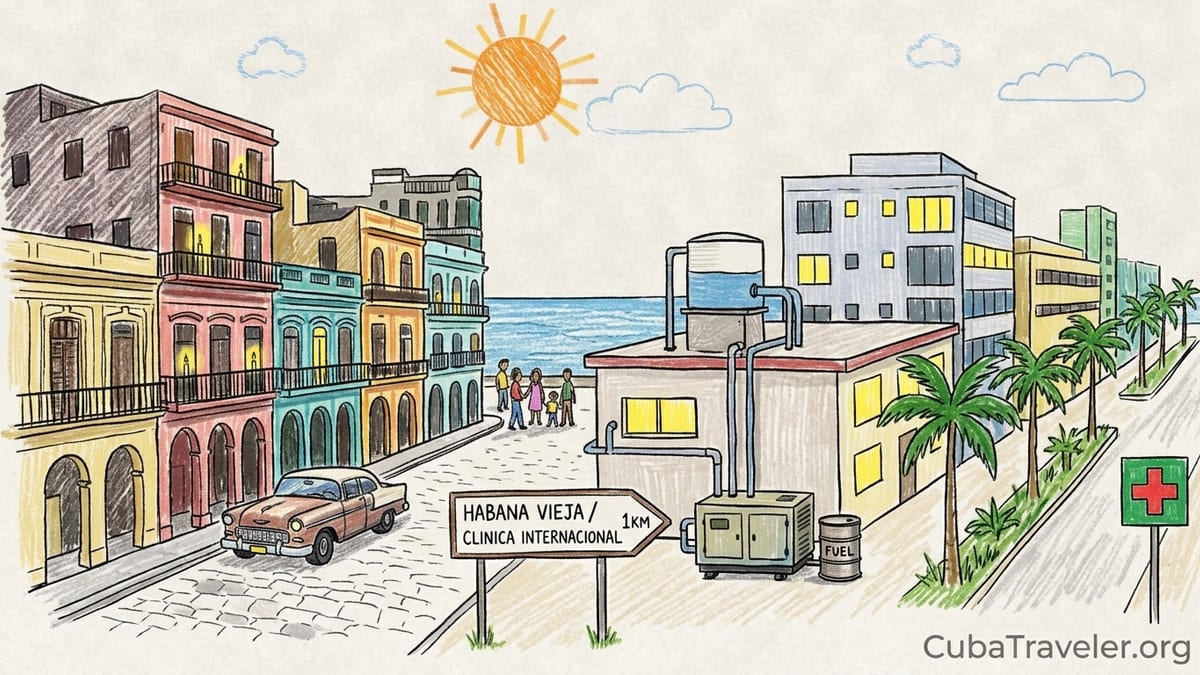
What “Safe” Really Means in Cuba in 2026
In Cuba right now, “safe” has a wider meaning than it did a decade ago. Violent crime against visitors remains relatively uncommon in tourist areas compared with many large Latin American cities, and I did not feel personally threatened walking in central Havana during the day. The bigger, less visible risks come from fragile infrastructure. Repeated islandwide blackouts since 2024, fuel shortages and a weakened economy have reshaped what matters when you book a room. A comfortable colonial balcony does not help if the water pump stops, the stairwell goes dark and your phone signal drops the same night someone in your group needs a doctor.
Several independent reports in 2026 describe rolling power cuts that can last many hours in some provinces and periodic nationwide failures affecting Havana itself. These outages disrupt water pumps, elevators, refrigeration, traffic lights and public lighting, and they also affect mobile networks and card payment systems. When you decide where to stay, it is crucial to ask, very specifically, how a property manages when the grid goes down. In practical terms, the safest places are not the ones that feel most luxurious, but the ones that still function reasonably well without external power or regular fuel deliveries.
The second layer of safety is medical access. Cuba still has an extensive public health network and several international clinics geared to tourists, including in Havana, Varadero and Trinidad. However, shortages of medications and diagnostics are widely reported, and transport to a hospital can be slower than many travelers expect. Choosing accommodation within a short, straightforward drive of an international clinic, and confirming how an ambulance or taxi would be arranged at night during a blackout, is just as important as asking about room safes or security guards.
Finally, there is the everyday question of personal security. Petty theft, occasional robberies and opportunistic scams are more likely when lighting is poor and streets are quiet. Official travel advisories note that well known tourist zones such as Habana Vieja and Varadero see more reported crime than purely residential districts, simply because visitors cluster there. That does not mean you must avoid them, but it does mean you should weigh walkability and atmosphere against the reality of dark corners, older buildings and strained police resources.
Havana Neighborhoods: Old Town Charm vs Practical Resilience
Havana’s central band runs from Habana Vieja at the eastern end of the bay, through Centro Habana, out to Vedado and finally Miramar in the western Playa municipality. All four zones host tourists, but they feel very different once you factor in access, infrastructure and nighttime movement. On my most recent visit, I deliberately stayed in all four within a single week to compare how they performed during blackouts and minor medical errands.
Habana Vieja is the Havana that appears on postcards: restored plazas, museums, cruise pier, many bars and paladares, and an easy walk to the Malecón. It is also dense, with narrow streets and many buildings that predate modern safety codes. When the lights went out one humid evening, I found myself walking three blocks to my casa particular with only a few battery-powered lamps in shop doorways. Stairwells in older buildings can be steep and irregular, and railings are not guaranteed. If you have any mobility issues or travel with small children, Old Havana’s charm should be weighed against the very real difficulty of navigating dark, crowded streets and high, uneven staircases.
Centro Habana, just west of the old city, is where many Habaneros live. It offers cheaper casas, plenty of street life and quick access on foot to both Habana Vieja and Vedado. From a safety perspective, its main strengths are affordability and location; its main weaknesses are building maintenance and infrastructure. Many Centro apartment blocks are crumbling around the edges, and I visited more than one rental where water only ran during certain hours of the day and the host relied on stored buckets to flush toilets when the pressure dropped. In a long stairwell without emergency lighting, a simple fall can become a serious emergency if ambulances are delayed by fuel shortages or traffic lights that are out.
Vedado sits further west and feels immediately more modern. Roads are wider, many apartment blocks have internal courtyards, and there is a noticeable presence of embassies, government offices and larger Cuban hotels. Walking here at night felt less claustrophobic because side streets are broader and some sections retain more public lighting. However, Vedado is not immune to blackouts or petty crime. On one evening, the hotel reception I was visiting switched smoothly to generator power while much of the surrounding neighborhood went dark, creating a sharp contrast between the bright lobby and the shadowy street outside. For solo travelers and anyone concerned about quick access to taxis, Vedado often strikes a realistic balance between urban convenience and manageable risk.
Miramar, within the broader Playa municipality, is the leafier, embassy-heavy western district. Large villas and modern hotel complexes line Avenida Quinta and the coastal strip. Several locals told me that parts of Playa, especially around major hotels and diplomatic compounds, sometimes experience shorter or less frequent blackouts than poorer districts, although this can change quickly with grid conditions. The flip side is that many Miramar streets are relatively quiet at night, with long distances between services. If you stay in a stand-alone villa here, you may need to rely on pre-booked taxis or a rental car, which becomes more complicated during fuel shortages.
Old Havana and Centro Habana: Walkability vs Infrastructure Risk
If you want to step out your door and be inside Havana’s historical core within minutes, Habana Vieja and parts of Centro Habana are unmatched. From a courtyard guesthouse near Plaza Vieja, I could walk to the cathedral, museums, the Malecón and countless bars without ever needing a taxi. For healthy travelers who prioritize atmosphere and do not mind heat, noise and crowds, that proximity is a genuine safety asset. You are never far from other people, and shopkeepers and neighbors tend to look out for familiar faces.
The tradeoff is the physical condition of the building stock and the narrowness of the streets. Some beautifully renovated boutique hotels in Habana Vieja have their own generators, water tanks and structured fire escapes, but many smaller casas occupy fragile buildings with aging wiring and partial renovations. A host in San Isidro showed me how they keep a rooftop tank filled when there is power so that guests can still shower in the morning if the mains cut overnight. Another admitted frankly that if the blackout lasted longer than a day, both water and refrigeration would be at risk, and there was no elevator backup.
In Centro Habana, I stayed in a third-floor apartment a few blocks from the Malecón. It had ocean breezes and a friendly owner, but no generator, limited water storage and a very dark interior staircase. During a daytime blackout, the building was hot but manageable. At night, the combination of high humidity, no fan, and a staircase lit only by phone flashlights made the apartment feel more precarious. Several recent visitors I spoke to described similar conditions in budget Centro rentals: cheap and authentic, but heavily dependent on luck with the grid and on your own physical fitness.
For travelers on tighter budgets or those who insist on staying in or next to Habana Vieja, the safest options are properties that can clearly explain how they handle electricity and water. In practice, that often means a restored boutique hotel or a very well organized casa particular whose owner lives on-site, with visible water tanks and backup lighting. When I asked probing questions, the best hosts could show me breaker panels, storage tanks and emergency lights and did not try to gloss over the reality of rolling cuts.
Vedado and Miramar: Services, Streets and the Illusion of Immunity
From a purely practical standpoint, Vedado is where I felt the most comfortable balancing infrastructure with access. Major Cuban and international-branded hotels, such as high rises near La Rampa or along the Malecón, typically have generators, large water tanks and 24-hour staffed reception. Several tour operators currently routing American groups through Havana report that they favor Vedado hotels precisely because restaurants and lifts keep working when the grid fails, and because taxis can reach the area easily even when public transport is disrupted.
However, staying in Vedado does not make you immune from the wider problems in Cuba’s system. Generators depend on diesel deliveries, which in turn depend on the same strained fuel supply that affects buses and private cars. In conversations with hotel staff in August 2026, a few admitted that they prioritize critical systems like lighting, elevators and kitchen refrigeration when fuel is tight, and may not run full air conditioning all night during severe shortages. Guests usually still sleep more comfortably here than in a powerless Centro apartment, but it is important to keep expectations realistic. Blackouts can still plunge surrounding streets into darkness, and phones can still lose data connectivity.
Miramar’s big advantage is space. Sidewalks are wider, traffic is calmer and large properties often have internal gardens or pools. Several all-inclusive style hotels in Playa maintain close relationships with private clinics or the main Havana hospitals and are used to arranging taxis or ambulances for guests. Some embassies cluster here, which can be reassuring during tense political periods. On the other hand, Miramar is farther from Old Havana’s attractions, and walking at night between widely spaced villas can feel more isolated than moving through crowded streets in Vedado or Habana Vieja.
Both Vedado and Miramar benefit from quicker road access to important medical facilities compared with more distant suburbs. From central Vedado, for example, you can usually reach a major Havana hospital or international clinic by car within 10 to 20 minutes when traffic is light. I saw hotel front desks maintain paper logs of ambulance contacts and private taxi drivers specifically for medical transfers. If health reliability is a key concern, this middle-to-western corridor of the city offers a better balance than outlying neighborhoods or very remote rentals.
Casas Particulares vs Large Hotels: Safety Tradeoffs in Practice
In 2026, the choice between a registered casa particular and a large hotel in Cuba has become a choice between intimacy and built-in redundancy. During my research, I stayed in both and deliberately asked awkward questions. How much water can you store? How long can your generator run if there are back-to-back blackouts? Who would answer the door at 3 a.m. if I needed an ambulance?
Well run casas particulares can perform impressively under pressure. One family-run house in Vedado had invested in a medium-sized diesel generator and separate water tank, funded partly by remittances from relatives abroad. When power cuts hit their block, their lights stayed on for several hours, fans kept turning and the refrigerator continued to operate. The owner showed me a handwritten log of fuel deliveries and generator hours, and he was candid that if fuel deliveries were disrupted for several weeks, they would have to ration power carefully. That level of transparency is a very positive sign.
Other casas had far fewer reserves. A top-floor apartment in Centro offered a beautiful sea view but no generator and only a small rooftop tank. The host explained that during previous long outages they moved perishable food into neighbors’ fridges and used buckets to carry water upstairs. There was no 24-hour reception and no second exit if the main staircase was blocked. This is not an unusual scenario in budget private accommodation across Havana, and it highlights why you should never assume that a casa will have hotel-style backup capacity.
Large Cuban and international hotels, on the other hand, almost always provide staffed reception, some form of on-site security, and larger-scale generators that can power elevators, emergency lighting and kitchen cold storage. Many have in-house doctors or quick referral arrangements to international clinics. When I visited a resort in Playa, a nurse was on duty daily and explained that they could summon an ambulance directly from the local international clinic, with payment handled by insurance or card. The weakest point is again fuel. Multiple recent reports show that even priority sectors such as tourism are operating inside a national fuel shortage, and some hotels have acknowledged adjusting generator use to conserve diesel. A hotel may keep key systems running, but it cannot promise perfect normality during extended islandwide outages.
A Due-Diligence Checklist for Any Stay in Cuba
Because conditions in Cuba are fluid, the safest strategy is to interrogate each individual property rather than rely solely on neighborhood reputation or star ratings. Before you book, and again a few days before arrival, ask specific, practical questions and look for clear, detailed answers instead of vague reassurances.
Locks and windows matter more than ever, especially when streetlights fail. Confirm that external doors to your room or apartment have at least one solid deadbolt or modern lock and that windows on accessible levels have secure latches or bars. When I checked into one otherwise charming casa in Habana Vieja, the balcony door did not close properly and the owner quickly produced a metal bar he normally used to secure it in place. That kind of improvised fix might be acceptable for some travelers but is a red flag if you are concerned about petty theft.
Emergency exits, stairs and lifts should be checked in person as soon as you arrive. Walk the staircase you would use in a fire or blackout, and note whether there are emergency lights or at least windows on each landing. In high-rise hotels, ask what happens to elevators during an outage, where the nearest stairwell is, and how often generator systems are tested. One Havana hotel engineer I spoke to said they run their backup generator every week, partially to reassure foreign tour operators that emergency systems are still functional amid the wider grid crisis.
Water storage, generator fuel and refrigeration are the heart of functional safety. Ask whether the property has its own water tank, how often it is filled, and whether it provides at least bottled drinking water when taps run dry. For generators, ask where the fuel is stored, how many hours of full operation they can guarantee after the last delivery, and whether they prioritize cold storage for food and medication. If you carry insulin or other temperature sensitive drugs, request to see the fridge yourself and ask how it is powered during cuts.
Communications and exit routes are the final piece. Check how reliable the mobile signal is inside the building and which Cuban network your host recommends. Verify whether landlines still function during power cuts and write down important local numbers, including the nearest international clinic, your embassy and at least one trusted taxi driver or transfer service. For many visitors, the safest option is to pre arrange airport transportation through a reputable hotel, official taxi desk or established tour operator rather than rely on ad hoc rides at night after a long flight.
Beyond Havana: Varadero, Trinidad, Viñales and the Northern Cays
Outside Havana, the safety equation shifts again. Scenic isolation, which looks so appealing in photos, can become a liability if you need a doctor or if fuel deliveries stall. In 2026, this is not a theoretical risk. Several coastal provinces have experienced long daily blackouts, and recent travelers report patchy fuel availability away from major tourist corridors.
Varadero, on the Hicacos Peninsula in Matanzas province, remains Cuba’s main beach resort strip. It concentrates a chain of large all-inclusive hotels and benefits from priority attention to keep at least core tourist services running. The town hosts an international clinic that provides emergency care, consultations, imaging and pharmacy services geared to foreign visitors, and many hotels have well established protocols to get guests there quickly by taxi or ambulance. Recent guidance and traveler reports describe resort doctors making room calls, arranging tests at the clinic and coordinating with insurance companies, which makes Varadero one of the more medically secure options on the island.
Trinidad, a UNESCO listed colonial town on the south coast, is a favorite for its cobblestoned streets and nearby beaches. It also has an international clinic that serves tourists, but it is smaller than Varadero’s and the town is farther from major urban hospitals. The surrounding mountains and rural roads are beautiful but can be slow to traverse, especially in heavy rain or when fuel is scarce. During my last visit, a local guide described how ambulance response from the clinic into the Valle de los Ingenios could be significantly delayed when roads were blocked or vehicles were low on fuel. Staying as close to the town center as possible, near paved roads and established taxi drivers, reduces the risk of being stuck in a rural rental without quick medical access.
Viñales, in Pinar del Río province, offers dramatic mogote landscapes and farm stays in casas particulares. Many visitors base themselves in the compact town and do day trips into the valley. This is a relatively safe strategy. You are close to local clinics, pharmacies and bus stops, and drivers are used to moving tourists along the main corridors. Some travelers, however, book remote eco lodges or farmhouses several kilometers out, often at the end of unpaved tracks. In a year when fuel is tightly rationed and rolling blackouts are frequent, that isolation can become uncomfortable quickly: no cooling, no easy way to charge phones and no clear path to a doctor at night.
The northern cays, such as Cayo Santa María and Cayo Coco, are linked to the mainland by long causeways. Resorts there tend to be all-inclusive bubbles with their own generators, desalination plants or water storage, and on-site medical posts with doctors on rotation. In good times, this controlled environment can feel very secure. In a prolonged national fuel or electricity crisis, these same advantages turn into vulnerabilities. All supplies, including diesel, bottled water and medication, must travel along a single road over the sea. If storms damage the causeway or fuel deliveries are delayed, resort managers must stretch existing stocks. For guests without a rental car, alternative transport off the cay may be limited to scheduled buses or arranged taxis, both of which depend on fuel availability.
Matching Accommodation Choices to Your Personal Risk Profile
There is no single “safest” neighborhood or property in Cuba. The right choice depends on your health, mobility, budget and tolerance for discomfort. For city travelers who prioritize culture and restaurants but still want practical security, a mid range or higher hotel in Vedado or central Miramar usually offers the strongest mix of transport access, backup infrastructure and proximity to medical facilities. From there you can taxi into Habana Vieja by day, then return to a building with staffed reception, structured fire exits and a generator at night.
Resort guests whose main goal is a beach vacation with minimal logistics are generally better off in Varadero than in very remote cays, at least while the national fuel situation remains tight. Varadero combines resort-style redundancy with easier overland access to an international clinic, nearby town and road network. If you do choose a cay, favor properties that can describe in detail how they handle extended power cuts, medical transfers and supply disruptions, and avoid highly isolated rentals without institutional support.
Travelers without cars, including most short term visitors from North America and Europe, should concentrate on places where you can walk to essential services or reliably find taxis even during shortages. In Havana, that usually means staying in a well equipped casa or hotel in Habana Vieja, Centro near major arteries, Vedado or Miramar close to main avenues, and avoiding far flung suburbs that rely on irregular shared trucks or crowded city buses. In smaller towns, choose accommodation within a short walk of the central plaza, main bus stop and at least one pharmacy.
For anyone with chronic health conditions, mobility limitations or a strong need for stable cooling and refrigeration, the hierarchy is simple. First, prioritize proximity to an international clinic or main hospital, and verify in advance how your accommodation would coordinate emergency transport there. Second, favor larger hotels or exceptionally well prepared casas that can show evidence of generators, water tanks and secure fridges. Third, avoid top floor walk ups, very old buildings without clear fire exits and extremely remote rural stays where ambulances may struggle to reach you in reasonable time during an outage.
FAQ
Q1. Is Havana safe to visit at all given the current blackout situation?
Havana remains visitable for many travelers, and tour operators continue to run trips, but the experience is more challenging than in previous years. Safety depends heavily on choosing accommodation with backup systems, planning for heat and darkness during cuts, and staying in areas with reasonable access to medical care and transport.
Q2. Which Havana neighborhood offers the best overall combination of safety and convenience?
No neighborhood is perfect, but many recent visitors and operators find Vedado offers the best balance between infrastructure, hotel options, wide streets and access to taxis, while still being a quick ride from Habana Vieja. Miramar and central parts of Playa can also work well, especially near major hotels and embassies.
Q3. Is it still a good idea to stay in a casa particular in 2026?
Staying in a casa particular can be an excellent choice if you select one carefully. Focus on hosts who live on-site, can clearly explain their arrangements for water, power and refrigeration, and are willing to show you tanks, generators or backup lighting. Avoid properties that cannot answer basic questions about how they handle long blackouts.
Q4. Do large hotels in Cuba always have reliable generators and water?
Most large hotels have generators and water storage, but “reliable” is relative in a national fuel shortage. Expect them to prioritize essential systems such as elevators, emergency lighting and kitchens, and understand that full air conditioning or all amenities may not be available during extended outages.
Q5. How close should I try to stay to a medical facility?
For healthy travelers, being within a 20 to 30 minute drive of an international clinic or main hospital is usually adequate. If you have significant health needs, aim for 10 to 15 minutes by car and confirm with your accommodation how ambulances or taxis would be arranged at night and during a blackout.
Q6. Is Varadero safer than Havana for a first-time visitor worried about infrastructure?
For a pure resort stay, Varadero often feels more controlled and predictable. Large hotels there are experienced in handling foreign guests, there is an international clinic in town, and resort staff commonly coordinate medical care and transport. Havana offers more culture but also more exposure to grid instability and urban challenges.
Q7. Are Cuba’s rural areas and small towns too risky because of isolation?
Rural stays in places like Viñales or the countryside near Trinidad are not inherently unsafe, but isolation amplifies existing problems. If you choose them, stay close to town centers, on paved roads, and in properties that can explain how they manage water, power and access to clinics, rather than in very remote houses at the end of long tracks.
Q8. What should I ask a host before booking in Havana?
Ask about door and window locks, stairwells and exits, water storage, generator fuel, how long fridges can stay cold without the grid, whether there is 24-hour contact, how to reach the nearest clinic, and how airport or intercity transfers will work if taxis are scarce.
Q9. Is it safe to walk around Havana at night during a blackout?
In well known areas, many people still walk around, but unlit streets increase the risk of falls, petty theft and getting lost. If the power is out, it is wise to keep movements short, stick to busier avenues, carry a small flashlight and avoid long walks through unfamiliar backstreets.
Q10. Should travelers postpone trips to Cuba until the blackout situation improves?
This depends on your risk tolerance and health. Travelers who need stable cooling, refrigeration for medication or guaranteed connectivity may prefer to delay. Others who are prepared for discomfort, choose robust accommodation and plan carefully can still have rewarding trips, but should understand that Cuba in 2026 requires more resilience and due diligence than in the past.