


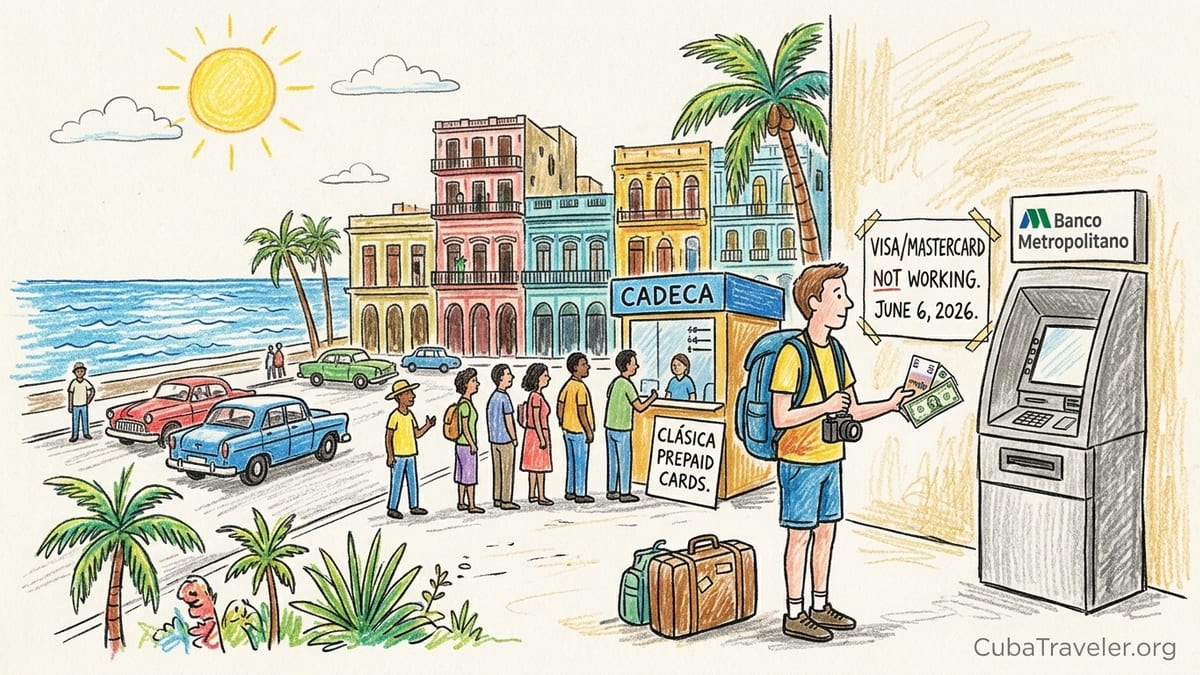
On June 6, 2026, Cuba quietly crossed a financial red line for travelers. That morning, the country stopped processing all Visa and Mastercard transactions after its foreign processing bank cut ties under expanded United States sanctions. Overnight, the cards that many visitors treated as a final safety net for cash advances and big bills simply stopped working. I flew into Havana weeks after the suspension took effect and watched confused tourists feed plastic into dead ATMs, shaking their heads at the same “operación no disponible” message. Whatever emergency plan they had assumed their bank card would cover had just evaporated.
Why Foreign Cards Stopped Being a Back‑Up in June 2026
On June 3, 2026, Cuba’s central bank announced that transactions with Visa and Mastercard would be suspended from June 6 because the foreign bank that processed those operations was no longer able to work with Cuban entities under tightened sanctions. Reuters and other outlets reported that from that date, Cuba could no longer receive income from sales made with those brands, and Cuban ATMs and point of sale terminals dependent on that processing route went dark for Visa and Mastercard users. By the second week of June, Havana’s ATM queues had thinned out not because the cash problems were solved, but because travelers had already learned that their main cards simply would not work.
Cuban authorities have stressed that other systems, such as the Russian Mir network and Chinese UnionPay, still function, and that foreign visitors can continue to use Cuba-issued prepaid cards like the Clásica and MLC products. Official tourism information now tells visitors to expect a largely cash-based experience and to rely on prepaid instruments purchased inside Cuba rather than swiping their home bank cards. That is a radical change from the pre-2026 pattern in which many Europeans and Canadians used bank machines to top up local cash every few days.
For travelers, the practical consequence is clear. You can no longer assume that “in the worst case I will find an ATM and pull out a few hundred” is a viable backup. Even if smaller non-sanctioned card networks continue to work, they are not widely held by North American or European visitors. Emergency planning for Cuba in late 2026 looks much closer to travel logistics in the early 1990s: you carry what you are prepared to spend, plus a margin for disruption, and you treat that physical money as a critical piece of safety gear.
That shift explains why the usual advice about a single emergency number is misleading here. In Cuba, you need to think in layers: a core cash budget for booked costs, extra cash for disruptions like missed transport and changed lodging, and insurance limits for the truly catastrophic events such as medical evacuation. The rest of this article uses real 2025 and 2026 price examples to sketch those layers for two concrete itineraries, and then shows how to turn them into a simple personal framework.
How Money Works in Cuba in Late 2026
Cuba’s official currency is the Cuban peso, the CUP, after the convertible peso was phased out in 2021. In theory, visitors can pay in CUP at official shops, state restaurants and ticket offices, usually at a government rate. In practice, many tourism-facing businesses quote in euros or occasionally United States dollars, especially for higher-end hotels, private casas particulares in Havana Vieja, and intercity transfers. The official tourism portal explains that foreign visitors can buy MLC prepaid cards at CADECA exchange offices, airports, hotels and ports, in euros and a few other major currencies, in denominations between 50 and 1,000. Those cards are then used for payments in shops and services that cater to hard-currency purchases.
In early 2026, articles in Cuban and international media noted that foreign Visa and Mastercard products, so long as they were not issued by U.S. banks, usually worked at some terminals and ATMs. That changed with the June 6 suspension. Current guidance from foreign ministries now explicitly warns that Visa and Mastercard are not accepted for transactions in Cuba and urges visitors to bring sufficient cash in euros or dollars for the full stay and all associated costs. U.S. government regulations still allow authorized travelers to spend on daily living expenses, but that legal permission does not translate into card functionality on the island.
The Clásica and related prepaid cards are one partial workaround. Cuban banking information and travel reports explain that foreign tourists can walk into designated banks or counters in major hotels such as the Hotel Nacional in Havana, hand over cash in euros or other accepted currencies, and receive a rechargeable card. That card can then be used in many shops, restaurants and gas stations that operate in MLC, the hard-currency accounting unit used in much of the formal retail network. However, the card comes with limitations that matter in emergencies: it is generally not refundable in cash, may have an expiry date, and only works at terminals inside Cuba. If you load far more than you finally spend, you may leave the island with stranded value.
On top of that, the peso economy operates alongside a fluid informal exchange market. Travelers posting trip reports in 2025 and 2026 describe paying private taxis or casa owners at exchange rates far above the official rate, sometimes 400 to 450 pesos for one euro or U.S. dollar in Havana. While these off-book exchanges can ease day-to-day spending, they are sensitive to enforcement campaigns and policy shifts, and they carry legal risks for locals. From a safety perspective, it is unwise to count on an informal rate or to assume that you can always find someone trustworthy to change large sums of cash when you need it most.
Legal Cash, Customs Declarations and the Risk of Carrying a Lot
Bringing cash is now unavoidable, but there are limits and trade offs. Cuban customs guidance used in airlines’ and tour operators’ documentation indicates that foreign travelers must declare if they bring more than the equivalent of 5,000 U.S. dollars in cash or other freely convertible currencies when arriving. There is no public rule that outright forbids larger amounts, but sums above that threshold must be registered and may attract questions on departure if the balance leaving the country is significantly different from what you declared on arrival. In practical terms, this means that most independent travelers try to stay below the declaration line, or, if they cross it, keep clear records of their spending and receipts for larger payments such as prepaid accommodation.
On the ground, Havana and major resort towns remain relatively safe by regional standards when it comes to violent crime, but opportunistic theft is a real problem. Travelers still report pickpocketing around crowded Old Havana squares, luggage rifled at bus terminals, and guesthouse doors that do not lock as solidly as they look. If you carry several thousand in euros and dollars, you have to treat that physical bundle as the lifeline for the rest of your trip. That changes small habits: leaving only part of your cash in a room safe, using hidden interior pockets in day bags, and never drawing full stacks in public view. It also means that your emergency planning cannot simply be “bring twice as much cash as you think you will need” without considering how, and where, you will reasonably protect it.
Legal use of foreign currency once you are inside Cuba is more straightforward. Tour operators and hotel chains from Spain, Canada and other countries often quote room prices in euros and expect payment in foreign cash or via prepaid systems backed by foreign currency. Private casas in Havana, Viñales and Trinidad frequently prefer euros in hand at check in. You can change euros into CUP at CADECA for day-to-day spending in peso-only places, but the official rate is usually less favorable than what you would receive informally. Official advice from several foreign governments now explicitly cautions against black-market currency exchange both for safety and legal reasons. In an environment where law enforcement campaigns against informal operators are periodic and unpredictable, wagering your entire emergency cushion on a handshake exchange is a poor risk.
The sensible compromise is to bring foreign cash in a mix that matches your bookings, keep written notes of what is reserved and prepaid, and then treat the remaining uncommitted cash as a finite pool that has to cover both known daily costs and unknown disruption costs. The following sections use that approach to lay out real-world budgets for two scenarios that many visitors will recognize.
Budget 1: A Three‑Night Essential Havana Trip
For a short Havana city break, we can sketch a realistic three-night budget using early 2026 price points from accommodation platforms, local tour agencies and travel reports. In January and February 2026, simple but well-reviewed casas particulares in central Havana Vieja often list at the equivalent of 25 to 40 euros per room per night, while mid range guesthouses with private bathrooms and breakfast included tend to sit around 40 to 60 euros. For this example, I will use 50 euros per night for a private room for two, breakfast included, booked directly with the host who prefers to be paid in euros in cash on arrival.
Arrival transfers from José Martí International Airport into central Havana booked via licensed taxis or through hotel desks are widely quoted in the 25 to 35 euro range for a standard car. A conservative working figure of 30 euros per direction is reasonable for 2026, especially if you prefer to lock in a legal transfer rather than negotiating with unlicensed drivers at the curb. Within the city, classic-car tours for one hour around the Malecón and Vedado often range from 30 to 50 euros for the vehicle, while regular yellow taxis for short hops run at a few euros per ride when converted from CUP. A modest city-transport budget of 20 euros per full day usually covers two people’s taxis and the occasional shared classic car ride.
Food costs vary sharply depending on whether you stick to state-run peso cafeterias, private paladares or hotel restaurants that price in hard currency. In late 2025 and early 2026, many private restaurants in Old Havana quote main dishes in the range of 6 to 12 euros when converted at the prevailing informal peso rate, with two people’s dinner including a shared starter, mains and a couple of drinks coming out near 25 to 35 euros equivalent. Breakfast in casas is often included. A daytime sandwich and coffee in a private café can be the equivalent of 4 to 6 euros. Setting a per person food and drink budget of 35 to 40 euros per day in Havana allows for two modest restaurant meals, a few coffees and occasional drinks in more atmospheric bars.
On top of those ordinary daily numbers sit the safety extras. Safe drinking water, whether through large bottled jugs in casas or mineral water bought at hotel shops, can easily run to 4 to 6 euros per person per day in the hot months if you avoid tap water entirely. A tourist SIM package from the state company Etecsa, purchased as a physical SIM or eSIM through authorized resellers, costs in the region of 25 to 35 euros for several gigabytes of data, local minutes and messages, enough for a three-night stay. Emergency transport reserves for this short trip might be another 40 to 60 euros, enough to pay for an urgent taxi back to the airport if your pre-booked ride fails or if you need to move quickly out of a problematic neighborhood.
Once you put those pieces together, a three-night essential Havana stay for two adults might look like this at June 2026 prices: 150 euros in lodging, 60 euros in airport transfers, about 240 euros in food, drink and local transport, 40 to 50 euros in water, 30 euros in connectivity and 50 euros in emergency local transport. That adds up to roughly 530 to 550 euros in cash for the pair, excluding flights and advance-booked experiences. Adding a disruption reserve equal to one extra night of accommodation plus one extra day of meals and taxis for both people, about 120 to 150 euros, gives you a safety margin that can absorb a cancelled domestic flight, a one-day delay or a simple miscalculation. The key point is that every part of that margin has to be stored as real notes, not as optimistic faith in a foreign card.
Budget 2: Seven Nights Plus a Forced Four‑Day Extension
The second scenario is where emergency planning really matters. Imagine you have prepaid seven nights in a mid-range Havana guesthouse and return flights that cannot easily be changed. On day six, domestic transport disruption hits. In recent years, foreign ministries have warned fairly often about fuel shortages, reduced domestic flights and erratic intercity bus services in Cuba. In that environment, a missed connection from a provincial town back to Havana, or a cancelled international flight out of Havana, is not a remote risk. If your airline rebooks you four days later but does not cover local accommodation and meals, your emergency reserve has to carry the weight.
Start with the base week. Using similar 2026 figures, a comfortable Havana guesthouse at 50 to 70 euros per night for two people, breakfast included, gives a seven night accommodation cost between about 350 and 490 euros. Assume 60 euros per night for a central, well reviewed option. Food and drink at 35 to 40 euros per person per day comes out at roughly 500 to 560 euros for two over a week. Airport transfers add 60 euros. Local taxis, a couple of longer rides to the beach or to outlying neighborhoods, and one or two vintage car tours might total 150 to 180 euros.
Next layer in the safety costs that people often forget to ring fence. Drinking water for two in a hot Havana week might run to 70 to 90 euros if you consistently buy branded bottles at tourist-oriented shops. A SIM or eSIM with enough data for seven to ten days comes in around 35 to 45 euros. A reserve pot for emergency local transport, such as last minute taxis during a fuel shortage when prices spike, should reasonably be at least 80 to 100 euros over a week. Already, your ordinary-plus-safety budget for seven nights climbs into the 1,000 to 1,100 euro range for two adults before you add any paid excursions or nightlife.
Now add the unplanned four days. If your original guesthouse is available, the host may extend at the same nightly rate, but in peak periods some raise prices or have subsequent bookings. Realistically, you might have to move to a slightly more expensive guesthouse or small hotel at short notice. Working with recent platform listings, 70 to 90 euros per night for a last-minute room for two with breakfast in central Havana feels plausible for 2026. Four nights at 80 euros average is 320 euros. Food and drink at the same 35 to 40 euros per person per day adds roughly 280 to 320 euros. Extra drinking water for four hot days for two people is perhaps 40 to 50 euros. Add another 40 to 60 euros for increased taxi use as you shuttle to the airport to check on flights or move between accommodations.
That means a four-day forced extension can easily consume an extra 700 to 750 euros in cash for two people in Havana if nothing else goes wrong. If one of you becomes mildly ill and needs a private medical consultation at an international clinic in Havana, you might face an additional request for payment in hard currency. Reports from 2024 and 2025 describe simple doctor visits for tourists being charged at the equivalent of 60 to 100 euros, with lab tests and prescriptions adding more. If you do not have a card that functions in Cuba and your insurer requires you to pay upfront then reclaim, that medical cost also has to come out of the cash you physically carry.
Running the numbers this way makes it clear why many foreign ministries now advise travelers to Cuba to bring not just the amount they expect to spend, but enough extra to cover several nights of additional lodging, local transport and essentials. For a couple on a one-week trip, that realistically points to carrying at least 600 to 800 euros above your base plan if you want a margin to handle a prolonged delay without immediately calling family or friends to attempt complex remittance workarounds.
Why Insurance Limits Matter More Than Cash for Medical Evacuation
There is one category of emergency where even the thickest travel wallet is irrelevant: serious illness or injury that requires hospitalization or evacuation to a third country. Cuba requires visitors to have medical insurance valid in the territory. Airlines and tour operators typically verify coverage as part of trip preparation, and Cuban immigration has the right to demand proof on arrival. Short-stay policies from North American and European insurers often include emergency medical limits in the range of 100,000 to 1,000,000 U.S. dollars, which sounds generous until you consider the cost of an air ambulance flight to Florida, Mexico or Canada.
Published examples from medical evacuation providers show that a dedicated air ambulance from the Caribbean to North America can cost tens of thousands of dollars. Even regional transfers to more sophisticated facilities in Mexico have price tags that easily exceed 25,000 dollars. In that context, the difference between a 50,000 dollar medical limit and a 500,000 dollar limit is more important than whether you brought 1,000 or 1,500 in cash. No realistic amount of notes in your money belt will pay for a private jet with medical staff.
However, high limits on a policy do not guarantee that a Cuban hospital can, or will, provide the care you expect. Health infrastructure on the island has been under strain, with intermittent medication shortages and gaps in diagnostic equipment. Travelers have reported clinics asking for payment in hard currency for some supplies or services that fall outside basic emergency care. In a major emergency, your insurer might arrange evacuation to a different country if acceptable standards of treatment are not available locally, but that depends on both medical assessments on the ground and the operational reality of flights at the time.
Another complication in 2026 is the interaction between travel advisories and insurance. Some policies reduce or exclude coverage for cancellation and disruption once a government issues an “avoid non-essential travel” warning for a destination. Others maintain emergency medical and evacuation coverage but restrict claims for voluntary changes. If your country currently advises against non-essential travel to Cuba, you need to verify, in writing, how that advisory affects your coverage. For many independent travelers, it now makes sense to treat medical and evacuation insurance as a non negotiable core, then build a separate cash-based reserve for extended stays and alternative flights that insurers will not fund.
Cancellation, Extended‑Stay and Evacuation When Advisories Turn Red
Government advisories and insurance fine print interact in messy ways. Suppose your foreign ministry moves Cuba from “exercise high degree of caution” to “avoid non-essential travel” because of shortages or civil unrest. If you booked before the change and decide to cancel, some insurers treat the new advisory as a valid reason to claim non-refundable costs, provided you bought a policy before the announcement. Others argue that advisories are a known risk and only cover cancellation due to narrowly defined events such as serious illness, death of a close relative or natural disaster. For travelers who continue with their trip despite a negative advisory, cover often narrows even further.
Extended stay coverage is a separate but related angle. A number of comprehensive policies do offer benefits for enforced trip extension due to medical reasons or events like natural disasters that close airports. Those benefits might pay for several extra nights of accommodation and meals within a daily limit. However, very few mainstream policies cover additional lodging and food because a carrier cancels flights for commercial or operational reasons without a covered peril like weather or strike. In Cuba, where fuel shortages or scheduling issues can ripple through domestic and international flights, you should not assume that insurance will pay for an extra four nights in Havana if your airline merely rebooks you later.
Hospitalization and evacuation coverage typically continues even when advisories go red, but the process of activating those benefits can be more complex. Insurers may require you to contact an assistance center before seeking non emergency care, and they can insist on moving you to a particular clinic with which they have arrangements. In Cuba, those clinics often expect either a guarantee of payment from the insurer or an upfront payment in hard currency from you. If the insurer’s card or transfer systems cannot immediately reach the clinic’s accounts, staff may look to the cash in your wallet as the fastest route to start tests or treatments.
That is why, even for medically focused emergencies, your on-the-ground emergency money still matters. It is not there to cover the full cost of surgery or evacuation, but to bridge the first 24 to 72 hours of medical decisions in a system that may not be able to instantly verify foreign insurance arrangements. A practical approach is to carry enough extra hard currency to fund at least one private consultation, basic diagnostics and several taxi rides between accommodation, clinics and the airport, on top of whatever you need for extended lodging.
A Printable Framework: Daily Spend, Disruption Reserve, Insured Exposure
Given all these moving parts, it helps to put your own Cuba emergency plan into a simple framework you could jot on paper and keep with your travel documents. Think of three separate buckets. The first is your daily spending cash, tightly linked to your itinerary: accommodation that must be paid in cash on arrival, expected meals, local transport and entry fees. For example, on a one week Havana stay like the one outlined earlier, two people might earmark around 1,000 to 1,100 euros to cover seven nights of lodging, food, water, city transport, a SIM package and a modest amount of paid sightseeing, all based on conservative 2026 prices.
The second bucket is your disruption reserve. This is where most visitors to today’s Cuba are underprepared. Based on real-world costs, a practical minimum may be one to two extra nights of your typical accommodation rate, plus a full extra day of meals and local transport for each traveler, multiplied by the number of days of disruption you judge plausible. For a pair on a Havana-only itinerary, planning for an unplanned four day extension might mean adding about 700 to 800 euros in cash above the base budget, enough to pay for four more nights in a mid-range guesthouse or small hotel, four days of food, water and taxis, and one or two basic medical consultations if needed.
The third bucket is your insured medical exposure. This is measured not in cash you carry, but in the written limits of your travel policy. Before you go, note the maximum emergency medical benefit, the separate evacuation limit if there is one, and any sub-limits for hospitalization or outpatient care. Then add two more notes: whether those limits remain valid if your government advises against travel to Cuba, and how the insurer expects you to pay for treatment on the island. Some explicitly state that you may need to pay reasonable costs upfront and then reclaim them, while others promise direct billing to clinics where possible. In both cases, your physical cash is the bridge between the moment something happens and the point at which your insurer’s systems catch up.
When you combine those three views, the uncomfortable conclusion is that Cuba in late 2026 is a higher-risk financial destination for anyone without slack in their budget. A traveler who cannot absorb several additional nights, extra taxis, higher last minute room rates or a changed flight without serious hardship faces disproportionate exposure. In older patterns of travel, you might have trusted that you could patch gaps with a credit card, call home, or rely on your airline and insurer to sort things out. In today’s Cuba, those supports are thinner and slower. The safest trips will be planned by people who treat emergency cash as a deliberate, separate line item and who consider, in advance, what they would actually do if they found themselves in Havana with a cancelled flight, a half-usable phone connection, no working foreign card and three days to wait.
FAQ
Q1. How much emergency cash should I bring for a one week trip to Havana in 2026?
For two adults in a mid-range guesthouse, many recent budgets land around 1,600 to 1,900 euros in total cash, which covers a base week of lodging, meals, water, city transport, a SIM package and simple sightseeing plus an additional reserve of 600 to 800 euros to handle several unplanned extra days. Solo travelers can scale those numbers down, but the principle of carrying enough for at least a few extra nights and local costs still applies.
Q2. Are Visa and Mastercard completely useless in Cuba now?
Since June 6, 2026 Cuban ATMs and point of sale terminals that relied on international processing for Visa and Mastercard transactions have stopped accepting those cards. Some other networks, such as Mir or UnionPay, still operate, but they are not widely held by typical visitors. You should plan your trip as if your usual Visa or Mastercard will not work at all for withdrawals or payments inside Cuba.
Q3. Can I legally use euros or U.S. dollars to pay in Cuba?
Yes. Many hotels, guesthouses and private services quote prices in euros, and some accept U.S. dollars as well. You can also exchange foreign cash at official CADECA offices or banks. What is not legal is participating in unauthorized currency exchange on the street, even though higher informal rates are widely discussed. Sticking to official channels for large exchanges is safer both legally and in terms of fraud risk.
Q4. What exactly is a Clásica prepaid card and how can it help me?
The Clásica card is a Cuban-issued prepaid card that foreign visitors can purchase with hard currency at designated banks, CADECA offices or counters in some major hotels. You hand over foreign cash, and the balance is loaded onto the card in a form that works at many local terminals, especially in stores and services priced in MLC. It can reduce the amount of cash you carry day to day, but the balance is usually not refundable in cash and only works inside Cuba, so it is not a substitute for an emergency reserve you can take home if unused.
Q5. How risky is it to carry several thousand euros in Cuba?
Carrying large sums anywhere involves theft risk, and Cuba is no exception. While Havana and major resorts are not known for high levels of violent crime, pickpocketing and opportunistic theft occur, particularly in crowded areas and at bus terminals. If you bring several thousand euros, you should plan secure ways to store and divide it, such as room safes, interior money belts and keeping only a day’s needs in a wallet. You also need to consider how you would explain and document amounts above the customs declaration threshold of 5,000 U.S. dollars or equivalent.
Q6. Will my travel insurance still cover me if my government advises against non-essential travel to Cuba?
That depends entirely on your policy wording. Some insurers maintain emergency medical and evacuation coverage regardless of advisories but restrict cancellation and disruption benefits. Others exclude most cover for trips taken against official advice. Before you book, and again before you travel, you should confirm in writing whether Cuba is covered, which benefits apply if advisories change, and whether extended-stay costs due to transport disruption are included.
Q7. Do I need to pay upfront for medical care in Cuba even if I have insurance?
In many cases you should be prepared to pay at least some costs upfront in hard currency. International clinics may accept guarantees of payment from insurers for major treatment, but smaller consultations, tests and medicines are often handled as cash transactions. Your insurer will usually reimburse you later if the treatment is covered. This is one of the reasons why an emergency cash reserve separate from your daily budget is important.
Q8. How much should I set aside specifically for medical emergencies that are not evacuations?
For non-catastrophic issues such as clinic visits, basic tests and medication, many travelers feel more comfortable carrying at least 200 to 300 euros per person on top of their disruption reserve. That amount can fund a couple of private consultations and prescriptions if you fall ill without rising into the territory where you would expect insurance to arrange evacuation.
Q9. If my return flight is cancelled, will my airline pay for my extra nights in Havana?
Sometimes, but not always. When cancellations are caused by weather or technical faults, some carriers provide hotel vouchers and meals. When disruptions are linked to broader issues such as fuel shortages or scheduling changes, airlines may only rebook you on a later flight without covering accommodation or local costs. In Cuba’s current context, you should not assume your airline will automatically pay for several extra nights, and your emergency fund should be sized to cope without that support.
Q10. What happens if I run out of cash in Cuba now that my cards do not work?
Running out of cash in Cuba can be serious because options to move money in quickly are limited. Some travelers arrange for relatives to send funds through specialized remittance services, but those depend on regulatory conditions and may not be fast. Others try to sell personal items or negotiate with guesthouse owners, but these are uncomfortable last resorts. The more realistic approach is to avoid reaching that point by carrying an adequate reserve, tracking your spending carefully, and resisting the temptation to burn through your disruption buffer on optional extras early in the trip.