


In the last two years I have watched more Cuba trips die at the check in counter than at any hurricane season. Almost every disaster started with the same words: “But the blog I read said…” Cuba has quietly shifted from paper tourist cards to e visas, from scribbled forms on the plane to mandatory digital pre registration, while airlines and commercial visa sites race to catch up. The result in 2026 is a minefield of half updated information, obsolete advice and expensive misunderstandings that can get you denied boarding or create long term problems with U.S. travel.
The New Reality: Cuba Visas Went Digital, Rules Did Not
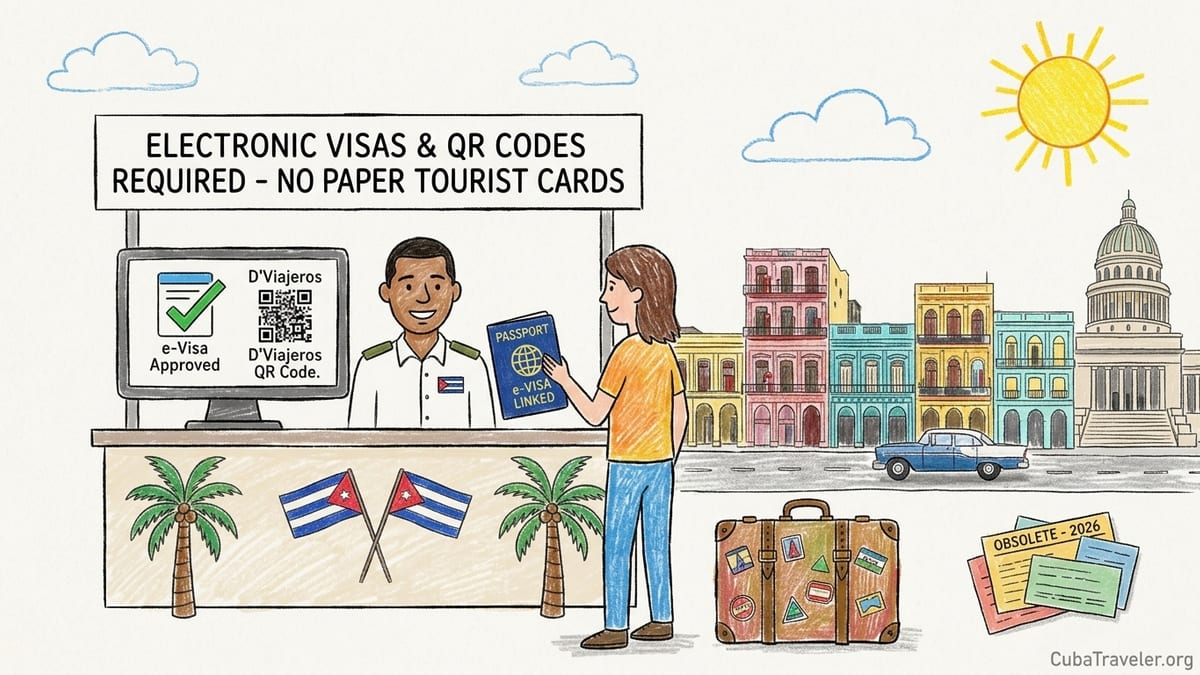
For years, traveling to Cuba meant buying a colored paper tourist card, filling it out on the plane and tucking both halves carefully into your passport. Many older trip reports still describe that ritual, usually alongside reassuring lines like “you can just buy the card at the gate.” In 2026 that description is mostly a historical curiosity. According to recent guidance from Cuban tourism authorities and tour operators, standard paper tourist cards have been phased out in favor of electronic visas linked to your passport and a mandatory D’Viajeros digital entry form that generates a QR code. That digital shift simplified the paperwork but did not relax the immigration rules behind it.
On the ground, the traveler experience has not become more forgiving. Airlines remain responsible for transporting only properly documented passengers. If your e visa data does not match your passport, if your D’Viajeros QR code cannot be read, or if your nationality requires a different type of authorization, the default airline response at the check in counter is still “no boarding.” In conversations with airline agents and fellow travelers in Havana and Varadero over the last year, I have seen people lose entire holidays over a single wrong digit typed into an online form.
What follows is an unvarnished look at the most expensive and avoidable mistakes I have seen or verified in 2025 and 2026, with a focus on evidence from official government advisories, embassy notices and airline instructions, contrasted with the outdated guidance that still circulates on commercial visa sites and old blogs. The goal is not to scare you away from Cuba. It is to keep your trip from being ruined by rules you could have easily respected if someone had spelled them out.
Mistake 1: Buying Obsolete Paper Tourist Cards in 2026
The first and most basic mistake is treating the old paper tourist card as a timeless truth. Many long running forums and trip reports still insist you must obtain a physical card in advance, often linking to third party sellers that ship a colored card to your home. Yet recent information circulated by Cuban tourism agencies and tour operators shows that standard tourist cards have been replaced by an electronic visa system for most visitors in 2026, with the authorization attached digitally to your passport rather than printed on a detachable card.
The mistaken assumption is that because thousands of travelers used those paper cards only a few years ago, they must still be valid today. The current rule is that you need a valid authorization in the format Cuba now uses for your nationality and point of departure, which in 2026 generally means an e visa profile in the airline system and a completed D’Viajeros entry form generating a QR code. Buying a paper card from a site that has not updated its product in years can leave you with a decorative souvenir that Cuban immigration no longer recognizes.
The consequences are immediate and expensive. If the airline’s system cannot validate your Cuban authorization on the day of departure, staff may refuse boarding or require you to purchase the correct format on the spot if they are allowed to issue it. I watched a couple in Toronto throw away more than 200 Canadian dollars on obsolete pink cards purchased online, then pay again at the airport for the new electronic visa tied properly to their passports. The evidence to check is simple: study the latest entry requirement pages from your government and your airline for Cuba and confirm whether they still mention paper tourist cards or refer instead to an electronic visa or “Cuba e visa” product.
The corrective action is to ignore any service that still shows only paper cards without a clear 2025 or 2026 update, and to treat photos of colored cards in older blog posts as nostalgic rather than practical. Purchase only the type of authorization your airline confirms it can verify on departure. If you already bought a paper card this year, contact the seller and your airline well before travel to confirm whether it will be accepted or whether you should seek a refund and switch to an e visa instead.
Mistake 2: Using a Commercial Site You Think Is the “Official” Cuba eVisa Portal
The second trap catches even seasoned travelers. Search for “Cuba e visa” in English today and your results will be dominated by commercial intermediaries that style themselves as “official visa processing,” “government approved” or “Cuba online visa.” Some imitate government color schemes and icons so convincingly that a casual visitor might never realize they are paying a private convenience fee on top of the real visa cost, or in extreme cases buying a product that is not integrated with airline or Cuban systems at all.
The assumption here is that the first result with a professional logo must be the government site. Yet the digital ecosystem around Cuba is fragmented. The only official digital entry platform Cuba itself advertises in public statements is D’Viajeros, a government site for advance passenger information and customs declarations that generates a QR code and is free of charge. That platform is not a substitute for a visa or tourist authorization, but many travelers misinterpret the presence of a .gov or official domain name in one place as proof that every site using similar branding is equally official.
The consequence can be severe sticker shock or, worse, a useless confirmation number. Over the past year I have met travelers in Cancun and Madrid who paid two to three times the going rate to intermediaries whose documents airline staff could not validate, then had to repurchase through their carrier’s own Cuba visa partner to be allowed to board. Some intermediaries advertise money back guarantees if your visa is refused, but the fine print may exclude cases where the error lies with the traveler, the airline or “force majeure,” leaving you little recourse when your code fails at the gate.
The evidence you should check is straightforward: your own foreign ministry’s Cuba advisory, plus your airline’s entry requirements page, both of which typically list the correct type of Cuban authorization and, where relevant, mention the name of any contracted visa provider. If the site you are about to pay does not match those references, slow down. The corrective move is to start from official travel advisories and airline communications rather than from search engine ads. Accept that you may still end up buying through a private contractor, but do it knowingly, with clear expectations about total cost, processing time and refund policy.
Mistake 3: Typos in Passport Number, Name or Nationality on the eVisa
Unlike the old hand written cards, the Cuba e visa links machine readable data directly to your passport details, and airlines increasingly validate that data before letting you anywhere near the jet bridge. The assumption that minor spelling differences or transposed digits are “close enough” belongs to a different era. Today a single wrong character can make your authorization effectively nonexistent in the systems that matter.
The current rule is simple but unforgiving: the key fields on your Cuban authorization and on your D’Viajeros form must match your passport. That includes the passport number, issuing country, nationality, full legal surname and given names, and date of birth. Many e visa forms do not prevent you from submitting a typo, and some lower cost intermediaries process applications automatically without manual review. Airline agents have told me bluntly that they see rejected boardings every week because a traveler typed the letter O instead of the number zero or entered a married name when the passport still shows a maiden name.
The consequence, if discovered at check in, is usually one of three outcomes: you are denied boarding outright, you are forced to buy a second visa with the correct data if same day processing is available, or you miss your flight while the intermediary attempts a correction that may take hours or days. In Havana, an immigration officer can theoretically decide to overlook a minor accent mark discrepancy, but you will not even reach that desk if the airline cannot validate your authorization code beforehand.
The evidence to check is your own paperwork. Before you pay, compare every character on the visa application preview against your passport’s biographic page. After issuance, review the confirmation email or PDF for the same details. If the status page your provider gives you does not display the data you submitted, that is itself a warning sign. The corrective action is painfully low tech: type carefully, cross check slowly and have another human being read every field aloud before you click submit. If you do find an error days before departure, contact the provider immediately, screenshot the mistake and ask in writing whether a correction is possible or whether a fresh application is required.
Mistake 4: Assuming Visa Approval Automatically Creates Your D’Viajeros QR Code
A newer source of confusion is the division between your visa authorization and the D’Viajeros digital form. Cuban authorities and multiple embassies have confirmed since early 2023 that completing D’Viajeros is mandatory for all arrivals, replacing most paper forms and generating a QR code to be scanned at the airport. That form collects immigration, health and customs data and is separate from your visa or tourist card. Yet many travelers assume that once their e visa is approved, some backend system will automatically generate the D’Viajeros record as well.
The rule is that you must complete D’Viajeros yourself within the window specified in the official instructions. Some consular notices describe that window as starting 48 hours before your arrival, while other tourism guidance suggests up to seven days. In practice most airlines and tour operators now suggest completing it within the week before departure, well before you leave for the airport. No commercial visa site can do this step for you because the Cuban government provides D’Viajeros directly and asks for information like your luggage details and health declarations that may change until near departure.
The consequence of assuming automation here is a frantic scramble at check in when airline staff ask for your QR code and you realize you never generated one. I have watched entire airport queues stall in front of a single family trying to complete D’Viajeros on a weak public Wi Fi signal. In some cases staff have allowed people to finish the form on their phones before boarding, but that depends on time and connectivity. If the system is down or your browser crashes, you can miss the flight despite holding a valid e visa.
The evidence to check is any up to date advisory from your country’s foreign ministry or from the Cuban tourism office, nearly all of which now mention the D’Viajeros requirement and specify that travelers must complete it on their own and present the QR code upon arrival. The corrective action is to treat D’Viajeros as a separate, essential task that you schedule a few days before departure. Use a stable internet connection, download or print the resulting QR code, and keep a screenshot on your phone in case the email never arrives or the site is slow at the airport.
Mistake 5: Waiting Until the Airport to Complete D’Viajeros or Fix a Broken Form
Even travelers who know about D’Viajeros often procrastinate, reasoning that it is an online form and therefore can be done “whenever.” Old blog posts that describe filling out paper arrival cards on the plane reinforce this mindset. But digital does not guarantee availability. Travelers in 2024 and 2025 have reported temporary outages and partial translations on the D’Viajeros site, and some consular guidance explicitly warns against relying on airport Wi Fi to complete it at the last minute.
The rule here is more practical than legal: complete D’Viajeros from home while you still have a reliable connection and enough time to troubleshoot. The form asks for your flight number, address in Cuba and luggage details, which you usually know several days before departure. If the system malfunctions or the confirmation email never arrives, you then have time to try again, contact the Cuban support email listed on the site or print the PDF version of your QR code from a different browser.
The consequence of waiting until the airport is that any small technical problem becomes a full scale crisis. I met a solo traveler in Mexico City whose D’Viajeros confirmation screen froze mid process. With boarding time approaching and no staff trained to help, she ultimately had to accept a same day change fee and fly 24 hours later, after completing the form successfully from her hotel. That single glitch cost her an extra hotel night, airport meals and about 200 U.S. dollars in airline penalties.
The evidence to check is your own confirmation: do you have a clearly legible QR code saved on your device or printed on paper, and does the personal data on the D’Viajeros summary page match your passport and visa? If not, your corrective action is to re enter the form calmly before travel, use a different browser if needed, and save both digital and paper copies in case the system is slow or offline when you arrive in Cuba or when airline staff want to see proof at departure.
Mistake 6: Treating the 72 “Business Hours” Processing Estimate as a Guaranteed Visa Deadline
Almost every commercial Cuba visa service and many airline partners advertise a standard processing time, often phrased as “within 72 business hours” or “three working days.” Too many travelers read that line like a contract, assuming that applying exactly three business days before travel is a safe bet and that any delay will trigger an automatic refund or legal remedy. In reality, both governments and intermediaries wrap those timelines in caveats about system outages, incomplete applications and high volume periods.
The rule is that processing times are estimates, not rights. Official Cuban sources and foreign consulates reserve the ability to take longer, request additional documentation or reject incomplete applications without committing to compensate you for missed flights. Many commercial services layer their own limitations on top, excluding delays caused by “government systems,” “security checks” or “force majeure.” I spent part of one Havana departure day interviewing a European couple whose visa intermediary received their application five calendar days before travel but delivered the code only after the airline’s check in closed, leaving their trip in ruins and no clear path to a refund.
The immediate consequence of trusting the 72 business hour tagline too literally is that any small disruption pushes your visa beyond the point where your flight is viable. If your trip falls near a major holiday, hurricane disruption or system maintenance window, backlogs can and do occur. Worse, some intermediaries claim their countdown begins only once your application is “complete,” a status they can interpret narrowly if any field is ambiguous.
The evidence to check is the detailed terms and conditions of whatever service you plan to use, paying special attention to refund clauses and any language about “best efforts” rather than guarantees. The corrective action is conservative planning: apply at least two to three weeks before your departure whenever possible, even if the advertised processing time is measured in days. If you must apply close to travel, have a clear backup plan such as the ability to shift your flights or book an alternative destination if the visa code does not arrive in time.
When a visa code never arrives or cannot be verified on the status page, act quickly. Screenshot your application receipt, any payment confirmation and all emails exchanged. Contact both the provider and your airline, explain that you may miss your flight due to non issuance, and ask in writing whether the airline can honor the ticket later if the visa comes through. You may not get a favorable response, but a documented trail will strengthen any dispute you later raise with your credit card issuer over fees for services that were not delivered.
Mistake 7: Buying a Second Visa When a Canadian Flight or Package Already Includes One
Travelers from Canada occupy a special corner of the Cuba puzzle. Official Canadian government travel advice has long noted that the standard Cuban tourist visa, or its electronic equivalent, is typically included in holiday packages or direct flights from Canada, with the cost bundled into the airfare. In 2026 that practice continues for many charter style packages, even as airlines adjust their schedules in response to changing demand.
The mistaken assumption, fueled by generic global visa advice, is that every traveler must always purchase a separate visa product online before travel. Canadian tour brochures often mention “visa included” in small print that is easy to miss, and some third party visa sellers aggressively market additional Cuba authorizations without asking where you are departing from. The result is Canadians turning up at airports clutching unnecessary extra visas that duplicate the coverage already attached to their tickets.
The consequence is mostly financial but can be significant over a family trip. A Canadian family of four I spoke with in Montreal spent nearly 400 Canadian dollars on a commercial Cuba e visa service because a blog suggested that “all travelers should arrange the visa online in advance.” Only later did they learn that their Sun destination package included the Cuban tourist authorization automatically, and their airline agent gently told them the extra codes were redundant. Because the intermediary had fulfilled exactly what was purchased, there was no obvious ground for a refund.
The evidence you should check in this scenario is your own booking confirmation and your airline’s Cuba information page. Canadian carriers and tour operators usually state clearly whether the Cuban tourist authorization is provided with the ticket. If the documentation from a Canadian tour brand or charter airline you are using says that the visa or tourist card is included, do not buy a second one from an unrelated site unless your nationality requires a different class of visa.
The corrective action here is one phone call or chat message to your airline or tour operator before you spend money elsewhere. Ask directly: “Is the Cuban visa or tourist card included with my booking, and which passengers on this reservation receive it?” Keep a record of the answer. If your package does include the authorization and a commercial site later tries to upsell you, you can decline with confidence and save that budget for mojitos in Havana instead.
Mistake 8: Using Tourist Status for Journalism or Professional Work
Cuba has long distinguished between pure leisure tourism and professional activities such as journalism, filmmaking, academic research and some volunteer projects. At the same time, commercial visa portals tend to offer only one simple product, labeled “tourist visa” or “tourist card,” without asking what you will actually do on the island. The result is that freelancers, content creators and even small documentary crews sometimes enter Cuba under tourist status while planning activities that the Cuban government technically regulates under different immigration and accreditation categories.
The faulty assumption is that “everyone does it” or that if you are not on assignment for a major outlet your blog posts and filmed interviews are indistinguishable from tourism. Cuba’s current regulations, however, allow authorities to treat unaccredited journalistic or professional work as a violation of entry conditions. U.S. travelers face an additional layer of complexity, because their reasons for visiting Cuba can also affect compliance with U.S. Department of the Treasury rules, especially the “support for the Cuban people” and “journalistic activity” categories administered by the Office of Foreign Assets Control.
The consequence can range from awkward questioning to more serious outcomes. At entry, Cuban immigration may ask about your occupation and purpose of stay. If your equipment or activities raise suspicion that you are working without permission, officials can limit or monitor your movements, deny press access or, in extreme cases, insist that you leave early. On the U.S. side, misclassifying a trip that is actually professional work under a simple “tourism” narrative may create problems if you are ever asked to document compliance with U.S. sanctions rules.
The evidence to check includes not just Cuban embassies’ visa type lists, which often distinguish between tourist, business, journalist and other categories, but also U.S. OFAC guidance if you are a U.S. citizen or resident. For non U.S. travelers, your own country may also have regulations about professional activities in sanctioned states. The corrective action is to be honest about what you will do. If you are going to Cuba primarily to report, film or carry out structured research, consult the relevant embassy or legal counsel about whether you should apply for a specific journalist or professional visa rather than relying on a tourist authorization that could later be challenged.
Mistake 9: Assuming a Single Entry Visa Covers Re entry After Mexico or Jamaica
A classic itinerary in the Caribbean pairs Cuba with Mexico, Jamaica or another nearby island. Many e visa systems worldwide issue single entry authorizations, valid for one arrival into a country within a certain time frame. Travelers who are accustomed to multi entry permissions elsewhere sometimes assume that their Cuban tourist authorization remains reusable for a quick side trip and return, especially if the overall validity period printed on the document has not yet expired.
The rule, as laid out in multiple foreign government advisories for Cuba, is that the standard tourist visa or card is good for a single entry and a specific initial stay period, often 90 days for many nationalities. To re enter Cuba after visiting another country, you would normally need a new authorization, regardless of whether the original document still shows a validity date in the future. Airline systems monitoring entry permissions treat a single entry used once as consumed.
The consequence of misreading this can appear mid trip. I met a European traveler in Kingston who had flown from Madrid to Havana, onward to Jamaica, and planned to return to Cuba for a few days before flying home. Only at check in for his Kingston Havana flight did the airline explain that his original Cuban tourist authorization had already been used and that he now needed a fresh one. With no same day processing available at that outstation, he had to reroute directly back to Europe and lost his planned second stay in Cuba along with several hundred dollars in change fees.
The evidence to check is the fine print on your tourist authorization and your own foreign ministry’s description of Cuba’s visa regime, which often uses the phrase “single entry” explicitly. You can also ask your airline or tour operator whether your ticket includes one or multiple Cuban entries. The corrective action, if you intend to leave and return, is to budget for and obtain a second authorization in advance or to structure your itinerary so that Cuba comes last, eliminating the need for re entry.
Mistake 10: Confusing Visa Validity with the 90 / 180 Day Stay Limits
Another subtle trap involves time limits. Several foreign government advisories explain that Cuba’s standard tourist visa allows an initial stay of up to 90 days, with the possibility of extending that stay up to a total of 180 days through local immigration offices. At the same time, both electronic visas and tour packages may mention validity periods, such as “valid for 180 days from date of issue,” which refer to the window in which you must start using the visa, not to how long you can remain inside the country without extension.
The mistaken assumption is that if your visa document says “valid for 180 days,” you may stay in Cuba for six continuous months without doing anything further. The current rule is more nuanced: unless you formally extend your stay with Cuban immigration, your permitted time on the island will usually be capped at the entry stamp or 90 days indicated by your authorization, even if the visa itself is technically valid as a piece of paper or code for a longer period. Overstaying that permitted period is an immigration violation, even if your visa’s printed validity has not yet expired.
The consequence shows up when you try to leave. Travelers who remain in Cuba beyond their permitted stay without securing an extension risk fines, exit delays and potential future entry trouble. I spoke with a Canadian snowbird in Varadero who assumed that a 180 day validity reference on his tour paperwork meant half a year in the sun. Only when he checked with a local immigration office did he discover he needed a formal extension after the first 90 days, a step that required fees and paperwork he had not budgeted for.
The evidence to check is your own government’s Cuba travel advisory, which usually spells out both the initial stay limit and the extension possibility, and any explanatory notes on the visa document itself. The corrective action is to design your itinerary within the clearly permitted stay or to plan ahead for an extension, asking local immigration or a reputable Cuban travel agency about the current process, locations and approximate fees. Never rely solely on the word “valid” printed on an e visa as proof that you can remain without limit during that entire period.
Mistake 11: Trying to Use a Foreign Tourist Visa When Cuba Considers You a Cuban Citizen
Cuba’s approach to nationality is stricter than many travelers expect. Cuban law generally treats anyone who is a Cuban citizen, including those who have acquired other citizenships, as Cuban for entry and exit purposes if they were born in Cuba or have not formally renounced their Cuban nationality. Several foreign ministries warn that dual nationals of Cuba and another country are expected to enter and leave Cuba using Cuban passports or specific documents, not as ordinary tourists using a foreign passport plus a tourist card.
The flawed assumption is that holding a second passport, such as Canadian or Spanish, automatically frees you from Cuba’s rules for its own citizens and allows you to use the simple tourist authorization everyone else buys online. In reality, Cuban authorities may still treat you administratively as Cuban, especially if you were born there, and can insist on Cuban documentation and exit permits that do not apply to other tourists.
The consequence can be painful delays and extra bureaucracy. There are documented cases of dual nationals arriving in Cuba with tourist cards in their non Cuban passports, only to have immigration insist that they regularize their Cuban status before exiting again. That process can involve exit visa fees, registration with Cuban consular authorities and extended stays that disrupt onward travel. From the perspective of the foreign passport’s issuing country, your ability to receive consular assistance in Cuba may also be limited by your dual status while you are on Cuban soil.
The evidence to check is both Cuba’s own guidance on dual nationality, typically available through Cuban embassies, and your residence country’s travel advisory, many of which carry specific warnings for citizens who are also Cuban nationals. The corrective action, if you have any Cuban connection by birth or parentage, is to consult a Cuban consulate before booking flights. Ask whether Cuba will treat you as a citizen, whether you need a Cuban passport or special permit, and whether the standard tourist visa is appropriate. Sorting this out in advance is far cheaper than being trapped in bureaucratic limbo at Jose Marti International Airport.
Mistake 12: Believing a Cuban Visa Alone Makes U.S. Tourist Travel Legal Under OFAC Rules
For U.S. citizens and residents, Cuba has a second legal layer beyond Cuban visas. The United States still maintains comprehensive sanctions on Cuba, and U.S. travelers must fit their trip into one of the permitted categories defined by the Department of the Treasury’s Office of Foreign Assets Control. “Tourism” in the ordinary sense remains restricted under U.S. law even though airlines sell tickets and Cuba is willing to admit U.S. visitors who hold proper Cuban authorization.
The mistaken assumption is that because you can easily purchase a Cuba e visa online and airlines offer direct or indirect flights, your trip is automatically lawful under U.S. rules. The Cuban visa proves only that Cuba is willing to let you in. For U.S. persons, you additionally need to ensure that your purpose of travel and activities on the island qualify under a general license category, such as “support for the Cuban people,” “journalistic activities” or “educational activities,” and that you keep appropriate records.
The consequence of ignoring OFAC rules is not denial of boarding by the airline, but the risk of U.S. enforcement later. While high profile penalties are rare for ordinary travelers, OFAC retains the authority to investigate trips that do not align with authorized categories, especially if other issues arise such as large financial transfers or public reporting of non compliant itineraries. Relying on a commercial visa site that markets Cuba as a carefree beach holiday without mentioning U.S. sanctions does not protect you.
The evidence to check is directly from the U.S. Treasury and State Department, which maintain pages explaining current categories of authorized travel and recordkeeping expectations. The corrective action is to choose a legitimate travel category that truly describes your Cuba plans, structure your itinerary accordingly and retain documentation, regardless of how simple the Cuban visa purchase process may appear. For U.S. persons, thinking about OFAC is part of planning, not an optional afterthought.
High Stakes Side Effect: How a Cuba Trip Can Break Your Future U.S. ESTA
One of the most underappreciated consequences of visiting Cuba in the 2020s affects travelers who rely on the U.S. Visa Waiver Program. In January 2021, the U.S. government redesignated Cuba as a State Sponsor of Terrorism, and U.S. Customs and Border Protection updated its ESTA policy accordingly. Official ESTA guidance now states that, with limited exceptions, nationals of Visa Waiver Program countries who have been present in Cuba on or after January 12, 2021 are not eligible to use ESTA and must instead apply for a regular U.S. visa if they wish to travel to the United States later.
The mistaken assumption among many European and other Visa Waiver travelers is that Cuba is just another stamp and that if their ESTA application goes through once, the story ends there. In practice, ESTA approvals can later be revoked if CBP systems detect disqualifying travel history. Universities and foreign ministries in several countries have circulated warnings that travelers who visit Cuba after January 12, 2021 may find their ESTA applications denied or their previously granted ESTAs canceled, even if they traveled for innocent tourism, with only narrow exceptions for diplomatic or military service in the interest of a Visa Waiver country.
The consequence can be far reaching. A traveler from a Visa Waiver country who spends a week in Havana in 2026 might enjoy a trouble free trip, then months later discover that they can no longer use ESTA to attend a conference in New York or visit family in California. They would instead need to apply for a B1 or B2 visa at a U.S. consulate, pay the application fee, gather documentation and face uncertain wait times for an interview slot. I have met multiple Europeans who planned spontaneous U.S. stopovers, only to find that a prior Cuba trip after January 2021 rendered their ESTA options unavailable.
The evidence for this policy is explicit in official ESTA FAQs and in explanatory notes issued by foreign ministries, which tie the disqualification to travel to Cuba on or after January 12, 2021, subject to limited exceptions for certain official purposes. The corrective action is not necessarily to avoid Cuba, but to decide in full awareness. If you rely heavily on ESTA for frequent U.S. trips and cannot risk losing that convenience, you should speak with an immigration professional about your situation before booking Cuba. If you do visit Cuba, assume that you may later need to budget time and money for a full U.S. visa application when the United States is your next destination.
What To Do When Things Go Wrong Anyway
Even the most meticulous traveler can encounter glitches. In 2025 and 2026, I have seen Cuba bound passengers struggle with non arriving visa codes, status pages stuck on “processing,” typo filled D’Viajeros confirmations, misdirected emails and airline staff interpreting rules differently from what consular notes suggest. Knowing in advance how to react can turn a complete trip loss into an expensive but survivable hiccup.
If your visa code never arrives by the promised processing time, the first step is documentation. Save payment receipts, confirmation numbers and screenshots of any status messages. Contact the provider through every available channel and request a clear written statement of whether your application has been submitted to Cuban authorities, is still pending internally, or has been refused. At the same time, inform your airline that your authorization is in doubt and ask what options you have for changing your ticket if the visa fails to materialize.
When the status page cannot be verified or the airline claims not to see your visa, try to gather cross checks. Some providers offer separate lookup tools based on passport number; if those do not reflect your authorization, you may argue that the service was not delivered as described and seek a refund through your credit card company. If the problem is an incorrect email address entered during purchase, ask the provider to resend the confirmation and change the contact details. In extreme cases, it may be faster to buy a fresh visa through an airline desk at the airport, though you should only do so if staff confirm that the document will be immediately recognized in their system.
If D’Viajeros fails mid process, resist the temptation to submit the form repeatedly without checking for partial confirmations. Use a different browser, clear your cache or try another device entirely. If the site is down on the day before travel, take screenshots of error messages and attempt again several hours later. Airline staff are more likely to show flexibility when they see evidence that an official system failure, not your procrastination, prevented completion. When your passport is replaced between visa issuance and travel, contact both the visa provider and your airline to ask whether the authorization can be transferred to the new passport. In many systems the safest course is to obtain a fresh visa linked to the new document, but some providers may offer guidance specific to Cuba’s current procedures.
Finally, if an airline refuses your documentation on the day of travel, ask calmly for a written explanation or at least for the relevant internal rule they are applying. You may not win the argument at the counter, but a contemporaneous record will help later if you seek partial refunds, travel insurance claims or chargebacks. Do not rely solely on “the agent said” memories. Write down names, times and what exactly was considered invalid about your visa or D’Viajeros proof.
The Takeaway
Digitization has changed the medium of Cuba’s entry process, not the underlying seriousness of immigration rules. The move from paper tourist cards to e visas and from scribbled landing cards to D’Viajeros QR codes may feel like modernization, but airlines are still gatekeepers, governments still retain discretion, and small mistakes can still translate into large bills or lost holidays. Old blog posts, even those only a few years out of date, are especially dangerous for Cuba because the critical pivot points 2021 and 2023 sanctions designations, digital form mandates, e visa rollouts have all landed in rapid succession.
If there is one consistent theme in every Cuba visa disaster I have watched in 2025 and 2026, it is overconfidence in second or third hand information. Travelers who checked their own government advisories, read their airline’s notices carefully, and treated commercial visa services as vendors rather than authorities rarely had problems. Those who relied on screenshots from social media, nostalgic stories about paper cards or search results dressed up as government sites were far more likely to be the ones still at the airport when their flight disappeared from the departures board.
Before you book, decide how a Cuba trip fits into your broader travel life, particularly if you depend on the U.S. Visa Waiver Program. Before you apply, assemble your documents, check your passport details and read the fine print of any service you use. Before you fly, complete D’Viajeros on a solid connection and confirm that your QR code and visa data all align. Treat every digital confirmation as something you may need to prove twice. The reward is simple: a smooth walk through Cuban immigration, a first breath of warm air on the tarmac and the feeling that your attention to detail, not luck, is what got you there.
FAQ
Q1. Do I still need a paper tourist card to visit Cuba in 2026?
In most cases the classic colored paper tourist card has been replaced by an electronic visa or digital tourist authorization linked to your passport. Some tour operators may still issue paper style documents for specific markets, but many airlines and Cuban authorities now work with e visas instead. Always check your airline’s latest Cuba information and your own government’s travel advisory rather than relying on old photos in blogs.
Q2. Is D’Viajeros the same thing as a Cuban visa?
No. D’Viajeros is Cuba’s free digital entry form that collects immigration, health and customs information and generates a QR code. It does not replace a visa or tourist authorization if your nationality requires one. You normally need both a valid visa or tourist authorization and a completed D’Viajeros form to board your flight and enter Cuba.
Q3. How far in advance should I apply for a Cuba eVisa?
Even though many services advertise processing in about 72 business hours, it is safer to apply at least two to three weeks before your trip. That buffer allows for system delays, requests for additional information and busy periods. Applying at the last minute based on optimistic estimates increases your risk of missing your flight if anything goes wrong.
Q4. I am Canadian. Is my Cuban tourist visa included in my flight or package?
For many Canadian travelers booking direct flights or all inclusive packages, the Cuban tourist authorization is included in the price, although policies vary by airline and tour operator. Check your booking confirmation and your carrier’s Cuba travel page, or contact them directly, before buying an additional visa from a commercial site. Paying twice is a common and avoidable mistake.
Q5. What happens if my D’Viajeros QR code email never arrives?
If you completed the form but did not receive the email, first check your spam folder and then return to the D’Viajeros site using the same passport details and date of arrival to see if you can regenerate the confirmation. Take screenshots of the completed form and, if possible, print the summary page. If the system appears to have failed, bring your evidence to the airport and allow extra time to resolve it with staff.
Q6. Can I re enter Cuba after visiting another country using the same tourist visa?
In general, the standard Cuban tourist authorization is single entry. Once you use it to enter Cuba and then leave for another country, you will usually need a new authorization to return, even if the printed validity date has not passed. Plan multi country itineraries so that either Cuba is your final stop or you arrange a second authorization in advance.
Q7. I was born in Cuba but have another passport. Can I travel on a tourist visa?
If Cuba still considers you a Cuban citizen, it may require you to enter and exit using Cuban documentation or special permits rather than as a regular tourist. Many foreign governments warn their dual nationals about this. Before traveling, consult a Cuban consulate to clarify your status and which documents you must use so you do not run into exit problems later.
Q8. As a U.S. citizen, is having a Cuban visa enough to make my trip legal?
No. U.S. citizens and residents must also comply with U.S. sanctions rules administered by the Office of Foreign Assets Control. That means your trip needs to fit within an authorized category, such as support for the Cuban people or journalistic activities, and you should keep records of your itinerary and spending. The Cuban visa only satisfies Cuba’s requirements.
Q9. How does visiting Cuba affect my future U.S. ESTA eligibility?
Under current U.S. policy, most travelers from Visa Waiver Program countries who have been in Cuba on or after January 12, 2021 are not eligible to use ESTA, except in limited official circumstances. If that applies to you, you may need to apply for a regular U.S. visa, such as a B1 or B2, for future trips to the United States. Consider this carefully if you depend on ESTA for frequent U.S. travel.
Q10. What should I do if airline staff say my Cuban visa or QR code is not valid?
Ask politely what specific element is considered invalid and whether there is a way to correct it on the spot, such as reissuing the visa with corrected passport details or regenerating the D’Viajeros QR code. Take notes of the staff explanations, names and times. If you must buy a new visa or change flights, keep all receipts and communications so you can later pursue refunds, insurance claims or disputes with your payment provider if a service clearly failed to deliver what was promised.