


Flying to Cuba in late 2026 is no longer as simple as buying a ticket and filling in a paper tourist card on the plane. Cuba now relies on an electronic visa system, different departure countries use different procedures, and U.S. sanctions still sit in the background of many airline check-in desks. This guide looks at real routes and current practices so you can understand how the rules change when you depart from Canada, Europe, the United States or via hubs such as Mexico City, Cancún and Panama City.
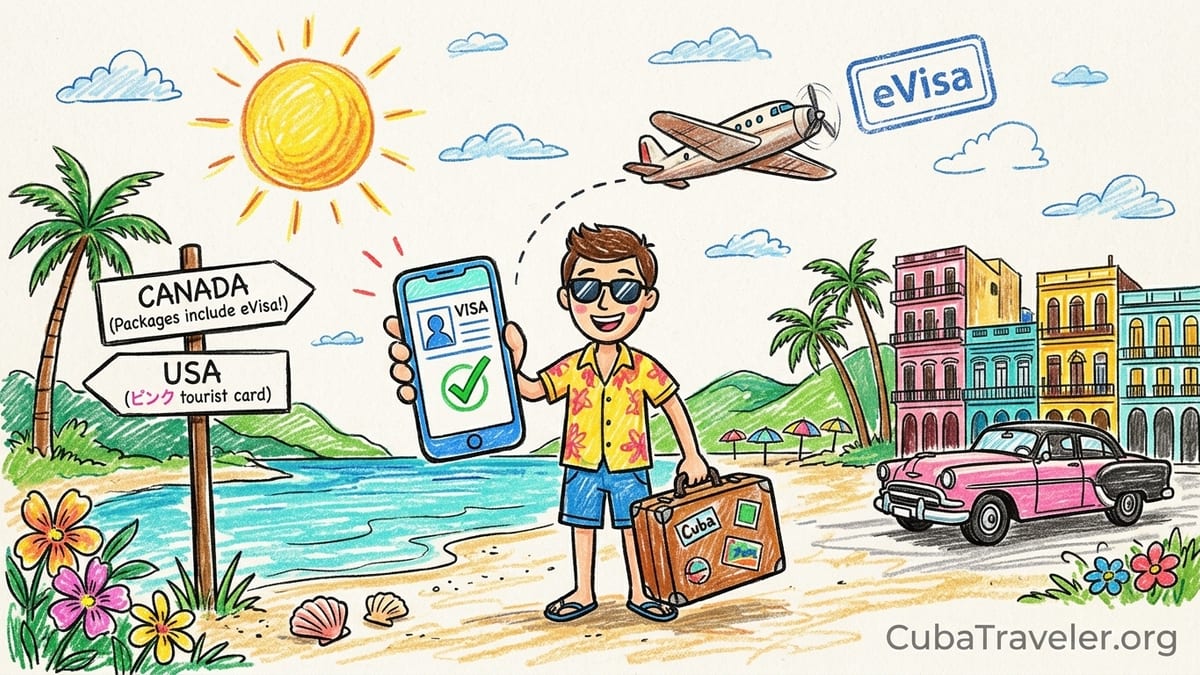
How Cuba’s eVisa and Tourist Authorizations Work in 2026
Cuba requires almost all visitors to hold a tourist authorization, still widely called a tourist card or visa, for entry. Official Cuban tourism guidance confirms that this authorization is compulsory for non-resident visitors and is valid for a single entry, usually for up to 90 days for many nationalities, with the possibility of extending once in-country. It can be obtained through Cuban consulates, travel agencies, airlines and, for most nationalities outside the United States, through Cuba’s official eVisa portal. The shift from the familiar green or pink paper card to an electronic format has been gradual, but by 2026 Cuban tourism promotion materials emphasize the eVisa as the standard way to obtain authorization before travel rather than at a counter on arrival.
The eVisa is not a universal, borderless authorization like a Schengen visa. It is tied to your passport details and checked by airlines before boarding. In practice, many travelers still experience it as part of a package: for example, a Canadian holidaymaker on a winter charter to Varadero may find that the airline or tour operator arranges the authorization automatically. Others, such as independent travelers flying Madrid to Havana on a point-to-point ticket, are prompted to apply online in advance and enter their eVisa number into Cuba’s D’Viajeros pre-arrival form. In every case, the airline functions as Cuba’s first line of control and will usually deny boarding if its system does not show an acceptable visa or tourist card.
Importantly, the Cuban eVisa is separate from health and customs declarations. Since 2023 Cuba has required arriving passengers to complete the D’Viajeros form online before travel and present a QR code at check-in or at the airport in Cuba. Airlines including legacy carriers and charters have integrated checks for this QR code into their boarding procedures, sometimes at bag drop rather than at the gate. Travelers who arrive at Havana or Varadero without the code are usually directed to airport kiosks, but this can cause delays and occasionally missed connections on onward domestic flights.
Another key point for planning is that payment methods in Cuba changed in mid 2026. Advisory notices from both Global Affairs Canada and Mexico’s foreign ministry report that Cuban financial institutions stopped processing Visa and Mastercard issued abroad as of June 6, 2026. That decision affects how travelers pay for eVisa services that are processed in Cuba, as some portals and consular services rely on local banking rails. Many travelers now purchase their Cuban eVisa through intermediaries based in Europe or North America that can accept payment cards, even though the authorization itself is ultimately issued by Cuban authorities.
Departing Directly From Canada: Packages, Charters and the Shift to eVisas
For years, flying to Cuba from Canada usually meant that the tourist card was silently bundled into a package holiday. The Canadian government’s official travel advice for Cuba still notes that the tourist visa is generally included in vacation packages or direct flights sold by Canadian tour operators. In practice, airlines like Air Transat, Sunwing and WestJet historically handed out green cards on board charter flights to Varadero, Cayo Coco and Holguín, which passengers filled out in pen before landing. That image lingers in many Canadians’ minds, even though Cuba’s migration system has largely moved on from that paper era.
Two changes since 2025 matter for Canadian departures. First, Cuban tourism material and tour operator briefings now state that Cuba uses an electronic visa system instead of paper tourist cards, with eVisa numbers feeding directly into the D’Viajeros form. Some Canadian-focused agencies that market Cuba, as well as recent traveler reports, describe purchasing the eVisa through online agents, receiving a PDF or confirmation email, then using that reference to complete pre-arrival formalities. Second, as of mid 2026, direct air connectivity between Canada and Cuba has been disrupted. Air Canada officially postponed resumption of its Cuba service in June 2026, while Canadian consumer outlets have reported that multiple airlines have paused flights amid safety and consular concerns. That means that although the rule about package-included authorizations still exists on paper, far fewer Canadians are actually boarding non-stop flights from Canadian cities to Cuban beach resorts.
Where direct flights do operate, especially seasonal charters in winter, tour operators typically still embed the eVisa cost in the overall package. A traveler might book a one-week all-inclusive in Varadero through a Canadian tour brand, see a line item called “Cuba visa/eVisa” or nothing at all, and simply receive an email before departure with an authorization number. At the airport, check-in staff verify the eVisa electronically and may ask the passenger to confirm completion of the D’Viajeros form. This model is most common on flights that are marketed and sold primarily to Canadians, where airlines can standardize procedures and pass through the Cuban fee as part of a package price.
However, more Canadians now reach Cuba via third countries, which fundamentally changes how visas are obtained. A Canadian traveler flying Toronto to Mexico City on one airline and Mexico City to Havana on another cannot rely on a Canadian charter to supply the authorization. They usually need to apply for the Cuban eVisa themselves through an approved provider, or purchase it through the airline operating the final leg. In this case, the rules of the departure country on the last segment, not those of Canada, control what airlines expect to see. That might mean buying an eVisa through a Mexican-based agency at a higher price than an online eVisa issued under a Canadian package deal.
Flying From Europe: Madrid, Paris, Frankfurt, Rome and Other Gateways
European departures to Cuba in late 2026 are concentrated on a handful of gateways. Madrid and Paris remain the most significant, with scheduled flights to Havana operated by European carriers such as Iberia and Air France and, at times, by Cuban airline Cubana de Aviación when aircraft are available. Frankfurt and Rome see less frequent but still relevant seasonal or charter services to Havana or Varadero, often aimed at package tourists from Germany and Italy. Capacity has fluctuated in response to demand and aircraft availability, but searches of autumn 2026 schedules show that non-stop services from Spain and France continue, while some secondary European routes have been consolidated or converted to charter-only operations.
From a visa perspective, European travelers benefit from Cuba’s global eVisa portal, which can be used from most countries except the United States. Official Cuban consular pages in Spanish state clearly that the tourist visa can be requested in person at consulates, at travel agencies, or via the internet from anywhere in the world except from the United States, through the national eVisa platform. Nationality, not residency, determines whether a traveler actually needs the visa; but the method of obtaining it often hinges on the airline or tour organizer. A Spanish tourist on a package holiday from Madrid to Varadero may find that the tour company collects passport details and secures a bulk batch of eVisas, whereas an independent German traveler booking Frankfurt to Havana on a stand-alone ticket is expected to apply for the eVisa and bring proof before check-in.
European long-haul airlines typically treat the Cuban eVisa as they would an electronic visa for Australia or an ESTA for the United States. During online check-in, the system may prompt passengers on routes such as Paris–Havana or Madrid–Havana to enter a visa number. At the airport, staff verify that this number matches the passport and that the passenger has completed the D’Viajeros form. Travelers who arrive at check-in without an eVisa are sometimes directed to on-site visa desks operated by partner agencies, but these services are not guaranteed. In recent years, some airports have withdrawn walk-up Cuba visa counters, forcing unprepared passengers to rebook flights while they seek authorization online.
Routing through other Schengen hubs adds another layer. For example, a traveler departing from Rome but flying Rome–Paris–Havana on Air France is processed according to French procedures for the final leg. The same applies for a German traveler who flies Berlin–Madrid–Havana: Iberia staff in Madrid check the Cuban visa irrespective of where the trip began. Airside transit within the Schengen Area does not affect Cuban requirements, because Cuba focuses on the port of embarkation for the last flight segment into Cuban territory. What matters is which airline is delivering you to Havana, Varadero, Holguín or Santiago, and how that airline has integrated the eVisa into its systems.
Departing From the United States: OFAC Rules and Cuban Entry Requirements
Departing from the United States to Cuba in 2026 involves two distinct layers of regulation. First, like everyone else, travelers must satisfy Cuban entry rules, which means holding an appropriate tourist authorization or visa and a completed D’Viajeros form. Second, anyone subject to U.S. jurisdiction, including U.S. citizens, U.S. residents and many non-U.S. travelers who depart directly from U.S. airports, must comply with the U.S. Treasury’s Cuban Assets Control Regulations administered by the Office of Foreign Assets Control, or OFAC. Airlines operating Cuba flights from U.S. cities therefore balance Cuban entry checks with U.S. sanctions compliance procedures at booking and check-in.
On the Cuban side, there is a specific requirement in force as of June 2026 that travelers on direct flights from the United States must carry a Cuban visa issued in the United States. Airline and visa-service guidance explains that this requirement comes from the Cuban government and is enforced at U.S. departure airports. In practical terms, this means that travelers flying, for example, Miami–Havana, New York–Havana or Houston–Havana cannot use an eVisa purchased through Cuba’s main online portal from abroad; instead they must obtain a U.S.-issued Cuban visa, often still colloquially called the “pink tourist card,” through the airline or a designated provider. Typical prices advertised by U.S.-based intermediaries in 2025 and 2026 have ranged from roughly 80 to 120 U.S. dollars, often including processing and courier fees.
OFAC regulations sit above these Cuban entry rules. Under current guidance, travel-related transactions involving Cuba are permitted for people subject to U.S. jurisdiction only if they fall within one of a limited set of authorized categories, such as family visits, educational activities, religious activities, journalistic work, humanitarian projects, or the commonly cited “support for the Cuban people.” OFAC’s own Cuba FAQ explains that these authorizations function as general licenses, which means travelers who genuinely fit within a category do not need to apply for an individual license but must keep records that demonstrate compliance. Airlines are required to collect a “reason for travel” attestation, as illustrated by American Airlines’ Cuba travel instructions where a reason code is mandatory for all itineraries touching Cuba.
The crucial nuance is that airline acceptance is not proof of OFAC compliance. A traveler who buys a Miami–Havana ticket, purchases the required Cuban visa at the airport counter and declares “support for the Cuban people” on an airline form can usually board if their documents meet airline and Cuban government requirements. But OFAC makes clear that each person subject to U.S. jurisdiction is responsible for ensuring their activities fit within an authorized category and for keeping documentation. If a traveler uses a tourist-style beach vacation as a cover for a declared category, that may still violate U.S. sanctions, even though the airline carried them and Cuba admitted them. This distinction matters later, because misrepresenting Cuba travel or sanctions compliance can have consequences for U.S. immigration applications, banking relationships and other interactions with federal authorities.
Travelers should also be aware that OFAC has continued to adjust the scope of its general licenses. A Federal Register notice in 2026 confirmed, for example, that authorization for travel to attend most professional meetings or conferences in Cuba under a general license was removed, with future conference travel requiring case-by-case licenses in many instances. While this change affects a narrower slice of travelers, it shows that relying on outdated blog posts or anecdotes from trips taken years earlier can lead to serious misunderstandings. Before booking a flight from the United States to Havana, Holguín or Santiago, travelers should check the latest OFAC Cuba sanctions page and, if needed, consult a qualified legal professional for personalized advice.
Transit Through Mexico City, Cancún, Panama City and Other Regional Hubs
Many travelers now reach Cuba by connecting through third-country hubs such as Mexico City (MEX), Cancún (CUN) and Panama City (PTY). These routes are especially relevant for Canadians facing reduced direct service, for Europeans flying on competitive fares via Mexico, and for some U.S.-based travelers who seek to avoid direct Cuba departures, although the latter must still consider OFAC rules. Understanding the difference between airside transit and entering the transit country is crucial for both visa planning and practical logistics.
In a true airside transit, a traveler lands in Mexico City on one international flight and remains in the secure international zone until boarding a connecting flight to Havana. They do not go through Mexican immigration and therefore are not considered to have “entered” Mexico from a visa perspective. Mexico does not issue a separate transit visa for most nationalities arriving from visa-free origins such as Canada, the EU or the UK when they remain airside. However, if the itinerary involves separate tickets, an overnight layover, or baggage that needs to be re-checked with a different airline, the traveler may be forced to clear Mexican immigration, in which case Mexico’s own entry rules apply. Travelers from countries that require a Mexican visa or who rely on an existing U.S. visa or Canadian eTA for entry should verify current Mexican policy before booking complex connections.
With regard to Cuba’s eVisa, what matters is the final leg to Cuba and how the airline that operates that leg handles documentation. For example, a European traveler flying Frankfurt–Cancún–Havana with a Mexican or European carrier will usually be expected to have a Cuban eVisa in hand before boarding in Frankfurt or Cancún. Some Mexican airlines allow purchase of a Cuban tourist authorization as an add-on during booking or at a specialized desk in terminals at Mexico City or Cancún, but availability can vary by day and by cabin load. Travelers who assume they can always “just buy it at the airport” sometimes discover that desks are closed or automated systems are offline, forcing them either to miss flights or scramble to buy an eVisa on a mobile device using a foreign payment processor.
Panama City’s Tocumen Airport has become a major connecting point for Cuba-bound travelers from South America and, at times, from North America and Europe. Passengers flying via Panama on carriers like Copa typically have their Cuban documentation checked at the origin airport, even if that origin is as far away as Buenos Aires or Montreal, because the reservation system flags Havana or Holguín as the final destination. For airside transit passengers, Panama does not impose additional Cuban-specific requirements. However, as with Mexico, any need to clear immigration or re-check baggage converts a pure transit into an actual visit, subjecting the traveler to Panamanian entry rules and potential airline change fees.
U.S. transit deserves separate attention. A traveler flying, say, Madrid–Miami–Havana or Toronto–Houston–Havana must be admitted to the United States, clear immigration, and then board a Cuba-bound flight under U.S. jurisdiction. Even if the traveler is not a U.S. citizen, their Cuba segment is governed by OFAC rules and by the Cuban requirement for a U.S.-issued visa. Additionally, transiting through the United States can affect future ESTA eligibility under the Visa Waiver Program. U.S. guidance for ESTA has long warned that past travel to certain countries, including Cuba, can make a traveler ineligible for ESTA and force them to apply for a full B1/B2 visa instead. Many European and other travelers report that declaring Cuba trips on ESTA applications results in denials, with consular interviews required for future U.S. visits. Choosing a route that touches U.S. soil can therefore have long-term consequences that far outlast a single Cuba holiday.
Arriving at Havana, Varadero, Holguín and Santiago: What Happens on the Ground
Cuba’s main international gateways in late 2026 are Havana’s José Martí International Airport, Varadero’s Juan Gualberto Gómez Airport, Holguín’s Frank País Airport and Santiago de Cuba’s Antonio Maceo Airport. Terminal usage has shifted over time as renovation projects and traffic patterns change, but recent airline timetables and traveler reports confirm that international flights continue to concentrate at Havana and Varadero, with Holguín and Santiago handling a mix of regional and seasonal services. Regardless of the airport, the basic arrival sequence is similar: document control, health and customs questions, baggage claim and finally ground transportation.
At document control, border officers scan passports and verify that an appropriate visa or tourist authorization has been issued. Since the rollout of the eVisa system, this check increasingly involves a quick database query against the passenger’s passport number rather than collecting physical cards. Some passengers, especially those whose authorizations were handled through tour operators, may still be asked to show a printed eVisa confirmation email or QR code. If the D’Viajeros form was correctly completed before travel, officers can see the submitted information via the QR code presented at check-in, which reduces the need to collect paper health or customs declarations upon arrival.
Practical experiences differ slightly by airport. Havana typically sees the largest variety of airlines and independent travelers, so immigration queues can be longer and procedures stricter, especially at peak evening arrival banks from Europe and Latin America. Varadero, oriented heavily toward all-inclusive beach tourists, often streamlines arrivals for charter flights, with tour reps guiding passengers toward buses immediately after customs. Holguín and Santiago can feel quieter, but their smaller size also means fewer staff and less redundancy when systems slow down. Recent travelers describe situations where a single malfunctioning passport scanner significantly delayed arrivals at smaller airports, underlining the value of having printed backups of eVisa confirmations even in an electronic era.
Once admitted, visitors are free to travel domestically within Cuba without obtaining a new visa merely because they change cities. A traveler might land in Varadero on a package flight, spend a few days on the beach, then take a domestic flight or bus to Havana for independent exploration. As long as they remain within the authorized stay period of their original tourist visa and comply with registration rules for private guesthouses, there is no requirement to apply for another Cuban visa. Extensions of stay are handled at local immigration offices inside Cuba and are based on the initial authorization, not on the number of internal movements between provinces.
Special Case: Maritime Arrivals and Why They Are Treated Differently
Most visitors still arrive in Cuba by air, but cruise and private yacht traffic has fluctuated, particularly in response to U.S. sanctions on cruise operators and to Cuba’s own health measures. The Cuban eVisa portal addresses maritime arrivals explicitly and instructs travelers who intend to enter the country by sea to contact a Cuban consular office before submitting an online application. This distinction matters because port calls, yacht moorings and other maritime entries sometimes fall under different immigration categories than standard air tourism.
For example, a European traveler planning to join a sailing trip that departs Cancún, stops at several Caribbean islands and then visits a Cuban marina cannot assume that a standard tourist eVisa will be appropriate. Instead, they are directed to contact a Cuban consulate or embassy, which can advise whether they require a special visa type, a cruise passenger manifest authorization, or some combination of both. Cruise passengers on large ships often have their immigration clearance handled collectively through ship manifests rather than through individual eVisas, although they must still carry valid passports and comply with any U.S. or home-country restrictions on Cuba travel.
From a compliance perspective, maritime arrivals intersect with U.S. regulations in complex ways. U.S.-based cruise lines have in the past halted Cuban ports of call in response to tightened sanctions, while non-U.S. flag ships have sometimes continued limited service. Travelers subject to U.S. jurisdiction who choose to embark on foreign cruises that call in Cuba must still ensure that any time and money spent on the island fits within an authorized OFAC category. Since cruise itineraries are often heavily structured, some travelers find it harder to design a “support for the Cuban people” program that satisfies guidance, as large ships may steer passengers toward state-affiliated excursions rather than privately run activities.
Because maritime cases involve more variables than standard air arrivals, this article focuses mainly on flights. The key takeaway is that if you intend to arrive in Cuba by sea, you should not rely on general air-travel eVisa advice. Instead, you should consult a Cuban consulate, your cruise line or yacht operator, and, if under U.S. jurisdiction, review OFAC guidance or seek specialized legal advice before making non-refundable payments.
Airline Document Checks, Route Scenarios and Handling Disruptions
On most routes in late 2026, airlines check Cuban travel documents in three stages: during booking, at online check-in and at the airport. At booking, some carriers serving Cuba display pop-up warnings explaining that passengers are responsible for holding a valid Cuban visa or eVisa and, for flights from the United States, for meeting OFAC requirements. U.S. carriers that operate Cuba flights embed a mandatory “reason for travel” step into the booking flow, matching OFAC categories, and may refuse leisure bookings that do not fit any recognized authorization.
Online check-in is frequently where eVisa numbers and D’Viajeros QR codes are first requested. Travelers departing from Madrid on an Iberia flight to Havana, for instance, may see fields prompting entry of visa and health declaration references before a boarding pass can be issued. Those unable to enter details online are typically flagged in the system so that airport staff know to verify documents manually. At the airport, desks for particular airlines or partner visa agencies sometimes handle last-minute Cuban visa issuance, especially for U.S.-originating travelers buying the required pink tourist cards. Boarding gate staff usually run a final document inspection, focusing on passports with adequate validity, matching names on visas and D’Viajeros forms, and, on U.S. flights, completed OFAC attestation forms.
Different route scenarios illustrate how this plays out in practice. A Canadian flying Montreal–Cancún–Havana on separate low-cost carriers must secure a Cuban eVisa from an authorized seller before leaving Canada, because neither airline is likely to provide a bundled visa service. They will show this eVisa at check-in in Montreal and again in Cancún if they re-check bags. A Spanish couple flying Madrid–Havana on a holiday charter might have a much smoother experience, as the tour operator handles visas collectively and provides clear instructions about D’Viajeros and insurance coverage. A U.S. citizen living in New York who flies New York–Mexico City–Havana on one ticket with a Mexican carrier still faces OFAC obligations and cannot bypass Cuban rules simply by connecting abroad; the Mexican airline will verify that they hold a valid Cuban eVisa or tourist card, and the traveler remains responsible for ensuring their trip fits an authorized category.
When flights are canceled or significantly delayed after a traveler has already obtained a Cuban eVisa and completed D’Viajeros, most problems relate to timing rather than basic validity. The tourist authorization itself is usually tied to a date window and a single entry, not to a particular flight number, so it commonly remains valid if the traveler is rebooked within a reasonable period. The D’Viajeros form, by contrast, is usually associated with specific arrival details and may need to be resubmitted if the travel date or flight changes. Airlines generally rebook passengers onto later flights to Cuba or offer refunds according to their general conditions of carriage, but they do not automatically reimburse the cost of Cuban visas or eVisas that were bought from third-party providers.
In practical terms, a traveler whose Madrid–Havana flight is canceled after they have already paid for an eVisa should first work with the airline to secure a new departure date within the visa’s validity window. If rebooking pushes travel beyond that window, they may need to apply for a new eVisa, potentially at additional cost. Travelers who had completed D’Viajeros for the original flight should log into the portal, check whether they can edit the existing submission, and, if not, submit a fresh form for the new date. Keeping digital copies of all receipts, visa confirmations and OFAC-related attestations can also help in seeking goodwill compensation from airlines or travel insurers, although neither is guaranteed to cover visa costs.
The Takeaway
Flying to Cuba with an eVisa in late 2026 is shaped as much by where you start and which airline you use as by your nationality. Canadians on remaining direct or charter flights often still encounter package-style arrangements where the tourist authorization is included, while those traveling through third countries like Mexico must obtain eVisas independently. Europeans departing Madrid, Paris, Frankfurt or Rome typically rely on Cuba’s official eVisa system or on consular visas arranged through tour operators, with the final carrier into Havana, Varadero, Holguín or Santiago acting as the decisive gatekeeper.
Departures from the United States add the extra layer of OFAC compliance. Cuba expects the appropriate visa or tourist card, now often in electronic form, and in many cases requires that this authorization be issued in the United States for direct flights. At the same time, U.S. travelers and others subject to U.S. jurisdiction must ensure that their activities in Cuba fall under one of the limited authorized categories of travel. Airline acceptance and Cuban entry do not equal U.S. legal compliance, and past Cuba travel can complicate future ESTA eligibility.
Connections through Mexico City, Cancún, Panama City and other hubs make it easier to reach Cuba from regions with limited direct service, but they also introduce extra points where documentation is checked and where misunderstandings about airside transit versus formal entry can cause missed flights. Domestic travel inside Cuba itself is straightforward once admitted; changing cities does not require a new visa. Maritime arrivals remain a special case that calls for direct consular guidance.
For most travelers, the safest route is to treat the Cuban eVisa and related paperwork with the same seriousness as visas for more regulated destinations, verify current airline and OFAC requirements before purchasing non-refundable tickets, and keep meticulous digital records. Doing so reduces the risk of being turned away at check-in, stranded during a disruption or facing unpleasant questions about sanctions compliance years after a Caribbean holiday has ended.
FAQ
Q1. Do I still need a tourist card if Cuba now uses an eVisa system?
You still need a tourist authorization to enter Cuba, but it is increasingly issued as an eVisa rather than a paper card. Airlines and border officers treat a valid eVisa as equivalent to the old tourist card for eligibility to board and enter.
Q2. As a Canadian, is my Cuban tourist authorization always included in my ticket?
Not always. On some remaining direct or charter flights from Canada, tour operators bundle the authorization into the package. If you travel via a third country like Mexico or book independent tickets, you will usually need to obtain the eVisa yourself.
Q3. How do European travelers flying from Madrid or Paris get the Cuban eVisa?
Most European travelers either apply online through Cuba’s official eVisa portal from outside the United States or obtain the visa through a tour operator. Airlines then verify the eVisa number at online check-in or at the airport before allowing boarding.
Q4. Why is departing from the United States to Cuba treated differently?
Direct departures from the United States are subject to both Cuban entry rules and U.S. sanctions. Cuba currently requires a Cuban visa issued in the United States for these flights, and people under U.S. jurisdiction must also ensure their trip fits into an authorized OFAC travel category.
Q5. Does buying a ticket and getting on the plane mean I comply with OFAC rules?
No. Airline acceptance only shows that the carrier believes your paperwork is sufficient to fly. OFAC places responsibility on each traveler to make sure their Cuba trip fits a legal category and to keep supporting records.
Q6. Can I just buy my Cuban visa during transit in Mexico City or Cancún?
Sometimes, but not reliably. Some airports and airlines offer on-site Cuban visa services, but desks can be closed or systems offline. It is safer to secure your eVisa before leaving your origin country, especially when traveling on separate tickets.
Q7. Will visiting Cuba affect my ability to use ESTA for future trips to the United States?
It may. U.S. guidance warns that travel to certain countries, including Cuba, can make travelers ineligible for ESTA. Many visitors who have been to Cuba later find they must apply for a full U.S. visa instead of using visa-free travel.
Q8. Do I need a new visa if I land in Varadero and then travel to Havana or Holguín?
No. Once admitted, you can move around Cuba, including taking domestic flights or buses to other cities, without obtaining a new visa, as long as you respect the validity period of your original authorization.
Q9. What happens to my eVisa and D’Viajeros form if my flight to Cuba is canceled?
Usually the eVisa remains valid for a window of time and can be used on a rebooked flight within that period. You may need to submit a new D’Viajeros form if your travel date or flight details change significantly.
Q10. I plan to arrive in Cuba by yacht. Can I use the same eVisa as air travelers?
Not necessarily. The official eVisa portal instructs travelers arriving by sea to contact a Cuban consulate before applying, as maritime entries may require different visa arrangements or approvals than standard tourist eVisas used for flights.