


I booked my next Cuba trip for Thursday, 18 March 2027, landing in Havana from Miami on an early afternoon American Airlines flight. I hit “submit” on my new Cuban tourist eVisa application on the evening of 15 January 2027, exactly 62 days before departure. That gap was not an accident. To work out the safest timing, I spent weeks cross-checking the official eVisa portal, consular calendars, and real traveler reports. What I found was that the "best" time to apply has surprisingly little to do with Cuba’s weather, and almost everything to do with which consular office handles your case, how you pay, local bank and public holidays, the legal validity of the visa itself, and the very tight window for the separate D’Viajeros form you must complete just before you fly.
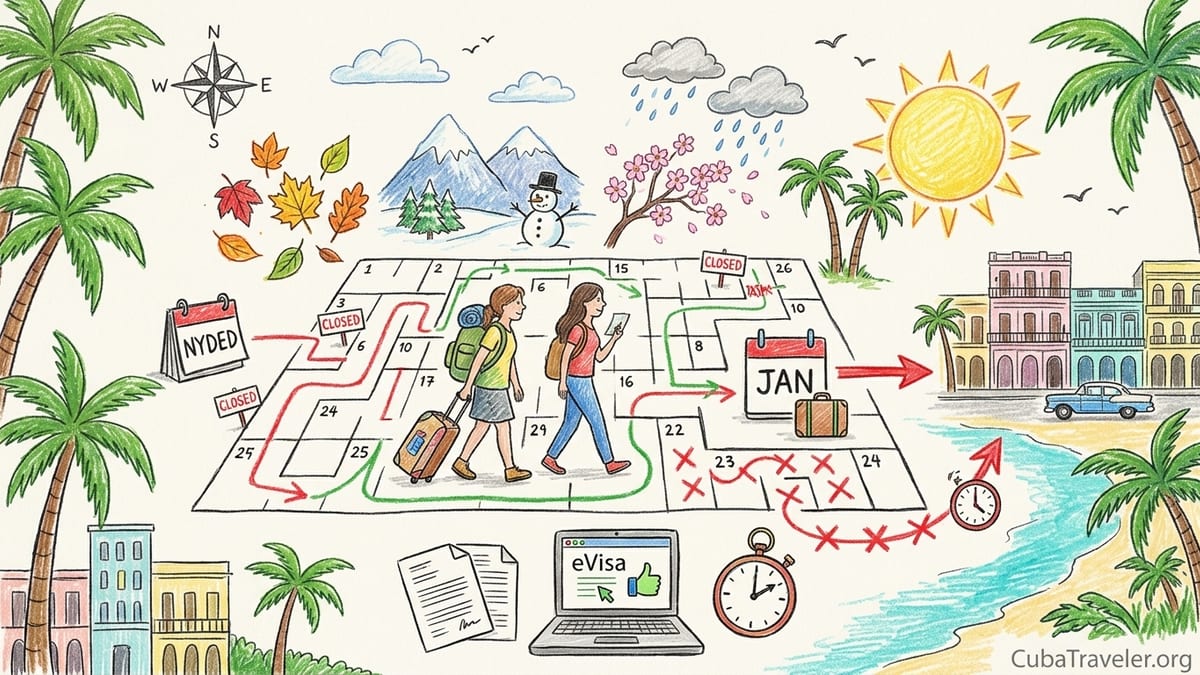
Why “Best Time to Apply” Is Not About Seasons
When I first started planning this trip, I automatically thought in travel-writer clichés: avoid July because of crowds, apply early for Christmas because “everyone” goes then, and choose a shoulder month like May for faster approvals. Once I dug into the Cuban regulations and the new eVisa-Cuba portal, that logic fell apart. Nothing in the rules suggests that January, July, or December is inherently easier for approvals. What actually matters is whether your application lands on the desk of a consular office that is open, staffed, and able to reconcile your payment and documents without interruption.
The official eVisa portal advertises that applicants “receive a response within the next 72 business hours.” In practice, this is a service target, not a guaranteed deadline. Weekends, local holidays in both Cuba and your own country, and even bank transfer cut-off times can stretch those 72 hours into a full week or longer. In my own case, I chose mid-January precisely to avoid long holiday closures on either side, and to give myself a generous buffer if something needed to be corrected.
The other surprise was that Cuba’s new rules separate three different clocks: the time it takes to process the eVisa, the legal period in which you are allowed to use that eVisa to enter after it is granted, and the length of stay you are given on each visit. Overlay on top of that a separate last-minute requirement, the D’Viajeros form, which you can only complete shortly before departure, and you get a planning puzzle that has almost nothing to do with whether you are going in January or July.
Once I began thinking in terms of working days, banking cut-offs, and legal validity, not sunshine and crowds, a far clearer picture emerged of when it is genuinely wise to apply and when you are simply gambling on luck.
My Timeline: Departure Date, Application Day and What Happened
For this investigation, I built a real itinerary rather than a hypothetical one. I picked 18 March 2027 as my departure date because it falls outside Christmas and New Year, avoids Easter weekend, and still sits comfortably in the high season for many European and Canadian travelers. I submitted the eVisa application on 15 January 2027, a Monday evening, from my home in the United States. I paid using a card-based online payment method instead of an international bank transfer specifically to remove at least one source of delay.
That 62-day gap between application and departure meant I was asking the system to do something very modest: approve a single-entry tourist visit long before I wanted to board my plane. I was not testing last-minute limits. Instead, I wanted to see whether applying this early created any hidden problems with the future validity of the visa, especially given Cuba’s legal changes that take effect on 1 November 2026.
Internally, I plotted my expectations in three layers. First, the portal’s own promise of a response within 72 business hours, which would theoretically put my decision sometime before the following Thursday if everything went smoothly. Second, a more realistic window of up to two weeks, which assumed that “business hours” might collide with local holidays in Cuba or my own bank’s processing delays. Third, a worst-case scenario where an error in my documentation required a resubmission and pushed me into February.
By anchoring everything to a specific flight and date, I could then walk through how the timing would look if I had chosen to travel at Easter, in July and August, or at Christmas and New Year, and whether those peak periods change the math in a meaningful way.
What Actually Drives Processing Time: Offices, Payments and Holidays
The strongest pattern I saw was not seasonal at all. It was structural. First, your “consular office” for eVisa purposes may not be the same as the physical Cuban consulate you would use for an in-person tourist card. The eVisa portal centralizes intake but then routes applications for background checks and approval. Crucially, those back-end offices still respect Cuban public holidays and weekends, and they also depend on your payment being confirmed in the system before the 72-business-hour countdown really starts.
If you pay by international bank transfer, every public holiday in your own country can become a processing speed bump. For example, if you sent a transfer from a European bank on Maundy Thursday, the funds might not land until after Easter Monday, even if the Cuban side is open. The same is true around U.S. holidays if you are wiring money from an American account. This means your effective clock might start days later than when you hit “submit” online.
Then there are the Cuban holidays themselves: 1 January (Triumph of the Revolution), 1 May (International Workers’ Day), 25, 26 and 27 July (National Rebellion Day period), and the late-December public holidays. If your 72-business-hour period touches any of those dates, the window automatically stretches. For instance, an application filed on 30 December, paid by bank transfer, might see no movement until after 2 January at the earliest. That is not a backlog in the sense of seasonal overload. It is simply fewer working days in the calendar.
The last structural factor is document accuracy. If the consular officer has to email you because your passport number does not match the uploaded scan, your travel dates look inconsistent with your ticket, or your accommodation details are incomplete, the case stops until you respond. In peak travel months like January to March and July to August, officers may have less flexibility to chase partial applications quickly, but there is no clear evidence of automatic slowdowns based purely on the month of travel. Cases that are complete and paid for tend to move, while incomplete ones tend to sit.
January–March, Easter, Summer and December: Comparing By Working Days
To see if high-season travel dates changed the risk, I ran my March 2027 itinerary through four different “what if” scenarios: applying for a trip in January to March, over Easter, in July or August, and between mid-December and New Year. Instead of assuming “busy months = slow visas,” I counted the working days available between a hypothetical application date and departure, adjusted for bank and consular closures.
For a January trip, say a departure around 15 January, an application filed on 15 December runs into a cluster of holidays at the end of the year. If your payment is a bank transfer initiated around 20 December, you might lose several days to Christmas and year-end banking slowdowns in your own country. On the Cuban side, 1 January is a public holiday. The real risk here is not a mystical “high-season backlog,” but the fact that you might, without noticing, compress your working-window down to one or two real business days before you fly.
Easter is a different kind of trap. Cuba does not always treat Good Friday as a full public holiday in the same way many European countries do, but your own banks and employers almost certainly will. If your employer only wires funds on certain days, or you are counting on a Friday transfer from a North American bank when several countries are closed for Easter, the lag can be several calendar days. A traveler aiming for an early April flight who applies in mid-March with a bank transfer may find that the 72-business-hour target quietly stretches to a week simply because of how the weeks fall.
July and August are often imagined as chaotic for travel offices, yet when I checked consular calendars and airline patterns, there was little concrete evidence of systematic slowdowns for Cuba visas in those months. The bigger issue is the National Rebellion Day period around 25 to 27 July. Depending on the year, the Cuban government may declare adjacent days non-working. That effectively removes a block of working days from the visa timeline. A last-minute application tied to a late July departure is therefore riskier than one tied to mid-June, but again for reasons of closed offices, not because “everyone applies in July.”
December and New Year combine the worst features of all the above. Western banks can become very slow between Christmas and early January, Cuban offices close around 1 January, and airlines are full. In this period, flight changes are common due to storms, overbooking and tight connections. If your eVisa is still pending when your departure is moved forward or backward, you may find yourself trying to change not just flights but all your entry documentation right when offices are least responsive. That is the main reason I treat December and early January departures as deserving extra buffer, even though the law itself does not penalize you for traveling then.
Why You Can Secure the eVisa Early but Must Save D’Viajeros for Later
One constant in my research was that two very different systems now shape a typical tourist’s arrival in Cuba: the eVisa itself and the D’Viajeros digital entry form. The eVisa deals with your permission to enter, the type of stay and maximum duration. D’Viajeros is more like a combined arrival card, health questionnaire and customs declaration. Crucially, they do not run on the same timeline.
The eVisa, once approved, can generally be issued long before you travel, and under the new legal regime that takes full effect on 1 November 2026, Article 191 gives a one-year period in which you can use that visa to enter after it is granted. That “use period” is independent of how long you may stay once admitted as a tourist. In practice, that means you could apply several months early, receive the eVisa in, say, January 2027, and still use it for an entry in October 2027, as long as your stay itself falls within the allowed tourist duration printed on the visa.
D’Viajeros is almost the opposite. Official and consular notices describe it as an online form that can only be completed close to your arrival. Some guidance from European missions and tour operators mentions a window of 48 hours before the flight, while others allow up to seven days. The common denominator is that you cannot complete it months in advance, because it has to match your actual flight number, arrival date and accommodation in Cuba. Airlines and cruise operators often treat the D’Viajeros QR code as boarding documentation, checking it at the gate in Miami, Madrid or Toronto.
In my own March 2027 planning, I treated the eVisa as something to lock in early, before I bought nonrefundable internal flights in Cuba or prepaid accommodation. D’Viajeros sat in my calendar as a separate task: complete it once my airline had locked my final schedule, roughly two days before departure. The longer I looked at real cases shared by travelers, the more it became obvious that these two pieces of the puzzle serve different risk profiles. Missing or mistiming the eVisa can prevent you from boarding at all, while a D’Viajeros error is more likely to cause stress at check-in or immigration, not a total collapse of the trip.
Understanding that distinction also explains why some tour operators tell their clients to finalize D’Viajeros in the last 48 hours, even if the system itself opens a few days earlier. They want the form to reflect the ticket you are actually flying on, after any last-minute aircraft swaps or schedule tweaks.
The November 1, 2026 Transition: Article 191’s One-Year Use Period
The legal reforms that culminate on 1 November 2026 add a layer of long-term planning for anyone who likes to arrange visas well in advance. Article 191 of Cuba’s updated migration regulation gives tourist eVisas a one-year period of use from the date they take legal effect in your individual case. Put simply, once your tourist eVisa is granted under the new rules, you generally have twelve months to use it for an entry into Cuba, unless your specific visa states a shorter use period.
It is essential to distinguish this from the length of stay. The eVisa’s use period answers the question “By what date must I arrive in Cuba at the latest?” The stay period answers “How long may I remain once I am admitted?” Many standard tourist entries are capped at around 90 days, sometimes with the possibility of one extension in-country for another period of up to 90 days. You could therefore be issued an eVisa in December 2026, use it to enter in October 2027, and still receive the full allowed stay for that category, even though you are nearly at the end of the one-year use period.
This matters directly for application timing. Before November 2026, some travelers hesitated to apply too early because they feared the visa might expire before their trip, especially for departures many months away. Under the Article 191 framework, that anxiety may ease for simple tourist visits. A traveler who knows they want to visit Cuba at some point in the next year could apply once, in a quiet period for both their bank and the consulate, and then schedule flights later with a comfortable buffer.
My March 2027 case sits squarely inside this new logic. Applying on 15 January 2027 for a mid-March entry used only a small fraction of the potential one-year use period. If I had instead applied on 15 November 2026 for a trip that might happen “sometime in 2027,” the law would still have given me until roughly mid-November 2027 to actually cross the border, subject to whatever is printed on my individual visa sticker or eVisa approval notice. That makes applying months ahead not just safe but arguably prudent, provided your personal situation is stable.
The catch is that legal transitions themselves can produce practical hiccups. Around 1 November 2026, consular staff will be adjusting to new documentation templates and IT changes. For that reason I would avoid submitting a non-urgent application in the final days of October 2026 or the very first week of November, not because the law is worse then, but because any major system change carries a small but real risk of short delays as offices adjust.
Three Timing Strategies: Early, Mid-Range and Last-Minute
All of this theory only matters if it changes what average travelers actually do. After mapping my own March 2027 trip, I ended up seeing three realistic strategies: several months early, two to four weeks early, and last-minute within a week of departure. Each has advantages and real, not theoretical, risks.
Applying several months early, the route I chose, makes the most sense under the post–1 November 2026 regime. With a one-year use period and a reasonably stable passport, you gain flexibility. For example, a Canadian couple planning a winter break “sometime between January and March 2027” could apply together for eVisas in October 2026, while exchange rates are favorable and their local bank has no holiday closures on the horizon. Once approved, they then have a year to slot in a specific package deal from a tour operator in Toronto or Montreal without revisiting the visa question.
The principal risk of early application lies in life changes. If you renew your passport after receiving the eVisa, you may need to update or reapply because the eVisa is electronically tied to the passport number used in the application. That can sometimes be fixed by carrying both the old and new passports, but only if the Cuban authorities and your airline accept that arrangement. If you know your passport will expire or you might legally change your name, applying many months ahead may lock you into extra paperwork later.
Two to four weeks early is the default comfort zone for many travelers. It aligns well with the advertised 72-business-hour processing plus a sensible buffer, but it demands more careful attention to holidays. A European family flying from Madrid to Varadero for Easter might apply in early March with cards rather than bank transfers. That window is wide enough that, even if Good Friday shuts down their bank and airline offices, there are still multiple business weeks for any corrections. For my March 2027 Havana trip, if I had applied around 20 February instead of mid-January, I would have given myself roughly 18 to 20 working days before departure, more than enough even with the occasional closure.
Last-minute applications within seven days of travel are where the stories of stress and missed flights cluster. Although some commercial visa providers advertise urgent processing, including delivery of an eVisa code in a few minutes once payment clears, those promises sit on top of systems that still depend on human checks and office hours in Cuba. A traveler in Toronto applying for a Varadero package one week out, paying by bank transfer over a weekend, is simply asking too much of the calendar, especially around Christmas, New Year or the late July holidays. In this window, even a small typo in a passport number or an unexpected airline schedule change can derail the trip.
That does not mean last-minute eVisas never work. They often do for straightforward cases during calm periods in the calendar. But from the evidence I found, they only “work” because nothing goes wrong, not because the system is designed to support such compressed timelines. The difference between a solid plan and getting lucky is whether you build in time to fix one or two things without panicking.
What If Your Passport, Travel Dates or Airline Plans Change?
One of the most persistent anxieties I saw in forums and consular FAQs concerned what happens when something changes after you have your eVisa in hand. The three most common shifts are passport renewals, trip date changes and airline disruptions that move your flight.
On passports, the basic rule is simple in concept and messy in practice. The eVisa is tied to the passport whose details you entered when you applied. If you renew that passport before you travel, you are carrying a different number to the one in the eVisa record. Some Cuban missions state that you must obtain a new visa if your passport changes, while others accept travelers who bring both the old passport (containing the eVisa or matching details) and the new valid passport for the entry stamp. Airlines at the point of departure often have the final say, because they are fined if they carry someone who is refused at the border. For my March 2027 trip, this was a key reason I checked the expiry date of my passport before applying and confirmed that it would remain valid well past my planned stay.
Trip date moves are more nuanced. If you simply bring your trip forward or push it back within the one-year use period of the eVisa, and remain within the maximum stay allowed, you usually do not need a new visa. However, if your new dates cross a threshold such as the one-year limit or a printed validity date for use, you risk turning up at the airport with a visa that is technically out of range. Imagine a traveler who applied in early December 2026 for an April 2027 trip, then pushed the holiday back to Christmas 2027. Under Article 191’s one-year clock, the original eVisa might no longer be valid for use by the time Christmas comes around.
Airline disruption can cause subtler problems. Many D’Viajeros forms require you to specify the exact flight number and date. If a major storm in the Gulf of Mexico cancels your Sunday flight to Havana and your airline rebooks you on Monday instead, your eVisa remains valid, but your D’Viajeros form no longer matches reality. In that case, the solution is typically to complete a fresh D’Viajeros form for the new flight and to carry both, along with your eVisa approval and ticket receipts. This is yet another reason not to fill out D’Viajeros too early; the closer you are to real departure, the more accurate your information will be.
Finally, there is the uncomfortable case of a change in your eligibility. If new legal issues arise between application and travel, or if your purpose for entering Cuba shifts from tourism to something more complex such as journalism or professional activity, you may no longer fit the category under which your eVisa was granted. In that scenario, the safe course is to contact the relevant Cuban consular office or the eVisa help service and seek written clarification or reapply under the correct category, rather than hoping no one notices at the border.
Month-by-Month Planning Table and a Realistic Recommendation
After plotting my own March 2027 application and stress-testing the calendar around typical Western and Cuban holidays, I built a simple month-by-month table that focuses on timing strategy rather than weather. This is not a guarantee, but a planning guide based on working days, banking rhythms and the new one-year use period after 1 November 2026.
January: Good for travel if you applied in November or early December of the previous year. Riskier for late applications because of year-end banking delays and the 1 January Cuban holiday. I would avoid sending bank transfers for January trips after about 15 December unless you have strong confirmation from your bank on cut-off times.
February: One of the most comfortable months for both applying and traveling. Few major public holidays affect banking in either Cuba or many origin countries. Applying in December or early January for a February trip strikes a good balance between early security and flexibility if plans shift.
March and April: Still comfortable, but pay attention to Easter. For an April trip, I would aim to apply in February, especially if your bank or employer closes for a long Easter weekend. If you must apply in March, use a fast electronic payment method and avoid sending transfers in the week just before Good Friday.
May and June: Legally straightforward months with fewer big holidays. These are ideal for testing the “apply months early” strategy. If you know you want to visit in June, applying in March or April leaves you with generous correction time and still uses only a small part of the one-year validity window.
July and August: Focus on the National Rebellion Day period around 25 to 27 July. For late July departures, send your application by mid-June, giving it several weeks to clear before public offices close or slow down. For August travel, consider an application in May or June, well ahead of any family holiday rush in your own country.
September and October: Generally calm from a consular perspective, aside from the usual risk of tropical storms altering flight schedules. These months work very well for the early-application model, especially once the Article 191 regime is fully embedded after 1 November 2026. An eVisa granted in March could easily support an October trip, as long as your stay itself remains within the allowed length.
November and December: Here the November 1 transition date matters. I would avoid submitting non-urgent applications in the last week of October 2026 or the very first days of November while the system adjusts. By late November, the new rules should be well in force, making it an excellent time to apply early for trips in the first half of 2027. For Christmas and New Year travel, I would treat late September or early October as a soft deadline for eVisa applications, giving you a wide cushion around bank holidays, flight disruptions and any consular closures.
Based on my own March 2027 case and the current official information, the most realistic general recommendation is this: once the November 1, 2026 transition has passed, aim to apply for the Cuba tourist eVisa about two to three months before your intended departure, earlier if your passport situation is stable and you like to book far ahead. Treat the portal’s 72-business-hour response time as a target, not as a promise you can rely on in the same way as an airline schedule. Use faster electronic payments rather than bank transfers when timing is tight, and keep a separate reminder to complete D’Viajeros in the last few days before your actual flight, once schedules are final.
FAQ
Q1. Does applying for a Cuba tourist eVisa in low season make approval easier?
Not based on the evidence I found. Approval depends more on complete documents, successful payment, and whether your case reaches a consular office during normal working days, not on whether you are traveling in January, July or November.
Q2. How strictly should I treat the eVisa portal’s “72 business hours” processing time?
Treat it as a service goal, not a hard guarantee. Weekends, public holidays in Cuba, banking delays in your own country and document corrections can easily extend the real processing time to a week or more.
Q3. When is the safest time to apply for a Christmas or New Year trip to Cuba?
For travel in the second half of December or early January, I would aim to apply around late September or early October. That leaves ample time for payment confirmation, holiday closures and any corrections, without coming close to the one-year use limit after the November 1, 2026 legal transition.
Q4. How does Article 191’s one-year use period affect early applications?
Once your tourist eVisa is granted under the post–1 November 2026 rules, you generally have up to one year to use it for an entry. That makes it safer to apply several months before you fix exact travel dates, as long as your eventual trip falls within that one-year window and your stay obeys the separate length-of-stay rules.
Q5. Why can’t I just complete D’Viajeros at the same time as my eVisa application?
D’Viajeros requires accurate, up-to-date flight details, arrival date and accommodation information. Because those often change closer to departure, and because the system itself only opens a few days before arrival, it is designed to be done shortly before you travel, not months in advance.
Q6. What happens if I renew my passport after getting the eVisa?
Because the eVisa is linked to the passport number you used when applying, a renewal can create a mismatch. Some travelers resolve this by carrying both the old and new passports, but others have been told to reapply. The safest course is to check your passport’s expiry before applying and, if you must renew, confirm requirements with the relevant Cuban consular office in writing.
Q7. Can I move my trip dates after my eVisa has been granted?
Often yes, as long as your new entry date still falls within the one-year use period and you do not exceed the maximum allowed stay. If you push the trip beyond that use period, or beyond a specific validity date printed on your visa, you risk having to apply again.
Q8. Is it ever sensible to apply for the eVisa in the last week before departure?
It can work in simple cases, especially if you use a fast payment method and avoid holidays, but it carries substantial risk. A single typo, a bank delay or a local public holiday can easily push your approval to after your scheduled flight. I would only consider last-minute applications if you have fully flexible tickets and can tolerate the trip being postponed.
Q9. How do bank transfers affect eVisa timing compared with card payments?
Bank transfers depend heavily on cut-off times and public holidays in both your country and any intermediary banks. They can add several calendar days before your payment is recognized on the Cuban side. Card-based or online payments are usually faster and more predictable for time-sensitive applications.
Q10. What is the single most important timing step most travelers overlook?
Many people focus hard on the eVisa and forget to schedule D’Viajeros. In reality you need both. My recommendation is to apply for the eVisa two to three months before departure, then set a clear reminder to complete D’Viajeros in the last few days before your actual flight, once your airline schedule is settled.