


Cuba has quietly overhauled how visitors enter the island. The familiar paper Tarjeta de Turista, once sold at airports and by tour operators around the world, has now given way to a fully electronic tourist eVisa system. By early 2026, this digital authorization is the standard way most leisure travelers secure permission to visit Cuba, with previously issued paper tourist cards only honored through the end of 2025. If you are planning a trip for 2026, you should assume you will be using the official Cuban eVisa platform or an accredited intermediary, not buying a cardboard card at the gate.
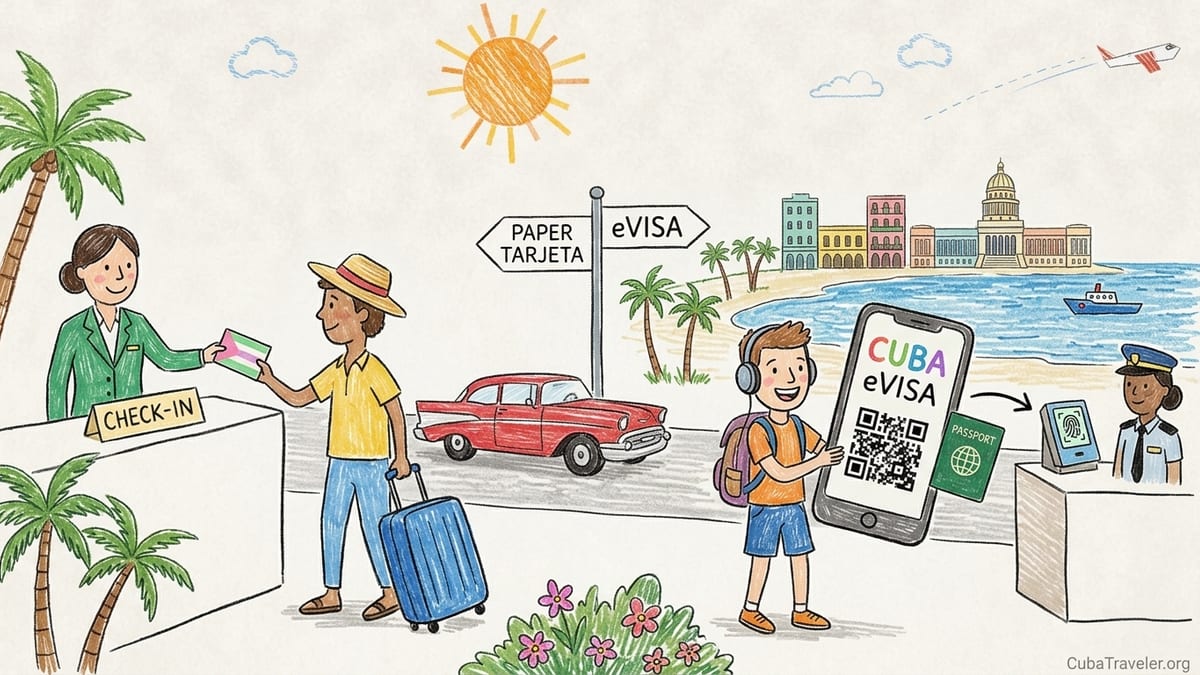
From Paper Tourist Card to Cuba’s eVisa: What Changed
For decades, visitors knew Cuba’s tourist permission as the Tarjeta de Turista, a small paper card often issued by airlines or packaged with resort holidays. Travelers from Europe, Canada and elsewhere routinely picked one up through their tour operator or at departure airports such as Madrid Barajas, Toronto Pearson or Mexico City. That system began to change in 2024 when Cuba’s Ministry of Foreign Affairs introduced the eVisaCuba platform, allowing tourists to obtain an electronic visa linked to their passport instead of a paper slip.
By mid 2024, travelers could use the online system in parallel with the traditional card, and airlines were briefed that an electronic tourist visa was now acceptable alongside the paper version. A widely circulated airline circular in early 2025 confirmed that Cuban authorities would temporarily accept both paper and electronic tourist cards at international airports, while encouraging carriers and agents to shift passengers over to the eVisa system. The transition period gave tour operators, consulates and travelers time to adapt while Cuba modernized its border controls.
In practice, this meant that during 2024 and most of 2025, you might still have been offered a pink or green tourist card at airport check in, even if you could already apply online. That chapter is now closed. Official tourism and consular briefings issued in late 2024 and 2025 describe a phased withdrawal of the paper card and its replacement with the eVisa as the normal route for leisure visits. Paper tourist cards that were already in circulation remained usable only through 31 December 2025. For trips beginning in 2026, the Cuban eVisa is the reference document, and travelers should not plan on paper cards being issued or honored as a routine option.
For visitors, the practical result is that the tourist permission is now a digital entry clearance, tied to your passport number and referenced on your advance arrival form. You will no longer detach a cardboard card at the border. Instead, you obtain approval in advance, enter the eVisa reference when completing Cuba’s online D’Viajeros declaration, and present your passport and QR code to immigration officers on arrival.
What the Cuba Tourist eVisa Actually Does
The Cuban tourist eVisa is a pre travel entry authorization that allows a foreign national to arrive in Cuba for leisure and other limited non remunerated purposes. Information sheets published for travel agents and consulates describe it as a single entry visa normally permitting a stay of up to 90 days, with a theoretical possibility of one extension in country through the immigration authorities. The authorization is granted for tourism, family visits, and similar private stays, not for paid work, journalism or long term residence.
It is important to understand that the visa has two different “clocks.” First, there is the visa’s validity period, usually several months, during which you are allowed to enter Cuba for the first time. Second, there is the length of stay allowed once you cross the border, most commonly up to 90 days for a standard tourist visit. The stay limit starts on the day you are admitted by Cuban immigration, not on the date the visa is issued. This distinction mirrors how many countries handle visas. For example, a visa might be valid from 1 February to 31 August, but the permitted 90 day stay only begins when you actually land and are stamped in.
The eVisa is not a guarantee of entry. Like visas everywhere, it represents advance authorization subject to final approval by border officials. When you present yourself at a Cuban airport such as Havana, Varadero or Holguín, immigration officers still have discretion to question you, review your documents, verify your accommodation details and, in rare cases, refuse entry if they believe conditions are not met. In most normal tourism scenarios this is a formality, but travelers should know that the visa alone does not confer a right to enter.
The tourist eVisa also has a narrow scope. It does not give permission to work in Cuba, perform paid services, film commercial productions, conduct formal academic studies or reside long term. Travelers coming to Cuba to take part in volunteer programs, extended field research or professional activities are often surprised to learn that these may require different categories of permission negotiated through Cuban institutions. If your trip goes beyond ordinary tourism, you should discuss the correct status with the nearest Cuban consulate or your Cuban sponsor before relying on a simple tourist eVisa.
Passport Validity, D’Viajeros, Insurance and Immigration Control
Alongside the eVisa itself, travelers must comply with three other pillars of the Cuban entry system: passport validity, the D’Viajeros arrival declaration, and proof of medical insurance that covers treatment in Cuba. None of these elements replaces another, and immigration officers may ask to see evidence of all of them before granting final entry.
Several foreign ministries, including the United Kingdom’s, report that Cuba expects foreign visitors to hold passports valid for at least six months beyond the date of arrival, and at least three months beyond the expected date of departure. Some Canadian tour material focuses only on the passport being valid for the duration of the trip, but many agents still advise the more conservative six month rule because airline staff will typically default to the strictest published requirement. In practice, a British, Italian, Spanish, German, French, Canadian, Australian or American traveler arriving in Havana with less than six months validity risks being denied boarding at departure by the airline even if Cuban border officials might permit entry.
Cuba’s D’Viajeros platform is a separate mandatory online declaration that must be completed within 72 hours before arrival. You enter your personal details, travel itinerary, health and customs information, and, in the case of tourists, your eVisa reference. The system then generates a QR code that airlines will check at boarding and that you must present to Cuban officials on arrival, either on your phone or printed. For example, a traveler flying London Gatwick to Havana with a UK charter airline would typically be unable to check in without showing both the eVisa confirmation and the D’Viajeros QR code.
Medical insurance is likewise mandatory. Cuban regulations require all visitors to have health insurance valid in Cuba for the entire stay. Many European travelers rely on policies from providers such as Allianz, AXA or Europ Assistance, while Canadians frequently hold coverage bundled with their Sunwing, Air Transat or WestJet packages. Airlines can ask to see proof at check in, and Cuban officials may verify it upon arrival. If you arrive without coverage, Cuban authorities reserve the right to sell you a local policy at the airport, usually through a state insurer, at prices quoted in hard currency.
Finally, immigration officers control the actual permission to enter and the duration stamped in your passport. They may request additional evidence such as a return ticket, confirmation of hotel or casa particular bookings, or proof of adequate funds, particularly for long stays approaching the 90 day limit. Overstaying without an authorized extension can lead to fines, complications when leaving and difficulties in securing future visas. Anyone who thinks they may need more than 90 days in Cuba should plan in advance to request an extension through the local immigration office, typically with the assistance of their accommodation host.
Who Needs a Visa: Nationality Comparisons for 2026
Cuba maintains a network of bilateral visa exemption agreements, primarily with certain Latin American, Caribbean, African and Asian states. Citizens of countries such as Russia, Serbia, the United Arab Emirates and several small Caribbean nations currently enjoy visa free short stays under these arrangements. For many Western travelers, however, a tourist visa is still required. It is important not to rely on generic listicles, as exemptions can be highly specific and subject to change through bilateral notes.
As of late 2026, travelers holding British, Italian, Spanish, German, French, Canadian, Australian and United States passports should plan on obtaining a Cuban tourist eVisa for leisure trips, despite some of them benefiting from visa free access to many other destinations. None of these nationalities enjoys a broadly advertised visa exemption agreement with Cuba for ordinary tourism. Spain’s consulate in Havana, for example, explicitly instructs Spanish nationals that if the purpose of their trip is tourism, the visa must be requested and obtained electronically through the official Cuban platform, reinforcing that a visa is expected even for European Union citizens.
There are, however, nuanced differences in how the system is implemented. Canadians, whose market is especially important for Cuban tourism, often receive their tourist authorization bundled with their air ticket or holiday package when traveling on direct charter flights. British, German and French travelers vacationing in Varadero or Cayo Coco through European tour operators may have their eVisa obtained on their behalf by the agency or airline, but this is an internal service rather than a formal exemption. Australian visitors usually need to apply individually or use a specialist visa company, while U.S. based travelers often secure their Cuban authorization through dedicated Cuba travel service firms at higher fees due to additional compliance steps.
The safest approach is to assume you need a Cuban eVisa unless an official Cuban diplomatic mission has confirmed a specific exemption for your passport and travel purpose. Even travelers from visa exempt countries may still require a different authorization if their trip involves study, work, or long term stays. Because bilateral agreements can evolve, anyone booking for late 2026 or beyond should cross check requirements with the nearest Cuban consulate or an up to date advisory from their own foreign ministry close to the travel date.
Special Case: Canadian Packages and Connecting Flights
Canada is Cuba’s single largest source of long haul tourists, and the two countries have developed streamlined arrangements for package travelers. Cuban tourism promotion material prepared for the Canadian market in late 2025 explains that paper tourist cards have been discontinued and replaced by the electronic visa system, but notes that for many Canadians the tourist authorization is still handled automatically. When you purchase an all inclusive package to Varadero, Cayo Santa Maria or Holguín through major operators such as Sunwing, Air Transat or Air Canada Vacations, the Cuban tourist eVisa is frequently included as part of the bundle and coordinated directly with Cuban authorities.
In practical terms, a Toronto resident flying non stop to Varadero on a charter flight might never handle the visa process personally. The tour operator collects passport details at booking, processes the eVisa via the Cuban system, and ensures the authorization is digitally tied to the passenger’s reservation. The traveler simply completes the D’Viajeros form before departure and presents their passport and QR code at check in. At Havana or Varadero airport, the immigration officer locates the electronic visa in the system and admits the traveler without ever asking to see a separate document.
The situation changes if a Canadian traveler is not on a direct flight or not part of a package. Cuban and Canadian informational leaflets highlight that passengers connecting through a third country, such as flying Vancouver to Mexico City and then to Havana on a Mexican airline, may need to obtain the Cuban eVisa themselves in advance. In these cases, the Mexican carrier is unlikely to have access to the Canadian package operator’s data, and Cuban border officials will expect to find an eVisa linked to the traveler’s passport. A Montreal based backpacker routing through Bogotá or Panama City on regular airlines would therefore need to apply for the eVisa independently, using the official platform or a reputable intermediary.
Canadians should pay close attention to what exactly is included in their booking confirmation. If the document clearly states that the Cuban tourist eVisa is covered, and the airline confirms this when contacted, no separate application is usually necessary for a direct charter. If there is no mention of the visa, or if the itinerary involves an overnight layover or ticket on a non Canadian carrier, it is safer to apply personally. In all scenarios, the passport validity and insurance requirements remain the same, regardless of how the visa is obtained.
Length of Stay, Extensions and What Counts as Tourism
Cuban tourist eVisa literature aimed at tour operators and travel agencies describes the standard authorization as single entry, valid for a stay of up to 90 days from the date of entry, with a possibility of extension once for a further 90 days through immigration procedures. This is somewhat more generous than the old tourist card regime, which in many cases provided an initial 30 day stay. For 2026 visitors, planning for up to 90 days is a reasonable working assumption, provided that your passport and insurance cover the same period.
Travelers aiming to remain in Cuba beyond 90 days must seek an extension in country. This usually involves visiting a local immigration office, sometimes in larger cities such as Havana, Santiago de Cuba or Santa Clara, with your passport, proof of accommodation, and payment of an extension fee in the currency specified by the authorities at that time. Some hotels and licensed casa particular hosts are familiar with the process and can assist guests, but it remains an official procedure at the discretion of Cuban immigration. Overstaying without an approved extension can lead to fines and complications when departing, so it is unwise to assume leniency at the airport.
The tourist category is intended for leisure activities such as beach holidays in Varadero, cultural city breaks in Havana, birdwatching in the Viñales Valley, or family visits, provided that no paid work or formal study is involved. It comfortably covers typical activities such as staying in licensed casas particulares, taking salsa or Spanish classes for a few weeks, joining guided tours to Trinidad, or visiting museums and cultural venues like the Fabrica de Arte Cubano. Using the tourist eVisa for this kind of short term, non remunerated stay aligns with Cuban practice.
Certain activities fall into a grey area. Volunteering with local organizations, long structured educational programs, freelance photography for commercial clients, or organizing large group retreats can raise questions about whether a pure tourist status is appropriate. In some cases Cuban authorities may tolerate such activities on a tourist stay; in others, they may insist on a different visa category coordinated through a Cuban institution. Journalistic work, professional filming, and any form of employment in Cuba almost always require specific authorization. Travelers planning complex projects should avoid relying solely on an online eVisa and instead consult the relevant Cuban embassy well before departure.
U.S. Jurisdiction Travelers and OFAC Restrictions
For travelers under United States jurisdiction, Cuban entry rules layer on top of, and do not replace, U.S. government regulations. A Cuban tourist eVisa or equivalent authorization from Havana does not in itself make a trip legal under U.S. law. Americans and others subject to U.S. jurisdiction must comply with the regulations of the U.S. Treasury Department’s Office of Foreign Assets Control, which restricts purely recreational tourism to Cuba and requires that most travel fall within one of a set of authorized categories, such as family visits, professional research, educational activities or support for the Cuban people.
In real terms, a U.S. passport holder flying Miami to Havana with a simple tourist eVisa but no appropriate OFAC category could find themselves in technical violation of U.S. sanctions, even if Cuban border officials warmly welcome them. Many specialized Cuba travel agencies in Florida and elsewhere handle both the eVisa process and the OFAC compliance paperwork, often marketing trips under the “Support for the Cuban People” category, which focuses on staying in private accommodation and engaging with self employed Cuban hosts. These agencies typically charge higher fees than generic visa providers because they include compliance guidance and documentation.
Travelers living in the United States but holding another nationality, such as a dual U.S. and Italian citizen, are often surprised to learn that OFAC rules may still apply to them, regardless of which passport they use to enter Cuba. Cuban immigration does not police U.S. sanctions, so you will rarely face questions about OFAC at Cuban airports. However, U.S. authorities can inquire about Cuba travel when you reenter the United States or in other administrative contexts. Anyone in doubt should seek informed legal or expert advice. From the Cuban side, the eVisa for a U.S. based traveler operates much like that for any other nationality, with the same typical 90 day stay, single entry structure and documentary requirements.
The New Migration Framework: Decree 136/2025 and November 2026 Changes
Cuba’s shift to a digital visa system is part of a broader modernization of migration law. In 2024 and 2025, Cuba adopted a new Migration Law, identified in official publications as Law 171, and its implementing regulation, Decree 136 of 2025. These instruments were published in the Official Gazette in May 2026 with a delayed commencement date. Analysts tracking Cuban legal reforms note that most of the practical provisions, including new concepts such as “effective migratory residence” for long term residents, are scheduled to take effect on 1 November 2026, six months after publication.
For tourists traveling in early and mid 2026, the day to day experience at the border remains largely under the existing framework, albeit already using the eVisa and D’Viajeros systems. You still apply for an electronic tourist visa, complete the online declaration within 72 hours of arrival, present valid insurance, and receive an entry stamp with a specified period of stay. The new migration law and its decree are more immediately relevant to Cubans living abroad, foreign residents, and those holding long term or specialized statuses in Cuba.
From 1 November 2026 onward, Decree 136/2025 will formally govern how the migration authorities exercise their powers under the new law. For ordinary tourists, the main visible impact is expected to be in how extensions, change of immigration category and long stays are processed rather than in the basic requirement for an eVisa. However, the decree confirms that immigration officers can require proof of return or onward travel, evidence of sufficient economic means, and confirmation of accommodation, and can deny entry or extensions if these are not convincing. Travelers booking late 2026 trips should therefore expect a renewed emphasis on documentation at the point of entry and when requesting extensions.
Because parts of the new framework concern how long absence from Cuba affects residency, and how foreign nationals transition from temporary to permanent statuses, some hybrid situations may arise. For instance, a foreign national who has been spending long periods in Cuba on a series of tourist stays might in future be asked to regularize their status under the new law rather than continue indefinite tourism. These details are still being interpreted and may evolve once Decree 136/2025 is fully in force. Anyone whose plans go beyond a straightforward holiday or family visit during 2026 should keep abreast of official updates, as the legal environment will be in active transition around November.
Decision Guide by Nationality, Application Routes and Checklist
By late 2026, the practical choice facing most individual travelers is not whether they need a visa but how to obtain the Cuban tourist eVisa most efficiently. British, Italian, Spanish, German, French, Canadian, Australian and U.S. passport holders planning standard leisure trips should assume they require a tourist eVisa unless a Cuban consulate specifically confirms a different status. Tourist cards issued on paper before 31 December 2025 are no longer a reliable basis for travel in 2026, even if some anecdotal reports suggest isolated exceptions during the switchover period.
British, German and French visitors commonly apply either through the official eVisa platform or via their tour operator. For example, a British couple booking an independent Havana and Trinidad itinerary might use a specialist visa agency that submits their details to the Cuban system and emails the approval, which they then reference on D’Viajeros. An Italian family traveling on a package to Cayo Guillermo may find that their Milan based tour operator arranges the visas automatically. Spanish nationals booking flights and accommodation separately can apply directly online, following guidance from their own foreign ministry pointing them to the Cuban electronic system.
Canadians traveling on direct packages from Toronto, Montreal or Calgary to Cuban beach resorts often have the eVisa built into their booking and may never log in to the Cuban platform themselves. Those who piece together itineraries using non Canadian airlines, especially with connections through Mexico, Panama or Colombia, will usually need to lodge an individual application. Australians and travelers from the Asia Pacific region almost always apply individually, often through third party visa centers that specialize in Latin American destinations. U.S. jurisdiction travelers frequently use dedicated Cuba travel services that bundle the eVisa with OFAC category documentation.
Regardless of nationality, the essential document checklist for most tourists visiting Cuba in 2026 looks similar. You need a passport valid for at least six months beyond the date you plan to arrive. You must have an approved Cuban tourist eVisa matched to that passport. Within the final 72 hours before travel, you must complete the D’Viajeros online declaration and receive a QR code. You should carry printed or clearly accessible proof of medical insurance covering Cuba for the entire stay, return or onward flight confirmation, and evidence of accommodation such as hotel vouchers or casa particular bookings. If you expect to request a stay extension, bring documentation and funds that will help persuade immigration officers that you can support yourself for the longer period.
FAQ
Q1. Do I still need a paper tourist card to visit Cuba in 2026?
No. Cuba has phased out the paper Tarjeta de Turista in favor of the electronic eVisa system. Paper cards already issued were honored only up to the end of 2025, so 2026 trips should be planned on the basis that a Cuban tourist eVisa linked to your passport is the standard entry authorization for tourism.
Q2. How long can I stay in Cuba on a tourist eVisa?
Most tourist eVisa information used by airlines and visa agents describes a single entry stay of up to 90 days from the date of entry, with a potential extension of a further 90 days through local immigration offices. Exact practice can vary, so immigration may stamp a different period in your passport. Always check the entry stamp and ensure your insurance and return flights align with the permitted stay.
Q3. What is the difference between the eVisa and the D’Viajeros form?
The eVisa is your advance entry authorization for tourism, issued by Cuban authorities and tied to your passport. D’Viajeros is a separate online arrival declaration that must be completed within 72 hours before you arrive. When you fill in D’Viajeros you usually enter your eVisa reference, and the system issues a QR code that airlines and border officials scan. You need both: the eVisa approval itself and a completed D’Viajeros form.
Q4. I am Canadian on a package holiday. Do I have to apply for the eVisa myself?
Often you do not. Many Canadian tour operators and airlines bundle the Cuban tourist eVisa into the package price for direct flights from Canada to Cuban resorts. In that case, the operator obtains the visa electronically and links it to your booking. However, if your itinerary includes connections through another country or uses non Canadian carriers, you may need to apply yourself. Always read your booking conditions carefully and, if in doubt, confirm with your airline or tour operator whether the Cuban eVisa is included.
Q5. Do U.S. citizens get a different type of Cuban visa?
Under the eVisa system, Cuban authorities generally issue the same type of tourist authorization regardless of whether the traveler comes from the United States or elsewhere. What differs for U.S. jurisdiction travelers is the overlay of U.S. OFAC rules, which restrict travel for purely recreational purposes. A Cuban eVisa alone does not satisfy U.S. legal requirements. Many U.S. based travelers therefore use specialized Cuba travel agencies that handle both the eVisa and the OFAC category paperwork.
Q6. What passport validity do I need for Cuba?
Cuban entry guidance and foreign ministry advisories commonly state that your passport should be valid for at least six months after the date you arrive in Cuba and at least three months beyond your planned departure. Some Canadian tourism materials emphasize validity for the full trip rather than a fixed six month rule, but airlines routinely apply the stricter interpretation. To avoid boarding issues, it is prudent to renew your passport if it will have less than six months validity when you enter Cuba.
Q7. Can I work or volunteer in Cuba on a tourist eVisa?
No. The tourist eVisa is intended for leisure travel, private visits and other non remunerated short stays. Paid employment, long term volunteering arranged with Cuban entities, formal study programs and professional activities such as journalism or commercial filming may require other categories of visa or residence, negotiated with Cuban institutions or through a consulate. Short informal activities like taking language classes or joining cultural workshops typically fit within tourist status, but for anything more structured you should seek official advice before you travel.
Q8. How will the new migration law and Decree 136/2025 affect tourists?
Decree 136/2025, which implements Cuba’s new Migration Law, is scheduled to take effect on 1 November 2026. Most of its detailed provisions focus on long term residents, Cubans abroad and foreign nationals with extended or specialized statuses. For ordinary tourists, the core requirements in 2026 remain the same: obtain an eVisa, complete D’Viajeros, carry insurance and comply with the stay limit. The decree may gradually influence how extensions are handled or how frequent long stays are treated, but short holidays and family visits are not expected to see radical changes on that date.
Q9. What happens if I overstay my authorized stay in Cuba?
Cuban authorities treat immigration overstays seriously. Travelers who remain beyond the date authorized in their entry stamp without an approved extension may face fines, administrative procedures at the time of departure, and potential difficulties obtaining future visas. You may be required to regularize your status at a local immigration office before you can leave, which can be time consuming and stressful. If you realize you need more time, it is better to request an extension before your current permission expires.
Q10. What documents should I have ready when I check in for my flight to Cuba?
At check in, you should be prepared to show your passport, proof of an approved Cuban tourist eVisa (or confirmation that it has been arranged through your tour operator), your completed D’Viajeros QR code, proof of medical insurance valid in Cuba, and confirmation of return or onward travel. Having printed copies of hotel reservations or casa particular bookings is also helpful in case airline staff or Cuban border officials request them. Keeping all of these documents in a single travel folder or easily accessible digital wallet can make departure and arrival smoother.