


Cuba quietly rewrote its migration rulebook, but as of October 28, 2026, the new framework is not yet in force. Many blogs already talk as if every tourist can now live a year in Havana on a simple visitor visa. That is not what the law says, and following that outdated or oversimplified advice could leave you facing fines, forced departure or, in extreme cases, detention. To understand what really changes after November 1 and how to extend a tourist stay safely, you first have to separate two ideas that are often confused: how long your visa is valid to enter Cuba and how long you are allowed to remain after you arrive.
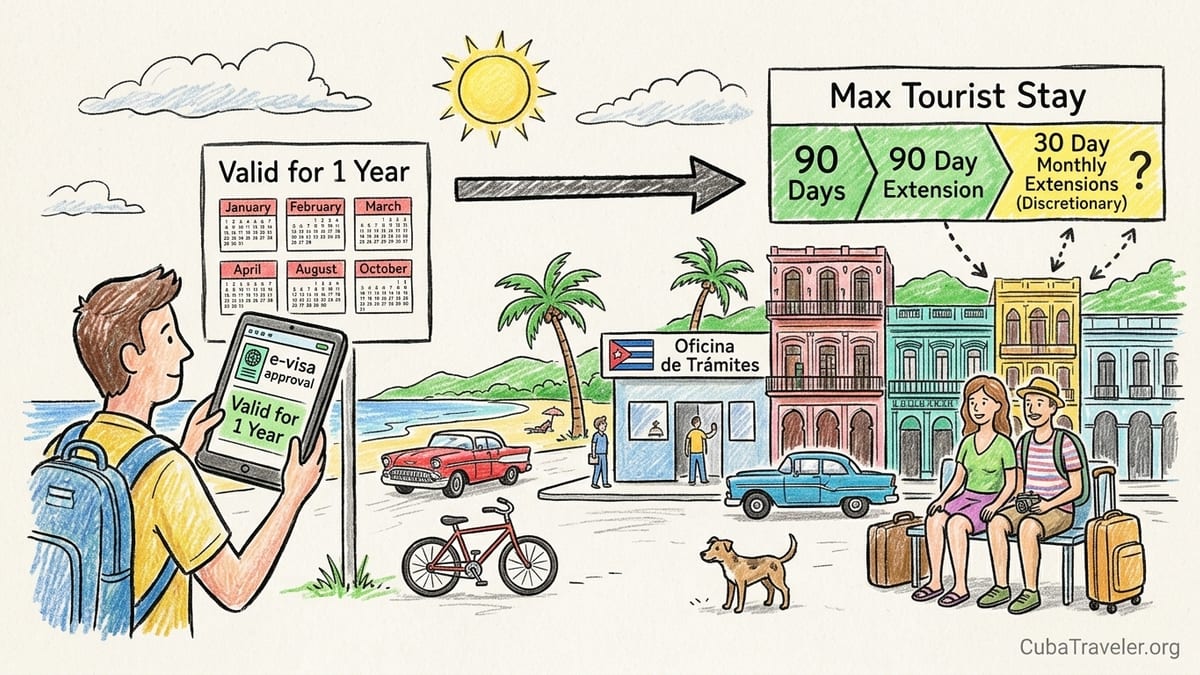
Entry validity vs. time you can legally stay
The most important distinction for anyone thinking about a long stay in Cuba is this: the period during which an unused visa can be presented at the border is not the same as the period you can remain in the country after entry. Older blog posts about the now retired paper tourist card often blurred this line, describing “30 days” or “90 days” without specifying whether that referred to validity to enter or maximum stay once admitted. With electronic visas and a new migration law, that confusion becomes more dangerous.
Under Cuba’s current practice, the standard tourist visa or tourist e-visa is single entry. Official tourism information from Cuba’s Ministry of Tourism states that the maximum stay as a tourist is 90 days, extendable once for another 90 days through an immigration office. That 90 plus 90 structure refers to time on the island, counted from the date stamped in your passport when you land, not to how long the electronic authorization exists in a database before you use it.
Law 171 on Migration and its implementing Decree 136 introduce a separate concept for electronic visas. Article 191 provides that an electronic visa can be used for up to one year from the date it is granted. In other words, you might receive approval in January and choose to enter in October using the same authorization, as long as you respect that one year utilization window. What it does not mean is that the same tourist admission automatically covers you for a continuous twelve month stay after the day you cross the border.
This distinction is not academic. Imagine a traveler who reads that an e-visa is “valid for one year” and assumes they can stay in Trinidad or Santiago de Cuba for twelve uninterrupted months without speaking to immigration again. That person would be in status for the first 90 days, perhaps for 180 if they obtain a regular extension, but beyond that they risk being treated as an overstayer unless they have gone through the separate, discretionary extension process created by Article 72 and regulated by Decree 136.
How the current 90+90 tourist stay actually works
As of October 28, 2026, the rule in force for tourists is still the 90 day stay plus a possible 90 day extension. The official Cuba Travel portal, operated by the Ministry of Tourism, clearly states that the maximum stay in Cuba as a tourist is 90 days and that this period is extendable for an additional 90 days through an immigration office. Spanish consular guidance to travelers echoes the same framework and stresses that the standard tourist visa allows a single entry, with one renewal of equal duration available in country.
In practice, that means a Canadian couple flying into Varadero on December 10 with a tourist e-visa will receive an entry stamp valid for 90 days, usually noted until early March. If they want to spend the entire winter in Cuba, they must visit an Oficina de Trámites de Extranjería, often translated as Immigration Processing Office, to request an extension before the first 90 days expire. Offices exist in provincial capitals and larger cities such as Havana, Santiago de Cuba and Cienfuegos, and processing usually happens in person.
Fees are set in the Cuban tax schedule published in the Official Gazette. For foreign nationals, the line item for a “prórroga de estancia en la República de Cuba” lists an amount of 30 units of the applicable state fee currency for an extension. In the past, this has translated to roughly 25 to 30 US dollars when collected through consular or travel agency partners, but because onshore payments inside Cuba are often priced in Cuban pesos or in MLC (freely convertible currency) cards, travelers should expect to verify the exact amount and accepted payment methods locally.
Real world reports from tourists who have extended in Havana or Holguín in 2025 and 2026 describe broadly similar procedures. Applicants fill out a short form, present their passport and proof of medical insurance valid in Cuba, provide evidence of legal accommodation if they are not in a hotel, and pay the fee, often via a revenue stamp or payment at a designated window. Waiting times can range from under an hour in smaller towns to half a day in busy offices. While many extensions are granted routinely, the decision is still made by an immigration officer rather than guaranteed by the visa itself.
What Law 171 and Decree 136 really change
Law 171 on Migration, approved in July 2024 and formally published together with Decree 136 in the May 5, 2026 Official Gazette, rewrites the categories and procedures for foreigners in Cuba. For tourists, much of the attention has focused on Articles 71 and 72 of the law and Article 191 concerning electronic visas, because taken together they appear to create a pathway for stays of up to one year. However, a close reading shows that these are approval based legal mechanisms, not blanket permission for every beachgoer to remain for twelve months without further scrutiny.
Article 71 of Law 171 sets the basic framework for non resident foreigners admitted as tourists. It establishes an initial authorized stay of up to 90 days, with the possibility of one extension of equal duration. That puts the 90 plus 90 scheme into primary legislation, aligning it with the current practice laid out by the Ministry of Tourism and foreign consular advisories. For most visitors contemplating a winter on the beaches of Guardalavaca or a long cultural immersion in Havana, this two step, 180 day ceiling will remain the default reference point.
Article 72 introduces something new. It allows foreigners who entered as tourists and who need to remain longer than 180 days to apply for successive extensions of 30 days each, up to a maximum of one year from the date of entry. Decree 136 fills in the procedural details, specifying that these “prórrogas de los no residentes” must usually be requested at least three working days before the current authorized stay expires, except in short stay cases under five working days. Critically, neither the article nor the decree language turns this into an automatic right. Each 30 day block is a separate request that Cuban immigration may approve or deny.
Article 191 of Law 171 deals with the electronic visa itself. It provides that an e-visa, once granted, can be used within a one year period to enter Cuba, replacing the older system where paper tourist cards had shorter validity windows and were physically presented at check in. This is primarily an administrative convenience. It does not modify the stay limits in Articles 71 and 72. Conflating the one year utilization period of an unused e-visa with a one year permissible stay once inside the country is precisely the mistake that has begun to appear in some travel blogs and agency marketing material.
Implementation date: why older advice is now actively risky
The new migration framework is scheduled to enter into force on November 1, 2026. As of the date of this article, October 28, 2026, Articles 71, 72 and 191 exist on paper but have not yet been implemented in Cuban airports or immigration offices. That means any step by step walkthrough that describes going to a local immigration branch today and requesting 30 day increments beyond six months as if the process were already operational is at best speculative.
This timing gap is precisely where older or careless online advice becomes dangerous. A long running English language blog might explain that “Cuba extended tourist stays from 30 to 90 days, and you can now renew indefinitely,” based on a mixture of pre 2022 changes and rumors about the new law. Another site might copy a translated excerpt of Article 72, then imply that everyone can simply show up once a month at the Oficina de Trámites, pay a small fee and live a year in Viñales on a tourist admission. Such claims ignore both the implementation date and the discretionary nature of each extension.
Travelers who rely on these sources without checking official Cuban information or up to date consular advice risk planning itineraries that are legally impossible. Consider a digital nomad who books a twelve month apartment lease in central Havana on the assumption that Article 72 guarantees them a one year tourist stay. They might arrive in early October 2026, only to discover that at that point the 30 day mechanism is not yet active and the practical ceiling remains 180 days. Their landlord expects a year of rent, but immigration expects them to be gone in six months unless a completely different status change, such as a work or study permit, applies.
Even after November 1, there is a strong chance that the way Law 171 is applied in practice will lag behind the theory written in the Gazette. Staff training, office capacity, fee collection systems and electronic records all need to adjust. In the first months, different provincial offices might interpret the same rule more or less strictly. That is why any advice presented as universal, instant and guaranteed for all nationalities should be treated with suspicion and cross checked in person.
Case studies: canceled flights, 90 day renewals and long stays
To see how the rules work on the ground, it helps to walk through concrete scenarios that real travelers are likely to face. The first involves a short extension around travel disruption, something that already occurs today. Imagine a German traveler whose ninety day tourist stay is due to expire on January 5, but whose return flight from Havana to Frankfurt is canceled due to fuel shortages and rescheduled for January 10. Under the current regime, the traveler should visit the nearest immigration office as soon as the delay is confirmed, bring the airline communication rebooking their flight and request a short extension or tolerance period to cover the additional days. Officers have discretion to regularize such cases, and fees may be adjusted or waived depending on the circumstances, but no passenger should assume extra days will be excused automatically just because a flight was canceled.
A second scenario is the classic 90 day renewal that many winter visitors already rely on. Picture a Canadian retiree who arrives in Cienfuegos on December 1 with the intention of staying until the end of May. Around late February, before the initial 90 days expire, she goes to the provincial Oficina de Trámites, carrying her passport, proof of medical insurance accepted in Cuba and the address registration from her licensed casa particular. She pays the extension fee set under the Cuban tax schedule and receives a fresh stamp extending her authorized stay to the end of May. Under both the current rules and Article 71 once in force, this kind of single 90 day extension up to 180 days is likely to remain straightforward, though always subject to the officer’s final decision.
The third case goes closer to the new legal ceiling. Imagine a Spanish tourist who enters Havana on December 1, 2026, after the new law has taken effect. They enjoy three months of language school and music, then successfully obtain the 90 day extension permitted by Article 71, taking them to about May 30. At that point, they wish to stay until late June to complete a project. Under Article 72, they could apply for a first 30 day extension, supported by documents showing their ongoing course or accommodation, and if granted would be in status until roughly the end of June. That would total approximately 210 days in Cuba.
Finally, consider a traveler who wishes to remain close to a full year. A remote worker from Italy enters Cuba on November 10, 2026. They extend at 90 days, reaching around May 10, 2027. They then start requesting successive 30 day extensions, each one requiring a trip to the immigration office, payment of the applicable fee and presentation of updated proof of funds, insurance and housing. In theory, if each application were approved, they could remain until early November 2027. In practice, any one of those monthly requests could be refused, and immigration officers might look more closely at whether the person is still a genuine tourist or has effectively become a de facto resident, in which case a different category should apply.
Fees, procedures and the real limits of discretion
One of the more misleading patterns in older online advice is the repetition of fixed extension prices from years past as if they were permanent. Figures such as 25 or 40 US dollars are still copied across blogs and forums without reference to Cuba’s official tax schedule. The most reliable published indication from the Cuban authorities appears in the 2026 special edition of the Official Gazette that lists state fees, where an item labeled “prórroga de estancia en la República de Cuba” carries an amount of 30 in the corresponding currency. How that value is expressed to tourists, whether in Cuban pesos, MLC cards or foreign cash via consular partners, is a question that can shift with economic conditions.
Procedurally, Decree 136 sets baseline rules that apply across Cuba. Requests for non resident extensions must usually be submitted at least three working days before the expiry of the current stay, with a narrow exception where the total stay has been less than five working days. Applicants are expected to be in good standing, which means no unresolved fines, no record of illegal work and no indications of public order issues during their stay. The decree also gives immigration authorities the power to request additional documents, such as proof of solvency, travel insurance or confirmed onward travel, especially as stays lengthen beyond six months.
In the real world, these procedural rules are filtered through office capacity and staffing. Travelers extending in Havana and Santiago report busy waiting rooms, ticket number systems and occasional requests to return another day if daily quotas have been reached. Language ability can matter; although some officers speak English, forms and explanations are primarily in Spanish. Those seeking repeated 30 day extensions under Article 72 should budget not only for the official fee but also for the time and logistical costs of making monthly visits to immigration, particularly if they are staying in smaller towns far from provincial capitals.
Most importantly, every extension beyond the initial 90 days is granted at the discretion of the Cuban immigration authorities. Law 171 and Decree 136 create the legal possibility for a yearlong tourist stay, but they do not oblige officers to approve each request. Factors such as the applicant’s conduct, financial situation, reason for wanting to stay and any broader policy instructions that may be in force at the time can all influence the outcome. Treating the one year horizon as an entitlement, rather than as a ceiling that might be reached only in favorable cases, sets travelers up for conflict and disappointment.
Overstaying, detention risks and changes of status
Overstaying a Cuban tourist visa has never been a trivial matter, and the new migration law does not soften that reality. The United Kingdom’s official foreign travel advice for Cuba states plainly that travelers who overstay their visa could be detained. United States travel guidance goes further in its general warning, noting that immigration violators in Cuba can face prison sentences measured in years and describing serious shortcomings in detention conditions, from lack of medical care to inadequate nutrition. While most tourist overstays end in fines and forced departure rather than criminal prosecution, the legal framework gives the authorities broad powers.
In practical terms, any traveler who has exceeded the stamped date in their passport, even by a few days, should expect complications when trying to depart. Airlines may refuse boarding until immigration clearance is given. Immigration officers at the airport can require payment of fines, a formal regularization of status or, in serious or repeated cases, initiate detention while the case is reviewed. For those who have worked without authorization, participated in political activities or ignored multiple instructions to leave, the risk of harsher measures under Cuban law is real.
Changes of status deserve separate attention, because the new law more clearly delineates categories like employment, journalism and study. A tourist who starts teaching English for pay in a private language school in Havana, even if they initially enter on a valid tourist e-visa, is likely to be seen as working without the correct migration status. Similarly, a freelance journalist who arrives on a tourist visa but then files critical reports for foreign media from inside Cuba may be accused of misusing their classification. Law 171 and its regulations reserve work, press and academic activities for people admitted under specific, preapproved categories, often coordinated through Cuban state institutions.
For someone planning to attend a six month course at the University of Havana, the correct approach is not to arrive as a tourist and hope to chain extensions, but to secure a student classification through the Cuban consulate or sponsoring institution in advance. A foreign engineer sent to work on an infrastructure project near Matanzas needs a work related visa and residence authorization rather than a string of tourist renewals. Attempting to remain for many months as a “tourist” while obviously studying or working will make each subsequent 30 day extension request under Article 72 more vulnerable to rejection and could trigger enforcement action.
Single entry vs multiple entry and life after November 1
The standard tourist e-visa used by most casual visitors is a single entry authorization. Official descriptions by both Cuban and foreign authorities note that the tourist visa permits one entry into Cuba, with a maximum stay of 90 days and a one time extension of equal length. That means that if you leave to visit Mexico or another Caribbean island and then try to re enter Cuba, you normally need a new visa, even if the original 90 or 180 day period has not yet elapsed.
Multiple entry visas are governed by different rules and reserved for specific categories of travelers, such as foreign business representatives, airline crew, some journalists and individuals with family ties in Cuba who travel frequently. These visas are usually issued through Cuban embassies or consulates abroad and can allow several entries within a defined validity period. However, they do not automatically confer the right to remain on the island for an entire year per entry, and the same stay limit concepts from Law 171 still apply. Someone with a multiple entry visa might be able to come and go several times in a year, but each stay would have its own authorized duration, extensions and compliance expectations.
Once November 1, 2026 arrives and the new law formally takes effect, travelers should not expect an overnight revolution at immigration counters. The core numbers will look familiar: an initial 90 day tourist stay, a possible 90 day extension, and then, in theory, 30 day increments up to a maximum of one year from the date of entry. The practical questions will revolve around who is allowed to climb that ladder of extensions, what additional documentation they must show and how consistently provincial offices interpret their discretion.
For example, immigration in Havana might develop informal guidelines favoring retirees with stable pension income and clear medical insurance coverage for longer stays, while being more cautious with remote workers or informal entrepreneurs who could be seen as engaging in unregulated economic activity. Travelers staying in resort zones like Varadero under packages sold by European tour operators might find that their hotels and agencies have streamlined relationships with local immigration offices for standard 90 day extensions, but less experience with the new 30 day serial extensions. These differences will only emerge through actual practice, which is why a cautious, evidence based approach is essential when planning to use the new legal possibilities.
Post November verification checklist and The Takeaway
Because Law 171 and Decree 136 will only show their real contours in practice after November 1, 2026, anyone contemplating a stay longer than 90 days should build a personal verification checklist rather than relying on secondhand blog posts. The first item is to confirm, with either the Cuban consulate that issued your visa or the official Cuba Travel information channels, that your entry category is indeed tourist and that no special conditions apply to your nationality. Some nationalities benefit from separate bilateral agreements; others have additional requirements.
Second, before making non refundable commitments for accommodation beyond 90 or 180 days, visit a local Oficina de Trámites de Extranjería early in your stay and ask in Spanish or with an interpreter how Article 72 extensions are being handled in that province. Take note of required documents, current fees, payment methods and any informal criteria officers mention. If officials signal that extensions beyond 180 days are being reserved for narrow categories, plan accordingly.
Third, keep written records of every interaction with immigration, including receipts for fees and copies of approval stamps or resolutions. If you request a 30 day extension to reach 210 days, and it is granted, you then have concrete evidence of how the law was applied in your case. If your request is denied, you can at least leave on time and adjust future plans without sliding into inadvertent overstay. Throughout, remember that staying compliant is your responsibility; “but a blog said I could stay a year” carries no weight at the border.
The takeaway for long stay visitors is straightforward. Cuba’s new migration law does open the door, in principle, for tourists to remain up to a year, but that door is guarded by immigration officers who retain wide discretion and by procedures that are still being rolled out. Until practice catches up with theory, the safest assumption is that 90 days plus one 90 day extension, for a total of 180 days, remains the reliable ceiling for most casual visitors. Treat any possibility beyond six months as a privilege that must be requested, justified and rechecked in real time, not as a right guaranteed by a few lines in the Official Gazette.
FAQ
Q1. Is my Cuba tourist e-visa really valid for a full year of stay?
The new law gives an electronic visa a one year window in which it can be used to enter Cuba, but your initial stay as a tourist is still limited to 90 days, with an extension to 180 days and then possible 30 day increments only if immigration approves them in your specific case.
Q2. Can I already request 30 day extensions beyond six months before November 1, 2026?
No. As of October 28, 2026, the provisions of Law 171 and Decree 136 that allow successive 30 day extensions up to one year are not yet operative, so current practice still centers on a 90 day stay with a single 90 day extension.
Q3. How do I extend my 90 day tourist stay to 180 days under the current rules?
You must visit a Cuban immigration processing office before your initial 90 days expire, take your passport, proof of medical insurance and accommodation, pay the applicable extension fee, and obtain an approval stamp or notation extending your authorized stay.
Q4. What happens if my return flight is canceled after my visa expires?
You should go to the nearest immigration office as soon as you receive the cancellation notice, bring the airline’s proof of rebooking and request a short extension or regularization; do not assume that a flight problem automatically legalizes extra days in Cuba.
Q5. Is it safe to plan a full year in Cuba as a digital nomad on a tourist visa?
Legally, the new framework allows immigration to grant up to a year, but approvals beyond six months are discretionary and may be scrutinized closely, especially if you appear to be working, so it is risky to sign long leases or make yearlong plans based solely on a tourist status.
Q6. What are the risks if I overstay my tourist visa in Cuba?
Overstayers can face fines, forced departure and, in more serious or repeated cases, detention, with some official guidance from foreign governments warning that immigration violators may be exposed to harsh prison conditions in Cuba.
Q7. Can I change from tourist status to a work, study or press visa while in Cuba?
In some situations a change of status is possible, but it must be coordinated with Cuban authorities and any sponsoring institution; simply working, studying or reporting while remaining on a tourist admission can be treated as a violation of the migration rules.
Q8. Are Cuba’s tourist e-visas single entry or multiple entry?
The standard tourist e-visa used by most visitors is single entry, meaning you need a new authorization if you leave Cuba and want to return, while separately regulated multiple entry visas are reserved for specific categories such as business travelers or frequent family visitors.
Q9. How much does it cost to extend a tourist stay in Cuba?
The Cuban tax schedule lists a specific state fee for a “prórroga de estancia,” roughly equivalent to a few dozen units of the applicable currency, but because collection methods and exchange rates change, you must confirm the exact amount and payment method locally at the time you apply.
Q10. What should I verify in person after November 1, 2026 before counting on a long stay?
After November 1 you should confirm with a local immigration office how Articles 71 and 72 are being applied in that province, what documentation and fees are required for extensions, whether any informal limits exist on stays beyond 180 days, and how many 30 day renewals they are currently approving for tourists in situations similar to yours.