


Family trips to Cuba are often planned around beaches and old cars, not birth certificates and citizenship law. Yet for families with children or any Cuban connection, the biggest risk rarely appears in glossy airline emails. Standard tourist visa instructions focus on one adult traveler with a single passport. That can be dangerously incomplete when you add minors, one-parent travel, or relatives Cuba may quietly treat as Cuban citizens regardless of their other passports.
Why “Simple” Cuba Visa Advice Fails Complex Families
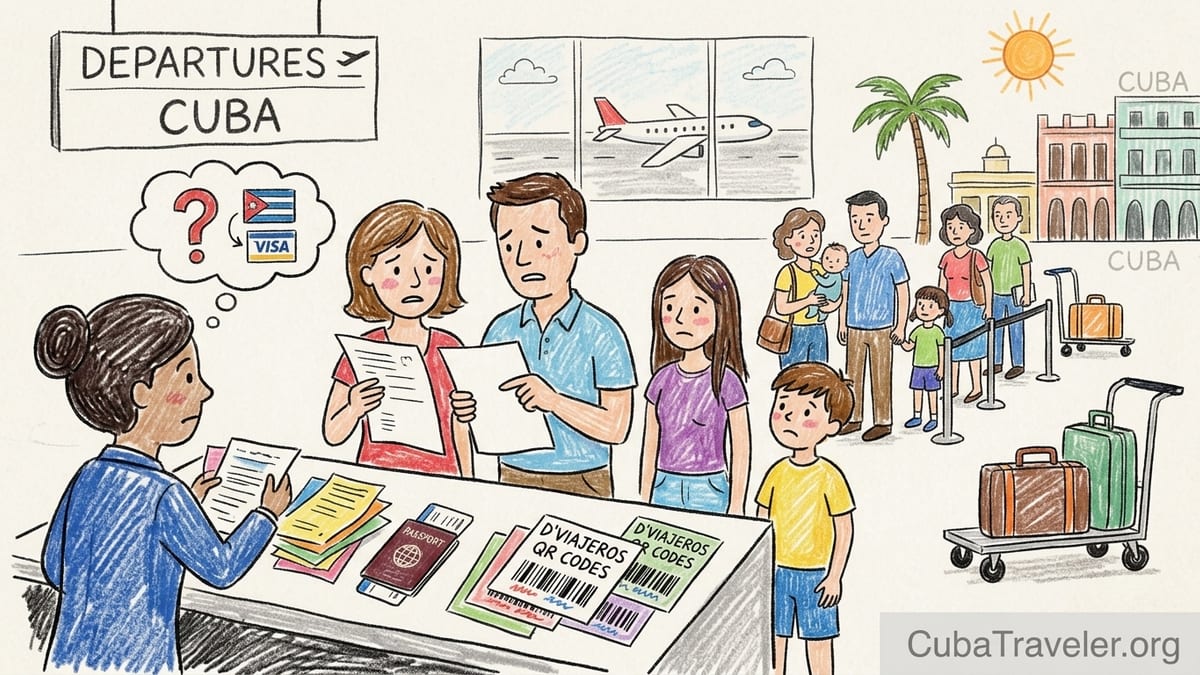
Imagine a Canadian couple from Toronto, Ana and Mark, traveling to Varadero with their two kids, ages 6 and 14. They buy package flights, pay for the new Cuban tourist eVisa that has replaced the old paper tourist card in many markets, and dutifully complete the mandatory D’Viajeros online form a few days before departure. The airline website talks about an eVisa “per passenger,” but the booking page shows one payment line and a vague note about “children included.” They assume the family is covered under the parents’ authorizations. At check in, they discover each child needs an individually issued eVisa linked to that child’s own passport. The result is a scramble with a third-party visa vendor at elevated prices and a serious risk of being denied boarding.
This kind of near-miss is increasingly common. Cuba’s move toward an eVisa model that is electronically linked to a passport, together with the D’Viajeros pre-arrival form that generates a QR code per traveler, has removed much of the informal flexibility families once relied on. Airline staff now scan barcodes and cross-check passport numbers on screens instead of glancing at a shared paper visa. If your child’s name and passport number are not in the system with their own eVisa and D’Viajeros record, they may not fly, even if your tour operator told you “kids are included.”
These problems multiply for families where one parent travels alone, grandparents escort minors, surnames differ, or anyone involved has Cuban roots. Cuban authorities and departure-country border officers may treat these travelers under entirely different rules than what generalized tourist blogs describe. The rest of this guide walks through those fault lines so you can build a documentation file that matches how Cuban and foreign authorities will actually see your family, not how a booking engine describes you.
Do Children Need Their Own eVisa and Passport, or Are They “On” a Parent?
The first critical point is that Cuban tourist permission is personal and electronically linked to a single passport. Official Cuban tourism guidance and multiple consular partners explain that the electronic visa is connected to the applicant’s passport, not to a household. Airline and tour operators that previously issued paper tourist cards at check in now increasingly provide an eVisa reference for each ticketed passenger, children included, precisely because the authorization must match each traveler’s passport details.
In practical terms, that means every child requires their own passport and their own eVisa approval. The past practice in some countries of adding children to a parent’s passport has been phased out. Family-focused instructions for the D’Viajeros form, which all passengers must complete before arrival, emphasize that there is one declaration per person, babies and children included, and that in a family group you should expect to have as many QR codes as people traveling. Travel operators that explain the system in detail note that while an adult fills out the form for each child, the child’s passport number, date of birth, and nationality are entered separately and stored as an individual record.
Consider a real-world example from 2026 charter flights out of Montreal. A family of five booked through a Canadian tour company that advertised a flat 20 Canadian dollar tourist card price. At the airport they discovered that this flat amount applied per traveler. Three children under 12 were charged exactly the same visa fee as the adults because the Cuban side does not offer a reduced “child tourist card” for most nationalities. Where eVisas are now sold instead of paper cards, prices can vary by provider, but current examples show fees in the range of 25 to 50 US dollars per person for many foreign travelers, again with no automatic discount for minors. If you multiply that by four or five family members, misreading “per person” as “per booking” becomes an expensive mistake.
More importantly, incomplete coverage can be a catastrophic mistake. If one child’s eVisa was never issued or is linked to an incorrect passport number, Cuban immigration systems may flag the mismatch when the airline transmits manifest data, and boarding staff can refuse that child carriage. In a family of four, that can mean everyone is forced to stay behind. The safest approach is to treat each child as if they were a separate adult traveler in terms of visas, passports, and the D’Viajeros entry, and to keep printed or digital copies of every child’s eVisa confirmation alongside their passport.
How D’Viajeros Really Works for Families, Including Toddlers and Babies
D’Viajeros is Cuba’s digital advance information system. The Cuban tourism ministry describes it as a mandatory online form that all travelers must complete before arrival, covering immigration, customs, and health data and generating a QR code that is scanned on entry. Airlines, consulates, and tour operators consistently warn that completion of D’Viajeros is now part of being “travel ready” for Cuba. In practice, you are often asked to show your code at check in, at the boarding gate, and again upon arrival.
Families sometimes assume there is a single household form, but Cuban and third-party guidance confirm the opposite. Every traveler must have an individual D’Viajeros submission, and Cuban airport staff are trained to ask for the QR code corresponding to each person. Family travel guides produced in 2024 and 2025 state plainly that on a family trip you will end up with as many codes as travelers and that children are not bundled under a parent.
The only practical concession for minors is who fills in the information. The online form allows an adult to complete the process on behalf of a child and includes specific fields for children under age 10 who are “accompanying” that adult. Operators that walk travelers through the form explain that you still submit one form per child and that the child’s passport details must be accurate, but the responsible adult’s email and contact information can be used. On the ground, Cuban officials will often interact solely with the adult, but they will scan each child’s QR code individually.
When calculating costs and time, a family of four should assume that: each traveler needs an eVisa linked to their passport, each traveler needs an individual D’Viajeros submission tied to that eVisa number and passport, and at least 15 to 20 minutes of careful form-filling per person is required if you are not familiar with the system. Using a hypothetical price of 35 US dollars per eVisa through a commercial provider, a two-parent, two-child family is looking at roughly 140 US dollars in visa fees alone, not counting any service charges added by tour operators. These numbers can vary, but what does not vary is the per-person structure. No one in the family, not even a baby, travels to Cuba “on” a parent as far as D’Viajeros and the eVisa are concerned.
One-Parent Travel, Grandparents, Guardians and the Paper Trail Problem
The next major fault line is who actually accompanies a child. Most countries, including Cuba’s common points of departure like the United States, Canada, and European Union states, treat international travel by minors as a high-risk context for abduction disputes and trafficking. Government guidance in countries such as the United States explicitly warns that when a child travels alone or with only one parent or guardian, foreign border officials may ask for a letter of consent from the non-traveling parent or evidence of custody arrangements. The key difficulty is that there is no global standard format or guarantee that a particular consent letter will be accepted.
In real life, this means that a mother leaving Miami for Havana with her 7-year-old son may never be asked for anything more than passports and boarding passes, while a similar family departing Madrid or Toronto could be required to show a notarized consent letter signed by the non-traveling father plus a certified copy of the child’s birth certificate before being allowed to board. European Commission visa guidance for Cuban Schengen visas is a useful warning sign: it specifies that minors traveling alone or with only one parent must show a legalized birth certificate and recent proof of parental consent from both parents or the legal guardian. While those rules are technically about applying for a Schengen visa, they reflect a broad European approach to minors, and some departure-country officials apply similar expectations outbound when a minor travels to Cuba.
Grandparents face an even more fragile situation. A retired couple in Montreal accompanying their 10-year-old granddaughter to see Cuban relatives cannot rely on the fact that they share a surname or that the parents have texted “it’s fine.” Airline staff in Canada, Spain, or the United States are increasingly trained to ask for written authorization from both parents, ideally notarized, plus a birth certificate that clearly links the child to the consenting parents and, where surnames differ, to the accompanying adults. Without that paperwork, they can simply refuse to carry the child, regardless of whether Cuban immigration itself would demand it on arrival.
Unmarried parents and families where children carry a different surname than the accompanying adult should be especially cautious. A father flying from London to Havana with his daughter who uses her mother’s surname may face questions at airline check in if there is no obvious link between them on their passports. In such cases, travelers have successfully used combinations of documents: the child’s long-form birth certificate naming both parents, a recent court order showing custody or guardianship, and a consent letter from the non-traveling parent. Some U.S. and Canadian travelers report that they have never been asked for these documents on Cuba routes, while others describe intense scrutiny when a custody dispute was suspected. The lack of consistency is precisely why relying on “no one checked last time” is unsafe.
The safest strategy is to over-prepare. Before booking, check the departure country’s official travel information for minors, contact the airline, and then confirm with the nearest Cuban consulate what they recommend for your specific situation. For a one-parent or grandparent trip, that usually means carrying, at minimum, original passports for all travelers, original or certified copies of birth certificates, proof of relationship if the surname is different, and a recent consent letter from the non-traveling parent or legal guardian, ideally notarized in the child’s country of residence. Even if Cuban border officials never request these documents, airline and exit controls in your home country can and do hold families at the gate when something feels off.
Cuban Dual Nationality: When Cuba Treats You Only as Cuban
The second major issue that standard visa advice often ignores is Cuban dual nationality. Cuba’s 2019 Constitution recognizes the possibility of dual nationality but states that within Cuban territory only Cuban law applies. Legal analysis of this rule, often described as the principle that “inside Cuba, your other nationality does not exist,” explains that Cuban authorities treat dual nationals exclusively as Cuban citizens when they are in Cuba, no matter what other passports they hold.
Practically, this means that many people whom airlines and foreign websites describe as ordinary tourists are not tourists in the eyes of Cuban officials. Travel advisories from governments such as Canada and the United States warn that individuals born in Cuba, or those whom Cuba considers to be Cuban citizens, may be required to present a valid Cuban passport to enter and leave Cuba. The U.S. State Department notes that travelers whose foreign passport lists “Cuba” as place of birth can be told they must enter with a Cuban passport or with specific documentation from Cuban authorities proving that they have formally renounced Cuban citizenship.
Consider a U.S.-Cuban dual national, born in Havana and later naturalized as a U.S. citizen. They book a trip from Miami to Havana with their American spouse and children. The airline sells them a Cuban tourist eVisa alongside their ticket, because its system sees only a U.S. passport. At the airport in Havana, Cuban immigration officers check the passport, see the place of birth as Cuba, and ask for a Cuban passport. If that person cannot produce one, officers may treat them as a Cuban who is trying to enter on the wrong document, rather than as a U.S. tourist lacking a visa. Travelers with this profile report being refused entry, sent back on the next flight, or told to resolve their Cuban documentation before returning, even when they carried a valid tourist card.
Canadian-Cuban dual nationals face similar scenarios. Canadian government travel advice explains that if you are recognized as a Cuban citizen, you are expected to present a valid Cuban passport when entering Cuba, and that consular assistance from Canada can be limited while you are in Cuban territory. A Canadian child born in Toronto to Cuban parents may be treated as Cuban by virtue of descent under Cuban nationality law, especially if the birth has been registered with Cuban authorities. In that case, a Canadian tourist eVisa may not be the right document for the child at all, and the family should clarify the child’s status with a Cuban consulate well in advance.
Children Born Abroad to Cuban Parents: The Most Overlooked Risk
Children born outside Cuba to at least one Cuban parent sit at the crossroads of family, migration, and nationality law, and they are the group for whom generic tourist-card advice is most misleading. Cuban nationality law provides for the recognition of these children as Cuban nationals under certain conditions. Government summaries of the law explain that recognition typically involves documentation such as the child’s foreign birth certificate, registration in a Cuban civil registry for acts and facts of Cubans abroad, and a Cuban relative who undertakes to support the child.
For many diaspora families, the process is partially completed. A Cuban-born mother in Montreal might have registered her Canadian-born daughter’s birth at the Cuban consulate to simplify future visits “home,” even if the child has never held a Cuban passport. Years later, when planning a resort stay in Varadero, the family assumes the daughter is simply a Canadian tourist, buys her an eVisa, and completes D’Viajeros using only the Canadian passport. If Cuban border officers see documents or prior registrations that indicate the child is already recognized as Cuban, they may conclude that she should hold and use a Cuban passport instead of an eVisa meant for foreigners.
The problem is rarely dramatic when the family’s Cuban paperwork is fully in order. Dual nationals with valid Cuban passports, including children, usually enter and exit on their Cuban documents while using their other passports only for travel to and from third countries. Difficulties arise when a child who is or may be Cuban in Cuban law tries to enter without a Cuban passport or with an expired one. Cuban practice, as reflected in consular advice and multiple traveler reports, is to insist on a valid Cuban passport for citizens entering or leaving the country. Attempts to substitute a tourist card or eVisa for a Cuban citizen can fail at the immigration counter, even when airlines have already allowed boarding.
Real cases shared in traveler communities describe Cuban-born adults and dual nationals detained on arrival because they attempted to use a foreign passport and tourist visa while their Cuban passport was expired or absent. In one typical scenario, a Cuban-born woman now living in Europe arrived at Havana with a valid EU passport and a tourist visa, only to be told by immigration that because she was born in Cuba, she must enter and leave as Cuban, and that an expired Cuban passport was not sufficient. She was eventually allowed in after long questioning and with conditions attached to her departure, but her foreign tourist visa played almost no role in resolving the situation because Cuban authorities did not see her as a tourist.
For children, the human stakes are higher. A teenager born in Canada to Cuban parents might be stopped at departure or entry if there is evidence that they hold Cuban nationality but do not have an up to date Cuban passport. In extreme cases, one parent could attempt to use Cuban nationality law to block a child’s departure or assert parental rights under Cuban jurisdiction. While such disputes are rare, recent high-profile custody conflicts involving U.S. minors taken to Cuba show how quickly parental disagreements can escalate once a child is inside a different legal system. The core lesson is simple: where there is any possibility that Cuba considers your child a Cuban citizen, you should not guess. You should ask the Cuban consulate in writing how the child will be treated on entry and which documents are required.
Expired Cuban Passports, eVisas and the Illusion of a Shortcut
Because renewing a Cuban passport abroad is costly and often slow, many dual nationals look for shortcuts, especially if they believe they have “left Cuba behind.” Official and quasi-official explanations of the Cuban passport regime note that Cuban passports historically required periodic extensions and payment of consular fees to remain valid for travel. While some of these rules have softened in recent years, the underlying principle that Cuban citizens need a current Cuban passport to enter the island remains.
A recurring pattern in traveler reports is the Cuban-born dual national whose Cuban passport expired while living in the United States or Europe. They obtain U.S. or EU citizenship, receive a new foreign passport, and assume they can visit Cuba as “tourists” using an eVisa like any other foreigner. Airlines often issue the eVisa, because their systems simply see a U.S. or EU document with no restriction, but Cuban immigration officers focus on place of birth and prior records. When they detect that the person is Cuban in Cuban law, the tourist eVisa is treated as irrelevant. Some travelers have been turned back, while others have been admitted on a one-time basis but warned that they must renew their Cuban passport before the next trip.
There are also misconceptions about traveling with an expired Cuban passport. During the COVID-19 pandemic, Cuban authorities temporarily relaxed certain rules to allow citizens whose passports had expired while consular services were disrupted to return. That emergency flexibility has largely ended, and relying on informal statements that “Cuba is letting expired passports in” is risky in 2026. Several accounts from 2024 and 2025 describe Cuban-born travelers being told by airline check-in staff in the United States that they could not board because their Cuban passport was expired, even though their U.S. passports and tourist visas were valid.
For dual nationals, the safest course is to assume that if Cuba considers you Cuban, you must enter and exit using a current Cuban passport, period. That may mean significant time and cost at a Cuban consulate before your trip, but it is far safer than gambling on an eVisa workaround that could collapse at the Havana immigration booth with your family watching. For families where only one parent is Cuban, or where children may have claim to Cuban nationality, this is not merely a bureaucratic inconvenience. It can shape which parent is seen as having legal authority over the child once inside Cuba, whether foreign consular officials can assist in a dispute, and how difficult it might be to leave in an emergency.
The Takeaway
Cuba remains a rewarding destination for families, but it is a country where documentation details matter more than many travel websites admit. The shift to passport-linked eVisas and the universal D’Viajeros form has eliminated old informal practices like treating children as appendages of a parent’s tourist card. At the same time, Cuba’s strict approach to dual nationality means that adults and children with Cuban roots can be treated in ways that bear little resemblance to how airlines, tour companies, or even foreign immigration officers categorize them.
For ordinary foreign families, the main task is technical discipline. Ensure that every traveler, including babies, has their own passport, their own eVisa when required, and their own D’Viajeros QR code. For one-parent trips, grandparents, and guardians, the risk is documentary: without a robust paper trail of birth certificates, custody or guardianship orders, and consent letters that satisfy both departure and arrival authorities, a perfectly legal family trip can end at the check-in counter.
For dual nationals and families with Cuban heritage, the stakes are legal and political. If Cuba considers you or your child Cuban, your foreign citizenship may recede into the background once you are on Cuban soil. That affects which passport you must use, how you exit, and what happens if family disputes arise. The only responsible approach is to confront these complexities directly before you book, in consultation with the relevant Cuban consulate and your own government’s travel advice, and then to travel with documentation that matches the reality of how Cuban law sees you.
Below are focused checklists to help structure that preparation, followed by detailed answers to common questions families raise when they first realize that “just book the flight” is not enough for a complicated trip to Cuba.
Checklist: Ordinary Foreign Families Without Cuban Links
For families where no traveler has Cuban nationality and no one was born in Cuba, the main challenges are correct eVisas, complete D’Viajeros forms, and proof of family relationships when names differ. A British family of four flying London to Havana in 2026, none of whom has Cuban heritage, should still treat each member as a separate case file. That means four valid passports, four eVisas issued in the correct spelling and numbers, and four D’Viajeros QR codes saved offline on phones and printed on paper in case of connectivity issues on arrival.
Parents should carry birth certificates for each child, especially if children do not share both parents’ surnames, plus proof of legal guardianship where relevant. Although many families report that they were never asked to show these documents when entering Cuba, departure-country controls are unpredictable. Having this file ready is an insurance policy. Additionally, proof of travel medical insurance that covers Cuba is widely recommended, and some airlines still check for it.
On the financial side, calculate visa-related costs per person in advance, using the latest fee schedules from your tour operator or chosen eVisa provider. A family of five paying 40 US dollars per eVisa is committing about 200 US dollars just in visa fees. Knowing that figure up front can influence trip budgeting and prevent unpleasant surprises at online checkout or airport ticket desks. This is particularly important for extended families or multi-household groups, where assumptions about who has “taken care of the visas” can hide missing entries.
Finally, plan when and where you will complete D’Viajeros. Families who leave the forms to the last night before departure often face rushed data entry, duplicated mistakes across multiple forms, and partial submissions. A better approach is to dedicate a quiet hour two or three days before departure, with passports, flight confirmations, and lodging addresses laid out on the table, and to complete and save each traveler’s QR code carefully. Screenshots or PDFs of each QR should be stored on at least two different devices.
Checklist: One-Parent Travel, Grandparents and Guardians
One-parent trips and child travel with grandparents or other guardians demand a deeper documentation bundle. Start by mapping your route and legal environment. A mother flying with her child from New York to Havana is subject to U.S. exit practices and airline policies, while a grandmother taking her grandson from Madrid faces Spanish regulations that often insist on formal notarial authorization for minors traveling without both custodial parents. Each leg of the journey can introduce different expectations.
Key documents typically include the child’s passport, the accompanying adult’s passport, an original or certified copy of the child’s long-form birth certificate, and, when applicable, adoption decrees or legal guardianship orders. Where the child’s surname does not match that of the traveling adult, emphasis on the birth certificate is even stronger, because it is the main document that shows the legal link between them. If the parents are separated, divorced, or were never married, court orders allocating custody or decision-making authority can be critical, particularly when the non-traveling parent might later claim the trip was unauthorized.
Parental consent letters are the most variable element. Some border officers accept a simple signed letter from the non-traveling parent, while others expect a notarized document with specific language, dates, and destinations. Rather than relying on a template downloaded from the internet, it is wiser to ask both the departure-country authorities and the airline what they consider adequate. Then, if possible, have the letter notarized in the jurisdiction where the child lives and carry it in original form, along with several photocopies. Even when you believe you have sole custody, a short letter from the other parent explicitly consenting to the Cuba trip can help avoid delays, unless legal or safety concerns make such contact impossible.
Grandparents and non-parent guardians should also carry contact information for both parents and, where feasible, copies of the parents’ passports. Airline staff sometimes call a parent directly if they are uncertain about a minor’s travel authorization. Having that conversation prepared in advance is far better than scrambling to find a phone number at the check-in desk. In rare but serious situations, such as active custody disputes or protective orders, traveling with children may require legal advice in both the home country and in relation to Cuban jurisdiction before any tickets are bought.
Checklist: Dual-National Adults and Children With Possible Cuban Nationality
For adults and children with any Cuban connection, the checklist is less about volume of documents and more about legal status. The first task is diagnostic: determine whether Cuba is likely to consider you or your child Cuban, either by birth in Cuba or by descent. If you were born in Cuba, or if your foreign passport lists Cuba as place of birth, Cuban authorities almost certainly see you as a Cuban citizen, regardless of any later naturalization elsewhere. If you were born abroad to at least one Cuban parent, the answer is less automatic and depends on whether your birth was registered with Cuban authorities or whether you have sought any Cuban identity documents.
Next, contact the nearest Cuban consulate and inquire in writing, if possible, about how you will be treated on entry. Describe your situation factually: where you and your parents were born, what Cuban documents you hold or previously held, and what foreign citizenships you now possess. Ask specifically whether you are required to enter and exit on a Cuban passport and what steps are needed to regularize your status if your Cuban passport is expired or you never had one. Keep copies of any written responses, although you should be prepared for the possibility that answers will be brief or non-committal.
If the consulate indicates that you or your child are Cuban citizens in Cuban law, prioritize obtaining or renewing the relevant Cuban passports before booking flights. Be realistic about timelines: reports from 2024 and 2025 suggest that some consulates take several months to issue or renew passports, especially for applicants living outside major diaspora hubs. Attempting to substitute a tourist eVisa for a necessary Cuban passport is gambling with entry, and the fact that an airline’s system will sell you an eVisa is no guarantee of Cuban acceptance.
During travel, dual nationals typically use their foreign passports for departure and re-entry in their country of residence but present their Cuban passports at Cuban immigration. That means carrying both passports and being prepared to explain this arrangement calmly to airline staff. For children, ensure that both passports reflect consistent biographical data and that you carry any birth certificates or consular registrations that link their identities. In custody-sensitive situations, be aware that once inside Cuba, local authorities may view disputes through the lens of Cuban citizenship and family law, which can differ sharply from frameworks in Canada, the United States, or Europe. Families should weigh this carefully when deciding whether and how to bring Cuban-national children into the country.
FAQ
Q1. Does every child need their own Cuban eVisa and D’Viajeros form, or can they travel under a parent’s authorization?
Every child needs their own passport, their own eVisa where required, and an individual D’Viajeros submission generating a personal QR code. A parent can fill out the online form on the child’s behalf, but in immigration and airline systems the child is treated as a separate traveler, not an add-on to a parent’s visa.
Q2. Are visa fees for children lower than for adults when traveling to Cuba?
In many markets, visa providers and tour operators charge the same tourist card or eVisa fee for children as for adults. For example, on some Canadian and European routes in 2024 and 2025, families report standard tourist card prices in the 20 to 50 US dollar range per traveler, regardless of age. You should verify the current tariff with your airline or visa provider, but do not assume a child discount.
Q3. What documents should a parent traveling alone with a child to Cuba carry?
At minimum, the traveling parent should carry valid passports for both parent and child, the child’s long-form birth certificate, and, where applicable, court orders showing custody or guardianship. In many jurisdictions, border and airline staff also expect a recent letter of consent from the non-traveling parent or legal guardian, ideally notarized, explicitly authorizing the trip to Cuba for specified dates.
Q4. Do grandparents or other relatives need special permission to take a minor to Cuba?
Yes, in practice they often do. Grandparents, aunts, uncles, or family friends escorting a minor should carry the child’s passport, birth certificate, copies of the parents’ passports, and a notarized consent letter signed by both parents authorizing the trip. Without this paperwork, airlines or exit controls in the departure country may refuse to allow the child to board, even if Cuban immigration would admit them on arrival.
Q5. If my child and I have different surnames, will that cause problems entering Cuba?
Different surnames do not automatically create a problem, but they increase the likelihood that airline or border officers will ask for proof of your relationship. Carrying the child’s birth certificate that names you as a parent, plus any relevant court or adoption documents, is important. These documents are primarily checked at departure in your home country rather than by Cuban border officials, but lacking them can still disrupt your trip.
Q6. I was born in Cuba but now have U.S. or Canadian citizenship. Can I travel to Cuba just on my foreign passport with a tourist eVisa?
If you were born in Cuba, Cuban authorities generally regard you as a Cuban citizen regardless of later foreign naturalization. Travel advisories from countries such as the United States and Canada warn that people in this situation may be required to enter and exit Cuba using a valid Cuban passport. While airlines may sell you a tourist eVisa based on your foreign passport, Cuban immigration can reject that approach and insist on Cuban documentation.
Q7. My child was born abroad to Cuban parents but has only a foreign passport. How do I know if Cuba considers them Cuban?
You cannot safely guess. Children born abroad to Cuban parents may acquire Cuban nationality by descent, especially if their birth was registered with a Cuban consulate or in a Cuban civil registry. The only reliable way to clarify their status is to contact the relevant Cuban consulate, provide details of the child’s birth and any Cuban registrations, and ask whether the child is considered a Cuban national and what documents are required for travel.
Q8. Can an expired Cuban passport be used together with a foreign passport and tourist eVisa to enter Cuba?
Relying on an expired Cuban passport and a foreign tourist eVisa is risky. While there were temporary relaxations during the pandemic, current practice generally expects Cuban citizens to hold a valid Cuban passport to enter and leave. Travelers have reported being denied boarding or facing difficulties on arrival when their Cuban passport was expired, even if they held a foreign passport and tourist visa.
Q9. Does foreign naturalization automatically end my Cuban citizenship from Cuba’s perspective?
No. Acquiring another nationality does not automatically mean Cuba considers your Cuban citizenship lost. Cuban constitutional and nationality rules allow for dual nationality, and they state that within Cuban territory only Cuban law applies. Unless you have formally renounced Cuban citizenship through Cuban procedures and obtained official documentation of that renunciation, Cuban authorities may still treat you as Cuban.
Q10. Where should I start if my family situation is complex and I am unsure which rules apply?
Begin with three parallel checks. First, read your own government’s latest travel advice on Cuba, focusing on minors and dual nationals. Second, contact the airline you plan to use and ask what documents they require for minors, one-parent travel, and dual citizens. Third, reach out to the nearest Cuban consulate, describe your family composition and any Cuban connections, and ask in writing how each traveler will be treated on entry and which passports and visas are required. Only once those three pieces align should you commit to non-refundable flights or accommodation.