


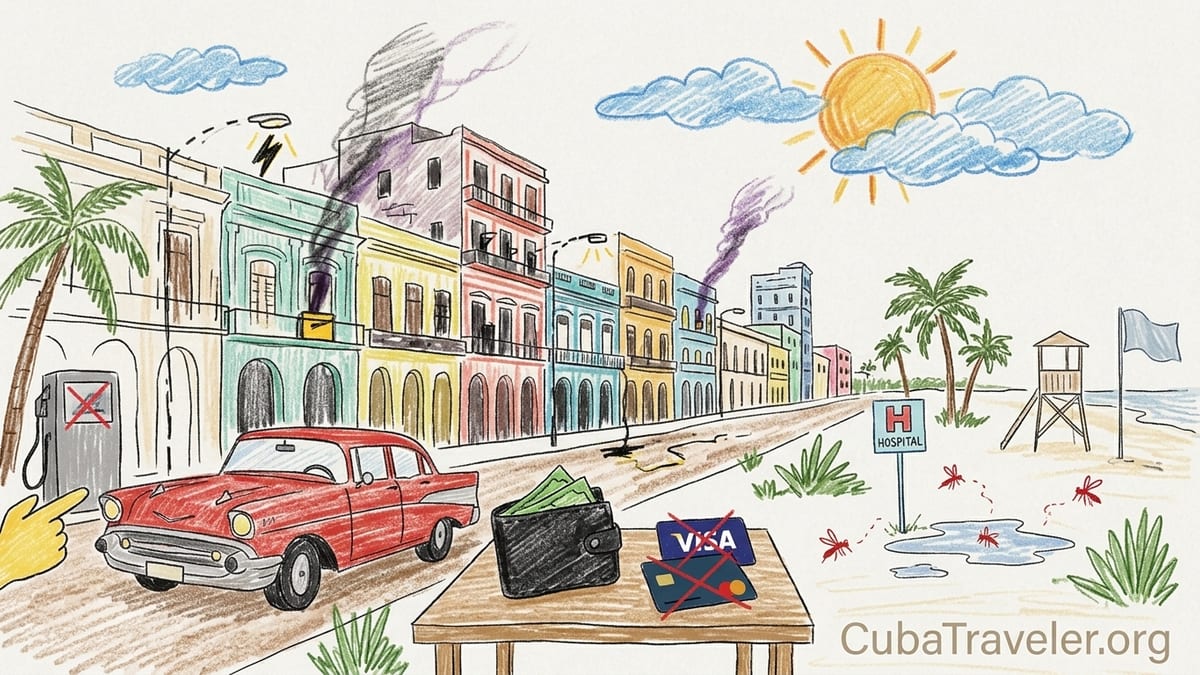
I have been writing about Cuba for years, and I used to echo the same comforting line you still see in glossy brochures: "Cuba is one of the safest countries in the Caribbean." In 2026 that sentence, on its own, is dangerously incomplete. The island’s famous low crime rate coexists with rolling blackouts, fuel shortages, severe mosquito-borne disease and, since June 6, 2026, a payment shock that has left many visitors stranded with useless plastic. The biggest risk now is not walking down a dark street in Havana, but walking into the country holding yesterday’s advice. These are not abstract policy shifts. They are disruptions that can turn a beach holiday into a medical, financial or logistical emergency within hours.
The New Reality: When Old Cuba Advice Becomes a Liability
Much of the English-language travel content about Cuba that still dominates search results was written before 2024. It celebrates classic cars, salsa bars and the reassuring idea that “Cuba feels safer than many Western cities.” That remains partially true in 2026, particularly in terms of violent crime, but it ignores what has changed: an energy crisis with blackouts that can last many hours, fuel shortages affecting internal transport, and a health system under strain from overlapping outbreaks of dengue, chikungunya and other arboviruses. Government travel advisories updated in 2026 now highlight prolonged power cuts and shortages of food, medicines and fuel as day-to-day risks, not temporary glitches.
On top of this fragility, Cuba took a step in June 2026 that quietly demolished one of the oldest pieces of "responsible travel" advice: bring a Visa or Mastercard as an emergency backup. According to official notices and multiple government advisories, international Visa and Mastercard transactions were suspended in Cuba from June 6, 2026 following decisions by the card networks and Cuba’s central bank in response to sanctions and compliance pressure. Overnight, millions of travelers lost their supposed safety net.
What has not changed is the kindness and creativity of ordinary Cubans. Guides, casa particular hosts and hotel staff are doing what they can, often with less electricity, fuel and pay than they had a decade ago. The systemic shortages are not their fault. But those shortages are real, and they weave through every aspect of a trip: how you pay, how you move, how you stay connected, and what happens when you get sick. The following twelve mistakes are the ones I now see turning trips into emergencies.
Mistake 1: Relying on Visa or Mastercard as Your Emergency Backup
The mistaken assumption goes like this: "Even if there are shortages, I will be fine because my Visa or Mastercard works almost everywhere that takes cards." That was reasonably accurate until mid-2026, especially for cards not issued by U.S. institutions. Official tourism sites still suggest Visa and Mastercard “not issued by U.S. banks” are accepted, and many commercial booking engines continue to imply that international cards are a reliable fallback for hotel extras or emergencies.
The current evidence says otherwise. In early June 2026, Cuba’s central bank and the card networks confirmed that Visa and Mastercard transactions in Cuba would be suspended from June 6, 2026, in connection with tightening sanctions and compliance decisions. Several foreign ministries, including those of Canada and Australia, updated their travel advice to warn that from that date Visa and Mastercard credit and debit cards would no longer be accepted in Cuba and that travelers must not rely on them for payments, including medical care. This has already left visitors attempting to pay clinic bills or hotel incidentals with cards that are simply declined.
The realistic consequence if you cling to pre-2026 advice is stark. You could land with a wallet full of plastic and walk straight into a cash-only economy. Medical clinics typically require payment up front for treatment. Some hotels and state shops have card terminals, but those may be configured only for domestic cards or specific international systems that are increasingly constrained. There are credible reports of travelers having to be bailed out by friends wiring money through third countries, or being forced to cut trips short because they could not access cash.
The warning signs begin before you travel: government advisories mentioning the June 6, 2026 cutoff; hotel confirmations that do not guarantee card acceptance on site; and Cuban tourism FAQs that still mention Visa and Mastercard without clarifying the suspension. The safer response is blunt but necessary. Plan as if your Visa and Mastercard will not work at all in Cuba. Bring sufficient physical currency in euros or another widely exchanged currency, split between secure hiding places, and confirm with your tour operator or host how and where it can be exchanged legally on arrival. If your government allows prepaying packages or excursions from home, front-load as many costs as possible before you fly. Consider whether you are truly comfortable traveling to a destination where your usual emergency payment tools are switched off.
Mistake 2: Assuming an All-Inclusive Generator Guarantees Comfort and Safety
Older Cuba advice often suggests a simple fix for the island’s infrastructure problems: "Book a big resort; they have their own generators so you will not notice blackouts." On paper that sounds reassuring. Booking portals for Varadero and Cayo Coco still use language like "24-hour electricity" and "full backup power." Travel agents tell nervous clients that a four- or five-star property with a generator is insulated from the worst of the energy crisis.
The lived reality is more complicated. Cuba has faced rolling blackouts since 2024, with nationwide outages following major power plant failures documented in October 2024 and again in 2025. Local testimony from both residents and visitors describes hours-long power cuts in Havana and provincial cities, sometimes up to 20 hours in a day during fuel shortages. Even resorts with generators must ration fuel when supplies tighten. Guests at all-inclusives have reported partial power, limited air conditioning, reduced food variety, inconsistent water pressure and temporary closures of bars or specialty restaurants during prolonged outages.
The consequence of overestimating what a generator can do is that you may find yourself in a tropical climate without reliable air conditioning, refrigeration or water just when you need them most. For a healthy traveler that can mean heat stress and food risk. For anyone with medication that needs refrigeration, mobility limits that make climbing stairs in the dark hazardous, or a child that dehydrates quickly, it can become an emergency. In a long blackout, some hotels reduce elevator use, dim corridors, or prioritize limited electricity for kitchens rather than rooms.
The warning signs are subtle but important: resort reviews from 2024 onward that mention "rotating power cuts," "lukewarm fridges," "gen sets running only at peak times" or "buffet reduced due to supply issues." The safer response is to treat generators as mitigation, not a guarantee. Before you book, ask the hotel specific questions: How many hours per day can they realistically run backup power if the grid is off? What services are prioritized? Can they reliably keep medications cold? How do they handle water supply and sewage during long outages? If the answers are vague or rely on "usually it is fine," think seriously about whether you want to trust your health to marketing copy instead of verified capacity.
Mistake 3: Planning an Island-Wide Rental Car Route Without Verified Fuel
Pre-crisis guidebooks describe Cuba as perfect for a road trip, with classic cars, empty highways and spontaneous detours. Many still recommend picking up a rental car in Havana and tracing the whole island from Viñales to Santiago, assuming petrol stations are just another stop. Some European tour operators continue to sell fly-and-drive packages designed years ago, with suggested daily legs that stretch hundreds of kilometers.
Since 2023, fuel shortages have turned that romantic plan into something much riskier. Official communications and on-the-ground reports describe long lines at petrol stations, priority fueling for state vehicles, and special fuel stations reserved for rental cars that only accept card payments through particular systems. A European destination management company updated its Cuba dossier in 2025 to note that from February 1, 2024, fueling rental cars in Cuba would be possible only cashlessly at specific dedicated stations, and that fuel availability across the island remained constrained. Travelers posting in 2024 and 2025 recount journeys where they arrived at marked gas stations to find them closed, dry, or with queues of several hours.
The consequence of assuming "we'll just fill up wherever" is not simply inconvenience. If you run low in central Cuba or on the causeways to Cayo Coco or Cayo Santa María, you may have no safe detour. Breaking down in a remote stretch without reliable phone coverage or quick roadside assistance can expose you to heat, dehydration and a complete failure to reach your next night’s accommodation. Missing your outbound flight because you could not find fuel to return the car is a very real possibility. In the current climate, some rental companies are themselves struggling with spare parts and maintenance, further raising the risk of mechanical failure.
Warning signs include any itinerary sold to you that assumes long driving legs without a fuel plan, rental contracts that make no mention of the current fueling system, or local contacts who answer fuel questions with "it depends on the week". The safer response is to shrink your ambitions and tighten your logistics. If you must self-drive, keep routes short, plan around the latest information on dedicated stations, and never drop below a conservative reserve. Consider hiring a car with a driver arranged through a reputable local agency; professional drivers are plugged into the real-time fuel situation in a way casual visitors are not. For many travelers in 2026, it is wiser to stay within one region and use a mix of pre-booked transfers and intercity buses, rather than chasing a cross-island dream on empty tanks.
Mistake 4: Trusting Flight Search Engines Over the Operating Airline
Another legacy habit from the easy-travel era is to treat large flight search engines and online travel agencies as a reliable view of what is flying. Many people still book Cuba itineraries based on aggregators that show multiple daily connections via regional hubs, assuming that if the website sells it, the flight is stable. In today’s Cuba, where tourism numbers have dropped sharply from pre-2019 peaks and fuel and foreign currency shortages affect aviation, that assumption is no longer safe.
Several international carriers have cut or reduced services to Cuba over the past few years in response to both economic pressures and fluctuating demand. Routes that appear for sale months in advance sometimes face last-minute schedule changes, consolidation or outright cancellation. Government advisories now explicitly tell travelers to monitor their booking directly with the airline because of frequent changes, and to avoid tight self-made connections via third countries when traveling to Cuba.
The consequence of trusting the search engine’s reassuring green check marks is that you may discover only at the last minute that your flight has been moved to another day, rerouted via a different city, or cancelled entirely. If you booked through a third-party platform, you may find it slow or impossible to get rebooked, especially if you are already in Cuba with limited internet access. Missed outbound connections can quickly become an overstay, with visa implications and additional accommodation costs you may not be able to cover if card payments fail.
Warning signs include unusually cheap multi-leg itineraries operated by smaller carriers, tickets labeled as "pending confirmation," or online reviews mentioning repeated schedule changes on the route you are considering. The safer response is to book directly with the airline that will physically operate your main segments into and out of Cuba, especially the long-haul legs, and to sign up for their direct notifications. Build generous layovers into any self-arranged connections and consider overnighting in the hub city on the way home. In a system this fragile, redundancy is not a luxury. It is risk management.
Mistake 5: Accepting Unregistered Airport Taxis and Informal Transfers
With formal systems under stress, travelers often turn to informal solutions. At Cuba’s airports, especially Havana, that now means a rising number of unregistered drivers, "friends of a cousin" or people who approach you in the arrivals hall with offers that undercut the official taxi rank. Old guidebooks that describe Cuban cities as safe can lull visitors into thinking that hopping into any car is fine because violent crime rates are low.
Current government travel advisories paint a more cautious picture. They warn against using unlicensed taxis, particularly at airports and major terminals, and note incidents where travelers have been overcharged, robbed or left stranded by informal drivers. While Cuba does not have the same pattern of carjacking seen in some other destinations, economic pressures, fuel scarcity and a dual-currency environment create strong incentives for scams and for drivers to improvise if they run out of fuel or parts mid-journey.
The realistic consequences of accepting an unregistered ride are not limited to financial loss. If a driver’s car breaks down on a dark highway during a blackout, you may be stuck without proper insurance coverage or any recourse. In the event of an accident, unlicensed taxis may not carry the basic insurance that your travel insurance expects, which can complicate claims. For solo travelers arriving late at night, a private car with no registration, no dispatch record and no receipt is simply a higher personal risk.
The warning signs are predictable: drivers approaching you inside the terminal before you reach the official taxi queue, no visible taxi license or meter, reluctance to give a clear price in advance, or pressure to accept a "special route" that bypasses the main road. The safer response is to use clearly marked, registered airport taxis arranged at the official stand or pre-book a transfer through your hotel or a reputable agency, even if the price is higher. Confirm payment method in advance, in cash if necessary, and keep a note of the vehicle number and driver’s name. In the Cuba of 2026, improvisation belongs in music clubs, not in your airport transfer.
Mistake 6: Walking Poorly Lit Streets During Blackouts
For years, travel writers praised the feeling of safety when wandering Havana’s streets at night, even in areas that would feel intimidating elsewhere. That sense of security was grounded in reality at a time when lighting was better and basic services were more stable. Today, the combination of deep economic crisis, long blackouts and stretched policing creates a more ambiguous environment after dark.
Cuban and international reports from 2024 to 2026 describe sequences of power cuts affecting whole neighborhoods, sometimes for many hours. Residents talk about "normal" schedules of alternating hours with and without power, and about long stretches with no street lighting at all. Visitors posting in late 2025 and 2026 recount walking out of a brightly lit bar or hotel into streets plunged into darkness, with no traffic lights and minimal mobile coverage. While Cuba’s overall rate of violent crime remains relatively low compared with many countries in the region, opportunistic theft and accidents rise when the lights go out.
If you cling to the older narrative that "Cuba is safe at night," you risk getting caught in these conditions without preparation. The immediate dangers are tripping on broken pavement, open drains or uneven cobblestones, and becoming a very visible foreign target in an area where many people are struggling. In a blackout, emergency services and taxis may also be slower to respond, and it is harder to navigate back to your lodging in unfamiliar neighborhoods.
Warning signs include scheduled "apagones" published locally, neighbors filling water containers or rushing to cook before power cuts, and staff casually advising you to "be back by nine" without explaining why. The safer response is to plan your evenings around the blackout patterns wherever you are staying. Carry a small headlamp or strong torch, avoid unnecessary walks through poorly lit streets, and favour licensed taxis at night if the lights are out. Choose accommodation in areas with at least some backup lighting in public spaces, and reframe nighttime wandering as a daytime activity instead.
Mistake 7: Carrying Visible Large Amounts of Cash
Once you accept that cards are unreliable, it is tempting to compensate in the other direction and carry a thick envelope of euros or dollars, assuming "Cuba is safe so I can bring as much as I want." Some pre-2026 forums even advised this as a clever hack to get better exchange rates, with travelers boasting about paying everything in hard currency.
With Visa and Mastercard suspended and the local currency under heavy pressure, cash is now both vital and highly sensitive. Government advisories emphasize that you must bring sufficient funds, but they also caution that carrying large sums, especially if visible, increases your risk of theft and could attract unwanted attention at borders or police checkpoints. Economic hardship has deepened in recent years, which makes an obvious wad of foreign cash even more of a temptation.
If you ignore this nuance, the consequence is that one small incident can wipe out your entire budget. A distraction theft in a busy market, a bag grabbed from a taxi seat, or a room break-in at a poorly secured casa particular can turn a manageable setback into a full-blown emergency, especially when you have no working cards to fall back on. Replacing stolen cash through international transfers into Cuba is complex and sometimes impossible due to sanctions and banking restrictions.
Warning signs include any itinerary that tells you to "bring all your money in cash and keep it on you at all times" or hosts offering to hold your entire roll "for safekeeping" without proper security. The safer response is to diversify and conceal. Bring enough cash, but split it between money belts, secure room safes and hidden pouches. Carry only what you need for the day in an inconspicuous wallet, and avoid counting or displaying large notes in public. Keep a small reserve in a separate bag in case your main stash is compromised. In a cash-only reality, discretion is a critical part of safety.
Mistake 8: Exchanging Money Through Unauthorized Street Operators
The black-market money changer is practically a character in older Cuba travel stories, portrayed as a way to beat the official rate and live cheaply. Even now, some blogs describe meeting someone in a park who offers a “better rate” than the government exchange houses, framing it as normal savvy travel behavior.
In 2026, this is both riskier and less necessary than those stories make it sound. Multiple foreign ministries warn specifically against informal currency exchange in Cuba, noting the risks of counterfeit banknotes, short-changing and robbery. There have been repeated reports of travelers receiving fake pesos or out-of-circulation notes from street dealers, only realizing later that shops and taxis refuse them. At the same time, Cuba has repeatedly adjusted its dual-currency rules, and some authorized exchange points now offer more realistic rates than in the past, especially in tourist areas.
Ignoring this shift can have several consequences. You might lose a significant portion of your funds to a fake or predatory deal, or you could find yourself in trouble with police if you are caught participating in unauthorized currency transactions. In a country where enforcement can be uneven and where protests have been met with arrests in recent years, you do not want your trip to intersect with any avoidable legal process.
Warning signs are obvious if you look for them: strangers approaching you whispering about euros, hosts insisting you skip official channels and change all your money with their contact, or people pushing you to exchange large sums quickly in secluded spots. The safer response is to limit yourself to authorized exchange points that your embassy or tour operator confirms are legitimate, even if the rate seems less exciting, and to exchange in smaller tranches so that you do not hold more local currency than you can realistically spend. At a time of rapid economic change, safety and traceability matter more than chasing a marginally better rate.
Mistake 9: Assuming Beaches and Marine Excursions Have Lifeguards and Safe Conditions
Brochures for Cuba’s beaches still show lifeguard towers and calm turquoise water, and tour desks in resorts sell catamaran trips and snorkeling excursions with cheerful language about "relaxing Caribbean seas." Older advice treats Cuba’s coast as comparable to developed resort areas elsewhere in the region, where strong safety frameworks exist.
Current travel advisories take a cooler view. They warn that not all beaches in Cuba have lifeguards, flags or clear signage, and that water safety standards on some excursions may not match those of North America or Western Europe. Rapid changes in weather, rip currents and limited rescue capacity in remote cayos magnify these gaps. Fuel and equipment shortages also affect the maintenance of boats, radios and safety gear. There have been reports of visitors finding life jackets in poor condition or in insufficient numbers on smaller tour boats.
If you bring an outdated assumption that "the resort will have checked all this," the consequence could be tragic. A weak swimmer may head into rougher surf than they can handle, or a family may take a snorkeling trip without adequate flotation devices, trusting in a rescue that proves slow or impossible. In a country where emergency services themselves are constrained by fuel, equipment and communications issues, the margin for error on water is thin.
Warning signs include unflagged beaches with no visible lifeguard presence, tour operators reluctant to discuss safety procedures, or boats with obviously aging gear and no safety briefing. The safer response is to apply your own due diligence: choose beaches with visible lifesaving staff where possible, check conditions before entering the water, and walk away from any excursion where you are not provided with a proper, well-fitting life jacket and a clear explanation of what happens in an emergency. Beautiful water is not the same as safe water, particularly in a system under strain.
Mistake 10: Underestimating Dengue and Chikungunya in Today’s Cuba
Many older travel guides and blogs mention dengue in passing, describing it as a "tropical disease" that rarely affects tourists who use repellent. Chikungunya is often absent altogether. That framing might have been marginally defensible years ago, but not in the mid-2020s. Cuba is now experiencing one of its most serious multi-virus mosquito-borne crises in decades.
The Pan American Health Organization, national health agencies and specialized travel-medicine services report sustained transmission of dengue across Cuba, with hundreds of suspected cases and multiple circulating serotypes. In 2025 the Cuban government declared an arbovirus epidemic after sharp rises in dengue, Oropouche and chikungunya cases. The United Kingdom and other governments updated their Cuba advice to highlight dengue and chikungunya risks, and by early 2026 travel health bodies were reporting tens of thousands of suspected chikungunya cases within Cuba during 2025 alone. Outbreak notices from the CDC and other agencies now advise "enhanced precautions" for travelers to Cuba due to these viruses.
The consequence of treating these diseases as background noise is severe. Dengue can cause high fever, intense pain, and in some cases life-threatening complications. Chikungunya often brings such extreme joint pain that locals call it the "broken bone" disease. Both can knock healthy adults flat for days and leave lasting fatigue or joint issues. If you are already in an environment with erratic electricity and water, falling seriously ill in a town with an overstretched clinic and limited pharmaceuticals is not just uncomfortable; it can become dangerous, particularly for children, pregnant people and those with underlying conditions.
Warning signs begin in the data: spikes in reported cases, health ministry statements about vector-control campaigns, and outbreaks in the very provinces that contain popular resorts. On the ground, the omnipresent sound of mosquito brigades spraying, visible standing water in urban areas, and locals talking about "fiebre" and "mosquitos" are all cues. The safer response is to treat mosquito protection as non-negotiable. Consult a travel-medicine specialist well before departure about dengue and chikungunya risk and any available vaccines or prophylactic advice compatible with your health profile. In Cuba, wear long sleeves and trousers in the early morning and late afternoon, use a strong repellent containing DEET, picaridin or another recommended ingredient, sleep with effective netting where possible, and choose accommodation that can keep mosquitoes out even when the power, and therefore the fans, go off.
Mistake 11: Assuming Travel Insurance Guarantees Treatment or Evacuation
Standard pre-2020 advice about Cuba is clear: you must have travel medical insurance, and once you do, you are covered. Many travelers still interpret that as a guarantee that any hospital will treat them cash free, that evacuation will be arranged automatically if needed, and that policy paperwork is a formality.
Recent official advisories paint a more nuanced picture. Foreign ministries now warn that medical facilities in Cuba, while capable in some areas, are under pressure from shortages of medicines and basic supplies. They stress that foreigners are usually treated in specific international clinics that expect payment up front, often in hard currency, even if you have insurance. Some advisories note that while a handful of clinics may be able to process payments through online gateways or foreign insurers, you should not rely on this working given Cuba’s connectivity and banking constraints. Evacuation, if medically necessary, often requires coordination between your insurer, a foreign air ambulance provider and Cuban authorities, all within the limits of sanctions and overflight permissions.
If you assume that a generic cheap policy or the “free insurance” that comes with a credit card is enough, you may learn too late that your coverage excludes Cuba altogether, does not cover evacuation to your home country, or only reimburses you after you have paid a large bill on the spot. In the context of suspended Visa and Mastercard operations, that can be catastrophic. Clinics have no obligation to wait for your insurer to sort out banking issues while you occupy one of their limited beds.
Warning signs include policy documents with vague wording about "territorial exclusions," low coverage caps that would barely pay for a few nights in a private clinic elsewhere, or insurers that cannot explain over the phone how they handle Cuba specifically in 2026. The safer response is to buy a robust policy from a company that explicitly confirms written coverage for Cuba, including medical evacuation, and to carry proof in hard copy. Check how claims are settled and whether the insurer can provide a guarantee of payment directly to Cuban medical providers. Back this up by carrying enough cash to cover at least an initial consultation and tests if electronic systems fail. Insurance is a tool, not a magic key.
Mistake 12: Approaching Demonstrations or Photographing Sensitive Sites Without Understanding Restrictions
For years, travel writing about Cuba emphasized its political uniqueness but often treated the security environment as placid. That tone has become misleading. Since 2021, Cuba has seen several episodes of protest linked to economic hardship, blackouts and shortages. International human rights reports document a firm state response, including rapid deployments of police, temporary internet shutdowns and arrests.
Most tourism marketing still avoids acknowledging this reality. Some guides even encourage visitors to "capture the real Cuba" by photographing everything, from patrols on the Malecón to security near strategic facilities, without highlighting the legal or practical risks. Current government advisories, by contrast, warn that taking photos of military or other sensitive installations, or participating in or filming demonstrations, can lead to questioning, detention or confiscation of equipment. In a context where domestic dissent is often curtailed, foreign visitors are not insulated from attention if they are seen as documenting or engaging with protests.
If you approach a demonstration out of curiosity, or raise your camera near a power plant, port or police operation, the consequences can be serious and swift. Travelers have reported being ordered to delete images, escorted to police stations or made to sign statements. In the worst case, you could face charges under Cuban law that your home country’s consular officials will struggle to mitigate, especially if tensions with foreign governments are high.
Warning signs include visible build-ups of security forces, crowds gathering in response to blackouts or shortages, or locals explicitly telling you "better not to film here." The safer response is to give any demonstration wide berth, resist the impulse to document sensitive scenes, and limit your photography of officials or strategic infrastructure. Keep your documentation focus on daily life, culture and landscapes, and respect requests from locals who prefer not to be photographed. Cuba remains a fascinating place to observe, but it is not a stage set, and its politics are not a tourist backdrop.
The Takeaway
Cuba in 2026 is not the Cuba of 2016, no matter how often the same nostalgic photos appear in travel marketing. The island still offers extraordinary music, architecture and landscapes, and many visitors do complete their holidays without major incidents. Yet the pattern that emerges from recent advisories, local testimony and on-the-ground reporting is clear. Structural problems with electricity, fuel, healthcare supplies, payments and public health have become too serious to ignore. Old advice that focuses solely on low violent crime and friendly locals leaves you exposed to the real, current points of failure.
Before you commit to a trip, you must resolve a short but uncompromising list of problems. You need a realistic payment plan that does not depend on Visa or Mastercard. You need a route that does not assume easy fuel or flawless domestic flights. You need accommodations that can handle blackouts without promising miracles they cannot deliver. You need a health strategy that addresses dengue, chikungunya and limited medications, backed by robust insurance that genuinely works in Cuba. You also need a clear understanding of where the legal red lines lie around demonstrations and sensitive sites.
Cuba’s people, from taxi drivers to doctors to small guesthouse owners, are not the problem. They are navigating the same shortages and uncertainties you will encounter, often with far fewer choices. The challenge for travelers is to stop romanticizing scarcity as "authenticity" and to start treating the island’s current infrastructure, healthcare and transport disruptions as central safety considerations. Attractive beaches, apparently cheap package prices and Cuba’s historical reputation for safety are not enough on their own. In 2026, the only responsible way to travel there is with eyes open, contingencies in place and a willingness to walk away if you cannot put those safeguards together before you depart.
FAQ
Q1. Is Cuba still safe to visit in 2026?
Cuba’s rate of violent crime against tourists remains relatively low compared with some neighboring countries, but safety now hinges more on infrastructure, health and logistics than on crime. Rolling blackouts, fuel shortages, payment disruptions and mosquito-borne disease outbreaks mean that a trip can become difficult or unsafe if you arrive unprepared. Whether it is “safe enough” depends on your risk tolerance, medical needs and how thoroughly you plan around these current conditions.
Q2. Can I use my Visa or Mastercard in Cuba after June 6, 2026?
No. Based on official announcements from Cuban authorities, card networks and several foreign governments, international Visa and Mastercard transactions have been suspended in Cuba since June 6, 2026. You should plan as if these cards will not work at all in the country, including for medical care and hotel incidentals, and bring sufficient cash in acceptable foreign currency.
Q3. How much cash should I bring, and in which currency?
The exact amount depends on the length and style of your trip, but you should bring enough hard currency to cover all essential expenses without relying on cards. Many travelers use euros or other widely exchanged currencies that are less entangled with sanctions than some alternatives. Split your cash between secure locations and avoid displaying large sums in public. Check your government’s latest advisory and speak with your bank or a travel-medicine clinic if you have specific medical costs to anticipate.
Q4. Are Cuban all-inclusive resorts functioning normally despite blackouts?
Large resorts often cope better with blackouts than small guesthouses, but they are not immune. Fuel shortages limit how long generators can run, which can affect air conditioning, water pressure, food variety and refrigeration. Some guests report relatively smooth stays, while others describe noticeable disruptions. Before booking, ask direct questions about blackout management, generator capacity and how the property protects vulnerable guests when the grid goes down.
Q5. Is it a good idea to do a self-drive road trip around the whole island?
In 2026, a long self-drive road trip around all of Cuba carries significant risks because of fuel shortages, dedicated fueling rules for rental cars and maintenance challenges. Running low on fuel far from major centers or getting stuck due to a mechanical issue can quickly escalate. If you choose to drive, keep distances modest, verify fuel options in advance and consider hiring a driver through a reputable agency rather than attempting ambitious cross-island itineraries.
Q6. What is the current health risk from dengue and chikungunya in Cuba?
Health agencies report sustained dengue transmission and large chikungunya case numbers in Cuba over the past two years, leading to official outbreak notices and government warnings. These diseases can cause severe illness even in healthy adults. Travelers should consult a travel-medicine specialist well before departure, use effective mosquito protection measures and be realistic about the limits of local healthcare and medication supplies.
Q7. Will my travel insurance automatically cover medical evacuation from Cuba?
Not necessarily. Some policies exclude Cuba, limit coverage amounts or only reimburse after you pay up front. Medical facilities in Cuba often expect immediate payment in hard currency, and evacuation requires complex coordination. You should obtain written confirmation from your insurer that Cuba is covered, including medical evacuation, and understand how payment will be handled if you are hospitalized in Cuba.
Q8. Is it safe to walk around Cuban cities at night during blackouts?
Walking at night during blackouts is considerably riskier than older guidebooks suggest. Poor lighting, uneven sidewalks and limited traffic control increase accident risk, while darkness and economic stress can encourage opportunistic theft. It is wiser to plan evening activities around known blackout schedules, use licensed taxis after dark in affected areas and carry a reliable light source if you must be out when the power is off.
Q9. Can I join or photograph demonstrations in Cuba as a visitor?
Doing so is strongly discouraged. Cuban authorities have reacted firmly to protests in recent years, and foreign governments warn that photographing or participating in demonstrations, or taking pictures of military or strategic sites, can lead to questioning, detention or equipment confiscation. It is safer to avoid demonstrations entirely and to be cautious when photographing security forces or infrastructure.
Q10. Should I cancel my trip to Cuba because of these issues?
Only you can decide whether the current level of risk is acceptable. Many travelers still visit Cuba and enjoy their time, especially those on well-organized packages with strong local support. However, if you cannot travel with substantial cash, have serious medical needs, are uncomfortable with infrastructure disruptions or prefer spontaneous, lightly planned trips, postponing may be prudent. The key is to base your decision on up-to-date government advice and realistic contingency planning, not on nostalgic images or outdated assurances.