


I still receive reader emails quoting the old language of “green” and “pink” Tarjeta de Turista for Cuba, as if we were frozen in 2018. Travelers swap stories about where to buy these little paper cards, how much Miami airport agents charge for the pink version, or which Canadian tour operator hides the green card inside a package. The problem is that most of this advice is now historically interesting rather than practically useful. Since Cuba’s transition toward an electronic visa system, continuing to tell people to “just buy a tourist card” is not only lazy, it actively causes confusion and wasted money.
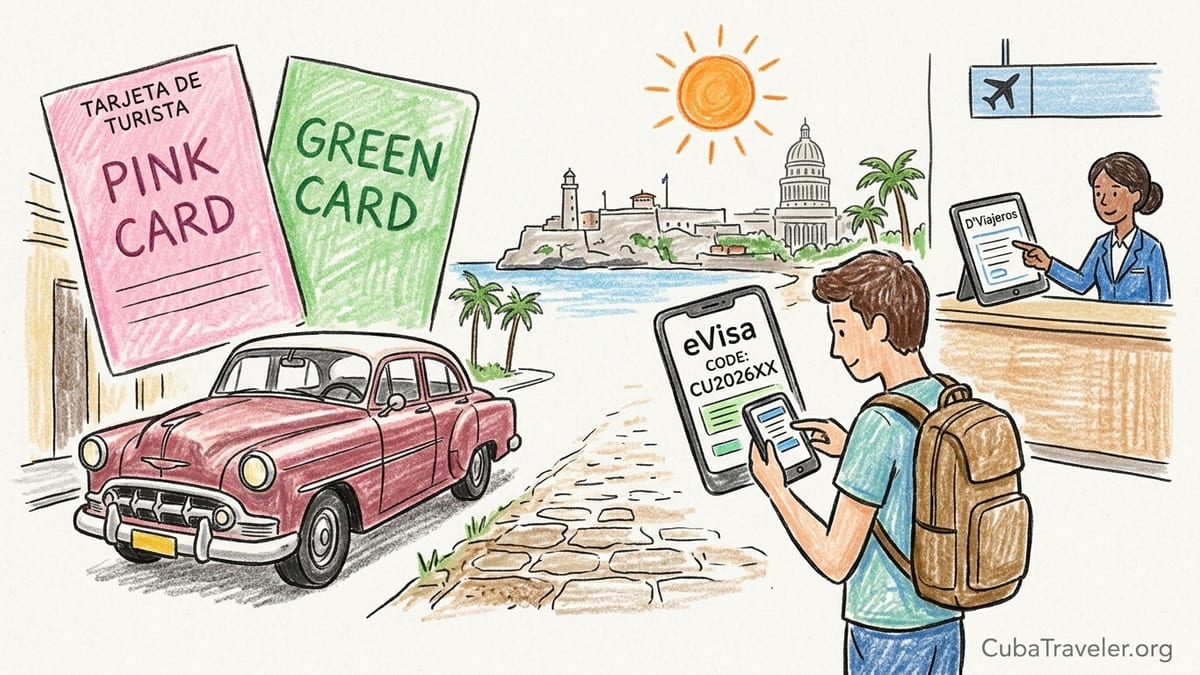
From Green and Pink Tourist Cards to eVisa: Why Old Advice Misleads in 2026
For years, Cuba’s entry system for visitors revolved around the paper Tarjeta de Turista, a cardboard slip that functioned as a simple visa for leisure trips. Travelers from Canada and Europe learned to distinguish between the “green card” usually used on flights from Canada or elsewhere, and the “pink card” routinely sold to passengers departing from the United States. Airport counters in Miami and Mexico City turned these cards into a profitable sideline, and online agencies sprang up selling mailed paper cards at hefty markups.
That mental model held for a long time, so much so that official tourism portals in Cuba still talk about a visa or Tourist Card as if it were necessarily a piece of paper. The official tourism site explains that visitors must carry “the corresponding visa or Tourist Card” and that these can be requested from consulates, travel agencies and airlines. The language has not fully caught up with the technology shift and many airline call centres and hotel sales agents still echo it in scripts and marketing copy.
Behind the scenes, however, Cuba has spent the last several years moving away from those paper tourist cards toward a centralized electronic system. The Cuban government’s eVisa portal describes the “visado de turismo” as a single entry authorization valid for 90 days, extendable once, and several consulates in Europe now publish price tables that quote both a traditional Tarjeta de Turista and an electronic visa in parallel while explaining that the old physical card has been phased out. Reporting on consular practice in Spain in 2026, for example, notes that the physical tourist card was discontinued and fully replaced by an electronic visa, with consular fees adjusted accordingly.
The result is a messy overlap of vocabulary. Travelers still hear about green and pink cards from blogs and forum threads, then arrive at a check in desk where the agent talks about an eVisa code that must be entered into Cuba’s D’Viajeros pre arrival form. I routinely see people pay a third party 80 or 100 US dollars for a “pink tourist card” departing from the United States, when in reality the ground staff are simply generating an electronic visa and passing on a surcharge for doing a task the traveler could have completed at home for a fraction of the price.
The Four Real Entry Scenarios in 2026
To cut through the noise, it helps to forget colours and cardboard altogether and think in terms of four real world situations in 2026. Every non Cuban traveler fits into one of these: you either buy your own eVisa individually, receive authorization automatically through an airline or package, benefit from a genuine visa exemption under a bilateral agreement, or require a full consular visa because your visit is not tourism.
First, there is the individually purchased Cuba eVisa. This is the scenario for many independent travelers from Europe and for anyone whose journey to Cuba involves a transit via the United States or another country where airline staff will not process Cuban entry paperwork on your behalf. The Cuban eVisa portal describes a 90 day single entry tourist visa that can be extended for another 90 days after arrival. European consulates, including those in Spain, now refer to this electronic tourist visa and list a consular fee in the 20 to 30 euro range for the authorization itself, separate from any service charges added by intermediaries.
Second, there is authorization bundled into your airline ticket or package. This is where the confusion really begins. The Government of Canada’s travel advice pages explain that Canadian tourists require a visa for Cuba but that it is “generally included in holiday packages” or provided by airlines operating direct flights from Canada. Canadian tour operators distribute official infographics from Cuba’s Ministry of Tourism stating that the tourist visa is included in the ticket price for passengers on direct flights from Canada and that paper cards have been discontinued in favour of electronic processing. The traveler never logs on to an eVisa portal or pays a separate fee, but they are not visa exempt. They are simply having a mandatory entry authorization bought for them in the background.
Third, there is genuine visa exemption. This is much rarer than online lists would have you believe. As of mid 2024 Cuba announced, at its international tourism fair in Havana, that Chinese citizens holding ordinary passports would enjoy short term visa free stays. The Chinese Embassy in Havana later clarified the policy in detail: from May 17, 2024, holders of ordinary Chinese passports can enter, transit or stay in Cuba for up to 90 days without a visa, while people travelling to work, study or report news must still obtain an appropriate visa in advance. That is a true exemption written into a bilateral arrangement and confirmed by both governments, not a travel agency perk.
Finally, there is the consular visa for non tourism purposes. Cuban consulates in Europe and elsewhere make this distinction very clearly. Spanish consular information explains that when a trip is not for tourism the tourist card or eVisa is not valid and that the traveler must obtain a specific visa type instead, such as a family, business, student or journalist visa. The procedure is more involved, often with a two step fee structure and stricter documentation, including invitation letters and proof of purpose. Many people with non tourist reasons to travel to Cuba, from visiting a spouse to filming a documentary, still mistakenly assume that buying the same eVisa used for beach holidays will be enough. That assumption can lead to denial of boarding or refusal of entry.
Why “Included Visa” from Canada Is Not Visa Free Travel
Canadian flights to Cuba are the clearest possible example of why a visa included in a ticket is not the same as a visa exemption. The official Canadian government travel advisory lists “tourist visa: required” for Cuba and explains that Canadian tourists can stay up to 90 days. In the very next line it notes that the tourist visa is generally included in holiday packages and by airlines operating direct flights from Canada. In practice, when you book a Toronto to Varadero package holiday with a company such as Sunwing or Air Canada Vacations, the tour operator or carrier arranges your Cuban tourist visa electronically, pays the Cuban side, and folds the cost into your fare.
On board, you no longer receive a physical green card to fill in. That ritual ended when Cuba’s Ministry of Tourism shifted to electronic visas and stopped issuing paper tourist cards on Canadian routes. Instead, the eVisa is linked to your passport and ticket record. You still must complete the D’Viajeros pre arrival online form before flying, and many Canadian travelers only discover at that point that they are asked to type in an eVisa number that they never realised existed. The tour operator or airline usually emails those details a couple of days before departure or embeds them in the booking page, but communication is not always clear.
The problems surface as soon as you change the routing. Consider a hypothetical Montreal resident with a Canadian passport who wants to visit family in Havana but finds a cheaper ticket via Miami rather than a non stop flight to Cuba. The Government of Canada’s advisory clearly warns that if you travel to Cuba via a third country you must obtain a Cuban electronic visa ahead of time and will receive a 10 character code to enter on your customs form. If that same traveler trusts an old blog post stating that “Canadians do not need a visa for Cuba” because tourist cards are included, they could easily show up in Miami without an eVisa, be unable to check in for the onward flight and end up paying a walk up fee at an airport desk for urgent processing.
I see similar misunderstandings in online discussions where Canadian permanent residents, travelling with passports from other countries, assume that flying from Canada magically grants them visa free status in Cuba. Airlines and all inclusive resort forums are full of comments like “if you are flying non stop from Canada you do not need a visa.” What those posters really mean is that you do not need to arrange and pay for a visa separately, not that Cuba waives the requirement. The distinction might feel pedantic when everything works, but it becomes very real if you rebook via another hub at the last minute or have to prove your eligibility to a skeptical check in agent.
European Travelers and the New Reality of Prearranged eVisas
For travelers from the United Kingdom, Italy, Spain, Germany and most of the rest of Europe, the new Cuba entry landscape is simultaneously simpler and more opaque. On paper, not much has changed: these nationalities still need to obtain authorisation before departure if they are travelling for tourism. In practice, the mechanism for doing that has moved steadily from paper tourist cards sold by local travel agencies toward online eVisa applications tied directly to passport data.
Spanish consular guidance is a good illustration. The official site for Cuban consulates in Spain explains that holidaymakers need a Tarjeta de Turista to visit Cuba, and then in the very next section outlines the “e visa” as an electronic version processed through the official portal. The fee tables for Madrid, Barcelona and Las Palmas, updated in late 2026, show a charge of around 30 euros for a tourist card and refer to an eVisa price held at 22 euros after recent adjustments in Cuba’s official gazette. At the same time, Cuban tourism boards in Europe and large online visa agents explain that since mid 2025 the old physical tourist card has been phased out, replaced entirely by the digital system.
The disconnect matters when you look at real booking journeys. A British couple booking a week at an all inclusive resort in Varadero through a UK package operator might see a “Cuba visa” line item bundled into their total price. In the background, the operator is submitting their passport details to the eVisa platform through an integrated channel and absorbing the consular fee. They never touch a piece of paper. Meanwhile, their friend booking flights independently on a low cost carrier from Madrid to Havana searches “Cuba tourist card Spain” and finds a proliferation of agencies still marketing the cardboard Tarjeta de Turista for home delivery. Those agencies now simply print an eVisa confirmation or act as a paid middleman to the official portal. The traveler might pay 60 or 70 euros for something that costs less than half that amount at source.
Germany and Italy show the same pattern. Travelers report that some brick and mortar travel agencies still talk in terms of tourist cards and hand over printed slips that resemble the old format, while in the background their details have been lodged electronically. Others buy directly from online intermediaries who never clearly describe that they are using Cuba’s eVisa system at all. The lack of consistent terminology across consulates, airlines and agencies allows outdated advice to live on in search results and creates a fertile environment for overpriced services.
There is also a more serious risk. Because blogs and even some embassy pages keep referring to “visa or Tourist Card” as interchangeable, it is easy for a European business traveler to believe that a tourist eVisa will be enough for a factory visit, a trade fair, or a filming trip. Cuban consulates are explicit that when the trip is not tourism a specific visa class is required, with an invitation letter and approval from relevant Cuban ministries. Confusing a tourist eVisa with permission to work, study or report can lead to unpleasant conversations at immigration counters in Havana.
Who Is Really Visa Exempt: The Very Short, Confirmed List
Faced with so much inconsistency, people understandably search for a simple list of visa exempt countries for Cuba. This is where caution is essential. Many commercial visa sites publish tables that mix outdated data with speculative entries and do not clearly distinguish between full visa exemption and limited arrangements for special categories such as students or diplomatic passports. Rather than reproduce those lists and risk freezing today’s snapshot in time as permanent truth, it is safer to stick to exemptions confirmed directly by governments and to acknowledge that they can change.
Take Chinese citizens as a concrete, documented example. At Cuba’s international tourism fair in May 2024, Cuba’s tourism minister announced a unilateral visa waiver for holders of ordinary Chinese passports. Chinese state and municipal media reported that from that month onward, Chinese citizens with ordinary passports could enter Cuba without visas. The Chinese Embassy in Havana subsequently issued a detailed notice explaining that from May 17, 2024, ordinary passport holders can enter, transit or stay in Cuba for up to 90 days visa free, while those coming to work, study, live or report news must still obtain visas consistent with their purpose of travel.
That policy has been reflected in broader visa requirement tables, which now list Cuba as visa not required for holders of Chinese passports for short stays. It is a significant step that has already encouraged more tourism marketing between the two countries and the resumption of direct flights. Crucially, it is limited. It does not mean that anyone flying on a Chinese issued travel document is automatically exempt, nor does it cover long term stays or non tourist purposes. If a Chinese journalist is flying to Havana to cover political developments, they must still arrange a press visa in advance through the Cuban embassy in Beijing.
Beyond the Chinese case and a handful of other bilateral arrangements, the safest statement an independent travel writer can make in 2026 is that true visa exemptions for ordinary passport holders are relatively rare and subject to change. Cuba’s foreign ministry publishes an official list of agreements, but those documents are written for diplomats and consular staff, not holidaymakers. Airline systems such as Timatic encode this information for practical use, and check in agents rely on those databases rather than on blog lists. For the average traveler, that means one thing: do not assume that because a third party website claims your nationality is visa free, you can ignore the possibility of needing an eVisa or consular visa. Verify with an official source before you pay anyone.
Cuban Citizens, Dual Nationals and Non Tourist Purposes
One of the most persistent and harmful myths around Cuba entry rules is that “everyone just needs a tourist card.” Nowhere does this fail more dramatically than for Cuban citizens and dual Cuban nationals. Cuban law treats people who hold or previously held Cuban nationality in a distinct way. Official guidance cited in international visa databases notes that anyone born in Cuba is expected to travel on a Cuban passport unless they can produce evidence that they have formally renounced their Cuban citizenship. That means a dual national who left Cuba as a child and now holds, say, a Spanish passport cannot simply buy a tourist eVisa and breeze through immigration as a tourist.
In practical terms, this catches out second generation diaspora travellers all the time. Imagine a man born in Havana in the 1980s, now a Canadian citizen living in Montreal. He travels on a Canadian passport and assumes that the all inclusive package his travel agent sells him is all he needs. The Canadian side indeed purchases a Cuban tourist visa for him, but when he lands in Havana the immigration officer sees his place of birth, asks for a Cuban passport and, if he does not have one, may send him to secondary inspection. Resolving his status can involve consulate visits, fees and delays that no tourist eVisa can fix.
The second large blind spot is purpose of travel. Cuban consular instructions in Spain and elsewhere underline that for work, study, residence, family reunification or media work, a tourist card or eVisa is not valid. Business visitors often need an invitation from a Cuban partner and approval from the Cuban Chamber of Commerce. Students require documentation from Cuban educational institutions. Journalists must obtain accreditation and a specific press visa. In each case, using an eVisa for tourism to mask a different purpose is not a clever workaround. It is a breach of conditions that can lead to refusal of entry or problems at renewal time.
I have heard journalist colleagues describe travel agents who cheerfully tell them “just go on a tourist card and say you are on holiday; everyone does it.” That may have been common practice in the era when interactions at the border were less digitised. Under the current eVisa regime, where applications are tied to passport numbers and integrated with online pre arrival declarations, it is not only ethically questionable but increasingly risky.
A Practical Comparison Matrix: How the Main Options Differ
To make this concrete, it helps to lay out the four key entry pathways side by side as they typically look in 2026. For the standard tourist eVisa purchased individually online, the application channel is either Cuba’s official eVisa portal or an authorized intermediary. Fees reported by consulates and travel agencies in Europe suggest an official charge in the range of a few tens of euros per person, sometimes increased by service fees. The visa is valid for a single entry, with an initial stay of up to 90 days and the possibility of one extension in country. Supporting documents usually include a passport valid at least six months beyond departure, proof of accommodation, return or onward travel, and medical insurance, which Cuban authorities have required since 2010.
When the authorization is included through an airline or package, the traveler rarely sees the application process. The channel is the tour operator’s booking system or the airline’s integration with Cuba’s electronic visa infrastructure. The fee is bundled into the ticket, often invisible but still present in the fare breakdown. The number of entries and permitted stay mirror the standard tourist eVisa: single entry and 90 days. The main supporting documents in the traveler’s hands are their passport, travel insurance policy and, in some cases, package vouchers. The risk here is informational rather than legal. Because they never manually request a visa, travelers come away believing they are visa exempt and that their route or nationality is inherently privileged.
For genuine visa exemption, the application channel is essentially none for short stays. A Chinese tourist with an ordinary passport, for example, presents their passport and return ticket at check in and at Cuban immigration without any prior visa or eVisa. There is no consular fee for the exemption itself, though other travel costs obviously still apply. The permitted stay is set by the bilateral agreement, in China’s case up to 90 days. Supporting documents beyond the passport will depend on airline policies but typically include proof of accommodation and sometimes evidence of onward travel. Crucially, as the Chinese embassy in Havana stresses, once the trip purpose shifts to work, study or long term stay, this pathway is no longer valid and a consular visa is mandatory.
Finally, the consular visa for non tourist purposes must be obtained directly from a Cuban consulate or embassy, occasionally through a specialized visa service that physically submits paperwork. Fees are higher and often split into an application or processing fee and a visa issuance fee, as Spanish consular schedules explain with figures that easily exceed one hundred euros in total. The number of entries and permitted stay vary according to visa type: a student visa may allow multiple entries during the academic program; a journalist visa may be limited to the accredited assignment period. Supporting documents are correspondingly detailed, from employment letters and contracts to university admissions and media accreditation. None of this can be substituted by a tourist eVisa without misrepresenting your purpose.
With these four columns in mind, it becomes obvious why casually telling readers to “just get a tourist card” or “Canadians do not need a visa” is at best incomplete and at worst wrong. It ignores the difference between who applies, who pays, what the trip is for, and whether the traveller is actually exempt from any requirement at all.
Where Old Advice Goes Wrong: Realistic Traveler Scenarios
The most vivid way to see the fallout from outdated guidance is to walk through concrete examples. Picture Emily, a British traveler who finds a cheap flight from London to Havana via Madrid and reads an old forum thread about green tourist cards. The thread assures her she can “buy a Cuban tourist card at Madrid airport on the day.” In 2019, that advice might have worked. In 2026, most Spanish airports no longer maintain walk up kiosks selling physical tourist cards because the process has moved online. Emily arrives at Heathrow without an eVisa, cannot check in because the airline system flags her as lacking required entry documents, and has to scramble to purchase an eVisa at a premium through a third party on her phone. Her savings on the ticket evaporate in service charges and stress.
Or consider Marco and Giulia, an Italian couple booking an all inclusive trip to Cuba through a large tour operator. The brochure still mentions a “tessera turistica” and they assume it refers to the same cardboard card their parents used. In reality, the operator is feeding their passport details into the eVisa system once they pay their deposit. Everything works smoothly on the outbound journey, but on their next trip they decide to book flights alone with a low cost airline and a separate hotel. They assume, based on the first experience, that “Italy must be visa exempt for Cuba because we never applied for a visa last time.” When the airline now asks for an eVisa number during online check in, they are baffled and end up paying an intermediary more than they would have paid if they had understood what happened behind the scenes the first time.
Then there is the Montreal Cuban Canadian example mentioned earlier, which repeats across the diaspora. A dual national books a package, arrives at the airport with only their Canadian passport and is surprised when staff mention that as someone born in Cuba they may face issues on arrival without a Cuban passport. A standard eVisa purchased by the tour operator does not change their underlying status in Cuban law. Old blog posts focused on the green tourist card have nothing to say about this scenario, even though it is one of the most sensitive edge cases.
One more case illustrates the danger for non tourists. A German filmmaker secures a small grant to shoot a documentary in Havana and reads that a tourist eVisa allows 90 days in Cuba. They fill in the eVisa form, ticking “tourism” as the purpose, and fly in with expensive camera equipment. Cuban customs and immigration quite reasonably question whether they are in fact tourists. Without a proper journalist or work visa, they can be turned around at the border or have their equipment held. The problem here is not that the eVisa system is hostile, but that old shorthand about tourist cards being a generic solution has been carried over unthinkingly into a more structured environment.
The Takeaway: A Clear Decision Tree for 2026
To navigate Cuba’s entry system in 2026 without wasting money or relying on obsolete tourist card lore, you can walk yourself through a simple decision tree. First question: are you a Cuban citizen, a former Cuban citizen or a dual national with Cuban roots. If the answer is yes or even “possibly,” your first stop should be a Cuban consulate or an official Cuban government channel to clarify which passport and which status you must use. A generic tourist eVisa is almost never the right tool for this group.
Second question: what is the real purpose of your trip. If you are going purely for tourism, to stay at a resort, explore Havana, visit beaches or travel around independently, then a tourist eVisa or equivalent authorization is the right category. If you are going to work, study, live with family, conduct research or report as a journalist, you should stop thinking about tourist cards entirely and look up the consular visa type that matches your activity. No amount of confident blog advice changes the fact that Cuban consulates themselves insist on specific visas for non tourist purposes.
Third question: does your nationality benefit from a confirmed visa exemption for short tourist stays, like the arrangement now in place for holders of ordinary Chinese passports. If you fall into that narrow category, you can plan your trip without an eVisa while keeping an eye on any changes in bilateral policy. If not, assume you will need some form of authorization and investigate whether your airline or tour operator provides it automatically or whether you must apply yourself.
Fourth question: how exactly are you getting to Cuba. If you are on a direct flight from Canada booked with a major Canadian charter or airline that explicitly states the Cuban visa is included, you will probably not have to complete a separate eVisa application. If your route involves the United States or another third country, or if you are flying independently on a carrier that does not bundle visas, you should budget time and money to secure your eVisa before departure. This is where reading your fare conditions and airline documentation carefully will save you both money and anxiety.
Five major sources of confusion sit at the heart of the stories I hear from readers. The first is obsolete tourist card terminology, green and pink cards that no longer define how the system actually functions. The second is the tendency to mistake package or airline inclusions for true visa exemptions and to extrapolate from “I did not apply for a visa last time” to “my nationality never needs a visa.” The third is mixing up nationality with departure country, believing that because you left from Canada or Mexico you were somehow covered, when in reality the carrier simply handled the paperwork. The fourth is the special case of Cuban citizens and dual nationals, whose obligations cut across the grain of generic tourist guidance. The fifth is the lingering assumption that one visa type fits every purpose, an assumption that collapses the moment you step outside pure leisure travel.
If you keep these pitfalls in mind, treat 2010 era blog posts about Tarjeta de Turista colours as archival material rather than practical guides, and verify your own situation against up to date official sources, Cuba’s 2026 eVisa landscape is manageable. The system itself is not the enemy. The real problem is advice that has not kept pace with reality, and travelers deserve better than that.
FAQ
Q1. Do I still need a green or pink paper tourist card for Cuba in 2026
In most cases no. Cuba has moved to an electronic tourist visa system, and paper tourist cards have largely been phased out or replaced by digital processing through airlines, tour operators and the official eVisa portal.
Q2. If my Canadian package holiday says “visa included,” am I visa exempt
No. You still need a Cuban tourist visa; your airline or tour operator simply obtains it for you and includes the cost in your ticket price. If you change your routing or travel independently you may need to apply for an eVisa yourself.
Q3. I am flying to Cuba via the United States. Can I just buy a pink tourist card at the airport
Some airports still have services that will arrange a Cuban visa for you, but what they now process is an electronic visa, often at a high service fee. It is usually cheaper and safer to secure the eVisa online before your trip.
Q4. I have a British, Italian, Spanish or German passport. Do I always need to arrange authorization before departing for Cuba
Yes for tourism you should assume that you need a tourist eVisa or equivalent authorization issued before you board your flight, whether arranged directly by you or bundled by a tour operator or airline.
Q5. Which nationalities are truly visa exempt for short tourist visits to Cuba
Only a limited number of nationalities benefit from confirmed visa exemptions. A clear current example is Chinese citizens holding ordinary passports, who can enter Cuba visa free for short stays, but this does not extend to work or study trips.
Q6. I was born in Cuba but now have citizenship elsewhere. Can I travel on a tourist eVisa like other foreigners
Often not. People born in Cuba are generally expected to travel on a Cuban passport unless they have proof that they no longer hold Cuban nationality. A standard tourist eVisa does not change that underlying obligation.
Q7. I am going to Cuba for business meetings, study or journalism. Is a tourist eVisa enough
No. Cuban consulates specify that non tourist activities require dedicated visa types, such as business, student or journalist visas, usually with invitation letters and additional documentation.
Q8. How long can I stay in Cuba with a standard tourist eVisa
The standard tourist eVisa generally allows one entry and a stay of up to 90 days, with the possibility of an extension in Cuba if approved by local authorities.
Q9. Do children need a separate eVisa for Cuba
Yes. Each traveler, including children, must have their own authorization for entry. Even when visas are bundled into a package, the airline or operator will issue one per passport.
Q10. How can I avoid overpaying for a Cuban eVisa or tourist authorization
Start by checking whether your airline or tour operator already includes the visa. If not, use the official Cuban eVisa portal or a reputable intermediary that clearly states fees, and be wary of airport desks or websites selling last minute “tourist cards” at inflated prices.