


Cuba in 2026 is easier to visit in some ways and more confusing in others. The paper tourist card that many travellers remember has largely been replaced by an official eVisa system, D’Viajeros remains compulsory yet inconsistently explained, and home-country restrictions for travellers from the United States and parts of Europe sit on top of Cuban immigration rules. This guide is designed as a neutral, practical hub that explains what tourists from the UK, Ireland, Italy, Spain, Germany, France, Canada, the USA and Australia actually need before boarding a flight to Cuba in 2026.
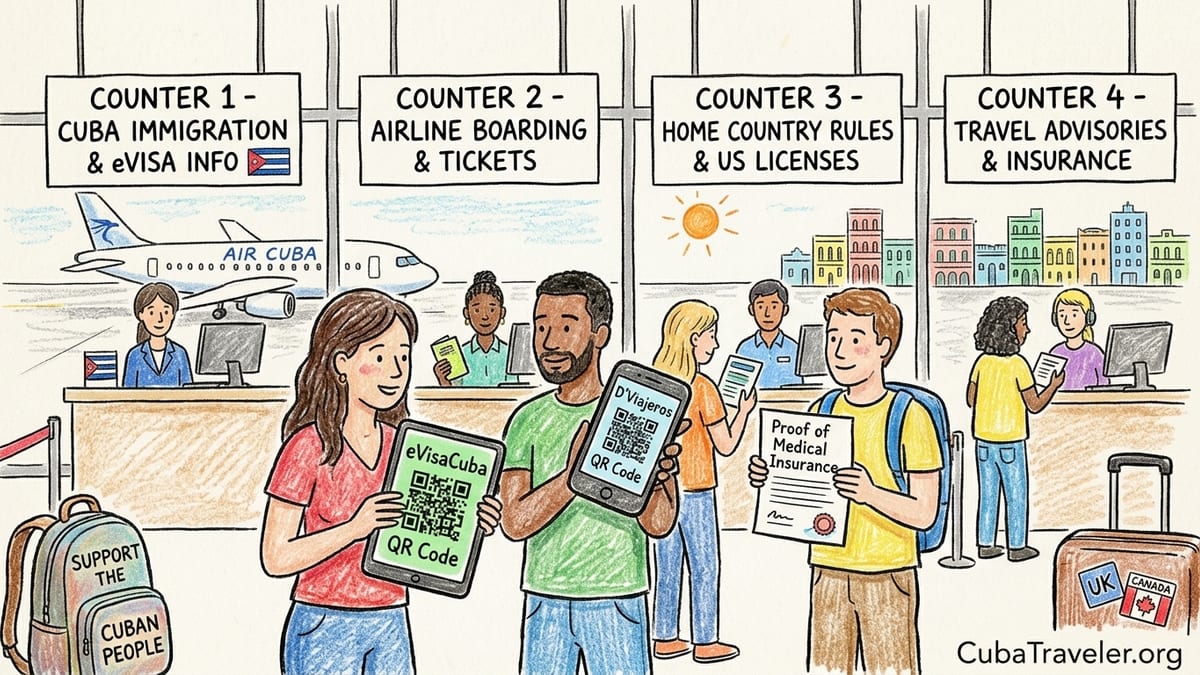
Four Different Systems You Must Understand Before Flying to Cuba
When travellers get stuck at the airport on the way to Cuba it is rarely because of one missing document. Problems usually arise because four different systems apply at the same time. First, there are Cuba’s own immigration and health rules, which decide whether you are allowed to enter the country. Second, your home country may impose its own restrictions or reporting requirements on travel to Cuba, particularly relevant for US citizens and residents. Third, airlines apply their own boarding rules and will refuse to carry you if they consider any document insufficient, even if Cuban border officials might arguably accept it. Fourth, government travel advisories from the UK, EU states, Canada, the United States and Australia can affect insurance coverage and your own risk calculations, even if they do not directly decide whether you are admitted at the border.
In practice this means that a French tourist flying Paris to Havana with Air France must satisfy Cuban entry requirements, French rules on travel to Cuba, Air France’s check in policies and any conditions set by her travel insurer. A Canadian tourist flying Toronto to Varadero with Air Transat faces Cuban rules, Canadian guidance and the airline’s requirements, which may be slightly different to those in Paris even though the destination is the same. Thinking in terms of these four overlapping systems is the best way to avoid last minute surprises at check in.
Throughout this article, remember that most rules depend on the passport you use at the Cuban border, not where you live. A Cuban-born Canadian who travels on a Cuban passport will be treated as a Cuban national by immigration and does not need a tourist eVisa, while a Cuba-born Briton who renounced Cuban nationality but enters on a UK passport will be processed as a foreign tourist and must follow the eVisa rules. The same principle applies to dual nationals and long term residents of other countries.
How Cuba’s eVisa System Works in 2026
Cuba’s official position in 2026 is that most tourists must obtain a visa before travelling, and that short term tourist visits are handled through an electronic visa rather than the old paper tourist card process for standard applications. The Ministry of Tourism and official Cuba Travel portal explain that the tourist visa is required for visitors who do not have Cuban residency and is normally valid for a single entry for a stay of up to 90 days. Several foreign ministries, including those of Bulgaria and Germany, now state that tourist visas for Cuba must be requested exclusively online through the official eVisaCuba portal, and recent documentation from that portal confirms that the tourist eVisa is for one entry with an initial authorised stay of 90 days, extendable once in Cuba for up to another 90 days.
In practical terms this means that a British, Irish, Italian, Spanish, German, French, American or Australian tourist planning a two week holiday in Havana and Varadero will normally apply online through the official eVisa portal or use a reputable visa agency that submits requests to the same system on their behalf. Application forms typically ask for your passport details, travel dates, planned address in Cuba and sometimes a scan or photograph of your passport’s data page. Processing times vary from near instant approvals for straightforward cases handled by commercial intermediaries, to several days if you apply via a Cuban consulate that still uses manual payment. Fees also vary depending on your nationality and where you apply, which is why many European and North American travellers continue to pay agencies or airlines to handle the process, even though an official self service option now exists.
Canada remains a partial special case. Canadians have long bought physical tourist cards from their tour operator or airline as part of a Cuba package, and some Canadian focused tour operators still describe a paper card as the practical document you will carry, even though behind the scenes they are now obtaining an electronic visa or equivalent authorisation linked to your passport. If you are Canadian and booking a package holiday that explicitly states your Cuba visa is included, it is usually safe to rely on that package, but independent Canadian travellers booking their own flights should check directly with the airline whether they must apply for the eVisa in advance or will be given a visa or tourist card at the airport.
Understanding the D’Viajeros Form and Its QR Code
D’Viajeros is a separate Cuban requirement from the eVisa. It is an online form that combines elements of an arrival card, customs declaration and health questionnaire and generates a QR code that authorities can scan on arrival. Official Cuban resources describe it as mandatory for all travellers, including Cuban nationals and residents, yet the instructions on when to complete it have been inconsistent. Some guidance refers to filling the form within 72 hours of arrival, others within 48 hours, and older translations mention different time frames again. Travellers arriving in 2025 and 2026 frequently report that the online system itself controls the real time window by only letting you start a form a limited number of hours before your flight.
Because of this inconsistency the safest approach for trips in 2026 is to treat the opening time of the current D’Viajeros portal as your reference point. When you plan your travel timeline, check a few days before departure how far in advance the portal will let you create a new form. If, for example, the system only accepts flights within 48 hours of the current time, mark a reminder to complete the form as soon as your journey falls into that window. Cuba’s own travel advice for foreign visitors recommends saving or printing the D’Viajeros confirmation as a PDF, because mobile data or airport Wi-Fi on arrival may not be reliable.
Travellers often confuse the D’Viajeros QR code with the eVisa authorisation. They are separate: the eVisa approval usually comes as a document or code generated after your visa application is accepted, while D’Viajeros is a short term form focused on your specific trip and health and customs data. In practice, you may enter your eVisa number or related details while completing D’Viajeros, but you must still have proof of both items when you check in and when you land. Several airlines now ask passengers to show the D’Viajeros QR code at the departure gate, particularly on flights from Madrid, London and Toronto, and will delay boarding if many passengers have not completed it.
The Relationship Between eVisa, Passport & Other Core Entry Rules
Cuba links the tourist eVisa directly to the passport you use for travel. Official guidance from Cuba Travel states that your passport must be valid for at least six months from your date of entry, and that the visa is electronically associated with that passport for the duration of your stay. This means that if you change or renew your passport after obtaining the eVisa but before your trip, you should not assume the authorisation automatically transfers. In such cases you may need to reapply or seek advice from a Cuban consulate or your visa provider to avoid arriving with mismatched documents.
A confirmed return or onward ticket is a standard Cuban requirement and is explicitly listed in guidance from several foreign ministries. In practice, airline staff usually verify this at check in. For example, a German tourist flying Frankfurt to Havana with Condor and returning three weeks later must present a return reservation at Frankfurt check in. A one way ticket to Cuba plus vague plans to continue to Mexico overland will often trigger questions from airline staff, who may refuse boarding unless you purchase an onward flight or show detailed evidence of a booked itinerary out of Cuba.
Tourists must also show proof of accommodation for at least their first night in Cuba. This can be a hotel reservation, a printed confirmation from an online platform or, in the case of those staying with relatives, an invitation letter or other supporting documentation. While Cuban immigration officers do not always ask for this, airlines based in Europe and North America increasingly want to see a booking at check in. For example, a British couple with an eVisa and return ticket but no hotel confirmation were recently required by a London based airline to book at least one night in a licensed Havana casa particular before being allowed to board.
Medical insurance that covers you in Cuba is another firm requirement. Cuban authorities have long insisted on health insurance for visitors, and foreign ministries including the UK’s Foreign, Commonwealth and Development Office and Canada’s Global Affairs warn travellers that they may be asked to present proof on arrival. Many package tours from Canada and Europe bundle in a policy, while independent travellers should carry a certificate from their insurer explicitly mentioning Cuba. A handful of airlines sell Cuban compliant insurance at check in, but availability can change, so relying on this as a fallback is risky.
Home Country Restrictions & Airline Boarding Rules
Separate from Cuban immigration rules, home countries apply their own restrictions and bureaucratic requirements to people travelling to Cuba. For US citizens and some permanent residents, the most significant issue is that straightforward tourism is still not a permitted reason for travel under US regulations. Instead, most independent travellers use the general license category commonly known as “Support for the Cuban People,” which requires that your itinerary focuses on local interactions, stays in private accommodation and avoids direct support to restricted entities. US authorities do not control entry at the Cuban border, but they can question travellers on their return and airlines departing the United States will ask US passengers to certify their category of travel when buying a ticket.
Europe based travellers also face indirect consequences. Since January 2021, most citizens of countries that participate in the US Visa Waiver Program, including the UK, Ireland, Italy, Spain, Germany, France and Australia, become ineligible to use the US Electronic System for Travel Authorization if they have been in Cuba after a specified date. Instead, they must apply for a full US visa to enter or transit the United States in future. This does not prevent them visiting Cuba, but it changes how easily they can visit the US afterwards. For example, an Irish backpacker who spends two weeks in Havana in 2026 will later be told that her existing ESTA is invalid and that she must apply for a B1/B2 visa if she wants to visit New York in 2027.
Airline boarding rules sit on top of both Cuban and home country systems. Airlines face fines and the cost of returning inadmissible passengers, so they often apply a stricter interpretation of entry rules than border officials. A Canadian charter airline may insist that all passengers show not only an eVisa or tourist card and D’Viajeros QR but also documentation of travel insurance before issuing a boarding pass, even if Cuban immigration officials only sporadically ask for proof of cover at the airport. Similarly, a Spanish airline operating Madrid to Havana flights may set an internal rule that D’Viajeros must be completed at least 24 hours before departure to avoid check in delays, regardless of the Cuban portal’s official opening time.
Nationality Specific Comparisons: UK, Ireland, EU States, Canada, USA & Australia
For British passport holders, current UK travel advice confirms that you must obtain a tourist visa before entering Cuba and that you can apply through the Cuban Embassy in London, a travel agent or the official eVisa Cuba site. The same advice stresses that your passport should be valid for at least six months after arrival and at least three months after your planned departure. British travellers should also note that the UK government currently advises against all but essential travel to Cuba for broader safety and infrastructure reasons. This advisory does not prevent you from entering Cuba but can affect insurance coverage; many UK insurers either exclude Cuba or require a specific policy extension while this advice remains in place.
Irish, Italian, Spanish, German and French passport holders face very similar Cuban entry rules. Most must obtain the tourist eVisa in advance and can stay up to 90 days on a single entry, extendable once inside Cuba. National foreign ministries in these countries emphasise the need for six months of passport validity, medical insurance and proof of return or onward travel. One key difference is how national consulates and airlines implement the eVisa changeover: some Spanish travellers still report receiving the traditional green paper tourist card via tour operators for flights from Madrid and Barcelona, while German and French tourists are now generally directed exclusively to the eVisaCuba portal or accredited visa agencies.
Canadian passport holders benefit from long standing arrangements between Canadian tour operators and Cuban authorities. Package holiday providers such as Sunwing and Air Transat typically include the visa or tourist card in the cost of the flight or package, and check in staff in Canadian airports often distribute the physical card or its eVisa equivalent at the gate. However, independent Canadian travellers booking with foreign airlines, such as Iberia via Madrid or Copa via Panama City, must follow the same eVisa process as Europeans. Canadians should also pay attention to fast changing banking rules. In 2026, several major card networks have limited or suspended operations in Cuba, which makes carrying sufficient cash in Canadian dollars or euros even more important.
US passport holders can technically obtain the same Cuban tourist eVisa as other nationals, with documentation confirming that American citizens are eligible for a 90 day eVisa. The difference is on the US side: airlines and US officials require travellers to state and document an authorised purpose of travel beyond simple tourism. American travellers often use specialist agencies that combine the eVisa application with detailed guidance on crafting an itinerary that fits the “Support for the Cuban People” category, including stays in private casas particulares and locally organised tours. Australians follow a more straightforward path: the Australian government’s Smartraveller service notes that tourists require a visa or tourist card before travel, typically arranged through the Cuban embassy, travel agents or airlines, and that US rules on post Cuba ESTA ineligibility also apply to Australians who intend to visit the United States later.
Tourism Versus Other Purposes: Work, Study, Journalism & Family Visits
The eVisa system described above is primarily for tourism and short leisure visits. If your main purpose in Cuba is something else, such as professional work, academic study, long term volunteering or formal journalism, you generally need a different class of visa issued directly by a Cuban consulate. For example, a French journalist planning to cover political events in Havana requires press accreditation and an appropriate journalist visa, not a tourist eVisa. Similarly, an Italian academic undertaking a semester long teaching exchange must obtain a study or work related visa that reflects the length and nature of the stay.
Failure to match the visa type to your actual activities can cause problems. Tourists are expected to engage in leisure activities, informal language classes and everyday cultural experiences, but not to carry out formal paid work for Cuban or foreign employers on Cuban territory or to operate as accredited media without permission. A Canadian photographer on holiday who posts casual street photos online is unlikely to face issues, while a US documentary filmmaker with a prearranged shoot schedule and local fixers should seek a more appropriate visa category.
Family visits occupy a middle ground. Many travellers with Cuban heritage or relatives in Cuba visit for what feels like a family rather than tourist trip, but if they enter on a foreign passport and do not hold Cuban residency they usually proceed on a tourist eVisa. If you were born in Cuba and later acquired another nationality, rules can be particularly complex. Cuban authorities often consider people born in Cuba to be Cuban citizens unless they have formally renounced this status, and some consulates insist that such individuals enter and leave Cuba on a Cuban passport. In these edge cases, you should contact a Cuban consulate well before travel and obtain written guidance specific to your circumstances.
Children, Dual Nationals & Cuba Born Travellers
Children visiting Cuba generally need their own travel documents and visas. A British family of four, for instance, will apply for four separate eVisas, each linked to the individual passports. Infants and young children are still expected to be listed on the D’Viajeros form, although practical implementation varies. Some families complete a single D’Viajeros form that covers multiple members, while others are instructed by the portal to submit one per passenger. Before departure, parents should check the current instructions on the D’Viajeros site and follow whichever option is clearly described at the time.
Dual nationals should always travel on the passport they intend to present at Cuban immigration. It is usually unwise to mix passports, such as checking in on an Irish passport but entering Cuba on a US passport, because the eVisa will be tied to one document number. Consider a dual Irish American citizen: if she buys a ticket from Madrid to Havana using her Irish passport and obtains a Cuban eVisa linked to that passport, she should also plan to enter and exit Cuba on the Irish document. Switching to the US passport at the Cuban border could create confusion over visa validity, while presenting the US passport on arrival in the United States could trigger questions about undeclared travel to Cuba if airline records show an Irish passport on the Cuba leg.
Cuba born travellers deserve particular care. As noted above, Cuba may treat anyone born there as a Cuban citizen unless they have formally renounced citizenship under Cuban law. This can affect entry and exit rights, requirements for military service age males and eligibility for local services. A Canada based traveller who was born in Havana but now holds only a Canadian passport should not assume that Cuban authorities will automatically accept the Canadian document for all purposes. The safest approach is to contact the Cuban consulate in your country of residence months in advance, explain your personal history in detail and ask whether you are expected to travel on a Cuban passport, a foreign passport with a special annotation or a particular type of visa.
Health, Yellow Fever Rules & Onward Travel Across the Region
On top of Cuba’s own health policies, some travellers must consider vaccination documentation, especially for yellow fever. Cuban authorities have periodically required proof of yellow fever vaccination from travellers arriving from countries with active transmission, often focused on parts of Africa and South America. The exact list of source countries and exemptions can change, so travellers who have recently spent time in Brazil, Colombia or other affected states should check with a Cuban consulate or a trusted travel medicine service shortly before their trip. Children under a certain age and pregnant women are often exempt from yellow fever certificate requirements worldwide, but you should not rely solely on general patterns in other countries when dealing with Cuba.
Region wide rules also matter if you plan to combine Cuba with other destinations. For example, the Dominican Republic has its own electronic entry form and specific yellow fever requirements for travellers arriving from certain Brazilian states, while some Central American countries maintain separate online health declarations that must be completed within defined time windows before arrival. If you are flying a multi stop route such as London to Havana via Punta Cana, or Montreal to Havana via Panama City, you may need to complete separate forms and meet separate vaccination documentation standards for the transit countries, even if you never leave the airport.
Finally, consider how your Cuban trip interacts with future travel to the United States. As noted, travellers from Visa Waiver Program countries who visit Cuba after a specified date are normally barred from using ESTA and must obtain a full US visa. This has concrete implications for common itineraries. A German tourist who flies Frankfurt to Havana this year and later wants to take a simple New York city break cannot rely on the usual quick online authorisation; instead, he will have to schedule a visa interview at a US consulate, pay a fee and accept longer processing times.
Timeline From Application To Arrival And Possible Extension
Working backward from your departure date is the easiest way to manage Cuba’s layered requirements. Around six to eight weeks before travel, check your passport validity and renew if it will have less than six months remaining on the date you expect to enter Cuba. At the same time, review home country advisories, insurance coverage and any special rules that could affect you, such as US travel categories or the impact on future ESTA eligibility. If you are Cuba born or a dual national, this is when you should contact a consulate to clarify which passport and visa class you must use.
Four to six weeks before departure, submit your Cuban tourist eVisa application through the official portal or a reputable agency. Many applications are processed far more quickly, but this buffer allows time to resolve payment issues, upload clearer passport scans or correct typo errors. When your eVisa is approved, save the confirmation in multiple formats and note the exact ten character code or reference number that links the authorisation to your passport. Around the same time, finalise your accommodation bookings for at least the first few nights and ensure your travel insurance policy explicitly covers Cuba while taking any home country advisories into account.
Within three days of departure, monitor the D’Viajeros portal to see when you can complete the form for your specific flight. As soon as the system allows your journey date, fill in the requested information, confirm that your passport and eVisa details are entered correctly and generate the QR code. Save a screenshot on your phone and print a copy if possible. At the airport, allow extra time at check in in case airline staff need to manually check eVisa codes, insurance documents and D’Viajeros confirmations. On arrival in Cuba, you will present your passport and have your eVisa verified electronically. Immigration officials may stamp your passport with the authorised stay period, typically 90 days, and may or may not ask about insurance or accommodation.
If you decide to extend your stay in Cuba beyond the initial 90 days allowed by the tourist eVisa, you must apply for an extension before your authorised period expires. Extensions are typically handled through local immigration offices or, in some tourist areas, via larger hotels that act as intermediaries. For instance, a Canadian snowbird spending the winter in Varadero might ask hotel reception for guidance on booking an appointment at the local immigration office to extend her stay by an additional 90 days. Fees are payable in Cuban pesos or another accepted currency, and you must show that you still have valid accommodation, insurance and a ticket out of the country at the end of the extended period.
Error Correction Checklist Before You Leave Home
Many entry problems in 2026 come down to correctable clerical errors rather than deliberate non compliance. To avoid last minute stress, run through a short error correction checklist a week before departure. First, check that your name, date of birth and passport number are identical on your passport, eVisa approval, airline ticket and travel insurance documents. Even a single transposed digit can cause delays, especially at airlines that run automated checks.
Second, verify that your eVisa’s ten character code or unique reference appears correctly wherever it is requested, including on the D’Viajeros form if you are asked to provide it. Third, confirm that your return or onward ticket departs Cuba before the end of your authorised stay, taking into account time zone differences. A British traveller who lands in Havana late on 1 March with a 90 day visa should ensure that his departing flight is booked for no later than 30 May, not 31 May, to avoid arguments over fractional days.
Fourth, test access to your eVisa approval email, D’Viajeros QR code and insurance certificate while your phone is in airplane mode. Take screenshots and store offline copies in case roaming or airport Wi-Fi fails. Finally, check for last minute changes to your home country’s travel advisory for Cuba. While this will not usually affect your ability to enter the country, it may alter your insurer’s position or prompt your airline to introduce additional documentation checks at the gate.
FAQ
Q1. Do I still need a paper tourist card to visit Cuba in 2026?
Most standard tourist visits now use the electronic visa issued through the official eVisa system, although some tour operators, especially in Canada and Spain, still provide a paper tourist card that functions as proof of that authorisation for specific flights. Always follow the instructions of your airline or agency, but understand that behind the scenes the authorisation is increasingly electronic and linked to your passport.
Q2. How long can I stay in Cuba on a tourist eVisa?
The tourist eVisa generally allows a single entry and an initial stay of up to 90 days. In many cases this can be extended once inside Cuba, usually through an immigration office or via larger hotels that liaise with immigration officials, for a total stay of up to 180 days. You must apply for any extension before your initial authorised period runs out.
Q3. When exactly should I complete the D’Viajeros form?
Official instructions have referenced different time frames, such as 72 hours or 48 hours before arrival, but in practice the controlling factor is what the current D’Viajeros portal allows. Check the site a few days before departure and plan to complete the form as soon as your flight falls within the portal’s permitted window, then save or print the QR code for boarding and arrival.
Q4. Do children need their own visas and D’Viajeros forms?
Yes, children generally need their own travel documents and visas, including tourist eVisas, because each is linked to an individual passport. How D’Viajeros handles families can vary: some versions of the form let one parent include multiple family members on a single submission, while others require separate forms. Always follow the instructions shown on the live portal when you apply.
Q5. I have dual nationality. Which passport should I use for Cuba?
You should use the same passport consistently for your flight booking, eVisa application, D’Viajeros form and entry to Cuba. The eVisa is electronically tied to one passport number, so mixing documents can cause confusion. If one of your nationalities is Cuban, or you were born in Cuba, seek advice from a Cuban consulate about whether you are expected to travel on a Cuban passport.
Q6. Do I need travel insurance and proof of funds to enter Cuba?
Yes, Cuban authorities require all visitors to have medical insurance valid in Cuba, and officials may ask to see proof on arrival. While formal proof of funds is less commonly requested, you should be prepared to demonstrate that you can support yourself, especially given recent restrictions on foreign bank cards. Many travellers carry a mix of cash in euros or Canadian dollars and prebooked, prepaid services where possible.
Q7. Can I work or study in Cuba on a tourist eVisa?
No. The tourist eVisa is intended for leisure visits and short informal activities only. Formal employment, long term study, internships, press work or organised volunteering typically require specific visas obtained directly from a Cuban consulate. Engaging in such activities on a tourist eVisa can lead to problems with Cuban authorities.
Q8. How does a trip to Cuba affect my ability to visit the United States later?
Citizens of many countries that use the US Visa Waiver Program, including the UK, Ireland, EU Schengen states and Australia, usually become ineligible for ESTA if they have visited Cuba after a certain date. They can still travel to the United States, but must apply for a full visa through a US embassy or consulate instead of relying on the quick online authorisation.
Q9. Can I extend my stay in Cuba beyond the initial 90 days?
Often yes, but you must apply before your authorised stay expires. Extensions are typically processed by Cuban immigration offices and sometimes through larger hotels that act as intermediaries. You will need to pay a fee and show ongoing accommodation, insurance and a ticket leaving Cuba at the end of the extended period. Approval is not automatic, so build some flexibility into your plans.
Q10. What should I do if my eVisa details or dates are wrong?
If you spot an error in your eVisa approval, such as a misspelled name or incorrect passport number, contact the issuing authority or agency immediately, well before departure. In many cases you will be asked to submit a corrected application or provide supporting documents. Do not rely on airline check in staff or Cuban border officials to fix such mistakes at the airport, as they may refuse boarding or entry if the data does not match exactly.